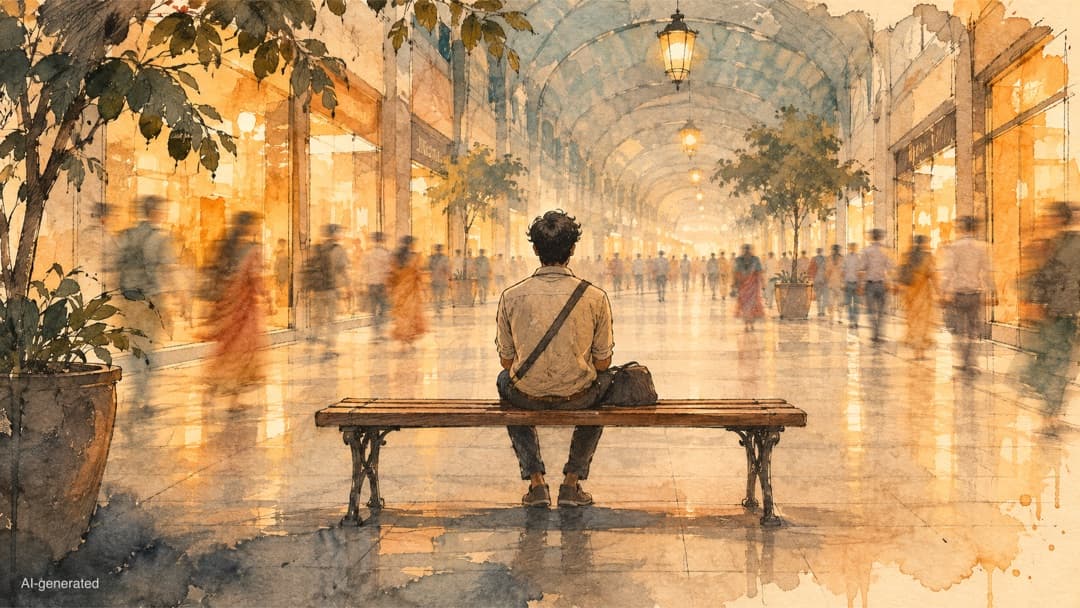
We study history, languages and money, and never the one who is reading, to whom all of it matters. Our interests feel like our own, and we call them freedom without asking where they came from. Had that stranger carried another name, would our view of him be the same? Self-inquiry cannot end in a final answer, because the one asking dissolves before it arrives, and returns the next morning. Do we want an answer, or do we want to look?

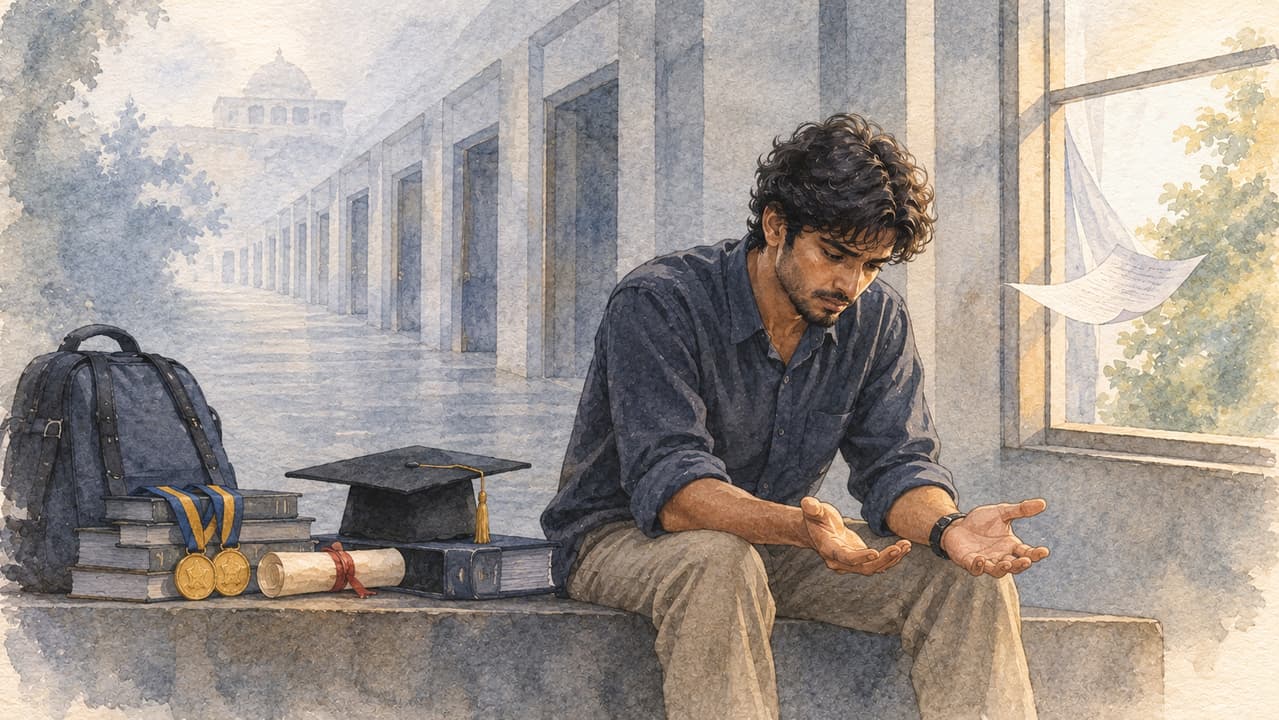
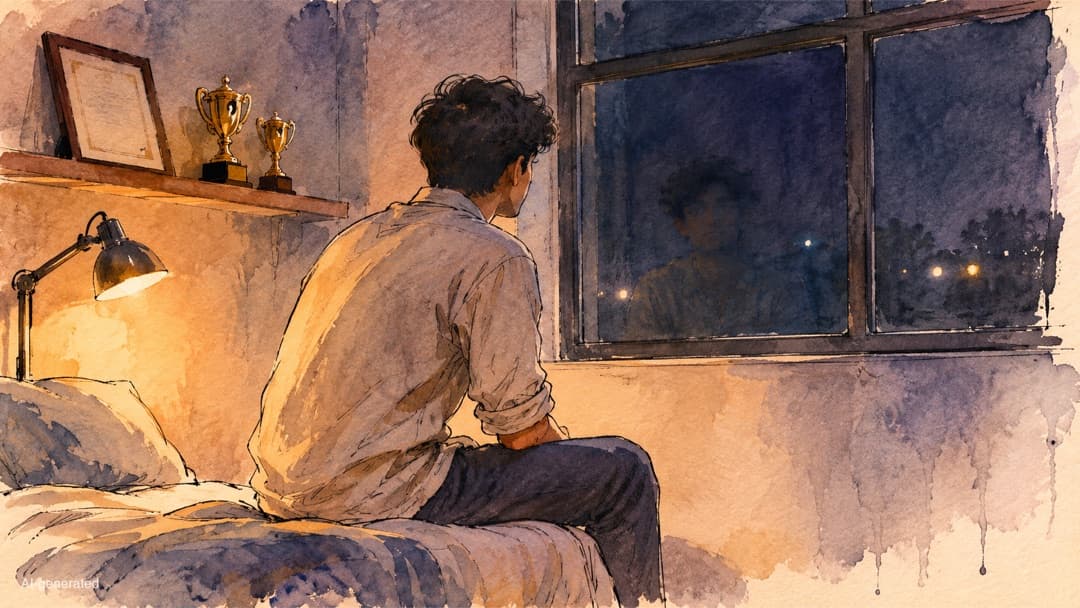
A degree, then a gold medal, then a PhD, and each time we tell ourselves this is the last milestone. Yet something still feels missing. Wanting to know what comes next is wanting to control it, and years of control have produced exactly this dissatisfaction. Even “I should be happy” is control. A mug that weighed 100 grams should not come back from the wash at 106: what we hear is meant to dissolve what we carry, not add to it. What if we simply stopped standing in the way?

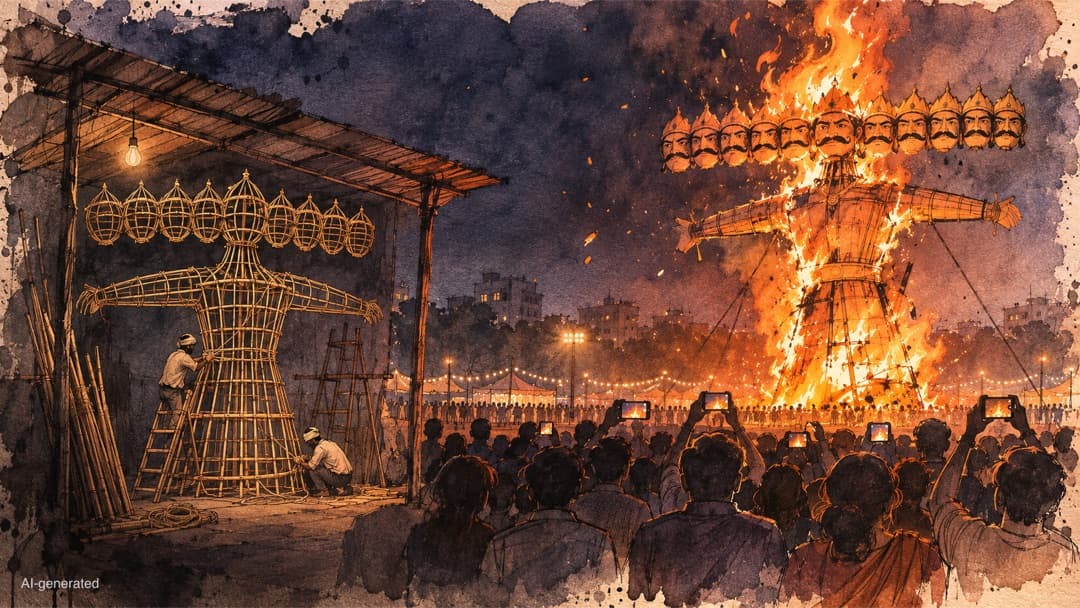
Every year we burn Ravan, and every year he is back. We ask what the punishment for living wrongly will be, hoping it is small, or can be postponed, or paid off. But the battle never ends, and the punishment is not a sentence handed down later. It is the self we live with, so familiar that it feels normal. What we truly intend shows in what our actions keep leading to, not in what we declare. Can we look honestly at the outcomes of our own lives?

We call it unfair that a handful of people hold so much of the country’s wealth. Yet the same reader turns the page, sees one of those few, and hopes his son will become one of them. The numbers show only who has how much, not who wants how much, and why. A family that needs a bigger home is satisfied once it gets one; the wanting that measures itself against the neighbour never is. Can we look honestly at what we are trying to become through what we own?

When a flood destroys a bridge, rebuilding it creates economic activity. Someone buys steel and cement, construction companies get contracts, workers are hired, and money changes hands.

When a flood destroys a bridge, rebuilding it creates economic activity. Someone buys steel and cement, construction companies get contracts, workers are hired, and money changes hands.

Children’s Day is celebrated on 14 November every year. We try to provide the best schools, facilities, and plans for our children’s future and celebrate their achievements with pride.

Children’s Day is celebrated on 14 November every year. We try to provide the best schools, facilities, and plans for our children’s future and celebrate their achievements with pride.

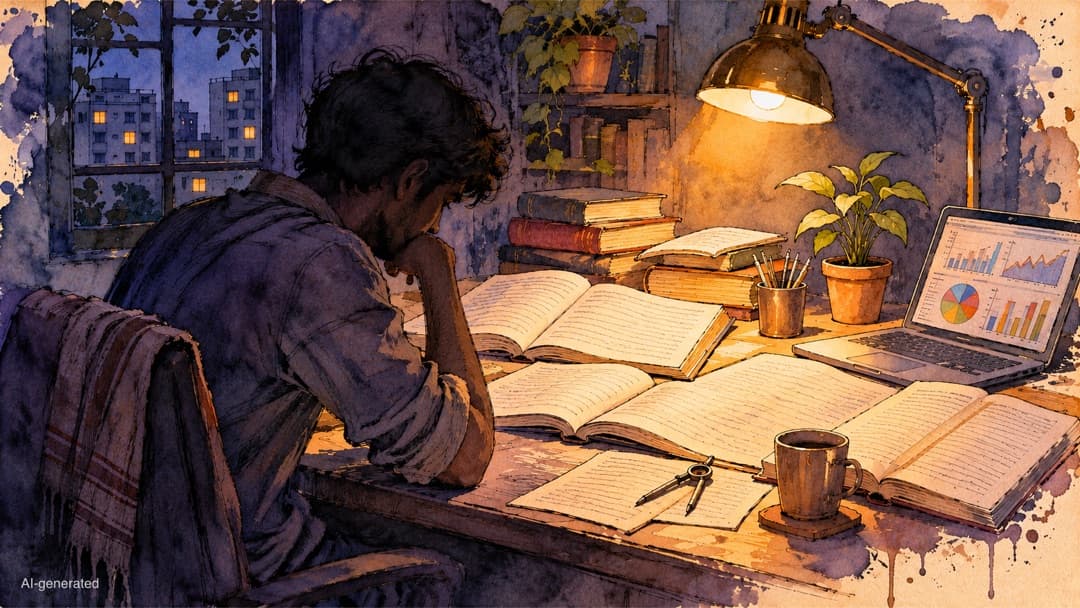
We sharpen the brain, collect the degrees, climb the ladder, and still feel strangled from within. The brain struggles with a hard maths problem, but who struggles with life? It is the one who uses the brain, the body and every opportunity, and calls all of it “mine”. We never examine that user, so its first claim, “I am important”, goes unchecked, and every value we build on it inherits the flaw. We chase prizes that give very little. Can we look at the one who is chasing?

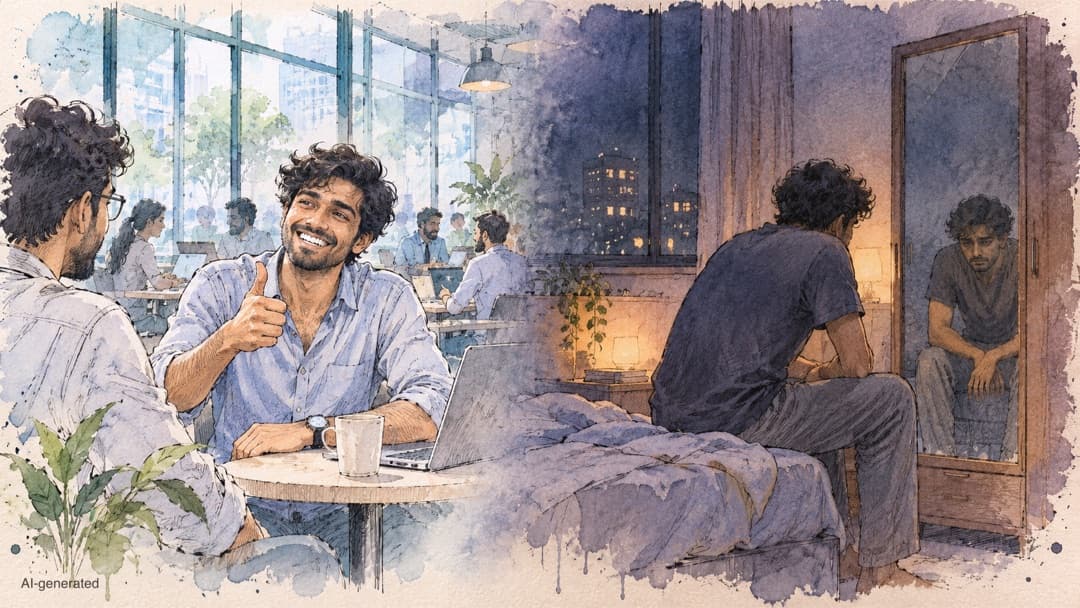
Someone asks how we are, and we say, “I am so good. I’m doing so well.” Then comes 3 a.m., and we know better. Nobody outside can check that claim, so the talk says an inner claim can be falsified only in the first person. Science runs on peer review; self-inquiry does not. A mirror can show where we stand, but whether we accept what it shows depends on honesty. Which of our own claims have we never allowed to be tested?

Someone asks how we are, and we say, “I am so good. I’m doing so well.” Then comes 3 a.m., and we know better. Nobody outside can check that claim, so the talk says an inner claim can be falsified only in the first person. Science runs on peer review; self-inquiry does not. A mirror can show where we stand, but whether we accept what it shows depends on honesty. Which of our own claims have we never allowed to be tested?

We believe we are born to be happy, and that happiness comes from more and more consumption. We keep consuming, and the lonely, anxious, restless feeling keeps returning. A sage, the talk says, has nothing to tell anyone who claims to be already fulfilled. The only question put to us is blunt: have all these objects and ideas worked on you? If not, why not be honest enough to discard them, instead of endlessly rolling on a flat plane? What could we learn by looking at the one who keeps trying?

We believe we are born to be happy, and that happiness comes from more and more consumption. We keep consuming, and the lonely, anxious, restless feeling keeps returning. A sage, the talk says, has nothing to tell anyone who claims to be already fulfilled. The only question put to us is blunt: have all these objects and ideas worked on you? If not, why not be honest enough to discard them, instead of endlessly rolling on a flat plane? What could we learn by looking at the one who keeps trying?

We leave a talk moved, and by evening it has faded, so we ask how to stay aware every moment. Yet one glance at a report that says cancer is never forgotten; even in our dreams we remember it, and no one has to remind us. We remember what we truly want to save. The mirror is held up once, and a teacher can do no more than that. Sunlight pours through every window, and we can still crawl under a rock. What are we choosing, each time we forget?

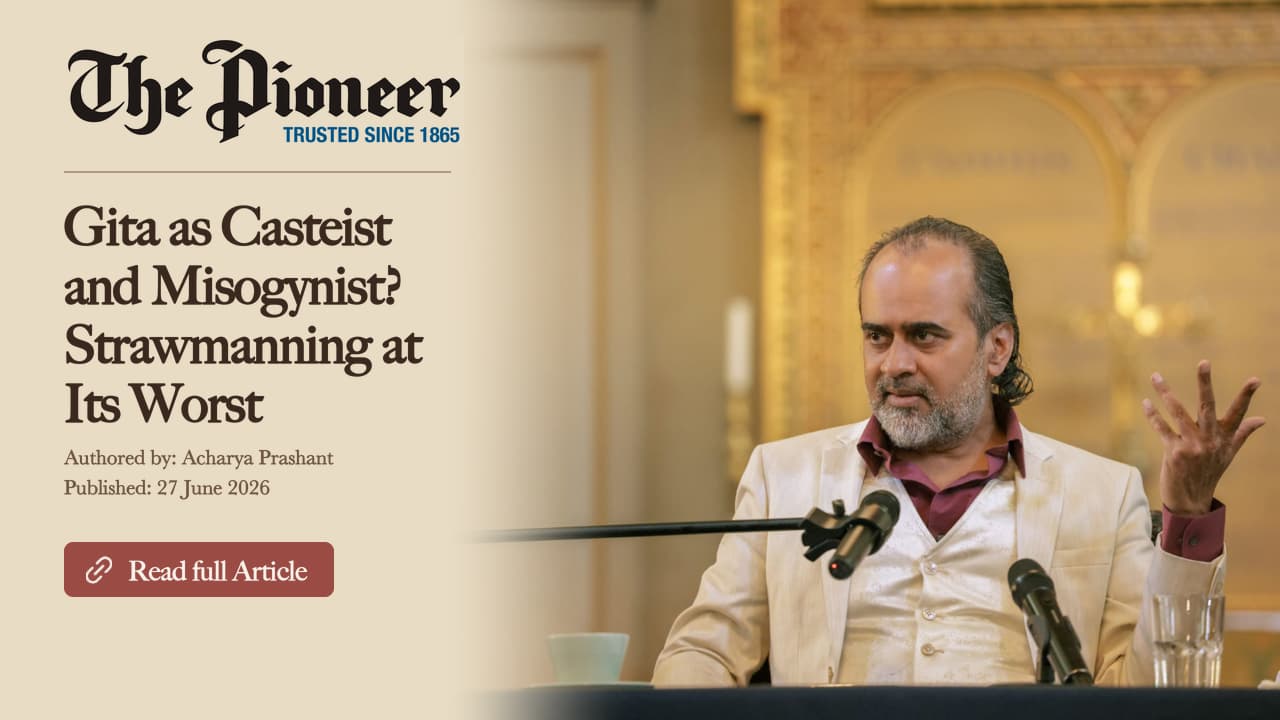
The Bhagavad Gita is often accused of supporting caste and misogyny through selective quotations that ignore context, grammar, and the text's central teachings. A closer reading shows that its emphasis is on inner qualities, conscious action, and spiritual equality rather than birth-based hierarchy or gender discrimination. Misinterpretations arise when isolated verses are detached from their broader meaning, while the Gita consistently points toward self-knowledge, freedom from ego, and the universal possibility of liberation for every human being.

The Bhagavad Gita is often accused of supporting caste and misogyny through selective quotations that ignore context, grammar, and the text's central teachings. A closer reading shows that its emphasis is on inner qualities, conscious action, and spiritual equality rather than birth-based hierarchy or gender discrimination. Misinterpretations arise when isolated verses are detached from their broader meaning, while the Gita consistently points toward self-knowledge, freedom from ego, and the universal possibility of liberation for every human being.

We have all put down a book that could have helped us, or dozed off halfway through something that mattered. A man who could not keep food down was given medicine, and he threw that away too, since it went in by the same route. Most of us strike a similar deal: we move into a place that stinks and, within a week, call the smell normal. Show our fifteen-year-old self the life we lead now and they would scoff. What would change if we admitted we do not like our condition?

We have all put down a book that could have helped us, or dozed off halfway through something that mattered. A man who could not keep food down was given medicine, and he threw that away too, since it went in by the same route. Most of us strike a similar deal: we move into a place that stinks and, within a week, call the smell normal. Show our fifteen-year-old self the life we lead now and they would scoff. What would change if we admitted we do not like our condition?

We say my body, my brain, my reason, my decision, and we never ask who is saying it. A boy who has tormented animals must be corrected, we all agree. Then he turns out to be our own son, and reasons to excuse him arrive without effort. Did reason change, or the one who owns it? Every courtroom shows how intent drives argument. The judge we admire may be the one who has learned to thin that owner down. When we decide, who is deciding?
Many of us say our family won’t let us be free. Then comes a plain question: where are the restrictions? Are they watching right now, chasing us with a lathi? Mostly they live in the mind, and we keep them there because breaking them has a price: someone’s hurt expectations, and perhaps no more money. So we call it love. Knowing what is worthwhile and refusing to pay for it is sheer cowardice. Physical confinement is another matter; no adult should put up with it. What price are we avoiding?

Many of us say our family won’t let us be free. Then comes a plain question: where are the restrictions? Are they watching right now, chasing us with a lathi? Mostly they live in the mind, and we keep them there because breaking them has a price: someone’s hurt expectations, and perhaps no more money. So we call it love. Knowing what is worthwhile and refusing to pay for it is sheer cowardice. Physical confinement is another matter; no adult should put up with it. What price are we avoiding?

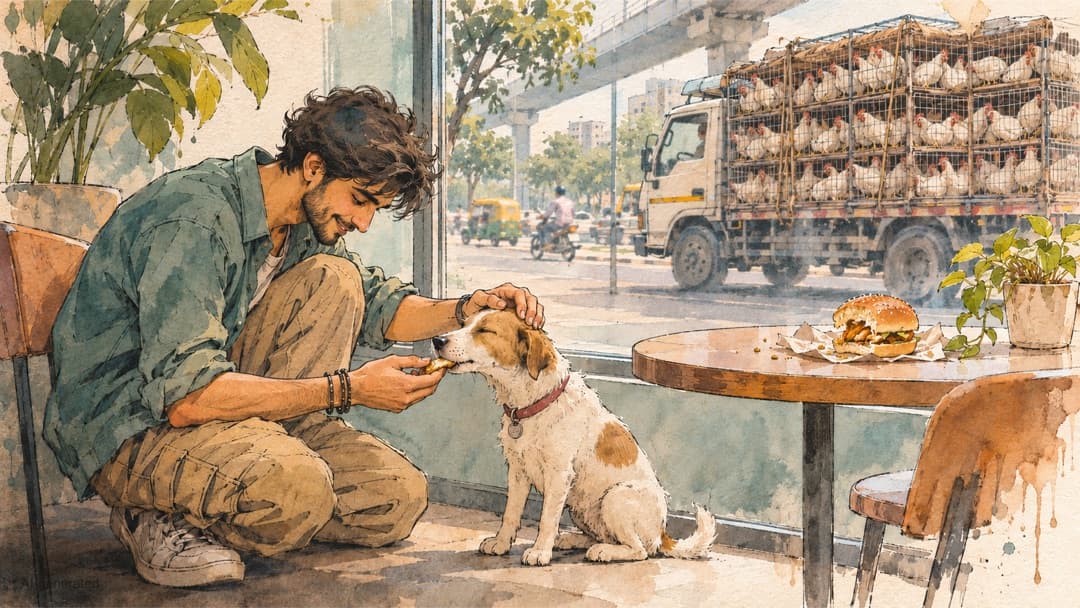
We are gentle with the people who matter to us, and quite different with those who have nothing to offer. A friend can be generous, peaceful and tender, and still sit down to a meal that began in a factory farm. Is that a blind spot, or one restless wish to gain, showing kindness here and hardness there? Nobody is bad in their own eyes, and even our giving may come from the same place. Who is it in us that is being good?

We are gentle with the people who matter to us, and quite different with those who have nothing to offer. A friend can be generous, peaceful and tender, and still sit down to a meal that began in a factory farm. Is that a blind spot, or one restless wish to gain, showing kindness here and hardness there? Nobody is bad in their own eyes, and even our giving may come from the same place. Who is it in us that is being good?

On the evening of November 15, just hours before a scheduled Gita session, a message arrived from Gauri Maulekhi, a prominent animal rights activist. She requested Acharya Prashant to join her in Patna the following morning to meet the Chief Secretary of Bihar and address the press about the Gadhimai festival in Nepal. This was no ordinary request. It was a plea to save thousands of animals and to raise a voice against a centuries-old practice of cruelty disguised as tradition.

From 1945 to today, consumption drives war beneath peace globally. We have continued to be exactly the same as we were on the day of Hiroshima and Nagasaki. That war happened because the various powers wanted to consume. Have we changed internally? If not, how can there be peace? The problem is not in the structures of thought or governance. The problem is within.

From 1945 to today, consumption drives war beneath peace globally. We have continued to be exactly the same as we were on the day of Hiroshima and Nagasaki. That war happened because the various powers wanted to consume. Have we changed internally? If not, how can there be peace? The problem is not in the structures of thought or governance. The problem is within.

Questioner (Q): Good evening, sir. Sir, because this conference is on Psychology and Technology, I would like to talk about something that’s very, very close to this. So, there’s a very famous quote by Carl Young, and I’ll use my phone so that I don’t get it wrong. It says,…

Questioner (Q): Good evening, sir. Sir, because this conference is on Psychology and Technology, I would like to talk about something that’s very, very close to this. So, there’s a very famous quote by Carl Young, and I’ll use my phone so that I don’t get it wrong. It says,…

Your only obligation is your liberation. These are just loveless social customs and economic structures where a woman is seen as a factor of production that produces babies. There’s no need to go to the husband’s place or even stay at your father’s if you are unloved and unwanted. The world is a vast opportunity. Live anywhere, stay anywhere, do whatever is the right work, and fly free—simple.

Questioner (Q): My question is regarding abortion. Broadly, there are two schools of thought regarding abortion. The first one is, because it is the woman’s body, she is the one who gets to decide whether to abort or deliver the child. The second school of thought says that the woman…

Questioner (Q): My question is regarding abortion. Broadly, there are two schools of thought regarding abortion. The first one is, because it is the woman’s body, she is the one who gets to decide whether to abort or deliver the child. The second school of thought says that the woman…
Vedānta is about the person gaining liberation from both of these—body identification and mental conditioning. So, ideally spirituality should be the woman’s best friend. But practically, evidence has been rather mixed; in fact, evidence has been that religion historically has been on the side of the oppressors when it comes to the women, oppressors of the women. The reason is that religion itself has not been well understood. Religion itself has been a victim of contamination, and when religion is contaminated then religion becomes a tool towards exploitation of women.

Vedānta is about the person gaining liberation from both of these—body identification and mental conditioning. So, ideally spirituality should be the woman’s best friend. But practically, evidence has been rather mixed; in fact, evidence has been that religion historically has been on the side of the oppressors when it comes to the women, oppressors of the women. The reason is that religion itself has not been well understood. Religion itself has been a victim of contamination, and when religion is contaminated then religion becomes a tool towards exploitation of women.

Bose's contribution to radio technology was kept in the dark and came to light only recently. Francesco Marconi, grandson of G. Marconi himself, in one of his lectures, addressed Bose as the inventor of radio, and his grandfather as its propagator. Additionally, the international organization IEEE gave Bose the title of ‘Father of Radio Science’. Many scientists believe that Bose deserved two Nobel Prizes – one for his research on radio waves and the other for his semiconductor research.

Mahatma Jyotiba Phule Opened the first indigenous school for girls at the age of 21. He worked all his life against evils like child marriage, suppression of women's education, casteism, prohibition of widow remarriage, and infanticide. Babasaheb Ambedkar called him his guru and intellectual father.

Mahatma Jyotiba Phule Opened the first indigenous school for girls at the age of 21. He worked all his life against evils like child marriage, suppression of women's education, casteism, prohibition of widow remarriage, and infanticide. Babasaheb Ambedkar called him his guru and intellectual father.

Our mood is always dependent on others and situations. Results have not been up to your expectations. So now you require a morale booster, some motivating speaker. The moment that fellow is gone, your energy also goes away. But there is another way of living. Deep within myself, I find a point that no external situation can touch. Whatever happens, happens on the surface. That will remain stable, uninvolved, a non-participant. Then you are really free.

The real issue is not about time at all. You are spending time exactly according to your values. Don’t ask how to utilize time. Ask yourself, "Do I know what is truly valuable?" When you are clear about what is truly valuable in life, all your time will be devoted to that. Become clear. Know what is truly valuable.

The real issue is not about time at all. You are spending time exactly according to your values. Don’t ask how to utilize time. Ask yourself, "Do I know what is truly valuable?" When you are clear about what is truly valuable in life, all your time will be devoted to that. Become clear. Know what is truly valuable.

Overview
Fighting Duryodhana is Dharma. Fight Duryodhana in the way you can, that is swadharma. Dharma is the same for everybody, but swadharma varies according to your physical, social, temporal conditions.
But remember that swadharma can never be in contradiction of Dharma; swadharma will always be something…

Are you looking for me? Look a little closely!
Am I in the Stupa, am I in the Shrine? You really want me, or just images of mine?
… a little closely!
The crowds in the Ashram are all misled, What you call as Yoga is such a dread,…

We drop the distractions, return to the work we know is right, and before long the mind is cluttered again. So we start sorting the noise: what is it, where is it from, why now? But nobody studies a trash bin while walking past it, and nobody gets off a train because the coach stinks. The turbulence comes from the part of us that is always at war with the part that knows what is right, and no one should expect a smooth road. Are we stuck because of the noise, or because we stopped?

We drop the distractions, return to the work we know is right, and before long the mind is cluttered again. So we start sorting the noise: what is it, where is it from, why now? But nobody studies a trash bin while walking past it, and nobody gets off a train because the coach stinks. The turbulence comes from the part of us that is always at war with the part that knows what is right, and no one should expect a smooth road. Are we stuck because of the noise, or because we stopped?
Many of us know the squeeze: a job that earns a living by making people want one more thing, and a nagging sense that this is not the life we want. It feels as though the world is pressing us into a deal. But a deal is signed, not imposed. The world offers a contract and something in us says yes, because it expects something in return. Can we be pressured by anyone we expect nothing from? Before asking whether to quit, can we look honestly at who is accepting the offer?

Many of us know the squeeze: a job that earns a living by making people want one more thing, and a nagging sense that this is not the life we want. It feels as though the world is pressing us into a deal. But a deal is signed, not imposed. The world offers a contract and something in us says yes, because it expects something in return. Can we be pressured by anyone we expect nothing from? Before asking whether to quit, can we look honestly at who is accepting the offer?