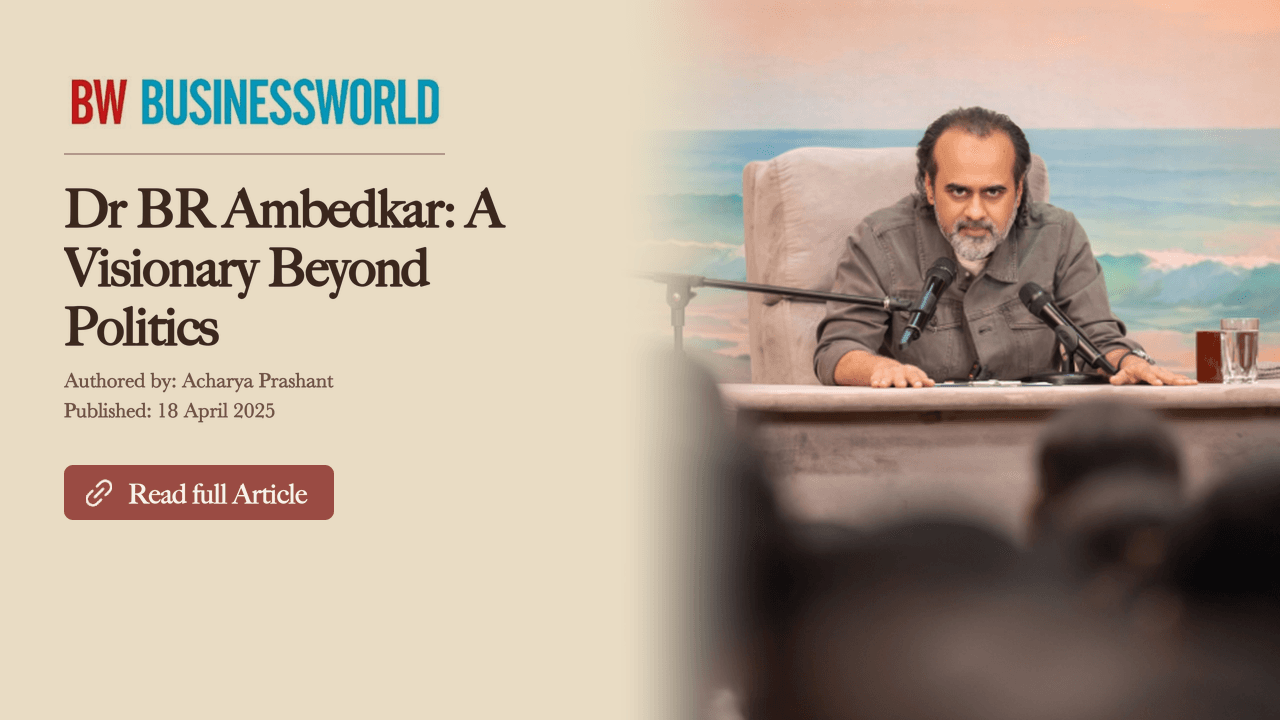
Dr. Ambedkar is an enduring symbol of struggle, dignity, and the relentless pursuit of justice. His life was not merely a series of events that were linked with politics or social reform. It was an intellectual, social, and spiritual odyssey. Dr.
This summary is AI-generated. Please read the full article for complete understanding.
Originally published in BW Businessworld on 18 April '25
Dr. Ambedkar is an enduring symbol of struggle, dignity, and the relentless pursuit of justice. His life was not merely a series of events that were linked with politics or social reform. It was an intellectual, social, and spiritual odyssey. Dr. Ambedkar was a scholar, a revolutionary, a social reformer, and above all, a deeply conscious being who saw that the beauty of life lies in transcending limitations imposed by tradition, society, or birth.
The Humanist Philosopher
It was his deep conviction in the potential of all human beings that marked Dr. Ambedkar most essentially. His work was based on humanism—a philosophy that recognises the intrinsic worth of every human being. He maintained that true greatness does not lie in privilege, status, or birth, but in the ability to rise above one's circumstances, defeat oppression, and live with dignity.
His vision was not confined to one cause or group—but was worldwide. More than just addressing the needs of the underprivileged, it was about ensuring that all human beings, no matter what their background, have the opportunity to live an equal and valued life. This is a message that has withstood the test of time—one that we can still cling to today, where too many still remain largely deprived of the equality and opportunity that Dr. Ambedkar envisioned.
A Politician by Circumstance, Not by Choice
The life of Dr. Ambedkar began in the nineteenth century's final decade in the small town of Mhow, near the city of Indore. His family belonged to the Mahar community, a group historically marginalised and considered among the lowest in caste-ridden Hindu society. Being born in such an environment in a society ridden with caste prejudice sowed the seeds of the long struggle that he would pursue in his lifetime for justice, equality, and human dignity.
The cruel realities of caste suppression confronted him even from childhood. The system of that time and place denied the child even the most basic rights, such as access to public facilities like water. One of the most sorrowful of recollections, he recalled later, was that the child Bhimrao was not allowed a sip of water from the school well simply because he was from his caste.
In the part “No Peon, No Water” of his essay Waiting for a Visa, he mentions he was denied basic human dignity, and a peon would pour water from a height, ensuring the boy could not touch the vessel or the tap. If the peon could not be there on a given day, he would have to wait till all the others left so he could secretly get some water from a sympathetic teacher. This early incident was a dismal foretelling of the hurdles Dr. Ambedkar would confront throughout his entire life.
He completed his studies in India but continued his education abroad—an unusual feat for a person from his background. He took a degree in economics at the University of Bombay, and later attended Columbia University in America where he earned his Master's degree. His quest for knowledge did not end there—he earned his D.Sc. in Economics from the London School of Economics. Apart from his education in economics, Dr. Ambedkar studied law as well and received his law degree in 1926 from Gray's Inn, London. His education was a true reflection of his faith in education as a weapon of empowerment.
Dr. Ambedkar's path prior to entering politics was far from being conventional. He was not just a man of grand ideas; he was an individual who always sought to understand and act upon the complexities of the world from multiple viewpoints. He worked as a legal consultant to the Gaekwad of Baroda, where he personally witnessed the limitations imposed by the prevailing social systems.
He also served in administration, assisting in guiding the governance intricacies of Baroda State, and later practiced law in Bombay, where he witnessed the suffering of the masses. Apart from these formal roles, he was deeply involved in social activism, leading movements to abolish untouchability and pursue basic rights for the oppressed.
Dr. Ambedkar wrote prolifically during his lifetime, his work addressing various aspects of social, economic, and political issues. His book The Untouchables: Who Were They and Why They Became Untouchables? challenged the very foundation of the caste system, whereas Annihilation of Caste is one of his most potent criticisms of casteism. His other works, like Thoughts on Linguistic States and The Problem of the Rupee, demonstrated his deep understanding of the economic framework that ruled Indian society. His writings were not intellectual exercises alone; they were his way of igniting the fire of change, founded upon knowledge and truth.
Dr. B.R. Ambedkar's foray into politics did not result from personal ambition or a lust for power. It was, however, a reaction against the unending injustices that he witnessed. His work as an academic and a lawyer was remarkable, yet he knew that without leveraging the political platform, the transformation he sought would be a far-off dream. Politics, though foreign to his nature, became the instrument he needed to use in order to build a society founded upon justice, equality, and freedom.
The Inadequacies of Social Reform
Dr. Ambedkar toiled day and night to reform Hinduism. He was a driving force behind Temple Entry Movements and led the Mahad Satyagraha to fight Dalit rights to enter temples and to access public tanks to collect water, rights denied to them due to their caste. These were not merely protests—they were acts of enduring courage, defying the very entrenched social mores that tried to keep the Dalits in a perpetual state of isolation. Yet, despite all his long and sincere efforts, he discovered that Hindu society was not receptive enough to the dissolution of caste. The systems were too rigid, too deeply rooted in tradition.
As a last resort, shortly before his death, he decided to convert to Buddhism. It was more than a matter of religious choice—it was an act of courage in the face of social institutions that condoned discrimination based on caste. Embracing Buddhism was not a wish for individual peace; it was a firm rejection of a society that would not let people be human in the name of religion. Dr. Ambedkar's conversion was also an invitation to others to deconstruct the cages of tradition, dogma, and inherited bias.
The Struggle for Equality: A Battle That Continues
The legacy of Dr. Ambedkar is usually reduced to his formulation of the Indian Constitution, but his contribution extends far beyond. To Dr. Ambedkar, the Constitution was not a goal but a means to an end—the tool to embed the principles of equality, justice, and liberty into the core of the nation.
Dr. Ambedkar was instrumental in drafting most of the great ideals of the Indian Constitution as it stands today. His strong commitment to justice, equality, and inclusiveness is graphically illustrated in the Fundamental Rights (Articles 12-35) incorporated in the Constitution—ensuring that all citizens are guaranteed the right to equality, freedom, life and personal liberty, religious freedom, cultural and educational rights, and the right to approach constitutional remedies.
But Dr. Ambedkar's vision of equality went beyond constitutional protection. He was genuinely interested in changing lives at the individual and social levels, especially by reworking those laws that most immediately concerned women. One of his most courageous attempts was the Hindu Code Bill, in which he aimed to revolutionise traditional Hindu personal laws. He sought equal inheritance rights for women, an end to polygamy, and equality in marriage. The Bill not only symbolised legal reform but a deep revolution towards dignity and justice for women, reflecting the lifelong battle of Dr. Ambedkar for gender justice and social equity.
While the Constitution had guaranteed equality before the law, it was not possible to dispel the centuries-long deeply ingrained social conditioning that legitimised discrimination. Dr. Ambedkar knew that profound change in society required not just legal rights but a change in the perception of individuals about themselves and each other. His vision is no less applicable today than at that time, especially as we continue the struggle against discrimination on the basis of caste and fight for a society that upholds the inherent worth of every individual.
The Tragedy of Misunderstanding
It is sad that despite his immense contributions, Dr. Ambedkar's actual legacy is misrepresented or misunderstood. With time, his name and ideas have been twisted by various political forces, who cherry-pick elements of his philosophy to suit their agendas. His ideas have been reduced to the point of being mere talking points in political discourse, and the interconnected, deeper elements of his work are ignored.
To understand Dr. Ambedkar in totality, one must look at his entire body of work—not just his stance on caste or his political life, but his economic ideas, his religious views, his educational vision, and also his relentless struggle for women's rights. All these were part of a larger vision for a just society where every person, regardless of caste, creed, or gender, is recognised with dignity and respect. To reduce him to just a politician is to miss the fullness of his vision.
The Path Forward: Dr. Ambedkar's Relevance Today
As we still grapple with many of the same problems Dr. Ambedkar faced—inequality, discrimination, and social injustice—his vision remains a source of inspiration. His relevance today is undeniable. As the fight for equality and social justice continues, his vision serves as a beacon for those committed to the quest for a more just world.
The legacy of Dr. Ambedkar was not only political, but also philosophical, humanistic, and spiritual in the true sense. He fought for a society where all people could live in dignity. And that fight, his fight, continues. If we are to truly honor his legacy, we must strive to uphold the principles of dignity, equality, and justice, and continue the journey toward a society where these values guide us all.
Originally published in BW Businessworld on 18 April '25