Live SessionsHIDP 2.0Acharya Prashant’s Philosophical FrameworkHis BiographyThe MissionHis WorkOperation 2030
Op-Eds & ColumnsMedia CoveragePress ReleasesInstitutional TalksPodcastsGalleryInvite Him
BooksArticlesVideo CoursesVideo LibraryCareers
Acharya Prashant App
Get it on Google PlayDownload on the App Store

Contact Us
[email protected]+91 96505 85100
Copyright © 2026 PrashantAdvait Foundation
Terms and ConditionsPrivacy PolicyUndertaking
AP Articles
For YouTrendingAll Topics
AP Articles
The Pioneer
7 Nov '26

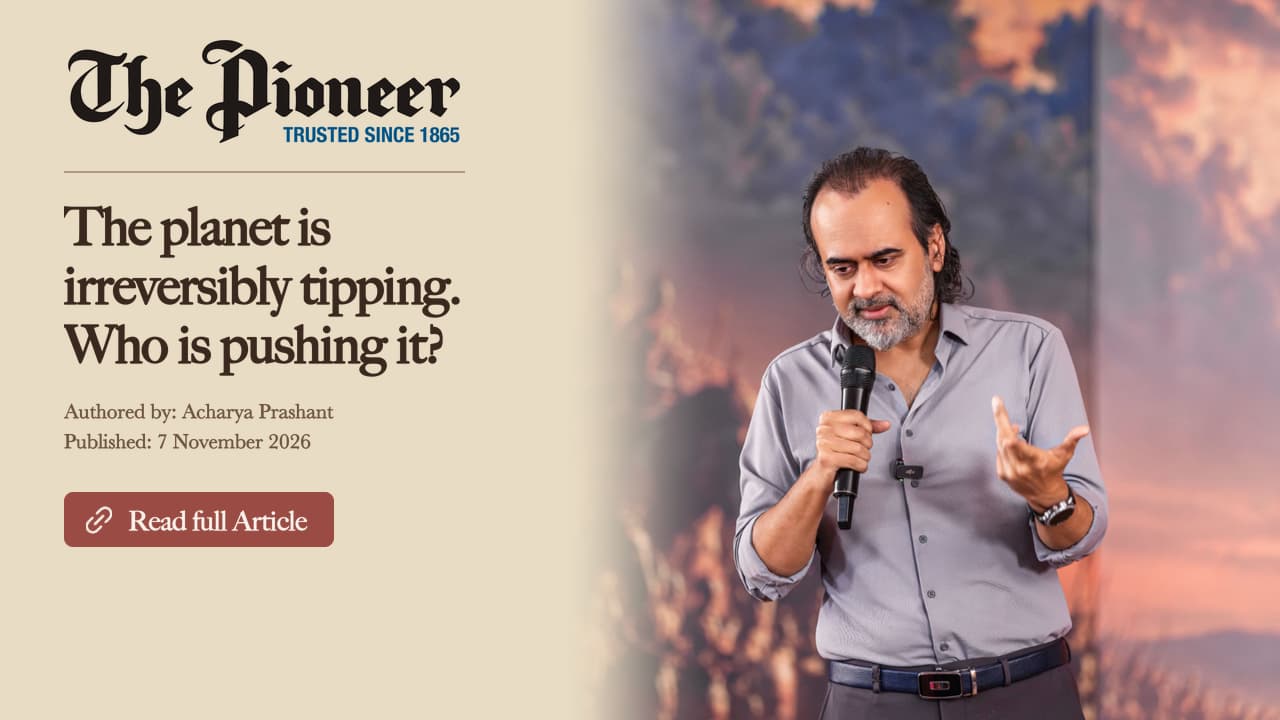
The planet is irreversibly tipping. Who is pushing it?

Acharya Prashant

6min
1.7kreads
5
The planet is irreversibly tipping. Who is pushing it?

We have begun to speak of the future climate as though we could settle the bill later. We shall keep emitting greenhouse gases, warm the planet beyond the limit we have agreed upon and, when technology has improved, bring the temperature down again.

This summary is AI-generated. Please read the full article for complete understanding.

Originally published in The Pioneer on 7 November '26

We have begun to speak of the future climate as though we could settle the bill later. We shall keep emitting greenhouse gases, warm the planet beyond the limit we have agreed upon and, when technology has improved, bring the temperature down again. Scientists call this overshoot. The habit is familiar enough: enjoy now, correct later.

The United Nations Environment Programme’s October 2026 Emissions Gap Report examines a pathway in which warming peaks around 1.7-1.8°C by mid-century and returns to 1.5°C by 2100. Even on this exceptionally demanding path, the probability of returning is only about fifty percent.

Even if we succeed in bringing the temperature down, what exactly comes back? A fever can subside while the organs remain damaged. When it comes to the Earth, we keep confusing the reading on the thermometer with the health of the patient.

We know an enormous amount about how the Earth responds to our actions. But what is happening within the human being who keeps acting in these ways, even when he knows the consequences? We study the planet’s tipping points with increasing precision. How seriously have we studied the one doing the pushing?

Greenland’s ice sheet contains enough water to raise average global sea level by approximately seven metres. Ice reflects sunlight; once it melts, darker surfaces absorb more heat, which encourages further melting. Some of Greenland’s meltwater enters the North Atlantic, where it can interfere with the circulation that transports heat through the ocean. Research published in Nature Geoscience in 2024 examined how changes in this circulation could affect rainfall across the Amazon. Ice disappearing near the Arctic may therefore alter the conditions under which a forest thousands of kilometres away survives. We divide the world into departments: oceans, forests, agriculture, glaciers. Nature has no such administrative boundaries.

Some of the warnings are already visible, not merely projected. The Global Tipping Points Report 2025 assessed that the central estimate of the thermal tipping threshold for warm-water coral reefs, around 1.2°C, had already been exceeded. We hope to return to 1.5°C by the end of the century, even though that temperature may already be too high for some ecosystems. Scientists call it hysteresis when reversing the original pressure does not necessarily reverse the resulting change. We can restore the number without restoring the world that existed when that number was last recorded.

The Hindu Kush Himalaya gives us a warning much closer to home. According to a 2026 assessment by the International Centre for Integrated Mountain Development, glaciers across the region lost approximately 12 per cent of their area between 1990 and 2020. Retreating glaciers alter water availability and increase the risks associated with expanding glacial lakes. A sudden flood can destroy a bridge, cut a village off from medical care and markets, ruin farmland and deprive families of their livelihoods.

The damage falls unequally, just as responsibility for causing it is unequal. A farmer struggling with an uncertain monsoon has not exercised the same power over the atmosphere as an affluent person accustomed to frequent flights, oversized homes and needless purchases. The question is why those who already possess far more than they need are so unwilling to stop. What are they still hoping to obtain?

We call climate change anthropogenic, man-made. But who is this man whose activity is changing the climate? Engineers ask how vehicles can be made more efficient. Scientists seek cleaner energy. Economists study how to make production cheaper and more productive. This work is indispensable. Yet the assumption behind the demand for all this production is seldom examined: that wanting more and more is natural, and that more must always be better. Who examines the want itself? I want to examine the one who is making these demands.

The ego is the claim of incompleteness. It is not that the ego sometimes feels incomplete; its very definition of itself is built upon incompleteness. So it keeps searching for something that will complete it. A possession is no longer simply useful. It must prove that its owner is somebody. For a while, acquiring it brings a fleeting feeling of completeness. Soon the old unease returns. The possession no longer reassures, and another is needed. We normally investigate the object. Was the house large enough? Was the promotion prestigious enough? We rarely look at the one who expected these things to make him complete. If the claimant is mistaken about himself, how will a better object fulfil the promise he has placed upon it? We have given unprecedented technological power to a claimant whose assumptions we hardly ever examine.

Get Updates
Receive handpicked articles, quotes and videos of Acharya Prashant regularly.

This site is protected by reCAPTCHA.

By continuing, you agree to our Terms and Conditions and Privacy Policy

The ego has a special affection for tomorrow. Let me first become secure, establish my position. Then I shall be less attached, more responsible, more generous. The promise of future wisdom is convenient for present desire. Our climate policies increasingly carry the same promise. A political promise can be revised; a physical threshold cannot necessarily be renegotiated.

The resemblance between ecological feedback and the ego’s habits is worth examining, though they are not the same kind of system. Yet in both we can see a pattern in which a disturbance gives rise to conditions that sustain further disturbance. But there is a crucial difference: an ice sheet cannot examine what is happening to it. The ego can be seen through. At Cambridge earlier this year, I was asked whether enough time remained for the inner transformation needed to address the ecological crisis. I asked the questioner to distinguish between work that takes time and seeing what is already before us. Rebuilding electricity grids takes years. But if I recognise that a pursuit is needless and destructive, and that I am defending it not because it meets a genuine need but because I am attached to the identity or gratification it provides, how many years must pass before I stop defending it? Perhaps the difficulty is not a lack of information. Perhaps it is that we do not wish to pay the price of what we already understand.

The Earth has limits. The ego’s appetite for more appears to have none. The ice does not choose to melt. The forest does not choose to lose its rainfall. But the one doing the pushing still has a choice. And that choice cannot be postponed without itself becoming a choice.

Originally published in The Pioneer on 7 November '26

This article has been created by volunteers of the PrashantAdvait Foundation from transcriptions of sessions by Acharya Prashant
5
5
LIVE Sessions
Experience Transformation Everyday from the Convenience of your Home
Live Bhagavad Gita Sessions with Acharya PrashantJOIN NOW
Categories
  • Trending
  • Bhagavad Gita
    Ashtavakra Gita
    Avadhut Gita
    Pingla Gita
    Paramhans Gita
    Ribhu Gita
    Uttar Gita
    Jivanmukt Gita
    Putra Gita
    Ajgar Gita
    Uddhav Gita
  • Relationship
    Sex
    Attachment
    Lust
    Depression and Anxiety
    Stress
    Fear
    Loneliness
    Overthinking
    Anger
    Money
    Happiness
    Desire
    Guilt
    Suffering
    Jealousy
    Confusion
    Motivation
  • Adhyatma Upanishad
    Kathopnishad
    Mundaka Upanishad
    Devi Upanishad
    Chhandogya Upanishad
    Ishavasya Upanishad
    Brihadaranyaka Upanishad
    Amritbindu Upanishad
    Kena Upanishad
    Niralamba Upanishad
    Sarvasara Upanishad
    Shewtashvtara Upanishad
    Narayana Upanishad
    Mandukya Upanishad
    Maitreya Upanishad
  • Veganism
  • Women Liberation
Search
Relationship
Related Topics
Truth
In Media
Ego
Liberation
Fear
Desire
Karma
India
Ashtavakra Gita
Maya
LIVE Sessions
Experience Transformation Everyday from the Convenience of your Home
Live Bhagavad Gita Sessions with Acharya PrashantJOIN NOW
Comments
Add Your Comment
A
Ayush Kumar
16d ago
this is outcome when we define development with perspective of consumption. Development should be the new ways to do things which make it more beneficial to nature not only pockets of the people.
S
Soniya Tirkey
18d ago
We are the ones pushing the Earth towards destruction. Our unexamined desires have become weapons that are destroying the planet. So, Unless we adress the destructure within us which is the very self the ego driven self, we will never find the right solutions or the direction in which we should work..
H
HadamRam
21d ago
100
H
HadamRam
21d ago
54
D
Deepika Sharma
21d ago
we are the only one who is responsible for the distruction of our planet as well as ourself.
Excerpts From Articles
Israel-Hamas: Unraveling The Role Of Religion In Conflict And Cruelty
Why do conflicts happen, and why is there cruelty in the world? These two things show us what religion means to regular people.
Read Full Article
The planet is irreversibly tipping. Who is pushing it?
We have begun to speak of the future climate as though we could settle the bill later. We shall keep emitting greenhouse gases, warm the planet beyond the limit we have agreed upon and, when technology has improved, bring the temperature down again.
Read Full Article
Sanatan Dharma is the way if the world is to be saved, rest is just cult
When it comes to philosophy and spirituality, the discourse often becomes dense. But in our endeavour to understand Sanatan Dharma, we will proceed with simple definitions and queries.
Read Full Article
Dr BR Ambedkar: A Visionary Beyond Politics
Dr. Ambedkar is an enduring symbol of struggle, dignity, and the relentless pursuit of justice. His life was not merely a series of events that were linked with politics or social reform. It was an intellectual, social, and spiritual odyssey. Dr.
Read Full Article
नदी की सफाई में क्या छूट जाता है?
हम यमुना को माँ कहते हैं। घाट पर खड़ा आदमी जब उसे माँ कहता है, तो मुझे उसकी नीयत पर शक करने की कोई वजह नहीं दिखती।
Read Full Article
Climate change: When disaster becomes a market
When a flood destroys a bridge, rebuilding it creates economic activity. Someone buys steel and cement, construction companies get contracts, workers are hired, and money changes hands.
Read Full Article
बाल दिवस: बच्चों को क्या दे रहे हैं हम?
बच्चों के लिए हम बहुत कुछ करते हैं। अच्छे स्कूल में दाखिला दिलाते हैं, उनके लिए सुविधाएँ जुटाते हैं, भविष्य की योजनाएँ बनाते हैं।
Read Full Article
आप बहुत गलत तरीके से जी रहे थे, अब आपको बता रही जिंदगी
ज़िंदगी की छोटी-से-छोटी स्थिति भी आपके सामने आती है तो अगर आपकी सुधरने की, सीखने की नीयत है तो उस स्थिति के बाद आप वैसे ही नहीं रह जाएंगे जैसे कि आप उस स्थिति के पहले थे. यह मैंने बात करी जीवन की किसी भी साधारण स्थिति की. अभी जो वैश्विक आपदा हमारे सामने है, वह तो निश्चित ही असाधारण है.
Read Full Article
चार राम हैं जगत में, किस राम को चुनेंगे आप?
यह प्रश्न केवल ईश्वर के बारे में नहीं है। इससे कहीं ज़्यादा यह हमारे बारे में है। हम किसे राम कहते हैं, इससे पता चलता है कि हम स्वयं को क्या समझते हैं, किसमें सुरक्षा खोजते हैं और किसके लिए अपना जीवन लगा रहे हैं।
Read Full Article
How To Get Freedom From Anxiety?
Especially in the modern world, unfortunately, a degree of constant anxiety has become an almost normalized state for us. A large portion of our mental health problems as a collective is very much about anxiety and fear. Burn-outs, career pressures, problems with self-esteem, fear of others, stress about studies etc.
Read Full Article
A Lesser Known Incident From Mahatma Gandhi’s Life
Mahatma Gandhi had been in South Africa at the center of a civil movement for more than two decades but he kept coming to India to attend Congress sessions. There was not much depth in those visits.
Read Full Article
Children’s Day: What Are We Really Giving Our Children?
Children’s Day is celebrated on 14 November every year. We try to provide the best schools, facilities, and plans for our children’s future and celebrate their achievements with pride.
Read Full Article
Related Topics
Truth
In Media
Ego
Liberation
Fear
Desire
Karma
India
Ashtavakra Gita
Maya
Articles On In Media
The Honey Trap You Are Born With
In Media
The Honey Trap You Are Born With
16min
105reads
1

Very few people know what they’re working so hard for. The boy preparing for an entrance exam doesn’t know it, and neither does the same fellow twenty years later, preparing for a promotion. Ask either of them, and he’ll tell you quite sincerely that he wants the rank for its own sake. But the manufacturer at the auto expo knows better. That’s why, at many launches, a young woman is made to stand beside the new model, smiling. Is she there to explain the engine? No. She is there to suggest that a woman like her comes along with the car.

The River I Worship, the River I Poison
In Media
The River I Worship, the River I Poison
14min
43reads
1

On Children’s Day I sat with a hall full of children. They had balloons in their hands and a lot of questions. One of them asked me, “Why did the bad people cut down the forest?”

How good people burn the planet
In Media
How good people burn the planet
6min
71reads
1

Go to a wedding in a small Indian town, and you’ll often hear the generator before you hear the band. Somewhere behind the tent, near the cooks, an old diesel set chugs away all night so that the lights never dip and the music never stops.