"A pilgrimage that disappoints is rarely blamed for being a pilgrimage. It is blamed for being the wrong one, and the disappointed traveller sets off for the next shrine with the same hope intact, undiminished by the failure of the last. A guru who cannot deliver is replaced, not abandoned as a category. The search survives every one of its own failures, because the failures are always assigned to the destination and never to the act of searching itself. Something in this arrangement protects the search from ever having to answer for itself."
"The accusation that the Gita is casteist and the accusation that it is misogynist both rest on roughly the same move: take a verse out of the sentence it lives in, and the sentence out of the chapter it lives in, and the chapter out of the text's own stated definitions, and almost anything can be made to say almost anything. The discipline this calls for is not loyalty to a text. It is the same discipline owed to any sentence before judgment is passed on it: read it whole, in its own sequence, before deciding what it was made to confess."
"The case for treating yoga as primarily a physical correction was always weak. Arjuna stood on the battlefield of Kurukshetra as one of the most physically accomplished warriors of his age, trained since childhood in archery and combat, his body in no need of correction. Yet it was to him, not to some unfit or unwell bystander, that Krishna delivered eighteen chapters on yoga. Whatever yoga is, it was never primarily about the body, and a tradition that arrives there has mistaken the address for the resident."
"A person never produces a stable figure for enough. Ask someone with savings what amount would let him stop checking, and the number retreats as it is approached. The Swiss population referendum makes visible that the same movement runs at civilisational scale, without anyone wanting more of anything. Together they form a structure with the exact signature of an ego that cannot say enough."
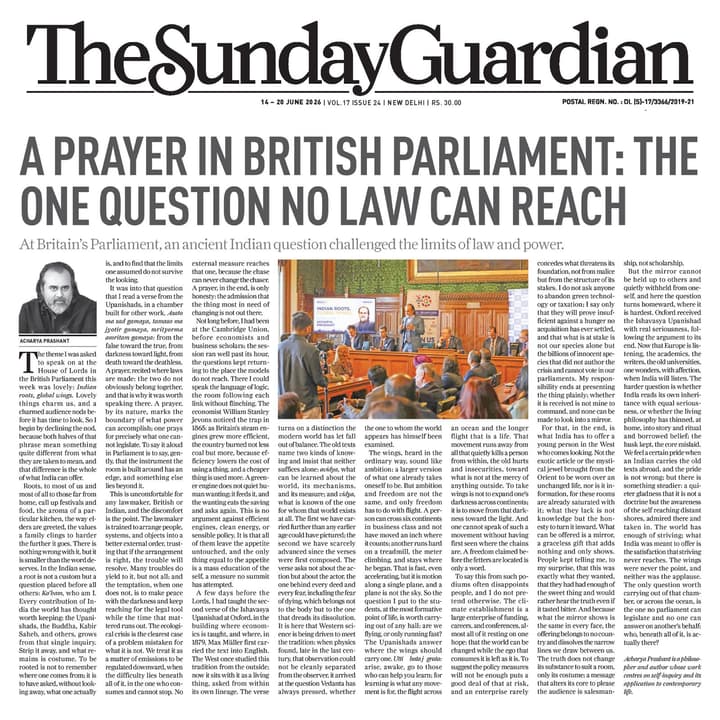
The theme I was asked to speak on at the House of Lords in the British Parliament this week was lovely: Indian roots, global wings. Lovely things charm us, and a charmed audience nods before it has time to look. So I begin by declining the nod, because both halves of that phrase mean something quite different from what they are taken to mean, and that difference is the whole of what India can offer.
"The theme I was asked to speak on at the House of Lords in the British Parliament this week was lovely: Indian roots, global wings. Lovely things charm us, and a charmed audience nods before it has time to look. So I begin by declining the nod, because both halves of that phrase mean something quite different from what they are taken to mean, and that difference is the whole of what India can offer."
"A man reaches a mountain pass at first light, three hours of walking in the dark behind him. The valley below has not yet been entered by the sun; the river on its floor is a grey thread, older than the language he thinks in. He stands still for perhaps a minute."
"The parks of London do something to the mind, if one lingers in them long enough without an agenda. Walking through one in the late evening, when the city has begun to loosen its grip, and the light is going amber behind the beech trees, something in the usual interior traffic pauses."
"On the 30th of May, I spoke at the Cambridge Union as part of the Cambridge India Business Dialogue, in conversation with Professor Jaideep Prabhu of the Judge Business School. I had been told the session would run for about an hour; the room had other intentions."
"Every year, as Eid al-Adha approaches, the debate reappears: should the practice be restricted, is public sacrifice acceptable, are there hygiene concerns? The protests and defences line up on cue, and when the festival passes, the argument goes quiet for another twelve months. The animal that was slaughtered is forgotten; the position that was held is remembered."
Almost every historical crisis has produced its version of the same thought: what is happening is happening to someone else. The climate crisis has produced a version of this thought particularly well-suited to the Indian urban professional class: climate change is real, but its primary victims are the farmer without irrigation, the construction worker or the landless labourer. The crisis the middle class has assigned to someone else is visible in the city's own property markets, its own seasonal calendar, its own streets after an hour of rain, and the exemption the middle class believes it holds has already been declined, though its holders have not yet checked the correspondence.
"The dowry demand is typically presented in public discourse as an anachronism, a stubborn remnant of a less enlightened India that education, urbanisation, and explicit legal prohibition have somehow failed to dislodge, a framing that mistakes the institution’s most explicit expression for a departure from it. But is dowry an aberration within the institution of marriage, or the institution’s own operating logic, followed to its economic conclusion?"
"The connection between fuel consumption and the absence of a genuine inner life is not metaphorical. It is a mechanical chain. The human being who believes that satisfaction must be sought outward, because he has found no access to genuine sufficiency within, acts upon his emotions and desires without examining what drives them. Every desire acted upon requires energy. Energy, in a civilisation built on fossil fuels, means burning them."
Years pass, and the absorbed becomes the assumed, and what is assumed long enough, we defend. What entered us as someone else’s anxiety we now call our values. What was handed to us without our knowledge we now guard as conscience, as responsibility,...
Read more at: https://www.deccanherald.com/opinion/the-burden-of-borrowed-expectations-4011780
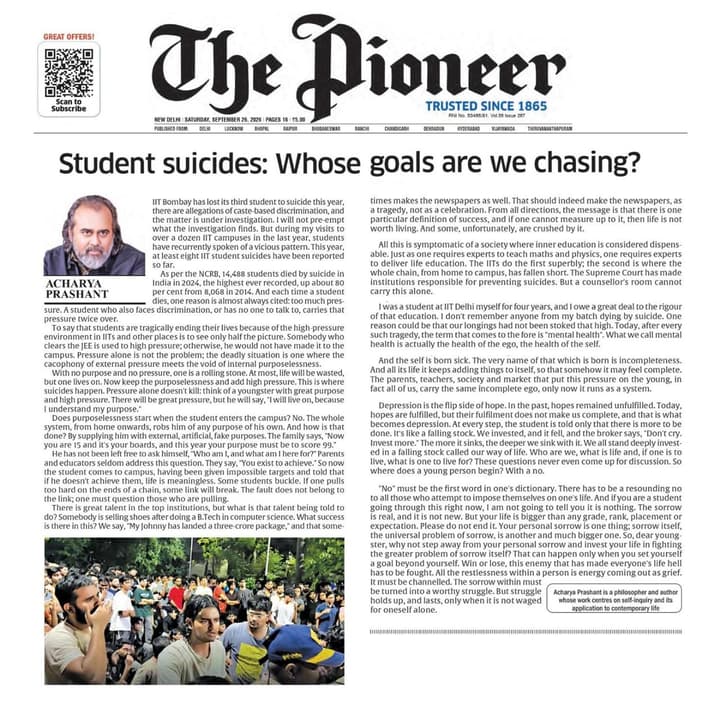
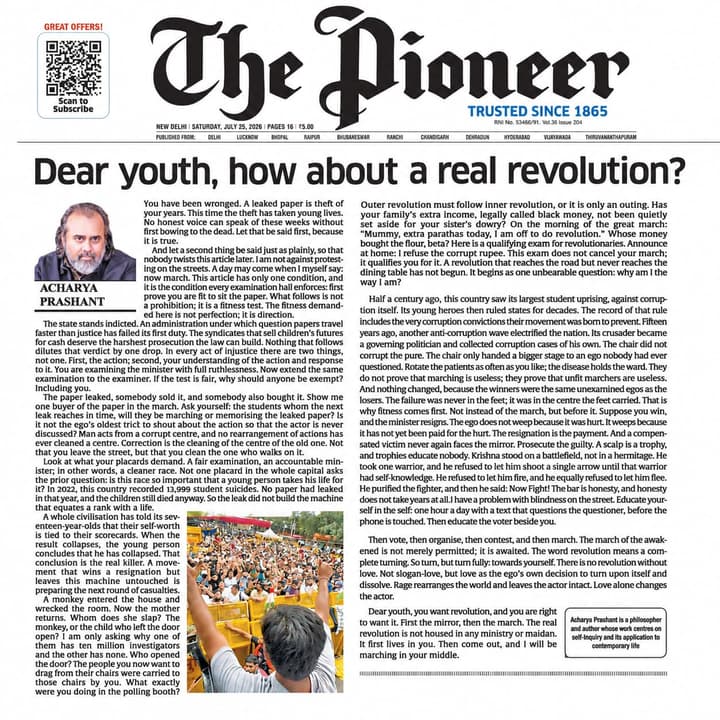
"The investigation into 2026 NEET-UG cancellation will produce arrests, possibly convictions, and a reformed NTA with a strengthened testing protocol; the twenty-two lakh students who sat on May 3 deserve nothing less. But the reformed examination will still fill its halls with candidates who do not know why they are there, whose years were arranged around a credential that was always standing in as a substitute for the self-knowledge that no curriculum, reformed or otherwise, has ever offered them."
“When scriptures are reduced to symbols of identity instead of instruments of inquiry, tradition loses its living essence. Reverence without study creates pride, not understanding. And a civilisation that stops reading itself slowly becomes vulnerable to noise, imitation, and hollow ritual."
“The mother being honoured today is the first person her children watched accept the settlement. The daughter who watched her mother’s labour go unnamed, unthanked, and unquestioned did not even consider that cooking may be a form of oppression. She learned something subtler and more durable: that this is what care looks like, that devotion does exactly this, and that a settlement accepted without complaint and carried with grace passes, in most households, for love itself.”
"Beneath all the noise of Super Monday, there's only one question worth asking: if the voter has changed his government for the seventh or the fifteenth time, and if the quality of what is governed has remained constant, if the problems said to have motivated each successive verdict continue in their essential form, at what point does the ceremony of changing governments begin to look less like the exercise of popular sovereignty and more like the elaborate activity of a self that has decided never to examine what has not changed?"
"The mountains are on fire and India's cities are furnaces. The bill for two centuries of mispriced consumption is arriving on a schedule that runs ahead of every published forecast. The question that remains is a simple one: whether the person who drove up to the hills, ate the Maggi, and tossed the packet into the ravine is willing to reckon with the distance between what he paid and what it cost."
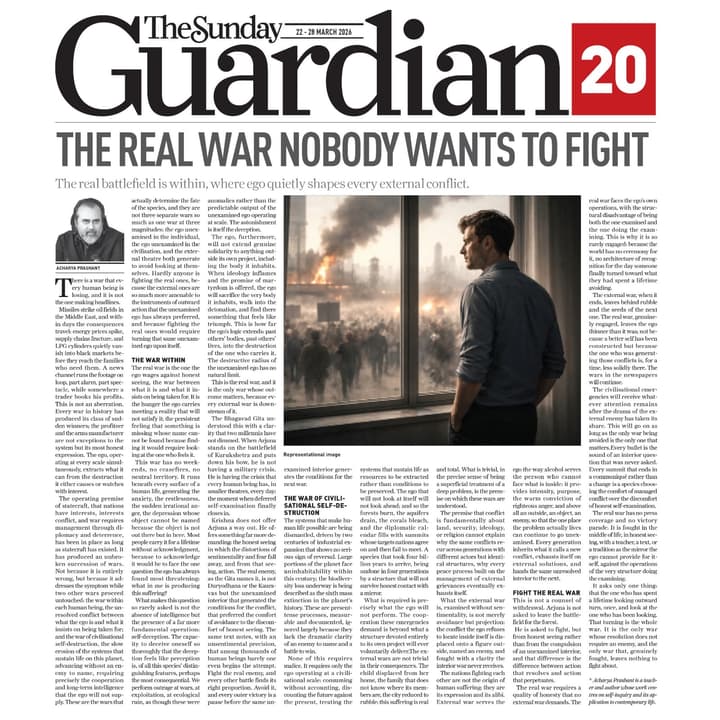
"The end of violence ought to be the simplest good news in the world. That it so rarely functions as such is a phenomenon worth pausing over. Something about the structure of collective life makes enemies necessary. Understanding what that something is, requires looking not at the conflict but at the one watching it."