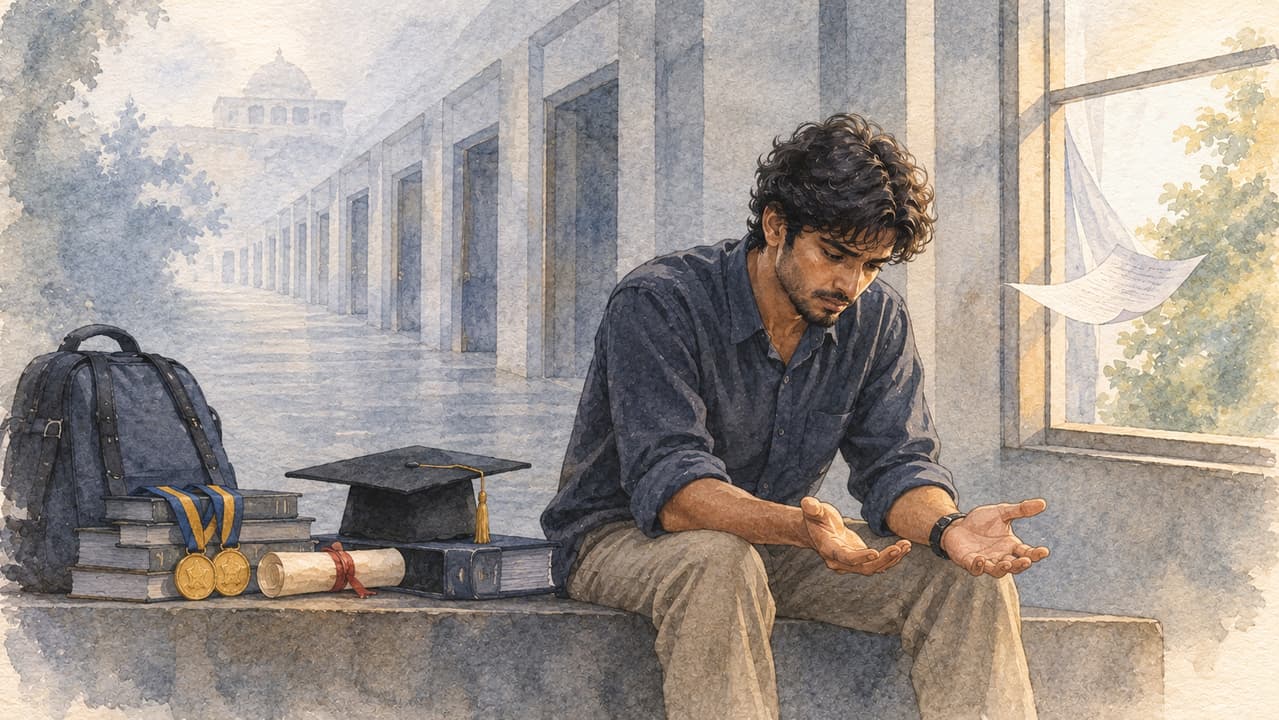



We study history, languages and money, and never the one who is reading, to whom all of it matters. Our interests feel like our own, and we call them freedom without asking where they came from. Had that stranger carried another name, would our view of him be the same? Self-inquiry cannot end in a final answer, because the one asking dissolves before it arrives, and returns the next morning. Do we want an answer, or do we want to look?
This summary is AI-generated. Please read the full article for complete understanding.
[From a conversation between Acharya Prashant and Peter Singer, Professor Emeritus of Bioethics at Princeton University and author of Animal Liberation, 2026. Singer asks how people can be helped to act less from the ego; Acharya Prashant speaks of education, the mirror, and why self-inquiry cannot end in a final answer.]
Peter Singer: Good. Good. Yes, I do. I have read about your life work, and I know that you are now engaged in mass education of the self. So maybe we should talk a little bit about how you think that can be achieved. Because in a way, I’ve also been working for that, right? I’ve been working for, as I said, expanding the moral circle. I’m part of what’s known as the effective altruism movement. Altruism and egoism we see as opposed. So, I would like to know how you think it’s possible to diminish the extent to which people act from the ego and rather act in a way that takes more account of the well-being of others both human and non-human animals.
Acharya Prashant: So, sir, if you see the kid is born and there are these senses and they are all looking in the outward direction. The very tendency, the very urge to look at oneself, first of all receives a handicap by our very physical structure. We are geometrically, anatomically not equipped to look directly at ourself. Even physically we require a mirror. And then as we grow up, there is the family, then there is the education system, and it is constantly talking of objects on the outside.