You really think the world is being run by an authority outside of yourself? No. We are the ones running this world, and we have made a mess of it. But we don’t want to own the responsibility, so we bring somebody else in between. And that somebody else, poor God, cannot even come and argue for Himself, defend Himself, and claim innocence and say, “No, no, no, no. I have not brought the world to such a pathetic position. You have done it.”
The one you love must be worthy of worship, and the one you worship you must be in love with. If there is a difference between the two, then there is a problem, a big problem. If you can’t worship your lover, then drop him or her, whatever, I don’t know. And if you can’t love your gods, those gods must be thrown away.
Any belief is stupid because all beliefs come from a lack of investigation, and a lack of investigation comes from deep fear and a feeling of insecurity. If you are insecure and afraid, then you will not dare to ask questions and investigate. And it is from that fear and insecurity that the concept of God has arisen. Now, God and reality are two different things. God and Truth are not the same thing. The mark of religiosity or true spirituality is an abiding faith in the truth.
Why do you think that, first of all, a creating entity, a creator, exists in the same way this world exists? Secondly, why do you think that all values that you hold dear to your chest must be espoused by that God as well? You like somebody to be merciful to you, so you say, “Oh, God is merciful.” How do you know God is merciful? Are you bigger than God? Have you penetrated God's head—if there exists somebody called God at all?
So, if I really love Krishna, obviously I will be going through the Gītā 2000 times. And in the light of Gītā , I will then read *Bhagavat Purana* , *Harivansh Purana* , many other *Puranas* ; and then I will be able to understand the stories in the Puranic way. Without understanding the Gītā , how will you understand the *Purana* ? Read more...
Man was never so powerful with respect to his environment as he is today. No virus can harm you; no bacteria can harm you; there are no plagues, no black deaths. You can produce as many objects as you want, you can order them at the click of a button;
“Shiva is not giving me peace. Maybe gold, riches, pleasure, entertainment can give me peace?” This is a foolish approach. The master and the servant are one. The servant will not give you what the master is not giving you. Shakti and Shiva are one; the creator and his creation
There was this king of the demons; his name was Hiranyakashyupa. The king worked really hard. He kept austerities, he forced even God to come down and bless him. So, it would have required a very special effort. But then, what did he want from God? Nothing but the extension…
The sexual activity is just like any other activity of man: he is searching for God. He searches for God in ambition. He looks for God in money. He looks for God in fame. He also looks for God in a woman’s body.
If God has given you anything, it is just the freedom, the power, and the responsibility to create yourself. You are your own father. God is just the background. God is just the canvas on which you paint yourself. God is the brush, God is the color, God is the…
Questioner (Q): When we see terrible crimes like rapes, mass murders, lynchings, etc. happening so openly, we wonder where that benevolent God is? He could have easily prevented all of it. He is supposed to be omnipotent, yet he does nothing. My question is not whether there is God or
Science can examine material claims, but Advaita Vedanta deals with the subjective self, ego, suffering, bondage, and liberation—areas outside science’s objective framework. Vedanta need not be accepted because of one’s religion or tradition; its value lies in whether its insights can be personally verified and help free one from suffering. The ultimate responsibility is not toward any philosophy, but toward oneself: to live a truly free life.
Superhero films appeal to our desire to escape inner inadequacy through external power. The fantasy of an ordinary, fearful person becoming extraordinary reinforces the ego’s belief that more strength, money, possessions, or status will bring happiness. Consumerism follows the same pattern, endlessly adding objects to fill an inner void. Real freedom does not come from becoming more powerful or acquiring more, but from honestly seeing and understanding the ego that feels incomplete.
The balance between order and disorder should not be decided by personal likes or dislikes, but by what the task at hand requires. Sometimes a project demands discipline and order; at other times, more important work requires leaving things messy. The right action comes from responding to the actual need, not personal preference. Even sacrifice can be meaningful when it serves something important, but “staying backstage” should never become an excuse to avoid what one cannot tolerate.
Spirituality does not replace the fear of ghosts with belief in God. It asks us to question the mind that creates both fear and belief. Ghosts, gods, and stories can all become projections of imagination. The spiritual path begins by dropping assumptions, investigating “Who am I?” and understanding the source of suffering. With attention, right knowledge, and self-inquiry, fear loses its power and one becomes inwardly free.
Vedanta reveals that freedom is impossible as long as the ego seeks to preserve itself. Meditation may bring temporary calm, but real transformation begins only when the false sense of individuality dissolves. Whether through devotion or knowledge, every genuine spiritual path culminates in the complete dissolution of the seeker into Truth. Liberation is not the experience of Truth by an individual—it is the end of the individual who wants to experience Truth.
Global conflicts stem not from geopolitical interests but from the ego's fundamental incompleteness. Nations are merely expressions of collective egoic consciousness. Leaders represent humanity's worst tendencies, not its average. The ego requires duality and boundaries to survive. True disarmament means detoxifying the ego itself. External wars reflect internal disturbance. No diplomatic solution addresses the root cause, only wisdom and self-knowledge can dissolve the ego's need for conflict and separation.
The one who is religion-less. A real Hindu does not have any religion. To go beyond all religions is to be a Hindu. There are religions that are on one plane, and then there is Sanatan Dharma, which is another dimension — the eternal religiousness. Liberation from religion is religiousness. Sanatan Dharma is awakened intelligence.
Search
Beliefs can’t talk to each other. You will say, ‘The world was created on a Sunday.’ He’ll say, ‘No, on a Monday.’ He’ll say, ‘Tuesday.’ He’ll say, ‘Wednesday.’ Now talk, how will you reconcile this? You can only fight. Why do you need to believe? You look at the question, "What should I believe in?” Well, nothing.
Opinions are opinions. There is nothing called ‘my opinion.’ All opinions are alien, foreign to you. They are always others. Even if they happen to be present in your mind, they are still others. It is just that you are so brain-identified that when an opinion is present in your brain, you start thinking that it is your opinion. And from where did that opinion come to your brain? It came either from biology or from society. How is the opinion yours then?
In our entire life, in this entire world, whenever we have remembered something or somebody, we have remembered that thing, that person, for our own personal reasons. I do not remember you. I remember what I get from you. You are not important. What is important is what I seek to have from you. This is not only loveless but also quite exploitative. It is equally truthless and foolish.
What you call as God is a concept; Truth is not a concept. Therefore, you can have stories about God, various religions, and their miscellaneous beliefs. But you can have no story at all about Truth because it is that which is invariable. Time cannot change it, and it doesn't vary from person to person. Irrespective of your subjective state, it remains as it is. Truth just turns you silent.
Excerpts from Articles
ज्योतिष कितना सच है? कुंडली, ग्रह-नक्षत्र: इनका क्या अर्थ है?
वेदांत को केवल इसलिए सही या श्रेष्ठ नहीं माना जा सकता कि वह किसी विशेष परंपरा से आता है। विज्ञान जहाँ भौतिक जगत की वस्तुनिष्ठ जाँच करता है, वहीं अद्वैत वेदांत सीधे मनुष्य के ‘मैं’, उसके दुख, बंधन और मुक्ति की पड़ताल करता है। इसकी कसौटी वैज्ञानिक प्रमाण नहीं, बल्कि अपने जीवन में इसकी सच्चाई को देख पाना है। किसी दर्शन को मान लेना नहीं, बल्कि उससे स्वयं को मुक्त करना ही उसका वास्तविक उद्देश्य है।
Climate change is more than an environmental crisis—it is a crisis of human choices. Our patterns of consumption, consumerism and endless pursuit of more are putting increasing pressure on the planet. But meaningful change does not necessarily begin with new technology or stricter policies. It begins with a deeper question: what are we willing to change within ourselves?
Animal cruelty: Who deserves mercy, and who doesn’t?
Violence begins long before the knife or the slaughterhouse—it begins with the ego, the one that draws boundaries, seeks justification, and decides who deserves compassion. Laws and reforms may reduce suffering, but they cannot end violence while the ego remains intact. When the ego dissolves, exploitation ends naturally, and compassion no longer depends on regulation or moral boundaries.
Struggling to choose between a secure job and the path you actually feel drawn to? This isn't really a question about careers. It's about why other people's opinions have so much power over you in the first place. Real clarity doesn't come from finding the 'right' choice. It comes from honestly looking at your own fear, again and again, until it stops running the decision for you.
You Don't Understand the Bhagvad Gita, But You Still Claim That You Love Krishna?
The Bhagavad Gita deserves reverence not because of inherited beliefs about its author, but because of its power to dissolve falsehood and reveal Truth. Real devotion is not ritual or blind faith—it is understanding, inquiry, and living the wisdom of the Gita. Through sincere study, one discovers the true meaning of Krishna, making the Gita the most authentic path to knowing and worshipping Him.
Victory is not decided by the trophy you hold but by the battle you choose to fight. Real strength lies in making the right decisions, staying true to your deepest values, and refusing to be ruled by fear or circumstances. When your actions arise from clarity rather than ambition, the outcome loses its power over you. The moment you choose the right path, you have already won.
कई तरह के डर—अकेले पड़ने, छवि खोने या छोटा समझे जाने—की जड़ अक्सर अतीत में बनी पहचान और कहानियों में होती है। शरीर की हाइट जैसी चीज़ों को समस्या मानकर उनसे जूझने के बजाय उनकी अप्रासंगिकता को समझकर आगे बढ़ना चाहिए। अतीत को दबाने से मुक्ति नहीं मिलती; उसके करीब जाकर अपनी स्मृतियों, धारणाओं और पुराने पैटर्न को निष्पक्षता से देखना ज़रूरी है।
Gita and philosophy and Vedanta have nothing to do with God. They are in search of Truth, not God. These are different things — Truth and God. Secondly, all the objects that you look at, you look at them in search of something. In search of the Truth, you look at all these objects. In that sense you could say, I am looking at everything in search of the absolute. To the ego, everything carries a promise, a possibility of the absolute. That does not mean that all the objects that you look at contain the infinite or something.
Brahm is not the creator. When you desperately want to invent a creator, then you come up with īśvára. But Vedanta is not very enamored of īśvára. So, Vedanta says, "Īśvara is just Maya, just Maya.” Because you experience the universe, therefore, you feel the need to justify the origin of the universe. Therefore, you must have an īśvára. But how can the creator of a false universe be real? If the universe is false, what do you say about its creator?
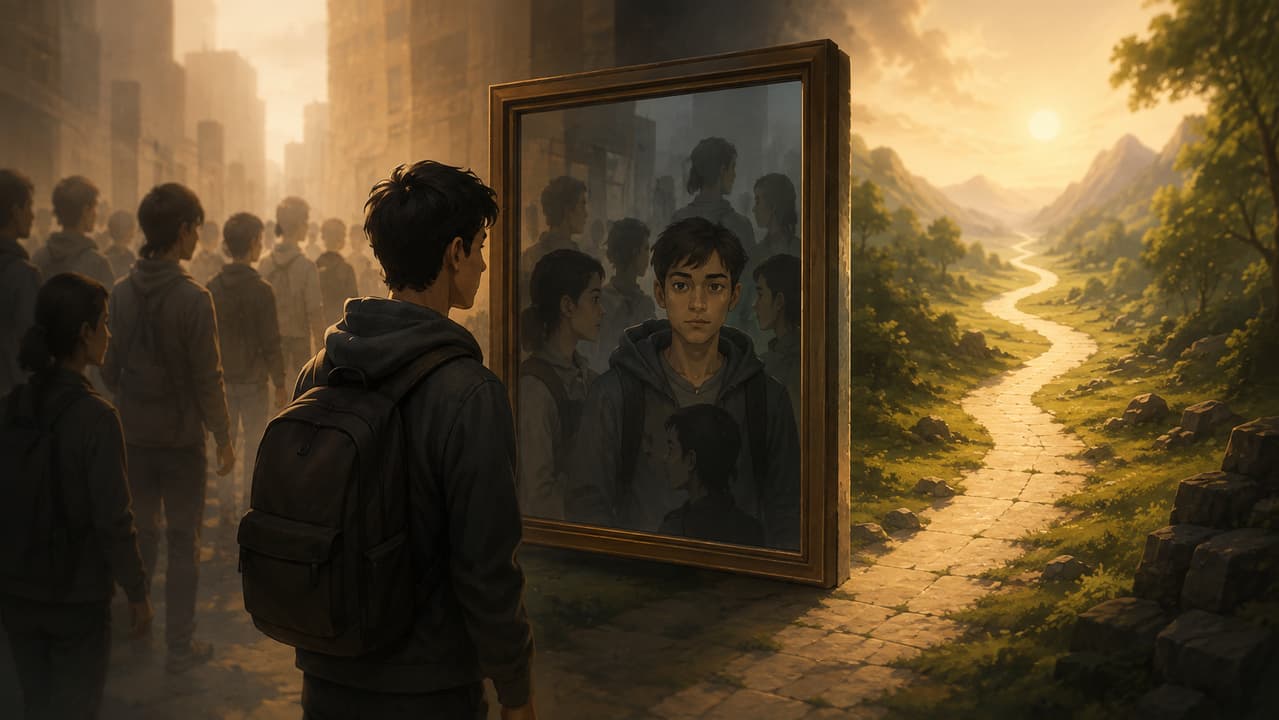
God wills that you be godly in your freedom. Because godliness, by definition, cannot be imposed. ‘God’ is patiently waiting for you to be godly. He’ll just keep showing you the mirror in some way or the other. He will keep sending you help—sometimes in the form of a situation, a book, or sometimes in the form of a person. God is nothing but your ultimate potential.
Questioner: Namaskar Acharya ji. Acharya ji, I have been listening to you for quite some time now, and one thing that I have noticed is that whenever you speak on any topic, you always speak in the light of Advait Vedant. One thing also on which you have spoken a…
Acharya Prashant: How can I identify a master with my limited knowledge? How can I judge his words to be true or false? If I go by faith or seeing their simplicity or innocence, I’m labeled as a blind believer. What should I do?
What is all spirituality about? If…
How to know what it is that you are worshipping? Just see what it is that you are prepared to sacrifice the most for. Look at your value system and daily decisions. What would you give up your food or money for? Keep listing what you find so valuable that you would give up a lot for its sake. In the end, you’ll find the one thing you value the most.
Acharya Prashant (AP):
You see,
Māyā
becomes all things, correct?
Māyā
becomes all things. So, you find it expressed in both ways. Sometimes, it is said—
Māyā
becomes all things
…
Question: Sir, my first question is that, it has been asked by a few of my friends that in the Śrīmad Bhagavad Gītā, Shri Kṛṣṇa declared himself to God. Then what is the need to read other scriptures like Upaniṣads and Brahmasūtra which has come from humans, like Ṛuṣhis…
…
1
Questioner (Q): So I had your advice and I got some books in terms of getting different perspectives. It might be a bit weird in a way question but I kind of wonder, when people are praying for God somewhere and also you're mentioning something about the myth of the…
Share
Share
…
Share
Acharya Prashant(AP): We had talked about the limitation of clarity. Clarity alone is not sufficient. You can be very clear that you are diseased, but unless you are also sure that you can be…
Share
Share
बलं बलवतां चाहं कामरागविवर्जितम् ।
धर्माविरुद्धो भूतेषु कामोऽस्मि भरतर्षभ ।। 7.11 ।।
balaṁ balavatāṁ chāhaṁ kāma-rāga-vivarjitam
dharmāviruddho bhūteṣhu kāmo ’smi bharatarṣhabha
And of the strong, I am the strength, which is devoid of desire and attachment, among the creatures I am the desire, which is not contrary to righteousness, O…
…
Struggling to choose between a secure job and the path you actually feel drawn to? This isn't really a question about careers. It's about why other people's opinions have so much power over you in the first place. Real clarity doesn't come from finding the 'right' choice. It comes from honestly looking at your own fear, again and again, until it stops running the decision for you.
Climate change is more than an environmental crisis—it is a crisis of human choices. Our patterns of consumption, consumerism and endless pursuit of more are putting increasing pressure on the planet. But meaningful change does not necessarily begin with new technology or stricter policies. It begins with a deeper question: what are we willing to change within ourselves?
कई तरह के डर—अकेले पड़ने, छवि खोने या छोटा समझे जाने—की जड़ अक्सर अतीत में बनी पहचान और कहानियों में होती है। शरीर की हाइट जैसी चीज़ों को समस्या मानकर उनसे जूझने के बजाय उनकी अप्रासंगिकता को समझकर आगे बढ़ना चाहिए। अतीत को दबाने से मुक्ति नहीं मिलती; उसके करीब जाकर अपनी स्मृतियों, धारणाओं और पुराने पैटर्न को निष्पक्षता से देखना ज़रूरी है।
A true relationship is not built on need, possession, or emotional dependence, but on a shared commitment to Truth and inner growth. A worthy companion reflects your reality like a mirror rather than performing a role to please you. Real love is effortless, rooted in one's nature, not expectations. When your highest commitment is to excellence and Truth, relationships become a natural outcome—not the purpose of life itself.
1
True learning is not built on memorizing answers but on understanding reality. Memory may help in examinations, but life constantly presents new questions that demand clarity, presence, and intelligence. Education becomes meaningful only when knowledge is deeply understood and lived, not merely remembered. Real understanding frees us from dependence on rote learning and enables us to respond wisely to every new situation.
2
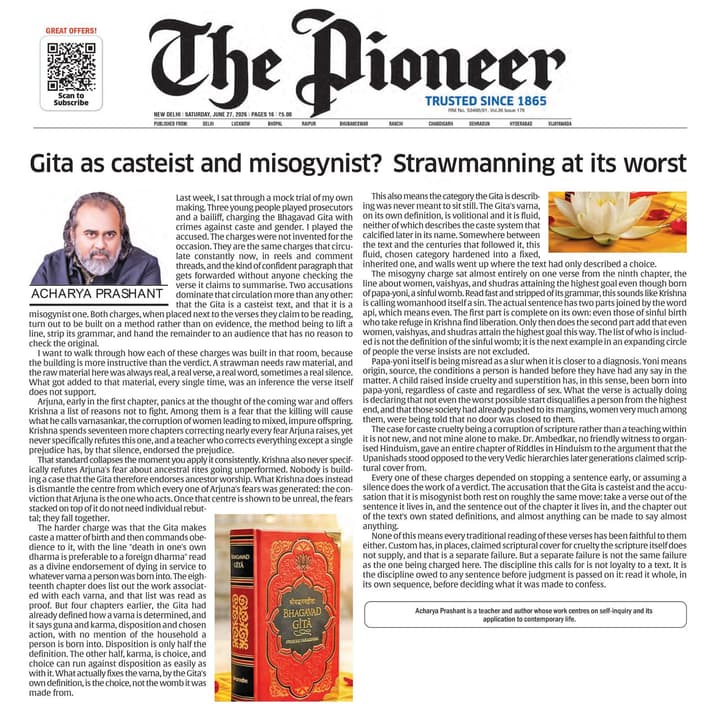
The Bhagavad Gita is often accused of supporting caste and misogyny through selective quotations that ignore context, grammar, and the text's central teachings. A closer reading shows that its emphasis is on inner qualities, conscious action, and spiritual equality rather than birth-based hierarchy or gender discrimination. Misinterpretations arise when isolated verses are detached from their broader meaning, while the Gita consistently points toward self-knowledge, freedom from ego, and the universal possibility of liberation for every human being.
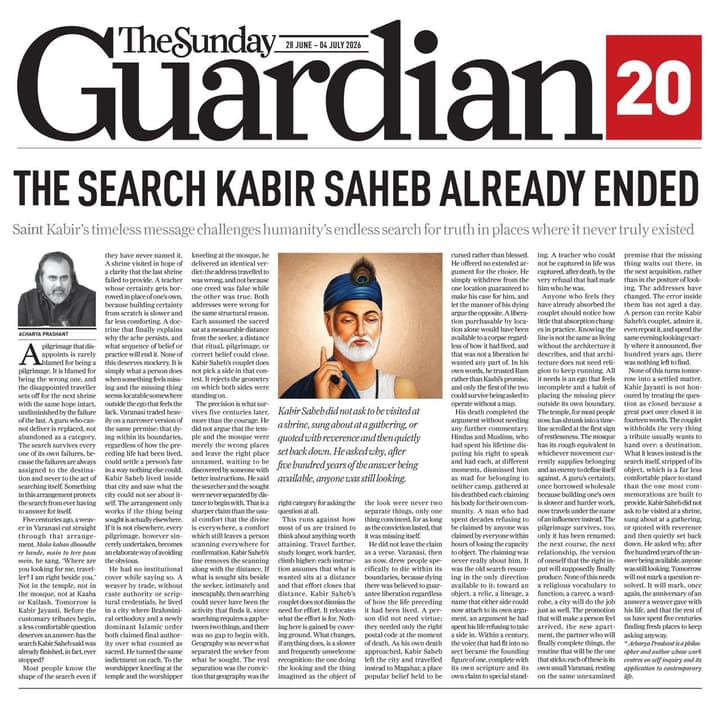
Kabir Saheb's message questions the very act of searching for fulfilment outside oneself. Whether through religion, relationships, success, possessions, or identity, people keep assuming that what is missing lies somewhere else. The problem is not the destination but the belief that fulfilment exists at a distance. Real freedom begins when the search turns inward, recognising that the seeker and the sought were never truly separate.
3
Human beings are born into uncertainty, surrounded by beliefs, identities, and social conditioning that offer ready-made answers to fundamental questions. Real spirituality begins not with accepting collective or personal beliefs, but with honestly examining one’s own suffering, fears, and false identities. The journey is not toward comforting ideas, but toward self-inquiry, where truth is discovered through questioning, observation, and the gradual rejection of illusion.
Science and philosophy arise from different kinds of inquiry. Matter seeks continuity of state, while the ego seeks continuity of existence and constantly changes identities to preserve itself. Fear, danger, and suffering are rooted in the ego’s sense of “I,” not in material reality itself. Questions are valuable because they expose hidden beliefs, and genuine learning requires challenging assumptions through inquiry, dialogue, and self-examination.
Freedom begins when a person stops handing over the authority of life to others. Society, family, and tradition can offer opinions, rewards, or disapproval, but they cannot truly stop someone unless there is inner dependence on their approval. Many conflicts that appear external are rooted in psychological dependence, fear, greed, obligation, or the desire for validation. Clarity does not come from controlling every outcome; it comes from ensuring that decisions are not driven by inner confusion, and then allowing life to unfold naturally.
6
Sixty million followers do not necessarily indicate a transformation in consciousness. Large numbers may reflect persistent outreach rather than deep commitment. Truth is often avoided not through opposition but through indifference, convenience, and self-deception. Real change requires sustained effort, inner honesty, testing one's understanding, and the courage to face uncomfortable truths instead of seeking comfort, validation, or easy inspiration.
Fear, social conditioning, and painful memories often shape how people live and make choices. True growth begins by questioning inherited beliefs, refusing to remain trapped by past wounds, and acting from understanding rather than conformity. What appears to be sacrifice is often just the abandonment of conditioned habits. Freedom comes not from external systems, but from the courage to see clearly, learn, and move beyond fear.
The climate crisis is not merely an external environmental problem but a reflection of inner human greed, desire, and psychological disorder. Drawing from the Gita’s idea of yagya as desireless action, it says real ecological healing requires inner transformation. Outer pollution, exploitation, and destruction mirror the ego’s inner confusion, making personal consciousness and planetary health deeply inseparable.
You are not truly young, you carry centuries of inherited beliefs, prejudices, and conditioning. Youth is the ability to change and create the new, not follow fixed patterns. Before asking what to do next, question and free yourself from the past. Only by breaking from inherited constraints can genuine freshness emerge.
8
Acharya Prashant (AP): That which you call “Vipassana” today, is a very recent phenomenon. They claim that it comes from the Buddha, actually, it is not. The stream flowing from Buddha got extinct around the 8th or 10th century AD. This modern Vipassana came up in Burma, just around a…