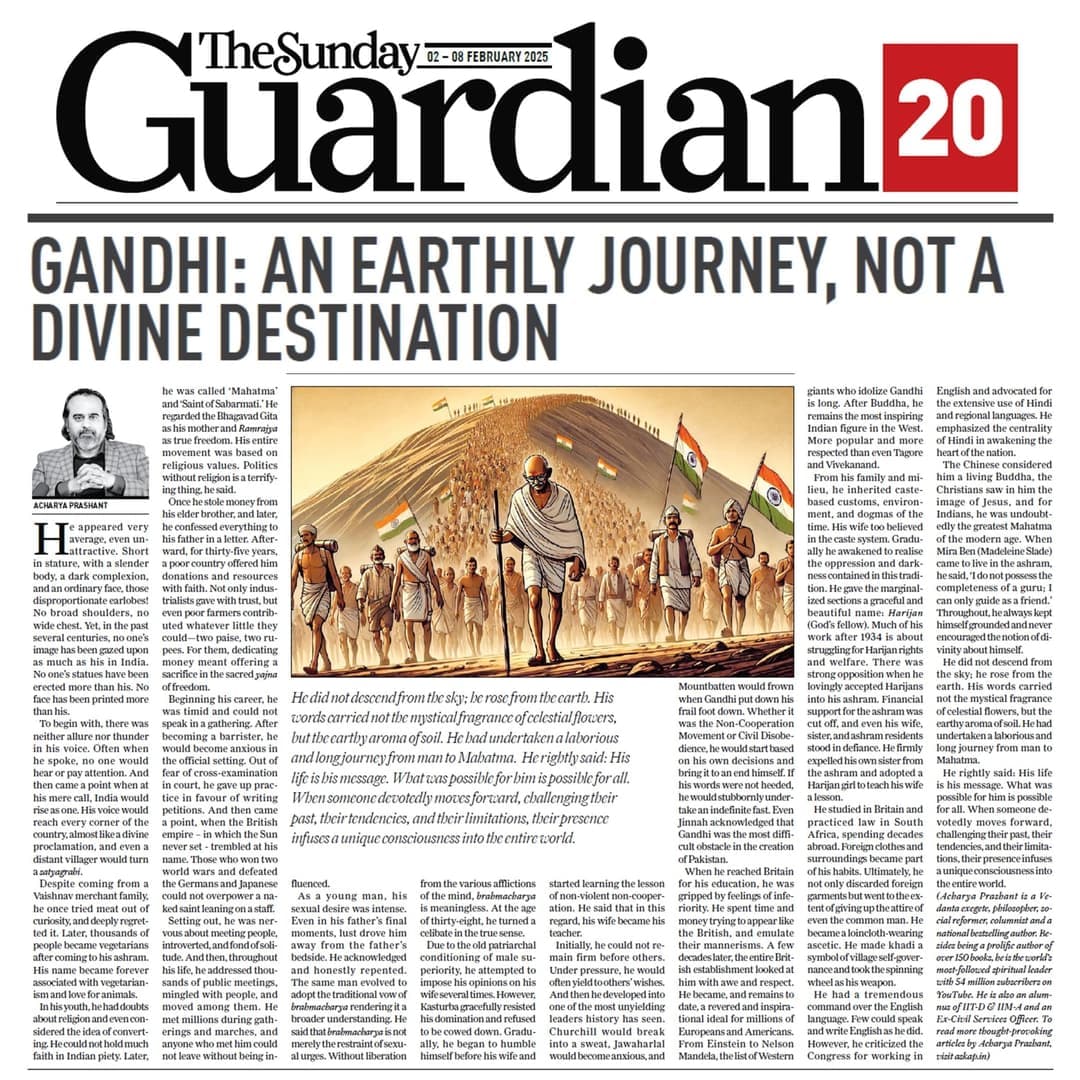
Gandhi did not descend from the sky; he rose from the earth. He undertook a laborious and long journey from man to Mahatma. And he rightly said that his life is his message — what was possible for him is possible for all. When someone devotedly moves forward, challenging their past, their tendencies, and their limitations, their presence infuses a unique consciousness into the entire world.
This summary is AI-generated. Please read the full article for complete understanding.
Originally published in the The Sunday Guardian on 2 feb '25.
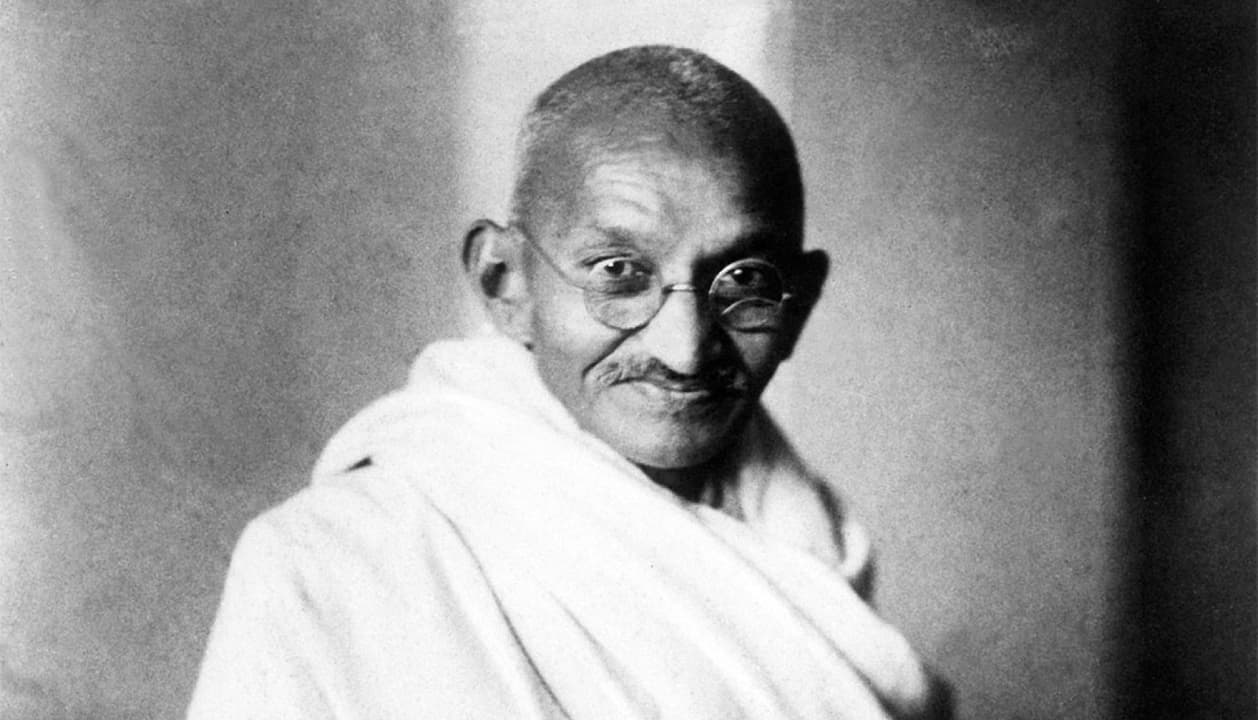
He appeared very average, even unattractive. Short in stature, with a slender body, a dark complexion, and an ordinary face, those disproportionate earlobes! No broad shoulders, no wide chest. Yet, in the past several centuries, no one’s image has been gazed upon as much as his in India. No one’s statues have been erected more than his. No face has been printed more than his.
To begin with, there was neither allure nor thunder in his voice. Often when he spoke, no one would hear or pay attention. And then came a point when at his mere call, India would rise as one. His voice would reach every corner of the country, almost like a divine proclamation, and even a distant villager would turn a satyagrahi.
Despite coming from a Vaishnav merchant family, he once tried meat out of curiosity, and deeply regretted it. Later, thousands of people became vegetarians after coming to his ashram. His name became forever associated with vegetarianism and love for animals. In his youth, he had doubts about religion and even considered the idea of converting. He could not hold much faith in Indian piety. Later, he was called ‘Mahatma’ and ‘Saint of Sabarmati.’