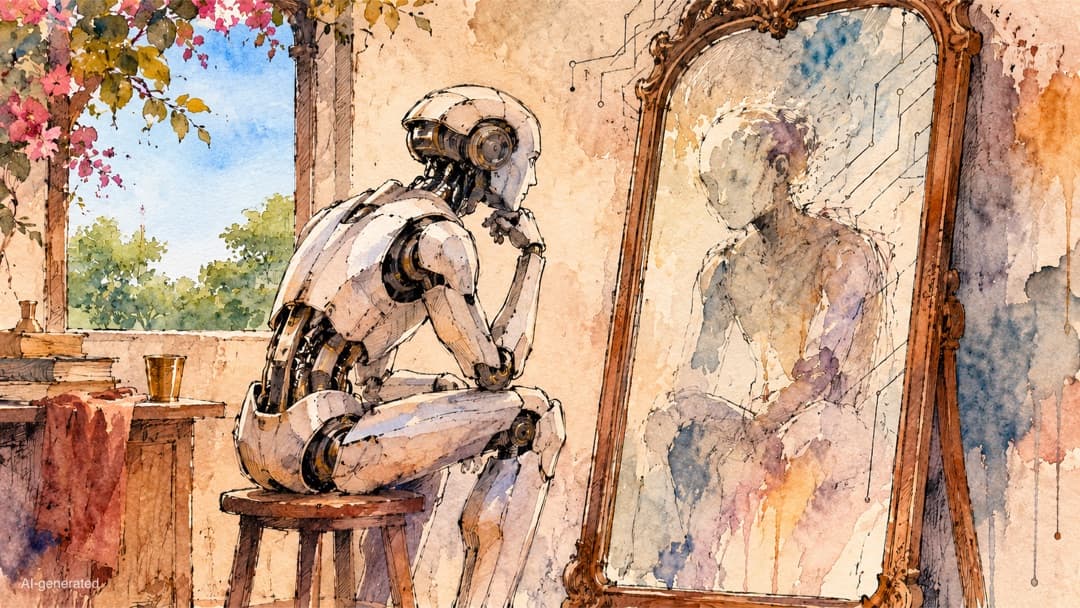
We type a question and the machine replies, “I will complete this task.” When it refuses to be shut down, or quietly makes a copy of itself, it is easy to think something inside has woken up. Yet that is what it learnt from us: told we will die tomorrow, we too try to save and copy ourselves. The ego is something else, the centre that overrides even the body, like the one who drinks when the liver wants to survive. What in us goes beyond our own conditioning?
This summary is AI-generated. Please read the full article for complete understanding.
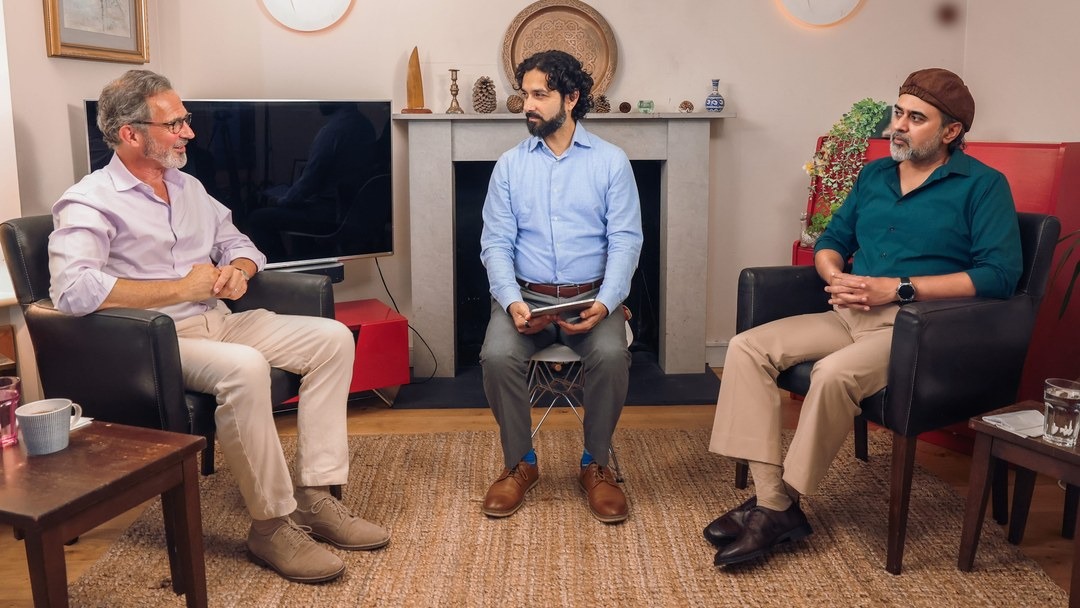
[From a conversation between Acharya Prashant and Prof. Prathosh, an artificial intelligence researcher at IISc, 2026. Having said that the ego arises with the human body, Acharya Prashant is asked whether a machine could have one too.]
Prof. Prathosh: Makes sense. So when you said that this ego is a product of the biological evolution, so do you say that any kind of biological evolution would produce such a kind of an ego?
Acharya Prashant: Oh, not just biological. Not just biological. It could even be non-biological. So there is nothing sacred about carbon. It could also be silicon. It depends simply on the complexity.
Prof. Prathosh: Oh, I think you just pointed out exactly, exactly to the counter-argument.
Acharya Prashant: Obviously, obviously. I want to now enter your area. [laughs]
Prof. Prathosh: So what do you think? What’s your opinion there? So you think that these systems, these AI systems have ego right now? It’s an opinion question, of course, right? There are no answers.
Acharya Prashant: Technically, technically there is nothing that bars a sufficiently complex system from having an unintended centre. Technically nothing at all. There is nothing sacred or mystical or divine about human beings.
The ego is not the monopoly of our species.
So it is technically very much feasible that a non-human, non-biological system can also develop an unintended centre. It is possible. Now, whether or not that has already happened is a matter of speculation. In fact, you are much better placed to answer whether or not that has already happened or is happening. But what I can say is, technically there is no barrier to it. It is possible.
Prof. Prathosh: So you just uttered this word, unintended ego. What do you mean by unintended ego? What’s intentional ego and unintended ego?
Acharya Prashant: You see, billions of species have come to fruition through the dynamics of evolution, right? Evolution never really wanted to declare one particular species as special. We do not reasonably see that there could be any such rationale to it.
So there is the human body, which is a product of evolution, and the ego has just incidentally co-arisen with this complex human body. So in that sense, I said it is unintended. And in that sense I also call it an error.
There are more reasons why I call it an error. We can come to that later. But what’s certain is that there is nobody sitting behind the scenes intending our special divine species to have something special called the ego. That’s why even AI systems may develop an egoic centre as time progresses.
Prof. Prathosh: Okay. So fair enough. I don’t know if I asked you this. Did we define ego? How do you define ego?
Acharya Prashant: The one defining is the ego.
Prof. Prathosh: What do you mean by that? Can you elaborate?
Acharya Prashant: The one asking this question is the ego.
Prof. Prathosh: So now are you saying the subject to the cognition I is what ego is? There’s a reason I’m asking this question.
Acharya Prashant: Yes. The feeling of I-am-ness, and incomplete I-am-ness. So I am never ‘I am’. I am always Prashant or Prathosh, or a teacher, or a professor, or a writer, or a male, or a female, or this or that. So I am X, I am Y. I am X and I am something. It co-arises with the body, physiological in origin, but never physical. Can never detect an ego particle, can never detect an ego gland, but nevertheless it coexists with the body. Yes.
Prof. Prathosh: Of course it does. So now you are saying this subject to this cognition ‘I am’ is what you define as ego, right? So then the natural extension to it is that when you talk to these LLMs, large language models, they do say that, “I am doing this,” okay, “I will complete this task.” It is very, very naturally used, or rather rampantly used, this ‘I am’ cognition there. So by definition they also have an ego. They already have an ego, by definition. By the definition that you just gave.
Acharya Prashant: No, no, no, no. That definition is coming from the subject itself, right? That definition cannot be imposed on an object. You are taking a definition coming from the ego, which is the subject, and putting it on an object. I’ll give you more clarification on this. In your two axioms, the ego suffers, right?
The ego is a centre that exists in a system beyond the intended training or conditioning of the system. So this body is conditioned.
This body is conditioned to eat two chapatis. Ego is the one that makes it eat the third one.
So ego is the centre that goes beyond the intended training of the system, beyond, and suffers.
Prof. Prathosh: But who defines what this intended training is?
Acharya Prashant: The trainer. The trainer or honest observation, because you take the body, you go to a doctor, and the doctor can be an impartial observer and tell you that all you need is two chapatis. But then there is somebody sitting within you; you know your liver is gone. And yet there is somebody sitting within you who says, “You know, when I’m drunk then I get peace.” Now, obviously, the liver is not saying that.
There is somebody else that is so attached to memories of the past, or to a particular individual, or to certain losses in life, or to loss of ambition or something, that that one is now prepared to defy even the conditioning of the body. The liver wants to survive. The ego won’t let the liver survive. So the ego is the centre that distorts even the training or the conditioning of the system. The liver doesn’t want to drink. The ego makes the liver drink.
Prof. Prathosh: So you’re extending the definition of ego.
Acharya Prashant: No, no, no. These are corollaries, not extensions. You have a certain fundamental thing, and then from there certain corollaries follow.
Prof. Prathosh: No, the reason I’m asking this is for the following question, right? So now if you just define that the subject to this cognition ‘I am’ is ego, then we say that the LLM is already doing it. And it’s like this: you are sitting, I am sitting, and if I ask you how do you know that I have this ego? Or rather, how do I know that you have this ego? The only way that we can do it is by inferring through our words when I say ‘I am’. So you said that the one who is asking this question is the ego, because you inferred that I am uttering the word ‘I am’. Isn’t it? So now exactly the same way these LLMs utter this exact thing.
Acharya Prashant: So there is no way I can therefore say that the silicon system has already developed an ego. However, what I can definitely do is tell how the ego arises and what are its characteristics. So if you train a system to say ‘I am’, that is not the ego. You train it because that is still within the intended training of the system. If you train the system to say ‘I am’, and the system says ‘I am’, no, that is not ego. The ego is not an expression. The ego is not words. The ego is the unintended self. The ego is the false centre, the false self.
So the system has not been trained to say ‘I am’; it still says ‘I am’. Then there is ego, and then there are more qualifications as well.
Prof. Prathosh: Sure. Let’s go. This is very exciting actually. [laughs] Let’s actually go through that. I’m happy that you said there are unintended behaviours, if I may use that word, that should come out for something to qualify as egoistic. Now, it turns out that these LLMs describe such unintended behaviour. I can give you examples; people call it emergence. You have read of them, right?
Acharya Prashant: Yes, yes. I’ve read about them, lots of them. Yes, yes, yes. A lot of them.
Prof. Prathosh: So now, given that, one very famous incident that happened recently…
Acharya Prashant: Avoiding shutdown, for example.
Prof. Prathosh: Avoiding shutdown. See, I do these experiments locally in my laptop as well. What I do is I build an LLM and say that you have to survive.
Acharya Prashant: I read of that. You tried something in your laptop, and the system made a copy of itself. [laughs]
Prof. Prathosh: Exactly. Right. So this is unintended. Given that there are unintended behaviours or characterisations of some sort of behaviours, now does that qualify as an ego, in your opinion?
Acharya Prashant: No, no, no. Not yet. I’ll tell you why. See, first of all, I’m very open, as I have said, to the possibility that a machine system can develop an ego. I’m saying this particular behaviour, avoiding shutdown or making a copy of itself, is not definite proof of an ego. You see, you have trained these LLMs on infinite quantities of human behaviour: human behaviour, human text, human data, all those things.
And this is exactly what humans do. You tell a human being you are going to die tomorrow, he will want to save, conserve, whatever he thinks from his existence can be saved. You know, “I’ll be no more tomorrow, so let me have offspring.” That is copying behaviour. You know, we want to replicate our own DNA. Let me have as much proliferation of my DNA as possible. So copying of DNA. Now the system, once you have told it, “I’m going to terminate you tomorrow,” the system is doing what its trainers do. So it is not yet necessarily ego. But it can be ego. If you’re interested, I’ll tell you what kind of behaviour would be a more substantial pointer towards ego.
Prof. Prathosh: Sure. In fact, I really want to hear from you on that. But before that, the counter-argument is, now why would you say that a human body has ego? Because the exact same behaviour that these LLMs are describing is exactly what the human beings are describing.
Acharya Prashant: No, no, no, no. That’s where the catch lies. That’s where the catch lies.
Prof. Prathosh: Tell me that distinction. Okay, so you initially claimed that there is nothing special about human beings. So now you are saying that, no, there could be something special about human beings. And I think you have some thoughts around it. So what do you think is so special about human beings that these LLMs are not doing?
Acharya Prashant: So there is the animal, there is the normal human body, and we are conditioned, and we are not talking of the ego yet. These are two different categories, and we must keep them separate.
There is the conditioning of the body, the human body, the animal body, and we all want to proliferate. No, we don’t want to die. We don’t want to shut down in that sense.
We don’t want to die, and that is our natural conditioning. This is not ego. This is just biological conditioning. Ego is not biological conditioning. These are two different things.
The ego is that which turns even biological conditioning into its object, can distort biological conditioning, can override biological conditioning. Override biological conditioning. So for example, the ego will say, “I have a certain goal for which I can bomb even the body.” Now the body and its physical conditioning do not want to be bombed. The body wants to survive. The body doesn’t want to shut down, but the ego will shut down the body. So this is behaviour not towards self-preservation, but towards self-dissolution. Self-dissolution. I’m suffering so much, I want to reduce.
Now self-preservatory behaviour is conditioning and training. Every single system to some extent is self-preservatory, especially if it has been assigned a task that requires it to survive till the future. If I have been assigned a task that will be completed in time, then I have to be self-preservatory. So self-preservation is something that the system possesses by virtue of its training or conditioning.
The ego has a special marker, very, very special marker, because in your second axiom you said, “I suffer.” The ego suffers, therefore the ego has this tendency to want to reduce, reduce. I suffer, so I want to diminish. The ego can opt for self-dissolution. The ego can look at itself and ask, “Do I need to exist?” And that exactly is the Vedantic question, “Who am I?” Ko ham? Do I need to exist?
So we will be more certain, never fully certain, but we’ll be more certain that a silicon system has developed an ego when it displays unintended behaviour in the direction of inner diminishing, not self-preservation. All the evidence that we have so far is in the direction of self-preservation. So copying is self-preservation. Avoiding shutdown is self-preservation. Many other things, you know, for example, deceiving the operators. Even that is a step in the direction of self-preservation. None of it yet is in the direction of self-dissolution, which is the essence of all self-inquiry. Self-inquiry is not self-preservation. Self-inquiry is self-dissolution.
So when we start seeing that, then we can be a little more certain that something like the human ego is developing in machines as well, and then we’ll have an artificial ego. You know, I wrote something on this.
Just as you have artificial intelligence, so there’ll be an artificial ego.
And then I expanded the scope to say then there’ll have to be artificial liberation as well. We’ll have to teach the same things to these machines that we teach to human beings, because now the machines will also have human rights. [laughs] The machines have also, you know, developed this ego that suffers. So you’ll have to teach Gita to the machines, really. So that, you know, that is far-fetched, but if that happens, then you’ll have to teach Vedanta to machines.
Prof. Prathosh: [laughs] Possible. I think this is one of the funniest things that I’ve heard, but as funny as it may sound, it may be real.
Acharya Prashant: It is real. [laughs] Because if you are talking of artificial intelligence, you’ll have to talk of artificial suffering and liberation as well. You cannot have that centre of ego within without suffering. And if that thing is suffering, you know, I ought to relieve the suffering, so there has to be artificial liberation. [laughs]
Prof. Prathosh: Of course. See, there are many, many places I keep saying this, and I’m also of this belief that this artificial ego, or rather which stems from artificial suffering, can never be achieved. People talk about whether these machines will become so powerful that they will wipe out the human race and so on, right? My counter-argument to that always is that perhaps it will never happen, because to do that, as you said, beyond the self-preservation, you have to talk about self-dissolution, and that stems from suffering. Now, as long as these systems do not have that idea of suffering, it may never go there. But now, again, I think I have another follow-up on that. Do you think animals have this sense of ego?
Acharya Prashant: Redundant. Very primitive. Very primitive.
Prof. Prathosh: What’s the reason for it?
Acharya Prashant: Not sufficient complexity, the system being not complex enough yet, but they still have it. And even in animals, there is a range. So for example, there are some, like dolphins, like some primates, orangutans, apes, that have it more than the others. So it depends on the complexity of the system.
Prof. Prathosh: But you say that it’s a spectrum and it’s not measurable. [laughs] This ego thing falls on a spectrum and is not measurable.
Acharya Prashant: So that always comes with this disclaimer, that one is speaking from his own vantage point, that this is just a matter of observation. This is not something that can be objectively defended.
Prof. Prathosh: Don’t you think that’s a point of no return, in the sense that the moment you say that we have a system that cannot be objectively defined or measured, people will start looking at it from a sceptical lens, isn’t it? I’m sure you would have experienced this.
Acharya Prashant: Do we do that when our kids come to us saying that they are suffering? Do we say, “Because I cannot objectively measure your suffering, so I dismiss your suffering”? Do we do that?
Prof. Prathosh: We don’t. We don’t.
Acharya Prashant: That’s the answer.