Many of us feel a small chill when a machine explains, writes or solves faster than we can. If being clever was what made us feel worth something, what is left? Cleverness was never intelligence. It was a favourite toy, and we built our self-esteem around it. Intelligence is the moment we look at ourselves and say, “Enough, I want to thin down.” The toy is gone, and we are not going anywhere. What would we be if our worth did not rest on being clever?
This summary is AI-generated. Please read the full article for complete understanding.
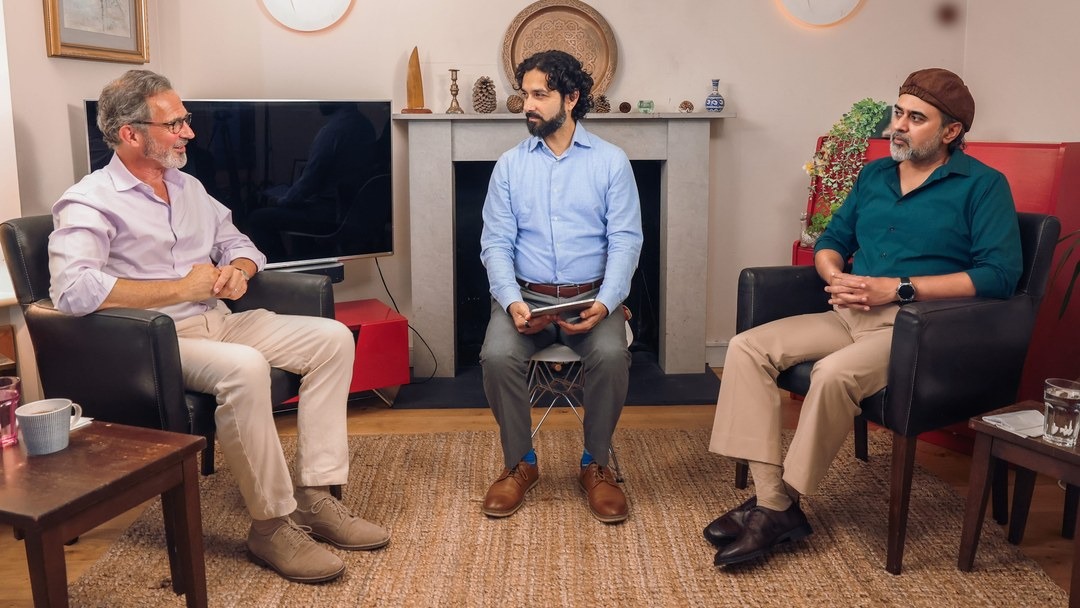
[From a conversation between Acharya Prashant and Prof. Prathosh, an artificial intelligence researcher at IISc, 2026. The discussion turns to what AI takes from the ego’s pride in intellect, and what education becomes.]
Prof. Prathosh: See, again, you talk about this ego and all that, and I keep telling people that intelligence is something that we very dearly attach to. And this AI has come up and dissolved that part at least of ego. You cannot say that, you know, you are great because you are intelligent anymore, right? So you have to look for something else as the human trait that is... Right? Because, see, if you look at it, people, I mean, what are the things that people ascribe to, right? That’s why Nachiketa says in Katha, it’s either mostly the intelligence or the kuleenata as they say, you know, that I’ve come in this lineage and all that. That people are egoistic about their lineage, about their material possession. Now, at least the intellectual association is sort of removed. Nobody can claim that they are great because they are intelligent. Okay.
So anyway, the other question that I asked in that video that became too popular is how do we conduct classrooms and pedagogy right now? So I know that you are also interested with the primary education and education in general. Now, there was already a lot of lacuna in the way we conduct pedagogy, right? Because, when we have been through the similar kind of systems and schools and colleges and so on. Now, question is, what are your thoughts on how would education look like in this age?
Actually, let’s discuss about two things, right? One, of course, from the angle of the Vedantic tradition, where education was never about information transmission. It was all about inquiry. That’s why in Taittiriya, et cetera, when Bhrigu comes and asks his father, he’ll say, “Adhi bhago Brahman.” He only says this, “Tapasah Brahma vijignasa.” Go and inquire yourself. There is nothing to teach here, right? So now can we think of a system that can cater to masses? Because we are dealing with a country that has... See, I come from the business of pedagogy, and if we have to incorporate those Vedantic ideas into pedagogy, do you have a plan? Do you have ideas about how to conduct this? See, one thing is, of course, this gurukul idea where, I mean, you associate with a thinner ego. That’s what education is all about, right? So you have somebody who has a thinner ego, associate with them, and then something happens. Now that cannot be simulated, or rather emulated in a system that would have to cater to 1,000 students, 10,000 students, and so on. In those situations, how do you think one needs to conduct pedagogy at all levels, starting from, let’s say, childhood to university education?
Acharya Prashant: You know, Prathosh, what has happened. The ego has had historically a very favourite toy. The toy was intellect. And AI has stolen the value of that toy, and now the ego is crying.
Prof. Prathosh: Which is a good thing. Which is a good thing, isn’t it?
Acharya Prashant: Yes. Once you see that, it is a good thing. You see, you use two words interchangeably in your statements, intelligence and intellect, and therein lies the problem.
Intelligence is a word that we are using for thinking, for analytical ability, for cleverness, and very dangerously, for a sense of worth.
Intellect is simply an object to the ego, not intelligence. Not intelligence. Intelligence is fundamentally different.
Prof. Prathosh: How do you differentiate them?
Acharya Prashant: Yes, we will differentiate them.
Prof. Prathosh: How do you differentiate them?
Acharya Prashant: And the sages have already done it for us.
Prof. Prathosh: Which is?
Acharya Prashant: Buddhi and bodh are fundamentally different. They have already laid the groundwork. Intellect is how this system operates. You can measure it using many proxies. IQ is one of them, and you can have so many others. Some are accurate, some are a little less accurate. So this is intellect. And the ego has since long prided itself on having this lovely toy. I can think more, I can reason more, and I can subjugate all the animals because I have this toy. So this is like a gun. This is a gun that we point at a lion and, you know, we put the lion in the cage. Intelligence is fundamentally different.
Intelligence does not pertain to an object of the ego. Intelligence pertains to the intent of the ego. If there is an ego that looks at itself and says, “Enough. Neti neti starts with me,” and says, “I want to reduce, I want to thin down,” that is intelligence. So we have never been intelligent at all. We have been intellectual. And intellect has been our favourite object, and now AI is threatening it, so we are feeling uneasy about that. But then, what is the problem? The toy is gone. We are not going away anywhere. The problem arises only when we build our self-esteem around that toy.
Prof. Prathosh: Not only self-esteem, we have built systems around that toy. Because it’s a systemic level change that we are looking at. In fact, as I said, education is built around that toy, okay? So now economy is built around that toy. Because, you know, you are rewarded depending upon how large is your gun, you are allowed. Exactly how many bullets do you have, right? How many bullets can you fire?
Acharya Prashant: And that is the reason why the planet is in such a miserable shape today, because we are rewarding the owner and the operator of the gun. We are not operating the right intent. We are operating the size of the gun. And the gun could be intellect, the gun could be capital, the gun could be factories, the gun could be a lot of other things that human beings have traditionally used to dominate and exploit. So they are all objects to the ego. And when we say AI is threatening us because AI will have more intellect, I often smile and say, “But you know, we do not even know whether AI has ego.” But historically, human beings definitely have had egos, and they have had all these guns. And we never said, “Oh my God, what a dangerous scenario.” And the scenario has been dangerous. The proof of that is the climate catastrophe. What else has brought us to this? So my suggestion therefore then is, instead of wondering about what AI can do to human beings, we should rather think about what human beings have done to themselves, what we have done to ourselves.
Prof. Prathosh: See, this is sort of now accelerating by this or amplifying by this thing because there is an agency now that has a better gun, okay? And there are a few people with larger egos that have this with them.
Acharya Prashant: No, the agency does not have a better gun. The agency is a better gun.
Prof. Prathosh: That takes us to our previous debate where does that have an ego? I mean, if you assume that that also had an ego...
Acharya Prashant: We are assuming that the ego is yet not there. Maybe, you know, two years later it will be there.
Prof. Prathosh: ... now that there is the gun.
Acharya Prashant: We don’t know.
Prof. Prathosh: Of course. Of course. Then it is the gun that we are talking about. But now my question was more on how do we conduct, of course, how do we conduct... I mean, not only education, like now that you expanded the horizon, we can actually expand the question as well. Now, we have built our economies around egos. We have built pedagogy around egos. We have built our system, family systems around egos. Now, and intellect, intellect and the cognitive abilities was at the center of all this. Now take that away. Right?
Acharya Prashant: Let us rather declare our celebration. That’s all that is left.
Prof. Prathosh: That’s what I’m saying. The entire lecture of that day was a rhetoric. It was a rhetoric that was a sort of celebration saying, “Look, you celebrated intelligence. Now that it is taken, tell me what?” Right? Don’t you think the kind of thought process that we are discussing here, which is the process of dissolution and all that, right? So do we know how to construct a world, be it pedagogy, be it economy or family systems, which can thrive with these principles? In fact, this will again take back to the initial question that I asked you, which is the orthogonality, right? Now we are talking about a system, okay, where ego is not at the center of operation, but the self, or rather the dissolution as we speak of, is at the center of the entire systems that we are building. So can we prescribe or rather, okay, can we think of a concrete system which we can build, which will serve masses, which operates not by keeping ego as its center, but this idea as its center? So that is the fundamental question here.
Acharya Prashant: Now let me offer a little bit in detail. And this will be a little personal to you, and you’ll enjoy this one. You see, you have been teaching since long, right? May I ask how many students are enrolled in that particular class where that famous discussion happened recently? 60 maybe?
Prof. Prathosh: I think around 80, 90 people is the class strength.
Acharya Prashant: 80, 90. And only those 80, 90 are the ones at most who are interested in that particular session. But that day, that special day, you said, “I’m not going to talk of the things that even AI can talk of.” And as you have famously quoted elsewhere, for rupees 2,000 a month. Even AI can talk of all those things just for rupees 2,000 a month, so why should I speak to you? And you stopped teaching of objects that even AI can refer to and can explain probably better than the human brain can do that, right? You did something else that day, and the entire country came to your classroom. Not just those 80, 90. You found the entire country voluntarily came to your classroom. You didn’t design that video to go viral.
Prof. Prathosh: Intent was not there.
Acharya Prashant: The intent was not there, right? Now, that is real education. That is real education. That is what teachers are for.
You see, we were talking of the four principal Upanishads that talk of both Vidya and Avidya, right? Ishavasya is the most famous of them, and the most quoted.
Now, given the importance of both Vidya and Avidya, the fact still remains that what to do with Avidya. Avidya is worldly knowledge, the kind that AI can beautifully deal in. Even what to do with the Vidya is decided by the ego. What to do with the gun is decided by the owner of the gun.
So the question then rightfully is, how did we reduce historically our education system to something that now AI is so easily able to replace? Education should ideally have been more about Vidya and less about Avidya, or at least equally. There should have been some semblance of balance, because that’s what the Upanishads are recommending, that you require both of these to cross through life. But then our education systems have been predominantly about Avidya.
Now, AI can replace this Avidya. Therefore, the systems now are bemused. They do not know what to do. They do not know what to do because historically they have been driving in the wrong lane. They have been missing the right lane. I’m not saying Avidya is not something that our universities should cater to. By Avidya, we mean physics, chemistry, mathematics, AI, and all the remaining knowledge that is contained in the various books. Not that that is to be dismissed. That is very, very, very important. You and I both come from streams of Avidya, and we have started our careers based on that. So we obviously know the importance. We are talking here of that which was missed, and that is something that AI, at least right now, cannot replicate. The country came to your classroom to look at a struggling human being.
They came to your classroom because you were asking a question to which even you did not have an answer. And you were the sage philosopher on that day dismissing all the shallow answers as Neti neti. So you asked this question: “What do you come to my class for? Because this is something that even AI can serve you.” And somebody said, “I come here because I trust you.” Somebody said, “I come here because I get a nice social environment.” I mean, you know that better than me. So there were all these miscellaneous answers coming to you. And with the Neti neti sword, you were discarding each one of them. Now, that is what a teacher is meant for, and that is the future of real education.
Remaining everything, AI will do. The teacher will be required to display his own struggles in a very honest way. In the teacher, the student should be able to see his own struggles.
In the teacher, the student should be able to see how the teacher is struggling, yet refusing to give up. Struggling, yet refusing to take the easier route and just somehow cop out.
And that is the reason why the entire country became interested, because your question belonged not to a particular field of science, it belonged to essential humanity. You know, if my intellectual field gave me a sense of identity and purpose, now if my identity, my sense of purpose, my sense of worth is built on an object that is going away. So what do I live for now? What do I survive for now? Now, then the question becomes the road to liberation.
Can I have life and identity free of dependence on any object?
And that’s why the whole country got interested, and that is the future of education. And that can be scaled. You do not think because in your question I heard that little skepticism that how to scale it up.
Well, we are scaling it up. We are scaling it up. I am teaching Vidya or creating an environment where Vidya can become possible to more than a lakh regular students almost 30 days a month, and that is happening. It can be scaled. It’s just that, you know, you yourself are an example of scaling up. Didn’t your words reach the entire country and even elsewhere? So scaling happened. Scaling can happen. And that scaling obviously required the support of technology, which comes in the domain of Avidya. So that’s the future of education.
Prof. Prathosh: Very nicely put. In fact, it reminds me of that Ishavasya quote only, you know, “Avidyaya mrtyum tirta va, vidyayamrtam asnute.” So it just used the same avidya to cater this. But again, as I said, no, this question, there is no disagreement here at all. What you said, 100% agreement. But now the thing is, this completely topples, yeah, that completely topples the way the world is looking at, especially the pedagogical industry because everybody was very comfortable in just peddling avidya, if I may use that word. So now go there, it was very easy, okay, you chisel your intellectual capabilities and so that, no. Now, we need a curriculum, okay, which is to be designed where you combine both of these, both the avidya and vidya parts of it. And how do we do it at a systemic level is a question that is to be answered both by policymakers and, you know, people who are interested here. I think that warrants a different discussion altogether.