That’s what the entire spiritual process is about, collecting the airfare. So that you can rise up, otherwise, you stay crawling on the highway. Life is not so that you just remain a crawler, a creeper. Life is so that you can take off.
Questioner: Acharya Ji, the concept of Maya, or the idea that the whole universe is an illusion, is at the core of Advait Vedant. However, Maya as a concept is unfathomable to many of us. So, how can your book help the general audience, who do not having deep
Questioner: Earlier you were talking of our current systems being a whitewashed extension of what already exists in the jungle. My question is, if the animal nature is so innate, natural and core to the human experience, then does one need to embrace it and perhaps enhance it in one’s
Yesterday I was reading that the male snake chases the female snake following her scent, the trail of her odor. Snakes can’t generally see much. They can’t even hear much. So, the deodorant that you use is
Acharya Prashant: Māyā and Brahm are beginningless for you. ‘For you’ because the question is coming ‘from you’. So, to you, these two are beginningless. Why are these two beginningless? Why can’t their origin be known? Because Māyā does not comprise of an entity called ‘
Questioner: My question is not about concept, it's more about attitude. I see in the spiritual community, normally we spend a lot of time talking about thoughts, about god, about concepts, about the subjectivity of things and when we go back to our daily life, we just do as everybody
Question: Sir, daily life puts forth so many insane demands and expectations that it becomes difficult to understand what to follow and what not to follow.
Questioner (Q): All experiences unfold in consciousness and are fundamentally subjective in the sense that there is no objective world out there independent of consciousness. This brings me to the concept of illusion. If the world and our experiences of it are illusions, then the world is devoid of meaning;
Science can examine material claims, but Advaita Vedanta deals with the subjective self, ego, suffering, bondage, and liberation—areas outside science’s objective framework. Vedanta need not be accepted because of one’s religion or tradition; its value lies in whether its insights can be personally verified and help free one from suffering. The ultimate responsibility is not toward any philosophy, but toward oneself: to live a truly free life.
Superhero films appeal to our desire to escape inner inadequacy through external power. The fantasy of an ordinary, fearful person becoming extraordinary reinforces the ego’s belief that more strength, money, possessions, or status will bring happiness. Consumerism follows the same pattern, endlessly adding objects to fill an inner void. Real freedom does not come from becoming more powerful or acquiring more, but from honestly seeing and understanding the ego that feels incomplete.
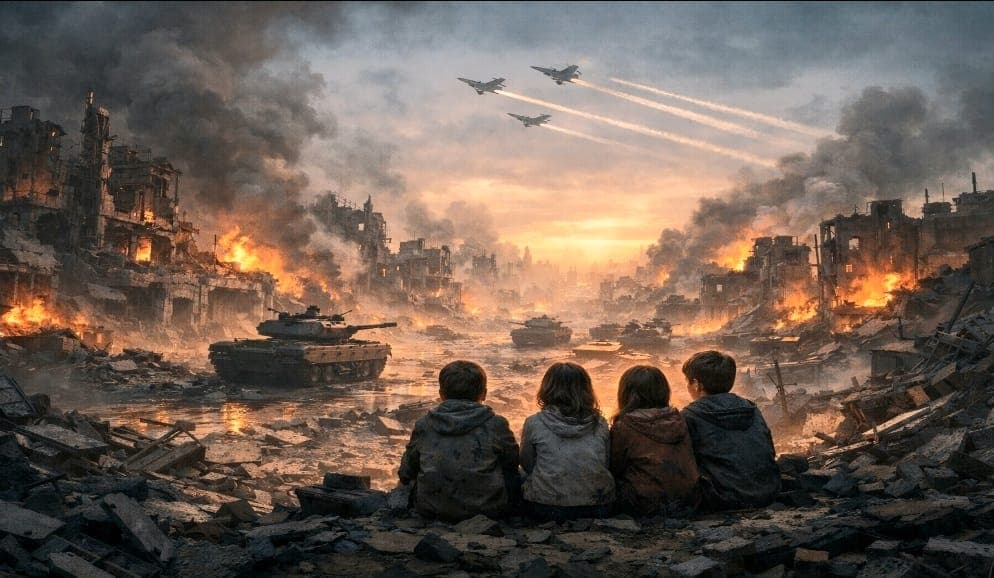
Global conflicts stem not from geopolitical interests but from the ego's fundamental incompleteness. Nations are merely expressions of collective egoic consciousness. Leaders represent humanity's worst tendencies, not its average. The ego requires duality and boundaries to survive. True disarmament means detoxifying the ego itself. External wars reflect internal disturbance. No diplomatic solution addresses the root cause, only wisdom and self-knowledge can dissolve the ego's need for conflict and separation.
There can be no self-respect without self-knowledge. And we have been repeatedly saying that the ego survives only in lack of self-knowledge. The less you know yourself, the denser and more crystallized your ego is. Self-respect is nothing but self-awareness. The more you know yourself, the more you realize who you are not, and that brings you to who you are. That is real self-respect, knowing oneself.
Some battles need to be fought just because they deserve to be fought, not for the sake of victory but for the sake of the fight itself. And victory is indeed possible. We are not fundamentally evil. We are all hypnotized since birth. That’s what is called Maya. Just as somebody can hypnotize us, somebody can also break the hypnosis. It is possible! Never, never lose Faith.
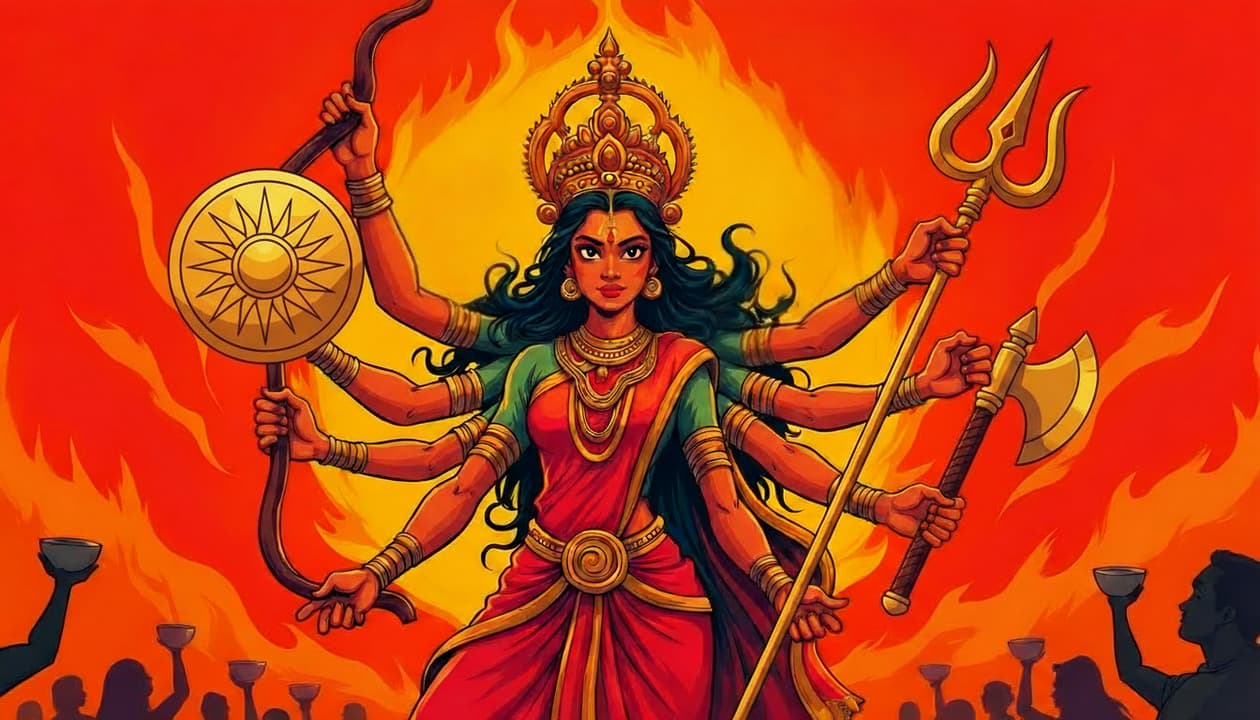
You are the subject, Puruṣa, and everything you can experience, perceive, speak, imagine, or think is Prakṛti. The only real spiritual question is to determine the right relationship between Puruṣa and Prakṛti. India came up with a beautiful answer: Worship Prakṛti with reverence, but do not try to possess or exploit her. The Shakti tradition with the Devi-puja is nothing but an answer to this question of right relationship. Durga, Ambika, and Kali — they all represent Prakṛti.
Because you underestimate Maya. Because maybe you are in the illusion that you have conquered, that you have left her way behind. Because probably you do not perceive that you too are still threatened. You feel, 'Oh, the thing is so easy, I overpowered it. Why is my dad not able to accomplish this simple feat?' Maybe it's actually so difficult that not only your dad is failing—even you have not fully succeeded.
1
Acharya Prashant: A fly comes and sits on my arm here (pointing towards the arm), I reject it, I discard it – Is the game over? Is she not ever going to return? Why? Because I discarded the fly and not my arm, so irrespective of how strong your resistance…
Excerpts from Articles
Animal cruelty: Who deserves mercy, and who doesn’t?
Violence begins long before the knife or the slaughterhouse—it begins with the ego, the one that draws boundaries, seeks justification, and decides who deserves compassion. Laws and reforms may reduce suffering, but they cannot end violence while the ego remains intact. When the ego dissolves, exploitation ends naturally, and compassion no longer depends on regulation or moral boundaries.
Climate change is more than an environmental crisis—it is a crisis of human choices. Our patterns of consumption, consumerism and endless pursuit of more are putting increasing pressure on the planet. But meaningful change does not necessarily begin with new technology or stricter policies. It begins with a deeper question: what are we willing to change within ourselves?
You Don't Understand the Bhagvad Gita, But You Still Claim That You Love Krishna?
The Bhagavad Gita deserves reverence not because of inherited beliefs about its author, but because of its power to dissolve falsehood and reveal Truth. Real devotion is not ritual or blind faith—it is understanding, inquiry, and living the wisdom of the Gita. Through sincere study, one discovers the true meaning of Krishna, making the Gita the most authentic path to knowing and worshipping Him.
Victory is not decided by the trophy you hold but by the battle you choose to fight. Real strength lies in making the right decisions, staying true to your deepest values, and refusing to be ruled by fear or circumstances. When your actions arise from clarity rather than ambition, the outcome loses its power over you. The moment you choose the right path, you have already won.
ज्योतिष कितना सच है? कुंडली, ग्रह-नक्षत्र: इनका क्या अर्थ है?
वेदांत को केवल इसलिए सही या श्रेष्ठ नहीं माना जा सकता कि वह किसी विशेष परंपरा से आता है। विज्ञान जहाँ भौतिक जगत की वस्तुनिष्ठ जाँच करता है, वहीं अद्वैत वेदांत सीधे मनुष्य के ‘मैं’, उसके दुख, बंधन और मुक्ति की पड़ताल करता है। इसकी कसौटी वैज्ञानिक प्रमाण नहीं, बल्कि अपने जीवन में इसकी सच्चाई को देख पाना है। किसी दर्शन को मान लेना नहीं, बल्कि उससे स्वयं को मुक्त करना ही उसका वास्तविक उद्देश्य है।
कई तरह के डर—अकेले पड़ने, छवि खोने या छोटा समझे जाने—की जड़ अक्सर अतीत में बनी पहचान और कहानियों में होती है। शरीर की हाइट जैसी चीज़ों को समस्या मानकर उनसे जूझने के बजाय उनकी अप्रासंगिकता को समझकर आगे बढ़ना चाहिए। अतीत को दबाने से मुक्ति नहीं मिलती; उसके करीब जाकर अपनी स्मृतियों, धारणाओं और पुराने पैटर्न को निष्पक्षता से देखना ज़रूरी है।
Struggling to choose between a secure job and the path you actually feel drawn to? This isn't really a question about careers. It's about why other people's opinions have so much power over you in the first place. Real clarity doesn't come from finding the 'right' choice. It comes from honestly looking at your own fear, again and again, until it stops running the decision for you.
Questioner: Acharya Ji, a good discussion happened yesterday in which many seekers participated and shared their understanding of Prakṛiti, Puruṣha and other things.
During the discussion, it was put that Prakṛiti, Puruṣha, Māyā, are mere concepts and that one is pure Ātman, never threatened and…
…
The principle of maya is founded on free choice. That's the very condition behind her existence, which is that, “I will disappear only when I choose to.” Grace is not something that happens coincidentally, randomly. Grace is a function of your own willingness. They say, “it may rain but you have to keep your umbrella aside.” The willingness to at least receive, be a recipient has to be there. Otherwise, you will remain dry and untouched.
I sometimes say to the ones around me, “If I am very unwell and dying don’t offer me Gangajal and all that, just sing Kabir Saheb to me, not that, that would take me to heaven, that might actually make me get up. I am not interested in heavens or swarg. But, if you bring Kabir Saheb to me chances are I will just spring back to my feet. No mambo-jambo, no miracles, no other worldly stuff. Read more....
Questioner: Namaste Acharya ji. My question is that I see many institutions are fueling the concept of Maya. Because I have seen on many premier institutions having Upanishadic phrases as their mottos—Na hi jnyānen sadṛushan pavitramih vidyate, Téjasvi nāvadheetamastu, sā vidyā yā vimuktaye. But at its…
Questioner:
What is
Duḥkha
?
Acharya Prashant: The thought, the desire of all that which is fleeting, ephemeral is Duḥkha. Why is it Duḥkha? To whom, is it Duḥkha? Few things have to be understood. Everything likes to be in its most stress-free state. That's what even…
2
Acharya Prashant: Māyā is only as powerful as you want it to be.
You are not being puppeted by Māyā; Māyā depends totally on you for her sustenance. If you ever find her dominating you, you must know that this is what you have wanted.
Never forget your essential…
Nitnem (Rahraasi Saahib)
Speaker: “Sabhi jeea tumaare jee tuun jeea ka daataara (All living beings are Yours. You are the Giver of all souls).”
The question is:…
We have seen so far, the predicament of the one who finds himself hopelessly caged against the Truth. We have seen the anxiety and the nervousness of Duryodhana in the first half of the first chapter. In spite of…
Acharya Prashant (AP):
You see,
Māyā
becomes all things, correct?
Māyā
becomes all things. So, you find it expressed in both ways. Sometimes, it is said—
sadṛiśhaṁ cheṣhṭate svasyāḥ prakṛiter jñānavān api
prakṛitiṁ yānti bhūtāni nigrahaḥ kiṁ kariṣhyati
Even a man of wisdom behaves according to his own nature. Being follows by their nature. What can restraint do?
~ Shrimad Bhagavad Gita, Chapter 3,…
…
Prakriti
and the purpose, too, is
prakritik
. The odor of the female
…
Māyā
*
’.
*
…
…
5
Questioner (Q): I want to know, essentially, the relationship between the material world and consciousness. Is the body, you know, just like putting together a few chemicals? And, how does consciousness come from an unconscious body? Or.. is it the other way around?
Questioner (Q): When we were studying for IIT, we used to think that everything would be sorted after getting into IIT or BITS. But it didn’t happen. Can such a thing actually happen at some point in life? Can I come to a point in my life where I can…
Answer: We all have felt that occasional boredom while reading our texts. We all have often felt that inertia to stay back at home…
…
2
Questioner (Q): Lots of layers of Ego are dropping and I wake up in the middle of the night and realize that I cannot trust anyone, anything including myself. My mind is going crazy and underneath it, I think I know all the answers to my questions. It feels so…
Question: When I sit in open Sky, I see the vastness, and the vastness feels like Freedom to me. It gives me lot of calmness and peace. The cool breeze, the rains, the Sun, these elements of physical nature give a lot of peace.
These elements of nature, especially the…
Climate change is more than an environmental crisis—it is a crisis of human choices. Our patterns of consumption, consumerism and endless pursuit of more are putting increasing pressure on the planet. But meaningful change does not necessarily begin with new technology or stricter policies. It begins with a deeper question: what are we willing to change within ourselves?
2
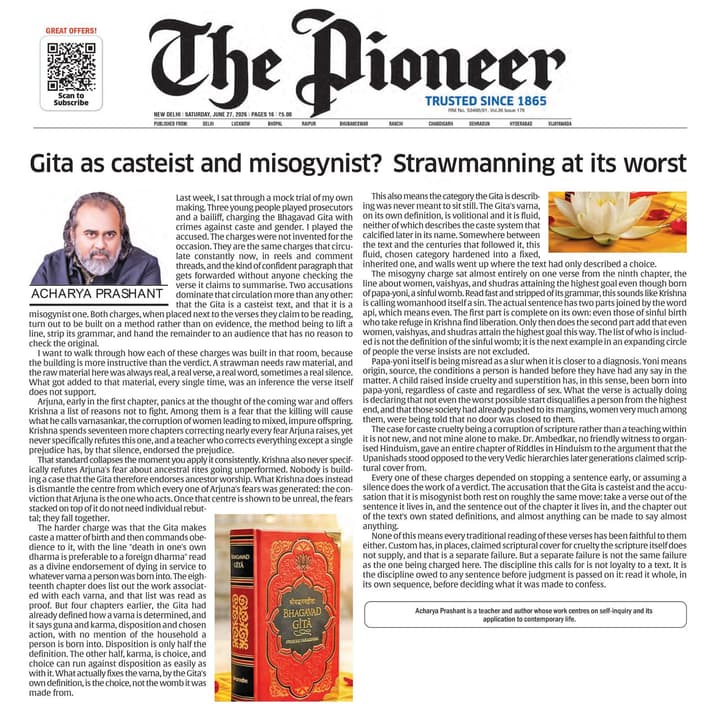
The Bhagavad Gita is often accused of supporting caste and misogyny through selective quotations that ignore context, grammar, and the text's central teachings. A closer reading shows that its emphasis is on inner qualities, conscious action, and spiritual equality rather than birth-based hierarchy or gender discrimination. Misinterpretations arise when isolated verses are detached from their broader meaning, while the Gita consistently points toward self-knowledge, freedom from ego, and the universal possibility of liberation for every human being.
Science and philosophy arise from different kinds of inquiry. Matter seeks continuity of state, while the ego seeks continuity of existence and constantly changes identities to preserve itself. Fear, danger, and suffering are rooted in the ego’s sense of “I,” not in material reality itself. Questions are valuable because they expose hidden beliefs, and genuine learning requires challenging assumptions through inquiry, dialogue, and self-examination.
The climate crisis is not merely an external environmental problem but a reflection of inner human greed, desire, and psychological disorder. Drawing from the Gita’s idea of yagya as desireless action, it says real ecological healing requires inner transformation. Outer pollution, exploitation, and destruction mirror the ego’s inner confusion, making personal consciousness and planetary health deeply inseparable.
2
Question: A gentleman was saying that a person, who is drinking or is drunk, he still has got some kind of stability on mind, and he too, can judge. That is what I felt to be perhaps wrong. A person who is drunk probably loses his judgement and whatever we…
8
Questioner: Acharya Ji, Pranaam! I read the six chapters from the book allotted to me yesterday. And now I don’t want to stop and there is a feeling of stillness. But when I look back to conclude what I have read, I cannot recollect much. There is a feeling that…
If you are honest, you will find that significant chunks of your time are being taken up by activities you do not even want to admit to yourself. The thing is, we ought to be objective; we ought to know where it is really going. And you might discover that nobody is actually all that short of time. Time is there; it’s just that when it is spent on activities that please us, we try to hide that time because it’s our little joyful secret.
Our mood is always dependent on others and situations. Results have not been up to your expectations. So now you require a morale booster, some motivating speaker. The moment that fellow is gone, your energy also goes away. But there is another way of living. Deep within myself, I find a point that no external situation can touch. Whatever happens, happens on the surface. That will remain stable, uninvolved, a non-participant. Then you are really free.
The only principle that truly runs this world, created by all of us, is the principle of greed and power. What do you think that fellow has earned his billions for? He didn't become a politician to be noble. The only thing that separates us from animals is the intellect, not the center the intellect is operated from. Don't locate the problem and the responsibility somewhere out there. We change ourselves; the world changes.
Superficiality offers pleasures. Superficiality offers cheap salvation. Therefore, it is easy to be attracted to superficiality. On the other hand, true spirituality challenges you to pay a heavy price. So, you see, all this knowledge has existed since antiquity. Yet there are people who do not want to read the Gita.
Ignorance is not about not having some particular knowledge. Ignorance is not an absence; ignorance is having knowledge. That which your mind is full of is ignorance. Ignorance is your basic sustenance. In such a situation, this utterance, “In reality, you are the One,” I repeat, must not be taken as the Truth in the sense of an affirmation. It is a method to help you drop that which fills you up. All it is telling you is this: “You are an entire universe sitting in your mind; you are not that.”
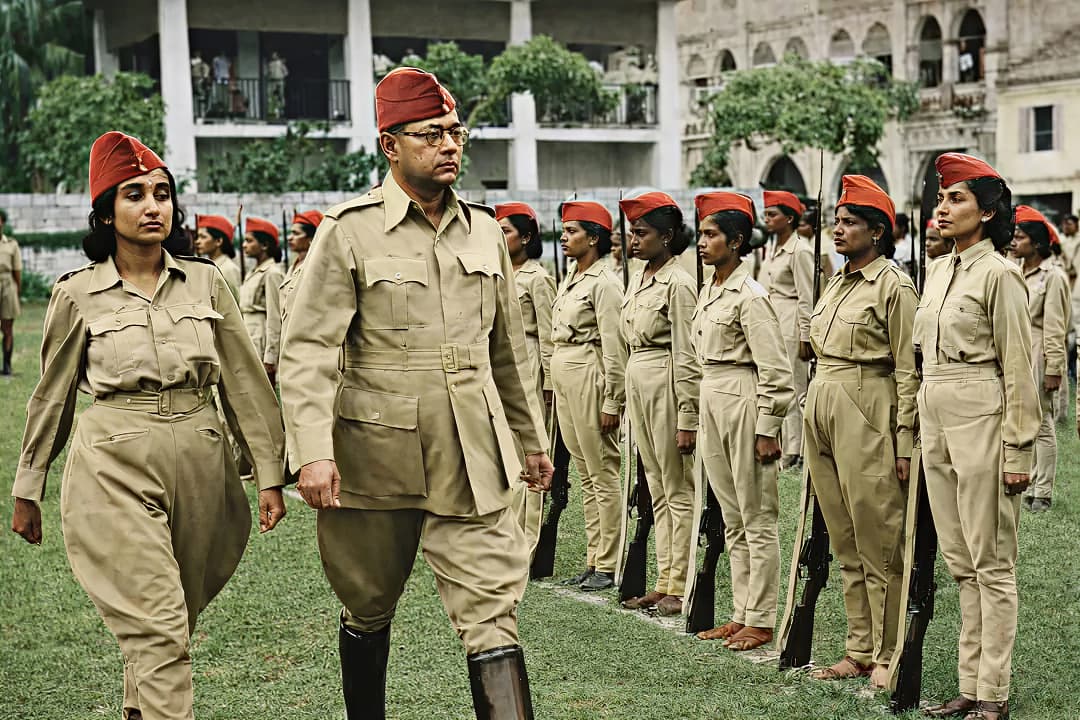
There is no revolution possible without the Gita. That’s the reason why even those who are not remembered particularly for their spiritual inclination, people like Subhash Chandra Bose, even they founded their core on Gita. What kind of revolution can you do if it’s the body that’s always at the top of your mind? You require a Gita to tell you that this body is perishable and would anyway go. Gita only teaches you, "Endure and fight."
5
Shri Krishna is saying: the mind is conditioned to move towards objects and perceive only their surface, periphery, or form. Develop the practice of penetrating further. Let Truth be your practice. The moment you would look at something, and you are in no position not to look at things being embodied, you would look at things. Nobody said that you have to practice lust. Lust just comes. You might be a total fool, an utter retard, and still you will find yourself getting sexually excited once you reach a particular age. Did you need some practice? No, you didn’t. It just happened. But if you are to understand lust, if you are to cross over, if you are to be a master of your body, then it will require a lot of practice, and that will necessarily and obviously tell you about your predicament.
The tiger chases the buffalo calf and brings it down. Does that disappoint you? No, because that was expected. Similarly, expect animal behavior all the time from everyone around you, including yourself. Everything we do comes from the jungle, so don’t be disappointed. Disappointment always arises from expectations. You really have to strive to be someone who is not an animal. And the first step in that striving is to address your own inner animal.
Manifestation is simply an expression of your desire. You desire something, and then you imagine your desire has been fulfilled. What does the common man desire? ‘Give me more money.’ What will the politician desire? ‘Finish off democracy and give me power for life.’ We have very stinking desires. Do we ever desire anything that is really good for everybody? The question remains: Was that thing worth it? You gave it so much time, so much respect, did it deserve that?
Duality is Truth wanting to know itself. If there is no duality, what will the Truth do? Alone, absolutely alone. He too needs a partner. So, it divides itself into two. All our sufferings, all imperfections are important. There is no reason to feel small about it. Without you, how will the Source know what it is to fail, what it is to suffer? Indulge yourself fully, but remember what all this really is. Don’t forget that.
Every living being, from humans to the smallest species, is trying to change the world to suit its own needs. But this is not intended to do any good to the world, it is just coming from the little ego. And the ego will not say, “I'm not all right;” it will try to change the world. So, if your idea of ‘good’ is only relative to your personal self, is it right to impose it on others? You must be clear about why you aspire to change the world, and whether you have brought about any change in yourself first.
As a doctor, can we limit our responsibility to the one particular body or to the set of few bodies that come to us for treatment? Or is the patient actually a representative of an entire society, an entire ecosystem? Can I really be a good doctor of the lungs, if I support a society that pollutes the environment in the name of development? So, if I'm a doctor, then health is my responsibility in the holistic sense, not just one patient.