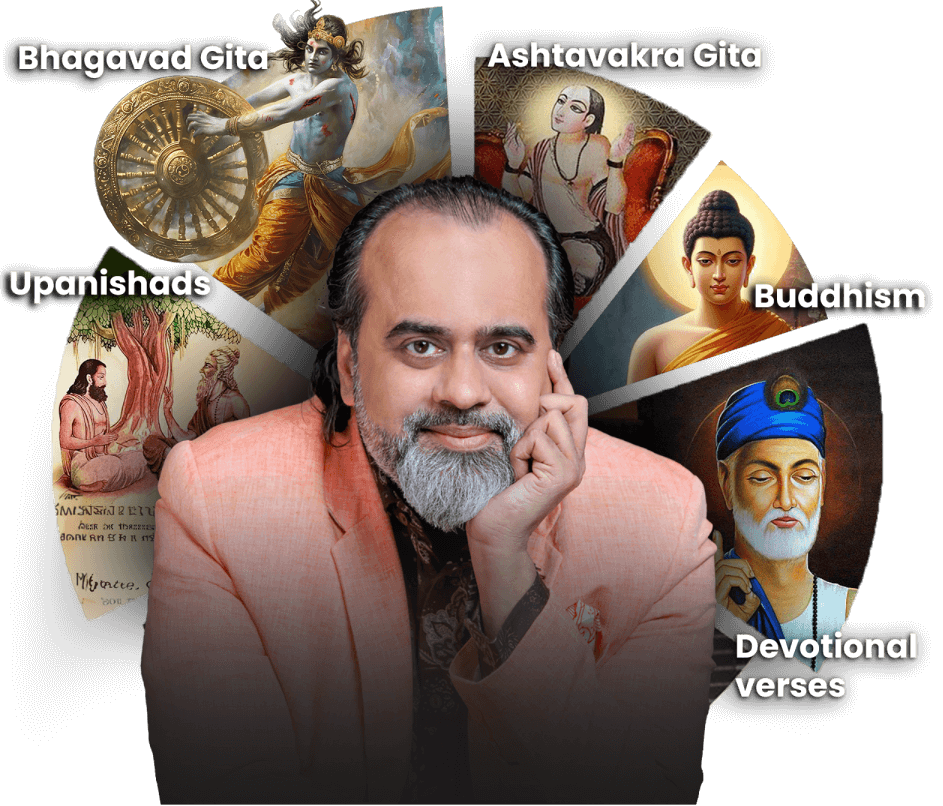
Feeling lonely on campus after being disappointed by friends? Acharya Prashant explains why loneliness should not push you into accepting the wrong company or remaining attached to relationships that pull you away from what is right. One person’s wrongdoing does not justify condemning everyone, nor does friendship mean supporting a friend in what is wrong.
Learn why the right company is the company that helps you move toward truth rather than merely giving you temporary relief from loneliness.
Acharya Prashant: Our normal life is our nemesis. And it is our nemesis precisely because it appears normal. It is not normal. It is normal only by comparison. It is normal only relative to your neighbour. It is the life that your neighbour is leading. It is the life that
Questioner (Q): Companionship in this journey, Satsang or a community, is difficult to find. When you seek out on this journey, it’s very very difficult to find people with whom you can talk about your experiences.
Questioner (Q): Sir, everyone is expecting something. Parents are expecting something, friends also expect something but sometimes I prefer to be alone. What to do in that situation?
See what the presence of other people is doing to you. Obviously, when you are with a sexual partner, then the power and the influence are magnified manifold. But even if the one you are with is not your husband or wife or sexual partner, even if that person is
A fellow who irritates you and keeps your mind agitated, why is he present in your life as a friend? How exactly is he taking care of you if his presence leads to an unsettled mind? What are these tags?
Lovers often like it when the partner acts silly. “It is so sweet, chomu is so silly!” But have you ever seen the partner going crazy saying, “My chomu is so enlightened”? An enlightened chomu
True love is not a biological instinct, emotional attachment, or social conditioning. Biology and science explain the body's drives, but they cannot explain the self that seeks freedom. Love is the inner restlessness to move from ignorance and bondage toward truth and liberation. Religion is not rituals or inherited beliefs but this personal journey of understanding. Freedom—not possession or conformity—is the essence of both love and religion.
Truth cannot be forced upon anyone, but neither should falsehood be entertained. Genuine love is not about preserving relationships at any cost; it is about helping oneself and others break free from illusion, even if that means risking the relationship itself. Spiritual growth begins by questioning conditioning, examining falsehood without bias, and choosing authenticity over comfort. Real relationships are built on the courage to seek freedom, not convenience.
Vedanta reveals that freedom is impossible as long as the ego seeks to preserve itself. Meditation may bring temporary calm, but real transformation begins only when the false sense of individuality dissolves. Whether through devotion or knowledge, every genuine spiritual path culminates in the complete dissolution of the seeker into Truth. Liberation is not the experience of Truth by an individual—it is the end of the individual who wants to experience Truth.
Love is not a special emotion reserved for selected people or relationships but a way of relating free from self-interest, possession, and psychological dependence. Most relationships become transactions driven by insecurity, where the ego seeks completion through ownership and exchange. Genuine companionship arises without the urge to control or claim another, allowing affection to exist naturally, freely, and without conditions or expectations.
That’s the purpose of life, no? To know your real destiny beyond your physical limitations and social conditioning. Most people do not know that such a dangerous thing is surreptitiously happening to them. I have found that we are quite big on media and social media now, so comments flow in their hundreds. And women actually have a self-righteous position when they say that we are not supposed to work and you better not expect that from us. Equally, men are conditioned about the roles they are supposed to play in life at home, in society, and how they are supposed to feel about themselves.
I have desires and you are the means to fulfill those desires. That’s why I come to you and I say I’m a loving person. This is not love. Most of that which we call love is actually just self-interest. A lot of our comforts, conveniences and identities depend on the other; therefore, we want to hold the other. Real love is possible only when you know that the other cannot bring anything to you. You relate to the other to share, not to gain.
You can tell someone, “Kid, this is the path of destruction. Leave it!” But you cannot forcefully pick the kid up and take her away. You know something is not right for the other person, and yet you can’t help her from doing it. You can’t give up, you can’t get angry, and you can’t stop what is happening. Great powerlessness. That’s how a Teacher feels.
“I love my job as long as I'm paid for it.” Can you work without being paid? If yes, then probably there is some beginning of love. There are ten things we all like, and all liking or disliking is conditional, and the mark of love is that it survives all conditions. If you come to something that is dearer to you than life itself, then you know what love is. Love is dangerous, because it would mean you have come to something that's more precious to you than life itself.
A friend is someone you can relate to in a way that uplifts your life, gives you clarity and insight. So, why isn't it possible to be with a person of the opposite gender who gives sharpness to your consciousness and a better understanding of life? If you cannot be friends with a person of the opposite sex, an important part of you will remain unnourished, unawakened, uneducated, and unaddressed. It is the mark of an awakened and spiritual society that men and women will be freely mingling with each other.
Friendship is nothing; friendship is a state of being in which you are concerned not with what you can get from the other person, but in the real advancement of the other person. And the real advancement is, discovering the Truth. So, a friend is a friend only if he brings you closer to the Truth; in whose presence you become less agitated, in whose presence a silence comes. Find out such friends, and then, there will be real magic.
Studies and friendships should not be mutually exclusive. Why can’t you have friends who have fun with books? Drop the word ‘balance’ from your mind entirely. Balance simply means fragmentation and division: this is to be done, that is not to be done, and I’m balancing both. Joy lies in absolute immersion.
If you have been with someone in periods of your unconsciousness, then don’t just drop them as you grow more conscious. If you were them in the periods of your inner darkness, try to share the light with them if and when you receive it. You have to ask yourself, “Have I tried hard enough to somehow save the relationship? Have I given the relationship its due?”
Excerpts from Articles
कद नहीं, अपनी कहानी बदलो
कई तरह के डर—अकेले पड़ने, छवि खोने या छोटा समझे जाने—की जड़ अक्सर अतीत में बनी पहचान और कहानियों में होती है। शरीर की हाइट जैसी चीज़ों को समस्या मानकर उनसे जूझने के बजाय उनकी अप्रासंगिकता को समझकर आगे बढ़ना चाहिए। अतीत को दबाने से मुक्ति नहीं मिलती; उसके करीब जाकर अपनी स्मृतियों, धारणाओं और पुराने पैटर्न को निष्पक्षता से देखना ज़रूरी है।
Victory is not decided by the trophy you hold but by the battle you choose to fight. Real strength lies in making the right decisions, staying true to your deepest values, and refusing to be ruled by fear or circumstances. When your actions arise from clarity rather than ambition, the outcome loses its power over you. The moment you choose the right path, you have already won.
Animal cruelty: Who deserves mercy, and who doesn’t?
Violence begins long before the knife or the slaughterhouse—it begins with the ego, the one that draws boundaries, seeks justification, and decides who deserves compassion. Laws and reforms may reduce suffering, but they cannot end violence while the ego remains intact. When the ego dissolves, exploitation ends naturally, and compassion no longer depends on regulation or moral boundaries.
ज्योतिष कितना सच है? कुंडली, ग्रह-नक्षत्र: इनका क्या अर्थ है?
वेदांत को केवल इसलिए सही या श्रेष्ठ नहीं माना जा सकता कि वह किसी विशेष परंपरा से आता है। विज्ञान जहाँ भौतिक जगत की वस्तुनिष्ठ जाँच करता है, वहीं अद्वैत वेदांत सीधे मनुष्य के ‘मैं’, उसके दुख, बंधन और मुक्ति की पड़ताल करता है। इसकी कसौटी वैज्ञानिक प्रमाण नहीं, बल्कि अपने जीवन में इसकी सच्चाई को देख पाना है। किसी दर्शन को मान लेना नहीं, बल्कि उससे स्वयं को मुक्त करना ही उसका वास्तविक उद्देश्य है।
Climate change is more than an environmental crisis—it is a crisis of human choices. Our patterns of consumption, consumerism and endless pursuit of more are putting increasing pressure on the planet. But meaningful change does not necessarily begin with new technology or stricter policies. It begins with a deeper question: what are we willing to change within ourselves?
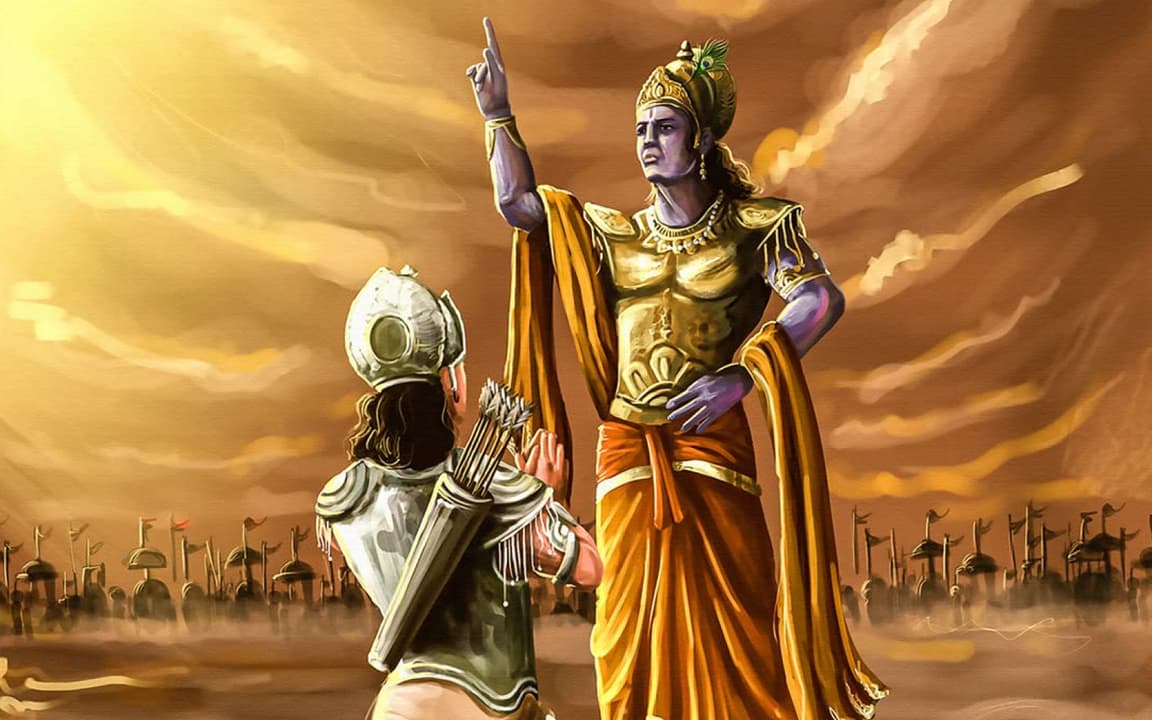
You Don't Understand the Bhagvad Gita, But You Still Claim That You Love Krishna?
The Bhagavad Gita deserves reverence not because of inherited beliefs about its author, but because of its power to dissolve falsehood and reveal Truth. Real devotion is not ritual or blind faith—it is understanding, inquiry, and living the wisdom of the Gita. Through sincere study, one discovers the true meaning of Krishna, making the Gita the most authentic path to knowing and worshipping Him.
Struggling to choose between a secure job and the path you actually feel drawn to? This isn't really a question about careers. It's about why other people's opinions have so much power over you in the first place. Real clarity doesn't come from finding the 'right' choice. It comes from honestly looking at your own fear, again and again, until it stops running the decision for you.
When you are speaking to a friend, do you need confidence? You don’t need confidence in the everyday situations at your home or with your friends. But in the interview room everybody says, “I need confidence,” right?
When do you need confidence? When does the question of confidence arise? The…
Acharya Prashant (AP): Do you really have a friend? What kind of friend is this who does not like you to do…
1
Question: Sir, in the morning, we were listening to Kabir. So, there was one of the doha which said, “Na kahu se dosti, na kahu se bair” (Neither friendship nor enmity with anyone at all). Usually, when you listen to it, it feels similar to what you also say that…
Acharya Prashant:
Whosoever makes you feel free, must be there in your life. Whosoever brings freedom, must surely be in your life and whosoever creates bondages upon you, bondages of any kind either implicit or
…
Acharya Prashant (AP): Have people in your social life who do not take you away from your academic life. What happens is that there…
Share
…
The only definition of a friend is someone who brings…
Share
Questioner (Q) - Ok, so you talked about influences in the previous answer. So, you know as an 18 year old there is thing called FOMO, Fear of Missing Out and its like kind of being influenced but we have been told that when we are 80 when we are…
is such a threat; you cannot like him. But silly
chomu
is so cute.
You…
6
Parental expectations, peer comparison, and academic pressure can overwhelm you only when you allow others’ desires to dictate your life. As an adult, you are responsible for discovering your own potential and making choices through your own understanding. Love is not about fulfilling each other’s expectations or keeping someone happy. True love requires freedom—giving others the space to live and grow, while living according to your own inner clarity.
2
We often call something “help” or “love” while secretly expecting something in return. When that return does not come, we feel hurt, revealing that the relationship was a trade, not genuine help. The ego, being unfulfilled, cannot truly love or share. Likewise, desperation to be loved makes us controllable. Real love emerges when we stop seeking validation, work on ourselves, and become so inwardly fulfilled that we no longer need to be loved.
The Bhagavad Gita is not a separate spiritual path or an escape from everyday life - it is a mirror that reveals the truth of your present life. Real spirituality begins with self-observation, not rituals or temporary practices. Lasting transformation comes when work, relationships, career, and personal growth become one integrated life driven by awareness, love, and freedom rather than ego, fear, money, or social pressure.
2
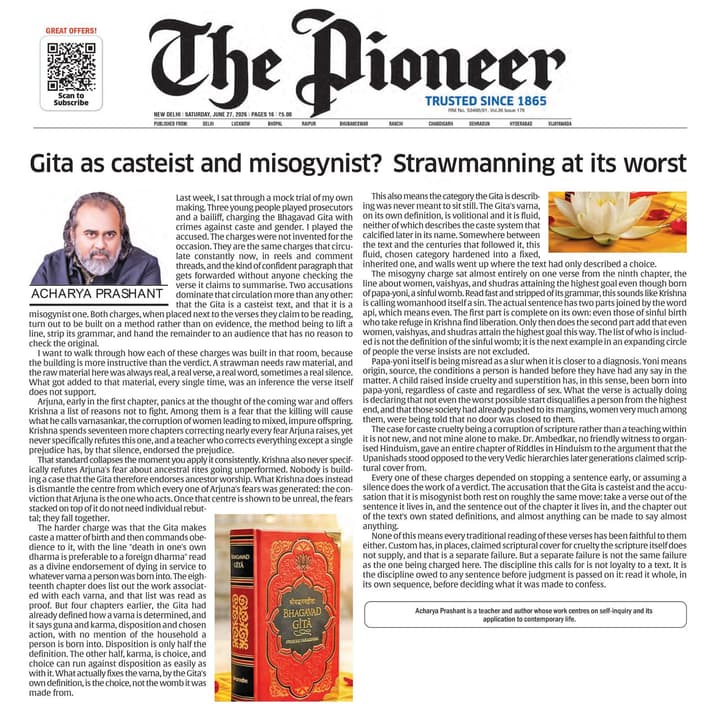
The Bhagavad Gita is often accused of supporting caste and misogyny through selective quotations that ignore context, grammar, and the text's central teachings. A closer reading shows that its emphasis is on inner qualities, conscious action, and spiritual equality rather than birth-based hierarchy or gender discrimination. Misinterpretations arise when isolated verses are detached from their broader meaning, while the Gita consistently points toward self-knowledge, freedom from ego, and the universal possibility of liberation for every human being.
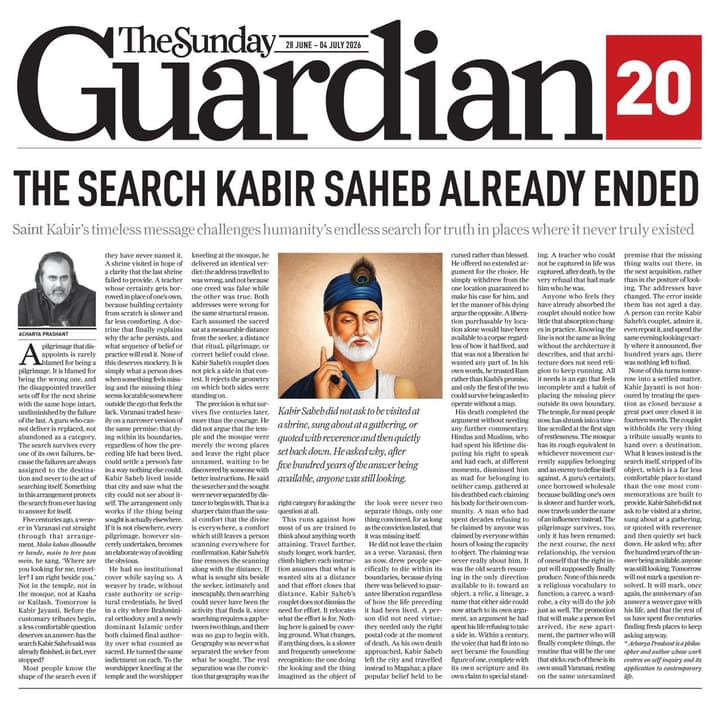
Kabir Saheb's message questions the very act of searching for fulfilment outside oneself. Whether through religion, relationships, success, possessions, or identity, people keep assuming that what is missing lies somewhere else. The problem is not the destination but the belief that fulfilment exists at a distance. Real freedom begins when the search turns inward, recognising that the seeker and the sought were never truly separate.
Modern relationships often create more insecurity, not less, because people are conditioned to seek completion, validation, and identity through another person. Social institutions, media, culture, and tradition continuously reinforce the idea that fulfillment lies in romantic attachment. As a result, relationships become driven by dependence rather than love. Real companionship becomes possible only when one is inwardly at peace and not using another person to fill an inner void.
Love is not attraction, possession, dependency, or a transaction driven by personal gain. As long as relationships arise from insecurity, ownership, or the desire for psychological completion, they remain centered on the ego. Love is simple, natural, and free of self-interest, flowing without preference or exclusion. The ego seeks security, continuity, and suffering because they preserve its identity, while freedom and joy threaten its existence. A meaningful life begins when one stops repeating old patterns, accepts uncertainty, and chooses freedom over the comfort of familiar cages.
Climate change, population policies, and social conflicts often arise from a common source: narrow love. People, communities, and nations justify actions that benefit their own group while overlooking broader consequences for humanity and the planet. True care is not exclusive or identity-based; it is expansive and inclusive. Even motherhood, patriotism, and family concern can become limiting when reduced to narrow self-interest rather than guided by wisdom, freedom, and universal responsibility.
The climate crisis is not merely an external environmental problem but a reflection of inner human greed, desire, and psychological disorder. Drawing from the Gita’s idea of yagya as desireless action, it says real ecological healing requires inner transformation. Outer pollution, exploitation, and destruction mirror the ego’s inner confusion, making personal consciousness and planetary health deeply inseparable.
Is loneliness really the absence of people, or the crowd of images and ideas inside us telling us that we “need someone” to feel complete? Two incomplete people cannot create wholeness together. Relationships are beautiful, but only when they do not become substitutes for inner completeness. Relate to the world, connect deeply, but never use another person to fill your inner hollowness.
It’s far easier to sit on a greatly decorated stage and talk about the virtues of Rudrākṣa, and what kind of water to drink, and why copper is useful; and all kinds of pseudo-scientific nonsense. But to really speak upon a Kabir or an Ashtavakra requires a tremendous understanding which does not come to everybody. If you are a spiritual teacher and you are saying you have not read any scripture, that raises questions on your love for the Truth.
Acharya Prashant (AP):
The question is, "Why do we forget? Why forgetting is a property of the mind?"
Do not ask, "Why do we forget?" Just remember that we forget. Because when you forget then you don’t ask this question that, "Why do we…
Love has to be seen as the need of the mind, the attraction of the mind towards Peace, towards rest. All attraction is there only with a desire; the hope is of fulfilment. So when the mind says ‘love’, along with love it has a picture of love. How do you know that somebody loves you? Only if he behaves according to set patterns. When real love comes to us, we close our gates to it. Love is not with a particular man or woman; Love is the natural state of the mind.
The kinds of meanings that we associate with love are actually quite demeaning. It’s not your own self-interest that you think of in love. Love is not an emotion; love primarily is a spiritual understanding. Saint Valentine would not be quite pleased with the meanings we have associated with his name and his day. The saints laid down their lives so that our faulty definition of love could be corrected, and that is probably the best use this day can be put to: correcting the definition of Love.
Superficiality offers pleasures. Superficiality offers cheap salvation. Therefore, it is easy to be attracted to superficiality. On the other hand, true spirituality challenges you to pay a heavy price. So, you see, all this knowledge has existed since antiquity. Yet there are people who do not want to read the Gita.
Real Love is a very pure thing. It is pure and it purifies. If you really love her, forget about the families, you won’t even bother whether she loves you, because Love does not demand anything in return. Forget about marriage or anything else. You love, you know love, and that is all, sufficient. Love unconditionally, and then a way will emerge. Unconditional Love is very, very intelligent, and knows no fear. It knows where the solution is, it will find a solution.
There is no revolution possible without the Gita. That’s the reason why even those who are not remembered particularly for their spiritual inclination, people like Subhash Chandra Bose, even they founded their core on Gita. What kind of revolution can you do if it’s the body that’s always at the top of your mind? You require a Gita to tell you that this body is perishable and would anyway go. Gita only teaches you, "Endure and fight."
You have to get into your own life, thoughts, feelings, actions, decisions, and see what holds you back. And freedom from what holds you back is the most important. That is what is most important. And then you can accept whatever price you have to pay for that most important thing. So it all starts from you. what is really important is a subjective thing. It depends on you. Nobody else can tell it.
5
Shri Krishna is saying: the mind is conditioned to move towards objects and perceive only their surface, periphery, or form. Develop the practice of penetrating further. Let Truth be your practice. The moment you would look at something, and you are in no position not to look at things being embodied, you would look at things. Nobody said that you have to practice lust. Lust just comes. You might be a total fool, an utter retard, and still you will find yourself getting sexually excited once you reach a particular age. Did you need some practice? No, you didn’t. It just happened. But if you are to understand lust, if you are to cross over, if you are to be a master of your body, then it will require a lot of practice, and that will necessarily and obviously tell you about your predicament.
We keep carrying the unexamined burden of the past all our life. That’s a great problem that we have. If you want to carry something from the past, if you want to remain related to it even today, then you have to ask: how does it benefit you? Because it’s an expensive decision to make. The purpose of life is to unburden yourself. Relate to something or somebody in a way that will help you clear away a lot of useless relationships.
Women, the way they are brought up in our country, anyway do not have much to lose. If I do not have much in life, and then there arrives a person who is attractive, earns well, is strong, then why, as a woman, will I not go for him? Your body is impelling you to take a particular decision, and you don't even know that it's coming from the body. The only solution is understanding, real, deep, honest observation of life. And this you could also call spirituality.
"As long as you are giving me pleasure and satisfying my needs, there will be peace. The day you stop, there will be war.” This is the usual social contract in which we exchange pleasures and dependencies. This is why there is a lot of violence. But there can be another way of relating to the other, where you are existentially complete within. There can now be beautiful, loving, compassionate relationships because you are not looking to be a parasite or a commander.
The fellow is the worst kind of human being possible. But you will not accuse him of disloyalty, infidelity, or cheating, because he still reserved his body for you. This simply tells that the relationship is founded on the body. The woman has been trained to consider herself the body, and so has the man. Why don't we broaden our definition of loyalty? Please ask, “You couldn’t be loyal to any kind of virtue. How will you ever be loyal to me?”
6
Drop the center of confusion, come to the center of clarity. Drop what the masses practice, come to the direct route of self-realization. That’s what it means.