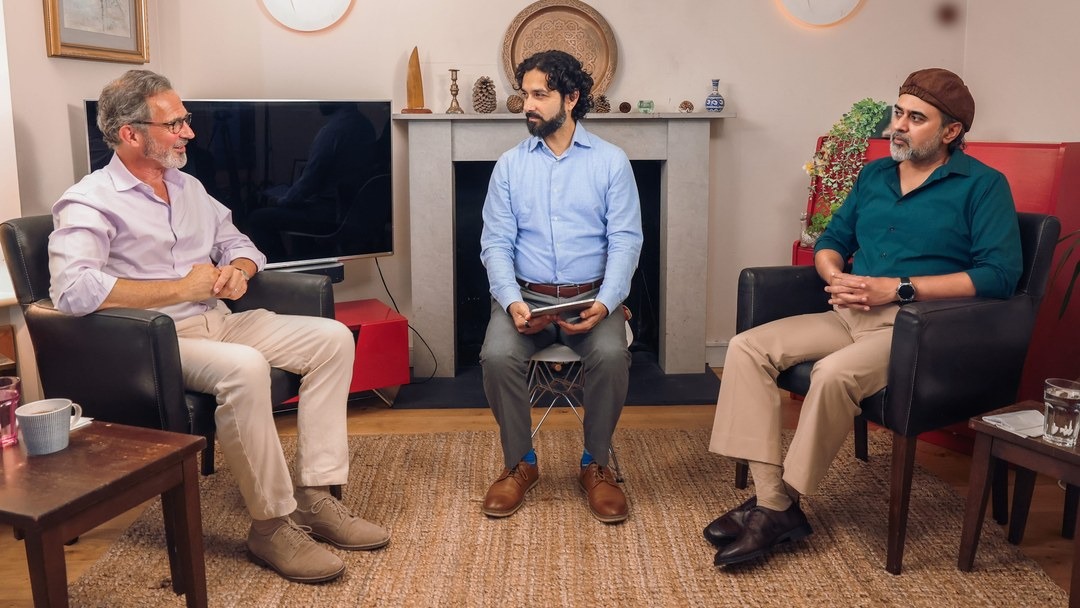
Most of us try to fix our suffering: a better job, a calmer mind, a new practice, a holier word to hide behind. But what if the trouble was never the pain itself? In this London dialogue with a teacher of non-duality, we look at who it is that says “I am”, why the sufferer hides in money and in holy concepts alike, and why non-duality is an intention, not a state. If the ego is a born lover, what does it truly want?

We have all felt it: a phone stolen, a job gone, someone who walked out, and suddenly it seems we were lost along with it. Things come, stay for a while and leave; that movement is not what hurts. It hurts when we were riding on what left. The same habit shows up when we try to learn: we want to be taught without our old walls being touched, and then we call the teaching confusing. So what are we really holding on to, the thing or ourselves in it?

We are gentle with the people who matter to us, and quite different with those who have nothing to offer. A friend can be generous, peaceful and tender, and still sit down to a meal that began in a factory farm. Is that a blind spot, or one restless wish to gain, showing kindness here and hardness there? Nobody is bad in their own eyes, and even our giving may come from the same place. Who is it in us that is being good?

Every year we burn Ravan, and every year he is back. We ask what the punishment for living wrongly will be, hoping it is small, or can be postponed, or paid off. But the battle never ends, and the punishment is not a sentence handed down later. It is the self we live with, so familiar that it feels normal. What we truly intend shows in what our actions keep leading to, not in what we declare. Can we look honestly at the outcomes of our own lives?

Are you looking for me? Look a little closely!
Am I in the Stupa, am I in the Shrine? You really want me, or just images of mine?
… a little closely!
The crowds in the Ashram are all misled, What you call as Yoga is such a dread,…

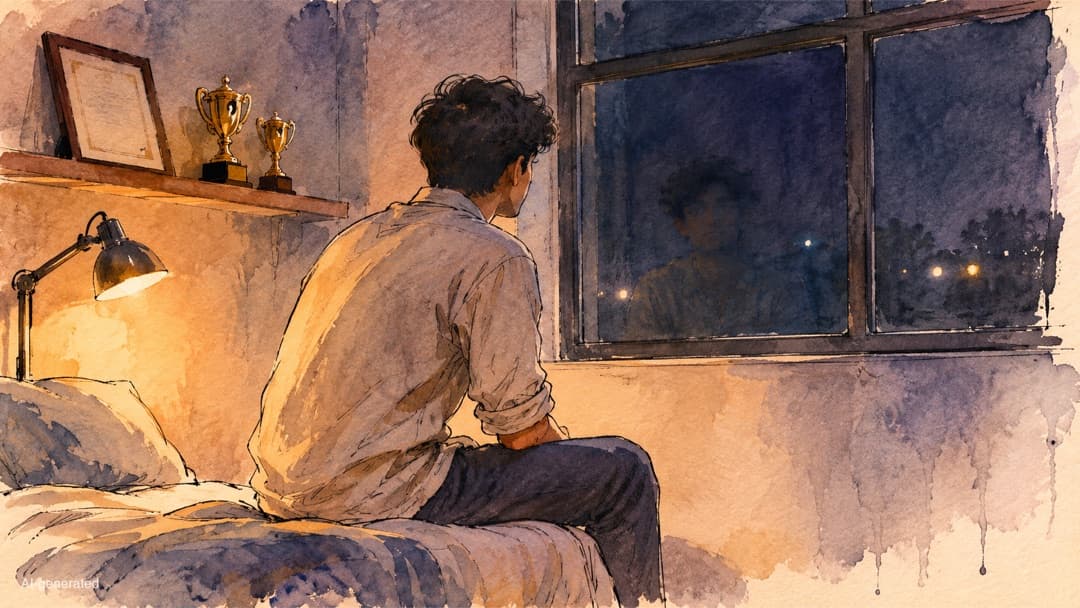
We sharpen the brain, collect the degrees, climb the ladder, and still feel strangled from within. The brain struggles with a hard maths problem, but who struggles with life? It is the one who uses the brain, the body and every opportunity, and calls all of it “mine”. We never examine that user, so its first claim, “I am important”, goes unchecked, and every value we build on it inherits the flaw. We chase prizes that give very little. Can we look at the one who is chasing?

We drop the distractions, return to the work we know is right, and before long the mind is cluttered again. So we start sorting the noise: what is it, where is it from, why now? But nobody studies a trash bin while walking past it, and nobody gets off a train because the coach stinks. The turbulence comes from the part of us that is always at war with the part that knows what is right, and no one should expect a smooth road. Are we stuck because of the noise, or because we stopped?

Someone asks how we are, and we say, “I am so good. I’m doing so well.” Then comes 3 a.m., and we know better. Nobody outside can check that claim, so the talk says an inner claim can be falsified only in the first person. Science runs on peer review; self-inquiry does not. A mirror can show where we stand, but whether we accept what it shows depends on honesty. Which of our own claims have we never allowed to be tested?

We believe we are born to be happy, and that happiness comes from more and more consumption. We keep consuming, and the lonely, anxious, restless feeling keeps returning. A sage, the talk says, has nothing to tell anyone who claims to be already fulfilled. The only question put to us is blunt: have all these objects and ideas worked on you? If not, why not be honest enough to discard them, instead of endlessly rolling on a flat plane? What could we learn by looking at the one who keeps trying?

Many of us feel a small chill when a machine explains, writes or solves faster than we can. If being clever was what made us feel worth something, what is left? Cleverness was never intelligence. It was a favourite toy, and we built our self-esteem around it. Intelligence is the moment we look at ourselves and say, “Enough, I want to thin down.” The toy is gone, and we are not going anywhere. What would we be if our worth did not rest on being clever?

First the board percentage, then the CGPA, the money, the house: we keep ticking things off and reaching for the next, as if we were items on a conveyor belt that started the day we were born. When we do not know what we want, we end up wanting everything. The same unexamined words, success, love, settling down, decide what we call a true calling. If the seeker is false, how can what we seek be true? What if we first looked honestly at our own ideas of life and success?

Research has shown that loneliness is found throughout the society, including among people in marriages along with other strong relationships, and those with successful careers. As a subjective emotion, people experience loneliness even when surrounded by other people.

Love is great. Love is necessary. Love is beautiful.
But what is love?
For most of us, love is the greatest excitement and comfort—and also the greatest suffering. Whether love has become a problem or something you cherish the most in your life, please go deeper into the matter. Know…

Spirituality is about belonging to existence. Not belonging to a narrow household, or caste or ideology. All these are boundaries. So, wherever there are boundaries, there is violence. Wherever there are boundaries, there is also the fear of being small, powerless, limited. The really non-violent one is at home, everywhere and in every situation. Non-violence is not about following duties. Non-violence is an action in clarity and love. That alone is non-violence.

Questioner: Would you please be able to explain to us the difference between the mind, the soul, the spirit, and consciousness?
Acharya Prashant: There is just consciousness; that consciousness requires physical support. That consciousness requires a physical support, right? That physical support is called: the man.
When we say consciousness,…

Questioner: Namskar Acharya ji. Pardon me for not remembering exactly but in one of the shivirs where we had read ‘Gospel of Sri Ramakrishna’ to come to terms with this expression called ‘Adhikar Bhed.’
So therein Ramakrishna was saying that, “now in modern times there cannot be any Adhikar Bhed,…

The building is raised on a weak foundation, and now you want to penalize everybody who comes and shakes it up even a little? You don't do this. Why did you allow this building to stand on such a weak foundation, and now you are trying to protect it through legislation? What kind of stupidity is this?

Acharya Prashant: Desire means that you are not alright with yourself and you want something else to happen, correct? So, we are anyway not living for ourselves. We are rather living to change ourselves. And are these not two very different things? If you are living for yourself as you…

Acharya Prashant: It has been told to us that there exist two centers. I suppose it has been very freshly told to you right? Very recently. He says, “How do I know that I am living out of the right center? How does a young man know whether he’s not…

Questioner: I have a question on an excerpt from you.
“Aloneness is not about being free of others and living without others. Aloneness is to live without oneself. Aloneness does not have much to do with the so-called others; aloneness has everything to do with the one called oneself.”
I’d…

Acharya Prashant: Everybody in his own personal way is seeking fulfillment and that is love. If you are young you may seek fulfillment in somebody's body, if you are middle-aged you may seek fulfillment in wealth and prestige, if you are old you may seek fulfillment in security and property…

Acharya Prashant (AP) All the diversities that you see are the world. And these diversities are what make the mind suffer and here the sages have picked up all the diversities and have said that all these diversities are actually one. The distinctions are merely apparent. Actually, there is an…

Acharya Prashant (AP): The mind has been continuously lying to you. What has it been telling? It's been telling you that there exists no reality outside of itself; that it's not possible to 'be' without being the mind. That's what the mind has been telling you in its own selfish…

Questioner (Q): I had been part of the last Delhi Camp, IIT Delhi Camp. During those three days, I have seen that you have spoken to the participants continuously for 6 hours, then later in the evenings, with hostel students, for another two, to three hours till 2 a.m. in…

Laugh with no care at all. Why take oneself so seriously? What hurt, what wound can be so big? When we fully well know that the only thing that really is the Truth. Can there be two truths? The truth and the wound. The wound has to be a lie. But it will continue to pretend to be the truth as long as you avoid looking at it. The more you look at it, the more you will see that the wound is just some kind of dressing up that has been needlessly done.

Questioner: Why think so much about decisions? Shouldn’t our decisions be spontaneous? I like to decide in a free flow.
Acharya Prashant: So the questioner is stressing on the spontaneity of decisions. He says that he likes to decide in a flow. It's a good thing, your intention is good.…

The word for a Guru does not really exist in the English language. So, they have borrowed Guru itself, Guru. But they have borrowed the word Guru and rather misunderstood it and misapplied it. So, anybody who seems to be an expert at anything, can be justifiably called a Guru in the English language. Now that's not the proper usage in spirituality or in Sanskrit.

Questioner (Q): Good afternoon, Sir. I have a doubt. In the market, there are a number of Bhagavad Gitas available. Somebody told me that there are eighty varieties of the Gita. Even though the slokas are the same, from what I have seen, the explanation was not making sense. In…

The hurt that you have received is a result of your own lack of understanding about the nature of life. This is an opportunity to understand life. It is an opportunity to not let the previous mistakes be repeated.

Questioner 1 (Q1): Acharya Ji, Pranam. There are certain and similar objects that occupy my mind every day. However much I try to get rid of them, they still linger. How should I get rid of them? Please help.
Acharya Prashant (AP): They are just occupying a void. That void…

Questioner (Q): Good evening, sir. Sir, because this conference is on Psychology and Technology, I would like to talk about something that’s very, very close to this. So, there’s a very famous quote by Carl Young, and I’ll use my phone so that I don’t get it wrong. It says,…

Acharya Prashant: If you look at knowledge that man has gathered in various fields, you will easily see that all of man’s knowledge is related to man’s desire. Man does not try to gain knowledge in fields that have absolutely no connection with man’s fundamental desires.
Man desires, man gets…

Acharya Prashant: Observing the daily ordinary actions of the mind, that is the only way. Observing it as an impartial observer. There is no other method that is going to work because all other methods are ‘isolations.’ The method does something to life. The method excludes life; the method…

Acharya Prashant: You have to ask yourself what your primary identity is. If your primary identity is that of the body, then do what the body commands you to do. Good. The body has an inbuilt software of its own, and it’s a self-improving software. Its capacity to keep improving…

Acharya Prashant (AP): What’s happening here, firstly I will read it out to you and then explain.Once, the five senses disputed among themselves about their personal superiority. The five senses quarreled as to who is superior among them. So, once the five senses disputed and each of them was…

Questioner (Q): I have been suffering from a type of OCD (Obsessive Compulsive Disorder) called somatic OCD for the last two years. I was in constant fear, every single moment, for around two years. I was on sleeping pills and anti-anxiety pills, but I think what helped me a lot…

Maturity is when you can transcend your body, and by the body, I mean the bodily compulsions. That includes your thoughts, your feelings, and everything because they are all bodily. You very well know how chemicals in the body translate into thoughts and feelings. Read more...

Questioner: Acharya Ji, a good discussion happened yesterday in which many seekers participated and shared their understanding of Prakṛiti, Puruṣha and other things.
During the discussion, it was put that Prakṛiti, Puruṣha, Māyā, are mere concepts and that one is pure Ātman, never threatened and…

Questioner(Q): Hello Sir, I am Saurav, PhD student at IIT-Patna. Sir, a couple of years ago I met with a bike accident. At that moment, I felt like time was moving very slowly. I don’t know if it was just my feelings, but I searched on the internet and I…

We have to realize that the root of all these external problems is man's mind. So, first of all, we have to get rid of the notion that by having the right kind of legislation, or structures, or systems, or international treaties or agreements, or social processes, we can just sail out of these troubled waters. Read more....

Acharya Prashant (AP): When you come upon something beautiful, try to understand it. That’s what is meant by watching. The worldly bird, the engaged bird would have surely glanced at her neighbour many times, that’s not really called looking. To look is to understand; do you really understand, or do…

Questioner: Namaste Acharya ji. My question is that I see many institutions are fueling the concept of Maya. Because I have seen on many premier institutions having Upanishadic phrases as their mottos—Na hi jnyānen sadṛushan pavitramih vidyate, Téjasvi nāvadheetamastu, sā vidyā yā vimuktaye. But at its…

The word for that is ‘Nirmam’ — you are not mine. It is instructive that the word ‘Nirmam’ has a pejorative meaning in layman language. There it means cruel, but Nirmam actually is a beautiful word. Nirmam means not mine. You’re not mine, why must I shelter you? You’re not mine—no. You are no well wisher. You are no lover. I will be nirmam. If this is cruelty, you need this kind of cruelty. It is a very life-affirmative cruelty. Read more....

Acharya Prashant: Before we say love for the country, we should know what is this thing called country. If we don’t know what is country then whom do we love? If we don’t know what country is then what do we call love as?
This is just a machine (pointing…

Questioner (Q): Put in some difficult situations and old locations, I am surprised to see my old tendencies of hurt and dependence are back; they never did leave. I am selfish, difficult and stubborn. Help me Acharya Ji. Help me move ahead of this pettiness. Please!
Acharya Prashant (AP): You…

The mind is the entire set, the whole universe of objects that the ‘I’ has a relationship with. Not the entire set of everything that is there in the universe. One does not have a relationship with everything. But whatsoever one develops a relationship with becomes mind. An object untouched by the self, the ego is just an object. But the moment the object is touched by ‘I’, it becomes vishay or mind. And, mind is an accumulation, a congregation of objects that it is in relationship with.

You didn't have anything special in the past. Had we had anything special in the past, then we wouldn't have come to the state of suffering we find ourselves in today. So, the past is not the solution. You have to realize how things are with you today. You have to look at your interactions with human beings today. You have to see how you relate to your body, to your friends, to your workplace—all these things. And from there, you—you develop an insight, and that insight offers, some freedom.

Questioner (Q): I think this is a follow up question of one of your videos, in which you described physical love, and you concluded with a statement that, “Love has to be learnt”. I wanted to learn more about this and how I can cultivate this kind of love in…

I'm not asking you to be a loner or an avoider of human company. It's just that things must be given their due place — and their due place depends on their quality. If you do not have good quality people around you, there are many other better options. Why not spend your evenings learning to swim or sing? And there could be so many other things. I mean, you would know better.

It’s not going to be right when the patient starts playing the doctor. We need to grow up; and having a kid, in that sense, is an opportunity. You want to be of some use to the kid, then grow up with the kid.