Most of us try to fix our suffering: a better job, a calmer mind, a new practice, a holier word to hide behind. But what if the trouble was never the pain itself? In this London dialogue with a teacher of non-duality, we look at who it is that says “I am”, why the sufferer hides in money and in holy concepts alike, and why non-duality is an intention, not a state. If the ego is a born lover, what does it truly want?
This summary is AI-generated. Please read the full article for complete understanding.
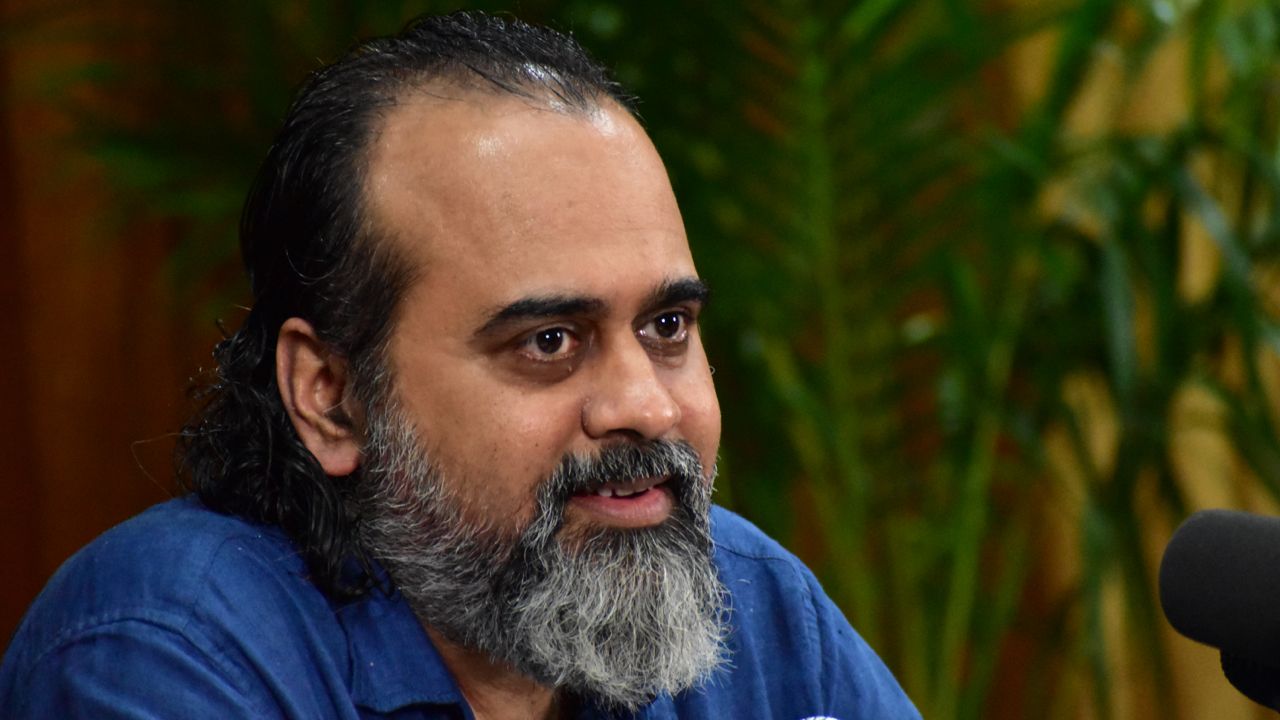
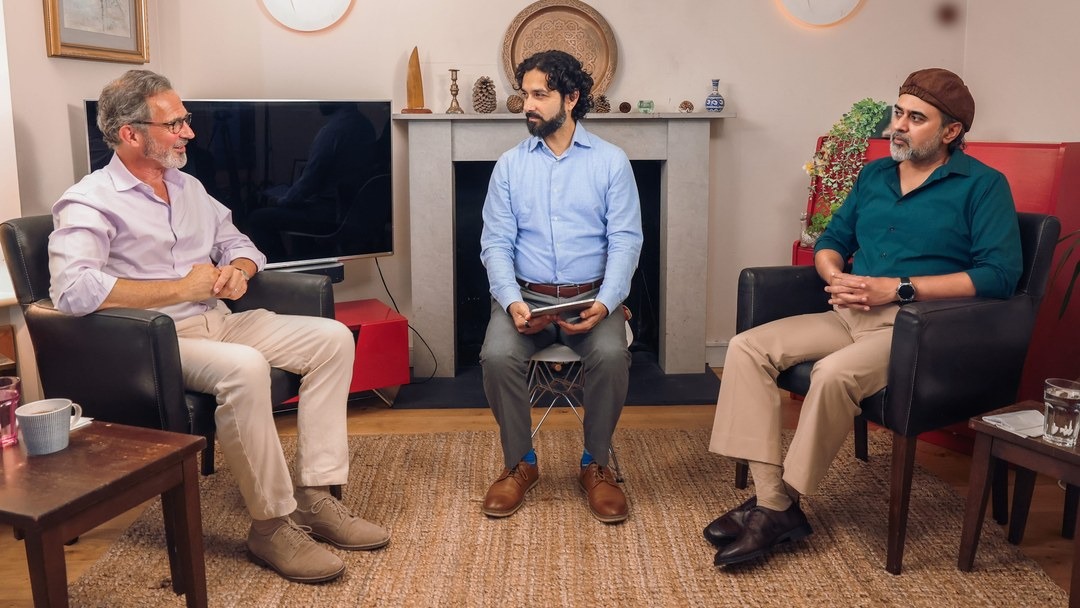
[From a conversation in London in 2026 between Acharya Prashant and Rupert Spira, a teacher of non-duality, where the host began by asking each of them what human problem their work is trying to address.]
Questioner: So let’s get started right away. I guess something that seems to come right on top is... And for each of you, we’ll start with you, Rupert. What is the human problem you’re actually trying to address in your work?
Rupert Spira: Suffering and conflict.
Questioner: Can you go a little... Tell us a little more, suffering and...
Rupert Spira: Okay. Yes. Okay. So we experience suffering on the inside, and we experience conflict on the outside conflict between individuals, between communities, between nations. And both these, suffering and conflict, are the inevitable consequence of the assumption of separation on which our world culture is founded. And indeed, any, any solutions to our current world predicament that is founded on the assumption of separation, however well-meaning it is and however effective it may be in the short term, will bring that assumption of separation into the solution and ultimately perpetuate it. The paradigm of separation on which our world culture is built, namely the belief that we are all separate individuals, separate from one another, separate from animals, separate from the world, separate from the Earth, and separate from God or the ultimate reality.
This is the founding idea on which our world culture is based, and suffering on the inside, conflict on the outside are the inevitable consequences of this paradigm the non-dual understanding, which is the understanding that underlies all the great religious and spiritual traditions says that this paradigm of separation is just an appearance. It’s an illusion. It’s not how things really are. Reality is really, is one. It’s not many. And really, the entire non-dual understanding could be summed up by saying simply, peace and happiness are the nature of our being, and we share our being with everyone and everything. In other words, just as sorrow and conflict are the inevitable consequence of the assumption of separation on which our world culture is founded, so peace on the inside, fulfillment and harmony, love on the outside are the inevitable consequence of the non-dual understanding.
So I feel that the non-dual understanding is really ... It’s humanity’s best hope. In fact, I think it’s humanity’s only hope. Because as I, as I said earlier, any solution to the problem of suffering and conflict that is founded on the assumption of separation brings that paradigm into the solution, and this idea of separation on which it is based will sooner or later resurface. That’s why we only see temporary ceasefires. Temporary. So we don’t, we don’t see lasting ceasefires, lasting ends to conflict. We see a temporary end for our desire for happiness, but we don’t find lasting happiness. So the non-dual understanding, I would suggest that this recognition of the unity of being is the, really the only understanding.
And it’s the understanding that underlies all the great religious and spiritual traditions. This is, I think, humanity’s ... I think it’s the next evolutionary step for humanity to resolve the epidemic of conflict, the sorrow that people feel inside themselves and the conflict that we experience between individuals, between communities, and between nations.
Questioner: Thank you. Acharya Ji, what is the human problem?
Acharya Prashant: First of all, it’s very nicely articulated to begin with. The problem ... Well, there are just so many problems, right? And all these problems are to somebody, that somebody experiences suffering, as was said. So suffering is the inner experience.
But the problem is not suffering. The problem is the sufferer.
The sufferer is the problem. The sufferer takes its condition as something separate from itself. The sufferer thinks that it can remain, and suffering can be taken care of through clever means. So nobody likes suffering. Suffering by definition is something that the sufferer doesn’t enjoy. So we know that, right? Nobody is going to willfully espouse suffering or conflict or the problem by any other name.
But the sufferer hides behind two very, very hospitable and very friendly universes. And because it’s a universe, so there is ample space to hide. It’s a large space. One is the external space, so you can get busy with one object after the other, and console yourself and hold hopes even after lots of episodes of believing that a particular object is going to deliver fulfillment to you. You can still rush to the next object because the external universe is infinite as we perceive it through the physical senses. The other place where the sufferer hides is the mental world of spirituality. So there are big words: truth, love, liberation, enlightenment, emancipation, Samadhi, Nirvana, Moksha.
And the sufferer can hide behind those words, right? And the sufferer is very good at self-deception. It camouflages. And therefore, the sufferer remains with so much place to hide.
You run outwards, you are called a materialist. You run into the mental world of holy concepts, and you are called a spiritualist.
And in either case, the sufferer remains to run. There is ample and infinite ground for the sufferer to continue running. The sufferer is the problem. And to think of addressing the suffering Without looking at the sufferer, without mentioning the sufferer is going to, going to turn suffering into an eternity. The sufferer is the ego. It is the sufferer, the ego, for whom everything exists.
So the sufferer could say, “Inside me is a place of great great truth, the ultimate reality,” or whatever. But then for whom? For you. And whatever is for you, whatever is to you, mm becomes, becomes food becomes another one of your objects. And the moment that happens you remain not just as you are, but actually fattened. So the sufferer I see as the central problem, the sufferer who has the capacity to colonize everything, to co-opt everything, to turn everything into one of its objects. And yes, very nicely, the field of non-duality that you mentioned, what is non-duality? To the ego, which is the suffering ego, the sufferer, to the ego, everything is an object. Which means whatsoever is mentioned by this organism is always a dualistic concept, a dualistic concept at one end of which the ego inevitably sits. That is, that is duality. That is duality.
So everything is to someone. All reality is to somebody. That is duality. Whatsoever you say, it is to you because you mentioned it. It is a concept to you. It is an experience to you. It is something to you. So the ... So reality whatever you call as real or imaginary or whatever, whatsoever you think of, imagine, or utter is always to you. So duality remains. Duality remains as long as the ego remains, as long as that one end of the, of the duality axis remains. The other axis will, the other end will find a suitable object. Therefore, non-duality is the disappearance, if not complete disappearance, the intention towards disappearance, which I call as love, is the progressive dissolution of one end of this bipolar duality. There are two ends of duality.
So non-duality is nothing but the progressive dissolution of the ego. The ego makes a decision. The ego chooses. It’s a sovereign choice. The ego chooses to thin out. And that movement is non-duality.
Non-duality is not a state. Non-duality is an intention.
Non-duality is an intention, and to appreciate that intention, we’ll have to first see what duality is. Everything is dualistic. Everything is dualistic. If the moment you mention mention, mention a carpet, it is to you. Or you could mention God, it is your God. You could say truth, it is your truth. You could say love, you know, it is, it is your concept of love. So everything is to somebody. Everything is dualistic. When this somebody who holds all things, huh, makes a choice towards its own welfare and decides to step away or step back a little, you know that is the movement towards non-duality, and non-duality is going to be an infinite movement. The journey would be continuous, but a journey with no destination at all.
That’s how I see. The ego is the sufferer, and the ego is at the center of all problems of the world and the individual, and therefore, all spirituality has to have the ego at its center.
If you’re talking of spirituality sans the ego, then we are talking of medical practice sans the patient.
Questioner: Perfect. So just building on this, so I’ve heard these terms again and again in the non-dual circles, awareness, the nature of awareness. So my question first to you, Rupert, is awareness a standing ground that is already the case, or is it an occurrence that arises and passes with no ground underneath it?
Rupert Spira: I want to try to connect your question to what Acharya ji has just said so that our conversation, we’re responding to each other. And and I would agree with everything that you said, that all experience takes place in subject-object relationship in relation to the subject. So the fundamental question underlying suffering and conflict is who is the self around whom the suffering revolves on the inside and the conflict arises on the outside. So the, this question into the nature of the self is the, is the solution to the problem of sorrow and conflict. I totally agree with you about that. And your introduction actually touched on it. At some stage in your introduction to this conversation, you said, I’m paraphrasing you said, “What is the nature of the self?” Right? To all your beliefs about it. Well, I’d like to extend that question. It’s not just what is the nature of the self prior to your beliefs, ‘cause your beliefs are just one aspect of your experience.
You don’t just think, but you feel, you relate, you act, you perce- and so on. We could, we could rephrase your question. What is the nature of the self prior to experience? Not just prior to beliefs and thoughts, but prior to feelings, prior to perceptions, prior to actions, prior to relationships. Because thoughts, feelings, sensations, perceptions, these are not always with us. Your thoughts are always coming and going. Perceptions are always starting and s- and stopping. Sensations are always appearing and disappearing. So none of these elements of experience, thoughts, feelings, sensations, and perceptions can be ourself. So the question is the fundamental question. What is the nature of ourself before it is qualified by experience, independent of thoughts, feelings, sensations, and perceptions?
So that’s why the, really the h- the hallmark of the ... Not really just the Vedantic teaching, but in fact, all teachings in one form or another, more or less directly, they suggest, at least initially, this turning away from the content of experience. Not just from the world, but from your thoughts, from your feelings. I’m obviously not the world because the world is what I perceive. I’m obviously not my feelings because the feelings are something that I feel. I’m obviously not my thoughts because I know my thoughts. This tracing back of your experience. Not rejecting, but discarding everything that is not essential to you. And if you do that well, you discard your perceptions, your thoughts, your feel- and so on. You arrive at your, at just the fact of being or being aware. You arrive at pure awareness.
So that, I’m coming to your, to your question now. What is the nature of awareness? But I want to make sure we’re not just talking philosophy, but experience. So having traced your way back through the layers of your experience, discarding everything that is not essential to you come to the fact of simply being aware or awareness itself. And if you make that journey, you can discover for yourself that awareness is unconditioned. It it’s not something that arises. No one has ever experienced, nor indeed could anyone ever experience the arising of awareness or indeed the disappearance of awareness. So if we stay very close to our experience awareness is unconditioned. It shares none of the limitations of the content of our experience. It doesn’t arise. No one has ever experienced the birth of awareness. It doesn’t disappear. No one has ever experienced the disappearance of awareness, and it doesn’t evolve.
The awareness with which you are aware of your experiences as a newborn baby is in exactly the same condition as the awareness that experiences your last experience on your deathbed. The experiences change and evolve, but awareness is changeless. It’s ever present, unlimited, and changeless. Another way of saying that is, it’s eternal, infinite, and without change. And it is that recognition that puts an end to the, as you say, not just the suffering, but the one on whom be- on whose behalf your suffering arises. It puts an end to the, to the sufferer. It doesn’t put an end to yourself. Yourself remains as it is, but yourself is liberated from all the, all the limitations that it borrowed from the content of experience, and it stands revealed as unlimited, infinite. In other words, the self, the self that we all share. We’re not individual selves. We’re one self. The space in every room on Earth is the same vast space of the uni- There are no individual spaces.
The space in this room is not really limited by the four walls of this room. Well, the self in each of us is not really limited by our thoughts, feelings, and ... So that, it is that recognition that brings the sufferer and its suffering, and the one who is in conflict and its conflict to an end.
Acharya Prashant: Awareness. Awareness. See, I have to start, if I am to be honest, hmm, from where I stand. All else is just speculation. So I must start from the first principles. And the first principles say that I feel that I am, right? I feel that I am. And all the other things that I talk of are to me. I am the ego, and I can talk of a lot of things, but all those things will be my objects, whether material objects or mental objects. All those things will be to me. Even if I says there is something prior to me, I’m the one saying that, right? So these are all my claims. These are all my claims. I could say I am gone, I am finished, I am liberated, but even that is a claim I make.
So I’m at the center of all my experiences, all my knowledge, all my claims, all my practice, and I’m the ego. I’m the ego. So- What do I do with myself? Because I’m not fine. I’m restless, I’m lonely, I’m anxious, I’m desperate. I crave, I dread. I’m jealous. I’m insecure. I have hope, I have memories, I have ambition. I suffer. I am the ego. I suffer. So what do I do now from here? Okay, let me look at myself. Why do I suffer? Oh, I experience my suffering, but I don’t understand it. Let me look at myself. What is this suffering business all about? But how do I look at myself? No X-ray, no CT scan, no MRI ever ever produces anything called the ego in the body.
But then there is something in the body that is continuously shouting, “I am, I am, I am, I am.” Okay, okay, fine, fine, fine. Let’s get into the brain with all the modern scientific techniques available. Maybe the I am-ness would be found here. No we see that when there is identification, then there is one kind of circuitry. We see that there are neuronic circuits that operate in one way and specific neurons and tissues that fire in some other way. But all those are markers, and they’re not causal. They are symptoms. They don’t, they don’t produce the I am-ness, right? They indicate when something related to identification is happening, they indicate the happening. They’re not causing it.
So what is this I am? How do we figure it out? Because this is the one suffering. I want to be logical. Hmm? I don’t want to proceed on assumption or speculation. The one suffering is the ego. I am suffering. Don’t we all say that? I am suffering. I am suffering. I am suffering, and how do I, how do I heal myself if I do not know myself? Know myself. How do I know myself? I cannot look directly at myself, so I’ll have to look at myself through my objects because my objects are my choices. It’s an infinite universe, and I chose certain objects for myself. It is only through them that I can get to know who I am, therefore, I’m not going to discard the objects. I’m not going to discard them. I’m not going to say, “Once I have discarded all the objects, what remains is the purity of my being.” How do I know whether my being has any purity at all, right?
I need to maintain a certain epistemic rigor. How do I know? How do I know? How do I say that if I remove all this, what remains is the purity of my being? I don’t know. What I know is that I’m very attached to this shirt. What I know is that I’m very afraid of the neighbor. Hmm. Those are my experiences. What I know is that I that I covet that car parked over there. Hmm. What I know is that certain memories from the past keep haunting me, and those memories then probably change their clothes and become hopes for the future. So that’s how I get to know myself. What draws me to that one? Why do I keep flipping objects?
So I’m not going to discard them because I cannot discard them as long as I remain who I am. Hmm. The presence of those objects in my life is an inevitable consequence of the fact of my being. I do not know the truth of this being. But the fact of this being is that remaining who I am inwardly, I will have to drink. Hmm. I’ll have to smoke. I’ll have to run after money. I’ll, I’ll have to have a political ideology because, because that’s who I have become on the inside, right? Now, now being a covetous person, I cannot be not afraid of the law or the police or the consequences, right?
So I’ll have to look at the entire spectrum of my relationships with the objects present in my life. And it is through them that I get to know who I am, and I get to investigate my claims about myself. For example, I’m wise. I’m wise. I investigate the objects, and then that claim is truly tested. Am I really wise? I say, “You know, without me, this organism, this physical system cannot operate.” Ah, come on, come on, come on. Let’s see. Let’s see. What happens when the I am-ness is really on the rise and very forceful? Does the brain operate properly? Does even the digestion operate properly? Hmm? What happens to my relationships when this I am-ness is surging? Huh?
But the, but the I am-ness makes a very, very powerful claim. It says, “Without me, nothing can move because I am the actor, I am the doer. I am the owner and the lord of this body. This is my body. This is my body.” But then I investigate the relationship of the ego with the body. The body too is an object. The body too is an object. The ego is the subject, the body is the object. When I investigate really the relationship of the ego with this body, I find that the body does very well even without the ego. The body can think. Feelings come. The body, body does what it has to. There are the intellectual machinery, the brain Does not need the ego to operate, and no, and neither do any other parts of the body.
So this is how I come to the fact of of my being, and the more I investigate it, the more its claims fall, which means I am-ness reduces.
I love to say the seer does not survive the seeing.
Only the ego can observe itself, and observing itself, it cannot remain what it is, right? And the ego and there is a progressive thinning, and it’s a continuous process because the ego is a physiological product, right? It is... It cannot be located anywhere in the body. But the thing is that when the, when the, when the body takes birth it’s then that the mouth says, “I am, I am, I am,” all those things.
So awareness, simply the relationship that the ego holds with a lot of, lot of objects, I would I would have to ask, who is the one aware? Who is the one aware? And and whenever you are aware, there is an object you are aware of or conscious of. We can flip words. We could say awareness is different from consciousness, but the fact remains that in your daily experience, awareness or consciousness always carry an object, and there is always somebody who is aware or conscious, and this somebody is the sufferer. Therefore, I will not allow this somebody to hide behind the concept of awareness. Thinning down the ego is the end goal of all wisdom literature, of all spirituality. That’s why, that’s why m- in India, you won’t even call it spirituality. You would call it self-knowledge. Adhyatma or Aatmagyan. It’s about knowing the self, and it’s about knowing the ego self. Knowing the ego self.
The pure self, well, when the ego thinks of the pure self, the pure self is just an idea, just a concept. That’s all. But the more practical question is, can the ego thin down? Can the ego thin down? And m- I would rather concern with myself with that question. And awareness is very, very helpful as a tool in thinning down of the ego because when I observe what I am aware of, that tells me of who I am. And who I am, I’m not talking of Atma or Brahman or Satya. I’m talking of Ahankar. That’s who I am, I must humbly admit. Hmm? Maybe in this humble and honest admission, there is a progressive reduction of the same ego, the same Ahankar, and that honest reduction is what we can truly call as Brahman, as Atman, as truth, even as freedom or liberation, even as enlightenment. Enlightenment as a journey, not a destination.
So that’s my take on this.
Questioner: I’m going to back up to what I think I heard you say, Rupert, which is that philosophy is different from experience. Jovan, if I got that correct. And my question is, my understanding of philosophy is that it’s the love for truth, so wouldn’t philosophy and experience go together?
Rupert Spira: Yes. Hopefully philosophy leads to experience. By experience I mean experience of who one truly is or experience of the nature of reality. So yes, the purpose of, or the ultimate purpose of philosophy is the recognition, the direct experience or recognition of the nature of yourself or the nature of reality. When I made a distinction between philosophy and experience, what I meant by philosophy in that sense was talking theoretically about oneself or the nature of reality, and having the direct taste or recognition of oneself. That’s why I made a distinction. But yes, they go together ideally. Not always. Not all philosophy leads to a recognition of the nature of reality.
But the ultimate philosophy, I would suggest, the highest philosophy, leads directly to experience. The experience of the self as it essentially is before it is qualified by experience.
Acharya Prashant: But, see, the self cannot be an object. If we are talking of the self as the one with the capital S Atma, Atman. The self cannot be an object. Only objects can be experienced. My my fear is that in talking of the self, the ego very clearly paints itself out of the picture. So I can, I can talk of the self, and the Upanishads talk of the self so much. I can talk so much of the self but where am I in all that? Who is the talker? Who is the one making the claims? Who is the one saying that I am tasting reality, I am now in touch with the nature of my being? If this claim is being made by the ego, if the claimant is the ego, then the ego is not just alive but throbbing.
And fattening itself. Fattening itself behind the claim that now I am in touch with that, with that great reality. And also we must see that all experience is dualistic. How can the ego survive to taste the truth? How can the small self survive to say anything about the great self?
Rupert Spira: Okay. I would suggest that as you say, all experience takes place in subject-object relationship. I know my thoughts. I hear the conversation. I see the world. W- w- the subject-object mechanism... The subject-object relationship is really the mechanism through which all experience takes place, with one exception, the awareness of being. Now, although the awareness of being is formulated in dualistic language, awareness of being, that’s just a limitation of language. The awareness ... In all other experience, the awareness that knows and the object that is known are different. I know my thoughts, as you explained. But there’s one experience in which the subject that knows and the object that is known are the same. It’s like the sun illuminates the Earth, the moon, and all the planets, so you could say that the sun is the subject of the illumination, the illuminator, and the Earth, and the moon, and the planets are the objects that are illuminated.
But there’s one e- there’s one experience that the sun has which doesn’t take place in subject-object relationship. That is its illumination of itself. The sun illuminates itself. And when the sun illuminates itself, the sun that illuminates and the sun that is illuminated are the same. So it’s the same. The awareness of being is the only experience there is that does not take place in subject-object relationship. Although when it is formulated, it ... The formulation, due to the limitations of language, takes place in subject-object, which is why a lot of the world’s great spiritual literature is formulated in poetry because of this recognition that rational conceptual language cannot formulate the awareness of being.
So I completely agree with you that the true self, if we can call it a true self, the true self that is spoken of in the Vedas is the true Self with a capital S cannot be known. Certainly cannot be known by the ... It can only be known by itself. And the experience of the true Self knowing itself is not an exotic, marvelous, enlightened experience. It’s just the ordinary, intimate, familiar experience that everybody is having all the time, the simple awareness of being. And the awareness of being is what we refer to when we say, “I am.” So you and I use the phrase, I am, in very different ways.
And I think this is important to point this out at this stage of the conversation because ... And I don’t think any way is right or wrong. It’s just two different ways of using language. But it’s important for your, for your listeners to understand the way we’re using the same concept to mean two different things. When you use the word I am, you refer to the ego. When I use the word I am, I refer to the infinite being, the self that we truly are. And, a- a- that that can be experienced ... It’s not that it can be experienced. It is experienced directly all the time by everybody. Everybody is always experiencing their own being.
But their own being, most people’s being, for most of us, our being is mixed with the content of experience most of the time. So instead of saying, “I am,” or instead of feeling, I am, we feel, I am sitting on a chair. I am having a conversation. I am a man. I am a woman. I am lonely. I am tired. I am excited. I am in love. I am married. I’m 22. I’m 40. And so on. We add the content of experience to the I am, and that’s, that’s what we call the ego or the separate self. The I am, infinite being, mixed with the content of experience and seeming to become a separate being, or an ego, or a separate self, in just the same way that the vast space of the universe, when mixed with the four walls of this room, seems to become a temporary finite space. It’s not.
If you took a sample of the space in this room and a sample of the space outside this room, the space in this room is not a temporary finite space. It’s the vast space of the universe. And it’s the same thing. If you take a sample of your, of yourself, the experience of being, you find no limits there. Now, as you rightly ask, who is it that has that experience? Can the true self be experienced by the ego? Of course not. The true self can only be known by itself, and the phrase I am refers to awareness’ experience of itself. It’s formulated by the mind. The mind says, “I am.” That’s a formulation in mind, but it refers to an experience that doesn’t take place in the mind. It’s prior to the mind.
Acharya Prashant: The only entity that says, I am, is the ego. When I say, I am, I have no reason at all to say it’s the infinite being claiming I am-ness, right? When I say, I am, it is simply the incomplete ego hankering for an object. Therefore, I’m unlikely to say, I am. I’m likely, more likely to say, I am X, I am Y, I am something, because I am the incomplete subject looking for an object to get some kind of imagined fulfillment. And that imagined fulfillment can also come from saying, I am the complete one. I am the infinite one. But it’s still the ego talking. It’s still the ego talking. You referred to the concept of Svayam Prakash, self-luminosity. Self-luminosity simply refers to the, to the honest choice ego makes in looking directly at your- itself, because the only the ego can be its own observer. Most of the times, the ego looks at itself through the eyes of others.
It looks at itself in a very borrowed way, in a reflected way. When the ego chooses to be its own honest observer, that is when it begins to reduce and thin down. And that’s the reason why this self-luminosity, of which you gave the example in form of the sun, and that is the reason why those examples are held in high esteem. Not in the sense that there is a great self and the self knows itself, but in the sense that only the ego is self-referential and the ego is self-certifying, and the ego says, “I am,” and without any need for reference check or validity check, you see?
And the ego illuminates everything outside of itself. The ego will say, for example, “I want to shed some light on Darius to know who Darius is.” Right? And if I get close to Darius, as the ego, if I start trusting Darius, what Darius tells me about me becomes part of my identity statement. Right? And that’s the way the ego operates. The ego is never Svayam Prakash, but it has the potential to be. And therefore self-luminosity refers to the choice of holding the mirror to oneself. Mm-hmm. Shedding light on oneself. That does not mean that there is some, some great self which can be likened to space. Even if I’m likening truth to space, who is making this comparison?
And though language is limited, yes, but language offers great possibilities also. One of those possibilities is that the holder of the opinion, that the one making the judgment or the claim, must always be mentioned in the sentence, and language does give that allowance. So who is saying, for example, that the self, the truth, is self-luminous? It is the ego saying that. Who else is saying that? Who else is saying that? Yes, you are very right that we all do feel that I am and I am aware, but that’s the signature of the ego. There is no, no, no great self in that. Would you say the same thing about a dead person who’s gone? Would you make the claim that he is still saying, “I am,” or feeling I am or is aware? We usually won’t make that claim for the simple reason that the ego- Mm-hmm ... Though it is just an error, it is a suffering error. Mm-hmm.
Though the ego is just an error, it is physiological in origin. You cannot have an ego floating outside of the body, so the ego depends on a particular configuration of the body. As long as that configuration holds, the ego is there. Therefore, as long as the body is there, the ego is there and the ego will say, “I am.” Right. The body falls dead. The configuration is gone. The material is still there, just the configuration is gone. Maybe somebody broke open your skull, right? The configuration is gone, and the awareness or the I am-ness would be no more there. That simply points to the fact that the one making the I am claim is the, is the, is the ego.
And that is good news actually, because as you very greatly opened the discussion with, all of this spiritual pursuit is for the sake of the ego. Nobody else. Mm-hmm. Right? I talk of all these things, I go into all the great works of philosophy because I’m suffering. Had I been truly all right, I wouldn’t have bothered to go to a teacher or a scripture, right? Therefore, my own suffering has to be the honest object of all my pursuit. Why must I talk about the great self when the little self is suffering? Mm-hmm. Or maybe the little self gains identity and self-preservation in its suffering, therefore it doesn’t want to look at yourself itself, because looking at itself would thin it down, so it rather chooses to talk of things outside of itself. Hmm? Including the great self.
Now, now, yes, the great self, yes, we can, we can talk of that, but I’m more interested in thinning down of the false self. Mm-hmm. And first of all, knowing for sure whether the false self is false at all. That too is a hypothesis I cannot honestly hold. I must check that. I must validate that, inquire, investigate, test. Only then I see whether this I am-ness is real at all. Now, now remaining the deluded ego, remaining the self-preserving ego, remaining the self-referential and self-certifying ego, if I make all claims about a lot of other things, that is just superstition. That is not something that’s going to help me either, because I’ll continue to suffer.
And the very first move in the discussion was why do we suffer? Because that’s the central problem of all pursuit. Right. The Buddha looked at the suffering man, the diseased one, the old one, the dead one, and from there he started asking questions Suffering is at the center of it, and the ego is the sufferer. So the ego has to look at itself and not talk of things, things beyond itself because in its own suffering universe, nothing is beyond itself. So yes, like there are these beautiful examples, and we often mention them, but I’m afraid that those examples if may, may serve the function of obfuscating the real deal. For example, the snake and the rope. You know? Last 15 years of my duration as a teacher of Vedanta these things, these just keep coming. The moon and its reflection on the surface of moving water, the ocean and the waves and the bubbles. Ashtavakra Gita, staple light.
So these things are there, yes. The sun, the self-luminosity, the Svayam Prakash concept they all are there. But but why, why do I quote all that instead of just looking at myself? The mirror is the best judge. Even as I talk of those things, do I see that I want to remain, that there is a deep urge to self-preserve? And equally, equally, there is the hidden urge to self-dissolve, the hidden urge to not remain. The reason why Sushupti in the, in the Vedantic parlance is so appealing, and the reason why if you can’t sleep deeply, the next day you’re all hoary and troubled. Because we want to be no more. We want to be no more. The ego suffers. On one hand, it wants to remain, and you talked of conflict. The first conflict is within. Do I move towards preservation or dissolution? Do I want to remain and talk of so many things, or do I simply move in the loving direction?
The ego is a born lover.
It loves the truth, and by truth I mean its own dissolution. Or do I simply give up and say, “Oh, I am false. I was making all bogus claims. Time to go. Time to sleep.”