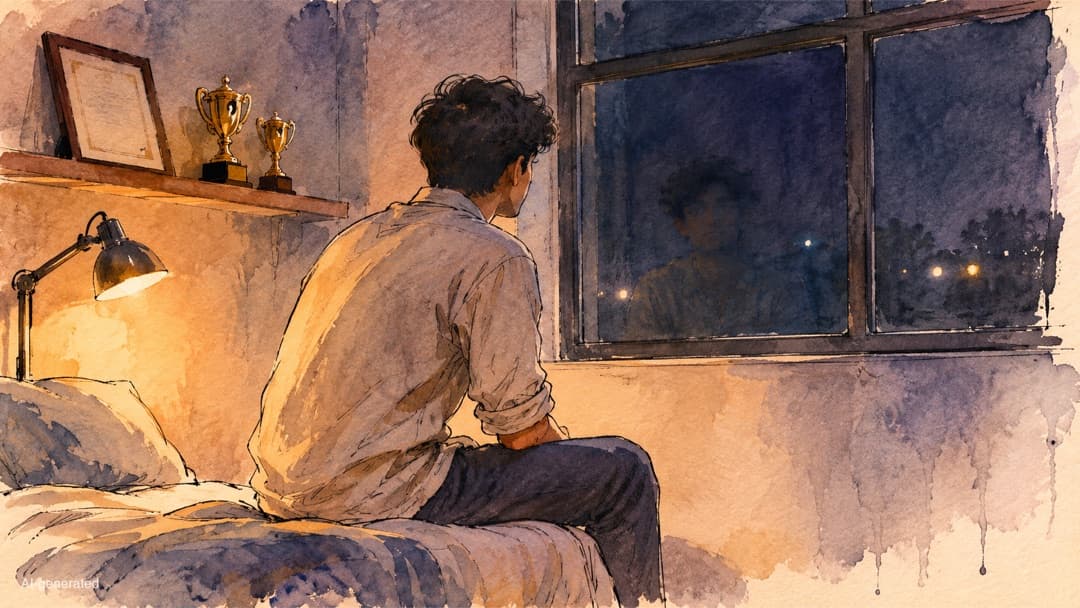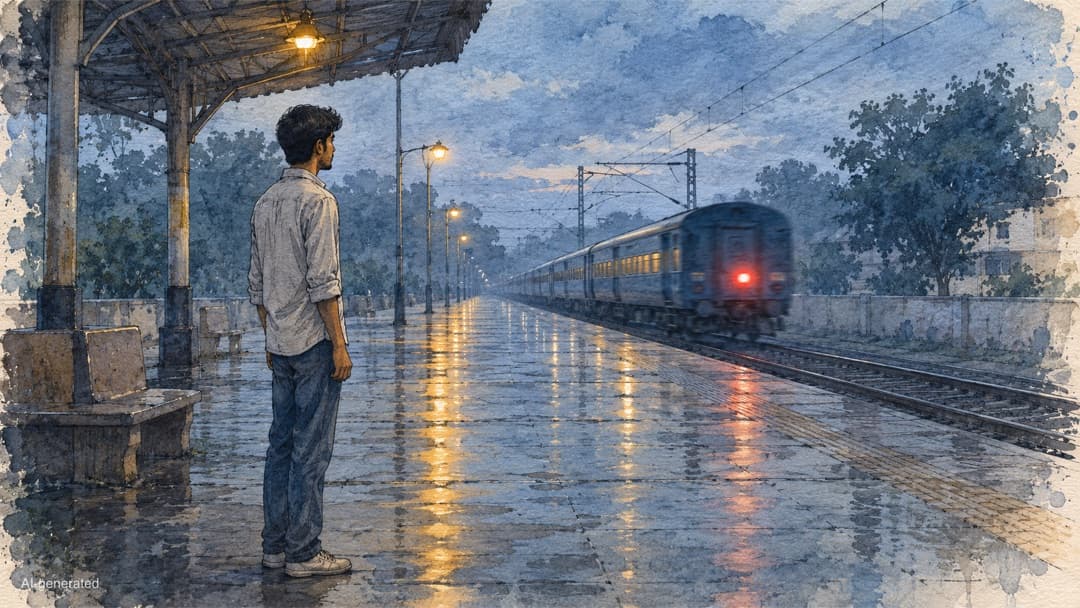
We have all felt it: a phone stolen, a job gone, someone who walked out, and suddenly it seems we were lost along with it. Things come, stay for a while and leave; that movement is not what hurts. It hurts when we were riding on what left. The same habit shows up when we try to learn: we want to be taught without our old walls being touched, and then we call the teaching confusing. So what are we really holding on to, the thing or ourselves in it?
This summary is AI-generated. Please read the full article for complete understanding.
[From a 2025 session in which Acharya Prashant reads and explains two Sufi stories: Mullah Nasruddin’s lost donkey, and the man who wanted to learn without being confused.]
One day, Nasruddin’s donkey went missing. The people of the village found him wandering on the streets joyfully shouting, “Thank God. Praise be to the Almighty.” So they wondered, “Mullah, why are you so happy? You have lost your donkey.” Nasruddin said, “Yes, but I wasn’t on it when it got lost.”
Acharya Prashant: So stupid as it looks, there is something deeper here, right? So stupid, does it not? That this guy is actually rejoicing that his donkey is lost, and you ask him the reason, he says “When the donkey got lost, I was not on it, so that’s why I’m so happy.” People will say, “What a fool. What a fool.”
There’s a deeper reason here. Donkeys will get lost. Donkeys come and donkeys go. Everything in life is a transient donkey. They come, they stay, they go. The manner of coming, the duration of staying, and the way of leaving, they differ. But the basic paradigm remains unchanged. Everything comes, stays, leaves. That’s it. That’s it. That’s it. And in this, there is no suffering. In this, there is just movement, and movement is not suffering. Stuff, objects, and objects include people as well, come, stay, leave, right? This in itself is not suffering.
Suffering is when there is such a huge association between you and that object that when the object leaves, it tears you apart and carries you along with itself. Things will leave, you stay your place. That is Mullah’s message, and then you can remain happy. Yes, the donkey got lost, but I was not attached to the donkey. I was not on the donkey. I was not compulsorily riding the donkey. The donkey got lost. I didn’t. And there is no great surprise in the donkey getting lost because everything is a donkey meant to get lost one day, including the body itself. Everything will be lost one day. When something gets lost, it is the thing that should get lost, not you. But if you are riding the donkey and the donkey gets lost, then everything is lost because now you are lost. Along with the donkey, you are lost. So let the donkey be there. There need not be a compulsive relationship.
You cannot say, “When my riches got lost, I was reduced to nobody.” No. The money got lost, you remained, and then nothing is lost. But that’s not the case with most people, right? When their riches get lost, they feel as if they are lost, gone, finished, vanished. No. I am who I am, and my being, my fullness is independent of whatsoever is around me. My completeness, my totality is independent of my relationships, associations, positions. Let everything get lost. Let nothing remain. I’ll still be who I am because donkeys are destined to be lost. One day the donkey came, one day the donkey went. That’s all right. I was there before the donkey came, and I will be there after the donkey is no more. I was there even before I came, and I’ll be there even after I am gone. Because I am the mother donkey. I too am a donkey who comes to itself. No?
Next time you suffer a loss. Yes, I lost something. What? Something. A pair of sandals. But I was not in the sandals. Fine. Nice. Imagine someone comes and tells you, “You know your friend?” Yeah. “Her sandals can’t be found.” Will you be too worried? And next he says, “There is another thing. She was in those sandals.” Now you’ll be worried.
Don’t be in whatever you have. What you have must remain at the periphery of your existence.
Let it get lost. You are still safe and secure. Getting it?
Next time you feel everything is lost, what will you tell yourself? I am not. I am not. You’ll not say not everything is lost. You’ll say, “Yes, everything is lost.” I am not. I am not. And then nothing is lost. But if even the smallest thing is lost, like a sandal, but you were in it. The sandals might be simple ones, normal, cheap sandals, let’s say. But everything is lost if you were in them. Don’t be in anything.
A man once went to a Sufi teacher and said, “I have come to learn, but I do not wish to be confused.” The teacher said, “Go away. You have no place here.” The man protested, “But why? I only want to know.” The teacher replied, “A man who wants to learn but not be confused is like someone who wants to build a house but is unwilling to disturb the ground. If the ground is not cleared, nothing can be built. You want to build walls on top of walls. I demolish walls.”
Neti-neti. Right? Nothing new needs to be really told to you. What you already think of as real needs to be shown as unreal.
I’ll tell you what the Sufi teacher will do next. This man has come to him with walls, right? And the teacher says, “I need to demolish these walls so that I can build something new.” Yes, the teacher will demolish the existing walls. And then what do you think the teacher will do? Do nothing. No new walls or structures will be built by the teacher. Nothing. Demolition is sufficient. After the demolition, what you have is just freedom. All structures are limits and boundaries. No new structure need be given. Only the old ones need to be demolished. We don’t need a new structure, a new paradigm, a new system.
So what will be there? Just barren ground? No. What has to emerge from the ground will re-emerge on its own. You don’t have to worry. Once the needless sand and brick and concrete is gone, the ground will show you what its own fertility is capable of. You don’t need to put anything artificially upon the ground. What is to be seen above the ground will emerge from within the ground. The ground of all being, that is what we call as the truth or self or Atma. The very ground of everything. And then there is the stupid ego that wants to build structures over this ground. No, you don’t need structures over this ground. Beautiful structures emerge from the ground on their own. Structures without a blueprint. Structures without your imagination. Structures beyond thought. Getting it?
But that will require you to see through your obsession with security. Walls provide at least an illusion of security, don’t they? If you do not penetrate that illusion, you’ll not be able to demolish the walls. There is no security in walls. You may think so, yes, but there isn’t really any.
When you say you are confused, you understand what is going on? Yes. What you are saying is, “I have come to the teacher with my preexisting frameworks, which is the walls, and I want the teacher to enter my framework and teach me. So the teacher should honor my walls.” It’s almost like saying the doctor should honor the disease. “Doctor, doctor, treat me in such a way that the disease remains.” [laughs] “Kindly switch the bulb on in such a way that the darkness remains.” And if the teacher fails in doing that, rather refuses to do that, you say, “Oh, he’s so confusing. He’s so confusing.”
The moment you hear someone saying this, the teacher is confusing, what the person is saying is, “I do not respect the teacher enough to allow him to demolish my walls.” So the result is confusion. There is the existing structure, and then there is freedom outside the structure that the teacher is beckoning me to, and I am confused. I am confused because these two are disparate. They cannot reconcile with each other, so you are confused. I cannot let go of my beliefs, my conditioning, and the teacher is talking of something beyond beliefs, so I stand confused. Confused.
So whenever you say you are confused, what you are actually saying is, “I have contempt for the teacher.” Which basically means having contempt for your own true self. The truth is simple. There is nothing there to confuse you. When you say, “But I could not understand what he was saying,” what you are saying is, “I cannot let go of my beliefs.” Otherwise, the teaching is just so simple.
One cannot not understand it. Yet the majority says, “Oh, no. Very complicated. Cannot understand.” The teacher is not complicated, you are. Not only are you complicated, you want to secure your complex entanglements. You’ll not allow simplicity to penetrate you. And then you lay the blame on the teacher. “He is complex. He is confusing.” Really?
A fact is a fact. What can be confusing about a fact? There is confusion only when fact collides with belief. This is a palm. What is confusing about it? But it’ll be greatly confusing if I believe since generations that this is a tortoise. My traditional belief, my holy belief is this is a tortoise, and God Almighty Himself declared this to be a tortoise. Now the teacher comes and says, “Please look at it simply, directly. Obviously this is just your palm.” But your grandfather told you this is… tortoise. You see, this is the tail. This is the shell. You see? Two limbs, two limbs, and this is a tortoise, obviously. Is it not? Now the teacher is saying, “No, no, no. This is your own palm.” There is no confusion. The thing is here. All confusion is simply dishonesty.
I’ll give you a way. See, you cannot be confused between a fact and a fact. You cannot be confused, right? He is sitting to his right, and then he is sitting to his left, and these two are mutually compatible facts. If he is sitting to the right of her, she is sitting to his left. All facts are always compatible with each other. In case of confusion, it would either be two imaginations not agreeing or a fact being stopped by an imagination.
So whenever you are confused, figure out where your imagination and assumption is. Don’t try to clear the confusion. Try to clear the assumption.