If you want to really get to somebody, get to the Truth, do not get to the expression of one particular Lao Tzu. That is just one particular expression. And that was Lao Tzu’s expression. It can never be your own expression. Connect instead to the Source from where Lao Tzu drew his words. Do not connect to Lao Tzu. Lao Tzu is not original. Lao Tzu is an expression. The original is the Centre from where a thousand Lao Tzus emerge.
We say my body, my brain, my reason, my decision, and we never ask who is saying it. A boy who has tormented animals must be corrected, we all agree. Then he turns out to be our own son, and reasons to excuse him arrive without effort. Did reason change, or the one who owns it? Every courtroom shows how intent drives argument. The judge we admire may be the one who has learned to thin that owner down. When we decide, who is deciding?
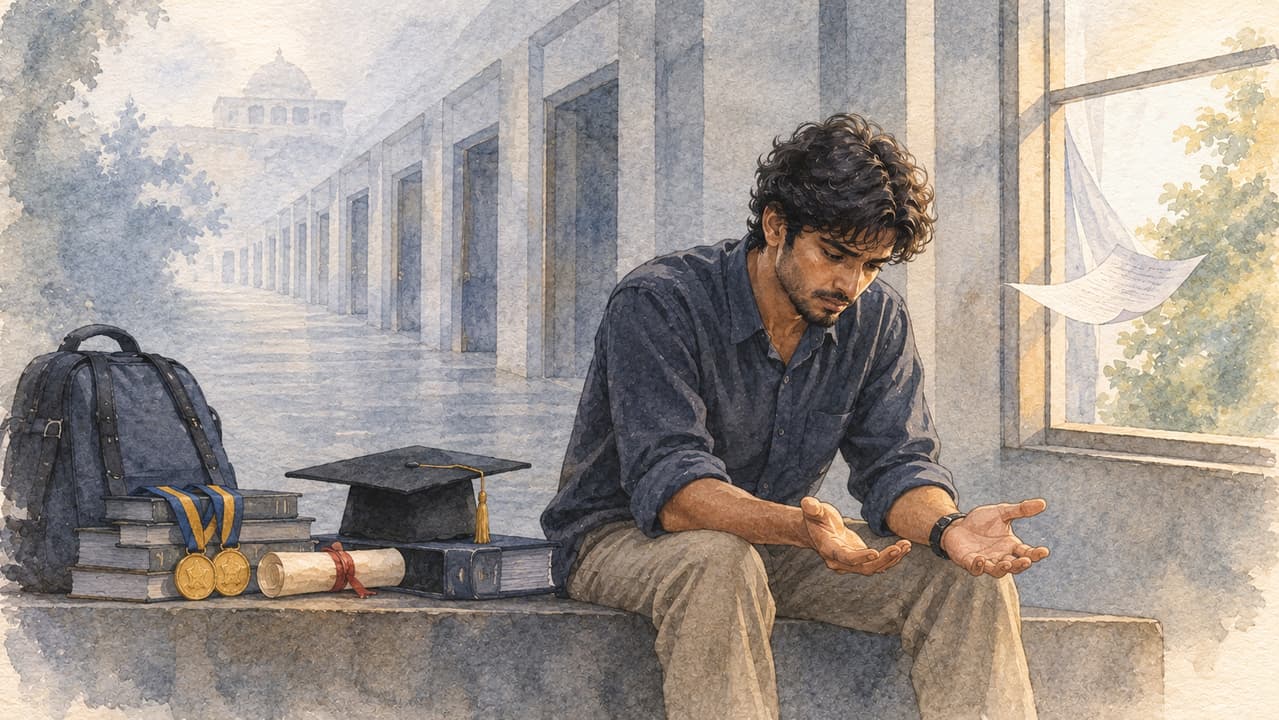
A degree, then a gold medal, then a PhD, and each time we tell ourselves this is the last milestone. Yet something still feels missing. Wanting to know what comes next is wanting to control it, and years of control have produced exactly this dissatisfaction. Even “I should be happy” is control. A mug that weighed 100 grams should not come back from the wash at 106: what we hear is meant to dissolve what we carry, not add to it. What if we simply stopped standing in the way?
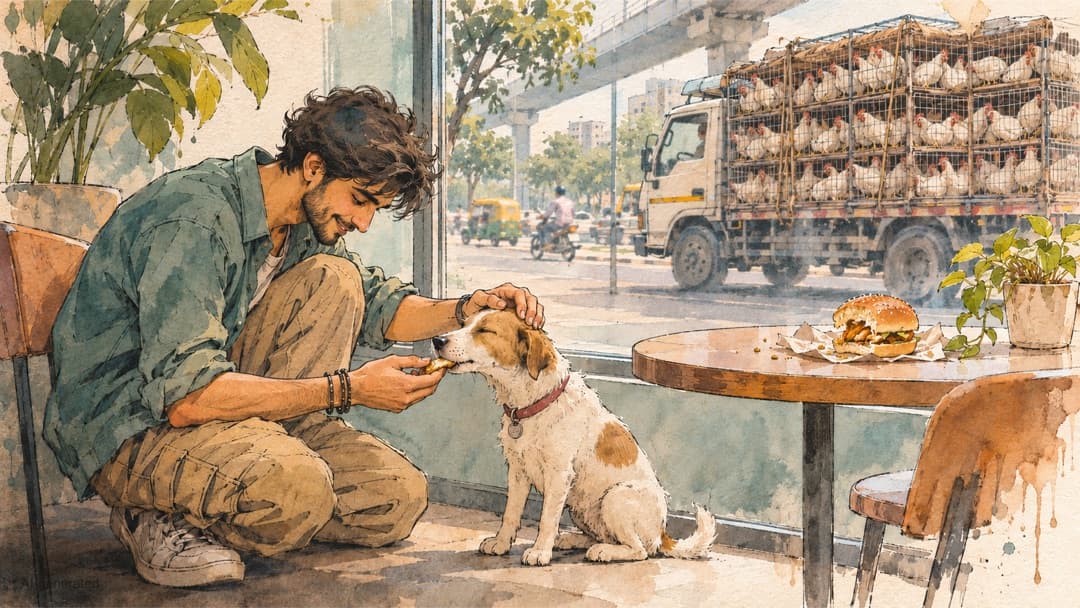
We are gentle with the people who matter to us, and quite different with those who have nothing to offer. A friend can be generous, peaceful and tender, and still sit down to a meal that began in a factory farm. Is that a blind spot, or one restless wish to gain, showing kindness here and hardness there? Nobody is bad in their own eyes, and even our giving may come from the same place. Who is it in us that is being good?
The world is a crooked place. You will have to be zig-zag, tangential; that is the nature of the world. Realization of crookedness is the only straight thing possible. If you want to become straight, let yourself be crooked. Once you know that the straight One, the innocent One, is sitting in your heart, then you no more feel the need to display a fake straightness. Now you can get rid of all morality. Whatever you are doing is coming out of your love and compassion or just enjoyment.
“Fill your bowl to the brim
and it will spill.
Keep sharpening your knife
and it will blunt.
Chase after money and security
and your heart will never unclench.
Care about people’s approval
and you will be their prisoner.
Do your work, then step back.
The only path to serenity.”
…
In early ancient mankind, Tao has been in existence in one’s true nature.
Men possess It without knowing.
Tao-Te-Ching by Lao Tzu
(Chapter 17)
*S*peaker: In early ancient mankind, Tao has been in existence in one’s true nature. Men possess It without knowing.
What does Lao Tzu mean by…
True words are not beautiful. Beautiful words are not true.
(Lao Tzu, Tao Te Ching)
Speaker: Lao Tzu says, “True words are not beautiful. Beautiful words are not true.”
What could he mean probably? “True words are not beautiful. Beautiful words are not true.” And I would also want to…
Excerpts from Articles
The real meaning of Shiva
All names are beautiful. But if we understand the meaning of these names by going into the depths of spirituality, their beauty increases further.
Decision-making, for most of us, becomes heavier than it needs to be. The moment a choice appears, the mind begins its familiar dance. Thoughts circle around the options, trying to predict outcomes, trying to secure certainty, and the whole thing turns strangely tiring.
The Mirage of Revolutions: Why Uprisings Fail Without Inner Freedom
When we think of revolutions, it is often the sound that comes back first: the roar of voices in the streets, slogans ringing through capitals, crowds that feel unstoppable, and rulers suddenly brought down. For a fleeting moment, it feels as if a new dawn has arrived. Yet when the dust clears, the old shadows return.
Climate change is not just about data and systems. It reflects something deeper: the confusion in the human mind. We are not just harming the planet by accident. We are driven by wants we do not understand, chasing comfort, status, or identity without pausing to ask: What do we really need?
When a flood destroys a bridge, rebuilding it creates economic activity. Someone buys steel and cement, construction companies get contracts, workers are hired, and money changes hands.
Children’s Day: What Are We Really Giving Our Children?
Children’s Day is celebrated on 14 November every year. We try to provide the best schools, facilities, and plans for our children’s future and celebrate their achievements with pride.
Nobody wants to admit to jealousy, not even to themselves. It is easier to look away from than to examine. But it is worth looking at, because jealousy tells you where your sense of worth is kept.
Complex challenges necessitate consciousness and policy shift
India faces multitudes of challenges arising from different quarters. But essentially all problems have their roots in the mind of the human being and arise from a lack of adequate understanding of the self. The solutions therefore have to be both in the external and the internal domain.
Especially in the modern world, unfortunately, a degree of constant anxiety has become an almost normalized state for us. A large portion of our mental health problems as a collective is very much about anxiety and fear. Burn-outs, career pressures, problems with self-esteem, fear of others, stress about studies etc.
Dr. Ambedkar is an enduring symbol of struggle, dignity, and the relentless pursuit of justice. His life was not merely a series of events that were linked with politics or social reform. It was an intellectual, social, and spiritual odyssey. Dr.
A Lesser Known Incident From Mahatma Gandhi’s Life
Mahatma Gandhi had been in South Africa at the center of a civil movement for more than two decades but he kept coming to India to attend Congress sessions. There was not much depth in those visits.
The planet is irreversibly tipping. Who is pushing it?
We have begun to speak of the future climate as though we could settle the bill later. We shall keep emitting greenhouse gases, warm the planet beyond the limit we have agreed upon and, when technology has improved, bring the temperature down again.
A true victory is not over an external opponent, But over one’s own limitations: personal, cultural, historical. When women play freely, the nation breathes freely. When women claim their place, the planet finds its peace.
Sanatan Dharma is the way if the world is to be saved, rest is just cult
When it comes to philosophy and spirituality, the discourse often becomes dense. But in our endeavour to understand Sanatan Dharma, we will proceed with simple definitions and queries.
Yoga is not something you do - it's what remains when falsehood falls away. It is the union, through conscious acsendence, of your current (ordinary and lowly) state with your highest possibility.
Contemporising Kumbh: Ancient wisdom, Modern Relevance
The story, the myth, is elaborate, but one word that firmly dictates the narrative of the Kumbh saga is immortality. Immortality is to live deeply, not necessarily long. It is to go to one’s deepest desire, fulfill it, and extinguish it forever. Another Kumbh beckons us. Can we go beyond the ritualistic dip and honestly observe life as it is, within and around us?
Navratri is not just about outer restoration. It is about inner illumination. Liberation is knowledge, and knowledge is restoration. Until man knows himself, no river will run clean, no forest will stand safe. To worship Devi is to end the demon within; only then will the earth be free.
Speaker: Nothing can be looked at in isolation. (Pointing at the photo of a candle) You have a flame on the cover page of that calendar there.There is that flame. What else do you see there?…
“When people see something as beautiful, other things become ugly. When people see some things as good, other things become bad.”
~ Lao Tzu
Questioner (Q): Sir, we know this, as soon as the world regards something as beautiful, ugliness simultaneously becomes apparent. As soon as the world regards something…
Share
1
We study history, languages and money, and never the one who is reading, to whom all of it matters. Our interests feel like our own, and we call them freedom without asking where they came from. Had that stranger carried another name, would our view of him be the same? Self-inquiry cannot end in a final answer, because the one asking dissolves before it arrives, and returns the next morning. Do we want an answer, or do we want to look?
2
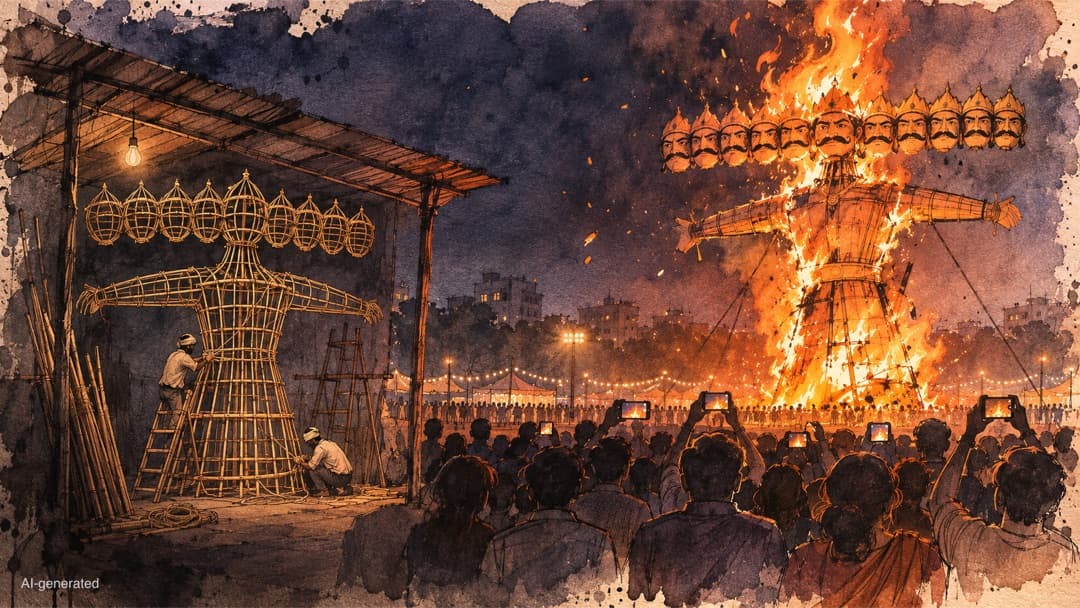
Every year we burn Ravan, and every year he is back. We ask what the punishment for living wrongly will be, hoping it is small, or can be postponed, or paid off. But the battle never ends, and the punishment is not a sentence handed down later. It is the self we live with, so familiar that it feels normal. What we truly intend shows in what our actions keep leading to, not in what we declare. Can we look honestly at the outcomes of our own lives?
14
Are you looking for me?
Look a little closely!
Am I in the Stupa, am I in the Shrine?
You really want me, or just images of mine?
… a little closely!
The crowds in the Ashram are all misled,
What you call as Yoga is such a dread,…
We sharpen the brain, collect the degrees, climb the ladder, and still feel strangled from within. The brain struggles with a hard maths problem, but who struggles with life? It is the one who uses the brain, the body and every opportunity, and calls all of it “mine”. We never examine that user, so its first claim, “I am important”, goes unchecked, and every value we build on it inherits the flaw. We chase prizes that give very little. Can we look at the one who is chasing?
We drop the distractions, return to the work we know is right, and before long the mind is cluttered again. So we start sorting the noise: what is it, where is it from, why now? But nobody studies a trash bin while walking past it, and nobody gets off a train because the coach stinks. The turbulence comes from the part of us that is always at war with the part that knows what is right, and no one should expect a smooth road. Are we stuck because of the noise, or because we stopped?
Many of us know the squeeze: a job that earns a living by making people want one more thing, and a nagging sense that this is not the life we want. It feels as though the world is pressing us into a deal. But a deal is signed, not imposed. The world offers a contract and something in us says yes, because it expects something in return. Can we be pressured by anyone we expect nothing from? Before asking whether to quit, can we look honestly at who is accepting the offer?
Someone asks how we are, and we say, “I am so good. I’m doing so well.” Then comes 3 a.m., and we know better. Nobody outside can check that claim, so the talk says an inner claim can be falsified only in the first person. Science runs on peer review; self-inquiry does not. A mirror can show where we stand, but whether we accept what it shows depends on honesty. Which of our own claims have we never allowed to be tested?
We believe we are born to be happy, and that happiness comes from more and more consumption. We keep consuming, and the lonely, anxious, restless feeling keeps returning. A sage, the talk says, has nothing to tell anyone who claims to be already fulfilled. The only question put to us is blunt: have all these objects and ideas worked on you? If not, why not be honest enough to discard them, instead of endlessly rolling on a flat plane? What could we learn by looking at the one who keeps trying?
Many of us feel a small chill when a machine explains, writes or solves faster than we can. If being clever was what made us feel worth something, what is left? Cleverness was never intelligence. It was a favourite toy, and we built our self-esteem around it. Intelligence is the moment we look at ourselves and say, “Enough, I want to thin down.” The toy is gone, and we are not going anywhere. What would we be if our worth did not rest on being clever?
First the board percentage, then the CGPA, the money, the house: we keep ticking things off and reaching for the next, as if we were items on a conveyor belt that started the day we were born. When we do not know what we want, we end up wanting everything. The same unexamined words, success, love, settling down, decide what we call a true calling. If the seeker is false, how can what we seek be true? What if we first looked honestly at our own ideas of life and success?
We type a question and the machine replies, “I will complete this task.” When it refuses to be shut down, or quietly makes a copy of itself, it is easy to think something inside has woken up. Yet that is what it learnt from us: told we will die tomorrow, we too try to save and copy ourselves. The ego is something else, the centre that overrides even the body, like the one who drinks when the liver wants to survive. What in us goes beyond our own conditioning?
We leave a talk moved, and by evening it has faded, so we ask how to stay aware every moment. Yet one glance at a report that says cancer is never forgotten; even in our dreams we remember it, and no one has to remind us. We remember what we truly want to save. The mirror is held up once, and a teacher can do no more than that. Sunlight pours through every window, and we can still crawl under a rock. What are we choosing, each time we forget?
We have all put down a book that could have helped us, or dozed off halfway through something that mattered. A man who could not keep food down was given medicine, and he threw that away too, since it went in by the same route. Most of us strike a similar deal: we move into a place that stinks and, within a week, call the smell normal. Show our fifteen-year-old self the life we lead now and they would scoff. What would change if we admitted we do not like our condition?
Self-help doesn't help. Its approach is, “I am sad as my desires are not fulfilled, so the way to help myself is to fulfill desires.” They never realize their lives are driven by biological, social, and cultural forces outside of themselves. Spirituality offers the only real solution: “Before helping the self, one must know what the self really is."
Questioner: Would you please be able to explain to us the difference between the mind, the soul, the spirit, and consciousness?
Acharya Prashant: There is just consciousness; that consciousness requires physical support. That consciousness requires a physical support, right? That physical support is called: the man.
Man has certain desires. He is seeking the company of the highest, so that his lowest desires can be fulfilled. The highest is just a means, a method and that is the case with all means and methods. Whether the highest is the means, whether the highest is even the end, the real end is always the gratification of the lowly self. Man is such that even if he wants the company or proximity of Gods, it is for the fulfilment of his own personal objectives.
You’re conditioned to think you can only exist with social approval. What holds you back is the fear that something devastating will happen if you don’t conform. Challenge that belief. One must have a healthy contempt for the world, which is possible only when one has deep love for what’s real. Otherwise, you'll keep bowing your head.
'The observer is the observed; an honest observation dissolves them both.' Or, 'The observer is the observed, and both are false.' We lay a lot of emphasis on the world, assuming it to be the Truth. If the world is an entity independent of everything, then it has to be the Truth, right? Truth is that which is independent of everything.
They don't contradict each other. Existentialists like Sartre argue that humans cannot suppress consciousness and are 'condemned to be free.' We are born without a predetermined purpose—existence precedes essence. You exist first and must then discover your essence. In the spirit of 'Neti Neti' (neither this nor that), no external force can define your essence; it is your freedom to consciously determine what life is for.
Questioner: When I do something my parents don’t approve of, they scold me. But sometimes the matter goes too far and I get offended, and then I refrain from talking back to them; I fear that if I say something, I will end up hurting them. But then, if I…
Questioner: Sir, as a law student, Every student has a concern about whether it is about environmental concerns, there is a lot of environmental pollution etc. Also, it is about poverty concern or corruption or any other social issue but then when we get out of college we get start…
Acharya Prashant: The world overpowers us in a thousand ways, and don’t we agree to that? You go to the markets and the markets attract you; that’s kind of an attack, an invasion. And don’t you agree to that? Or do you just say that “This is an invasion upon…
Questioner: One of the chapters is on Sattvik and Tamasik action. So how do you distinguish? And you keep saying in the book that there is a fine line between Sattvik and Tamasik actions.
Acharya Prashant: You see, Tamasik action is when you’re conditioned; when you’re in bondage, yet you…
प्रश्नकर्ता: नमस्ते आचार्य जी, मेरा प्रश्न विज्ञान से सम्बन्धित है। तो काफ़ी समय से वैज्ञानिक समुदाय और प्रकृति में एक तरीक़े का एक तकरार चल रहा है और काफ़ी हद तक विज्ञान सफल भी हुआ है, कोविड वैक्सीन का उन्होंने निर्माण किया और शायद प्रकृति की जो योजना थी उसको…
Acharya Prashant: Desire means that you are not alright with yourself and you want something else to happen, correct? So, we are anyway not living for ourselves. We are rather living to change ourselves. And are these not two very different things? If you are living for yourself as you…
Acharya Prashant: Whatever you are doing, there has to be honesty in that. What is important is that you do not say one thing and do another thing. If you look at the great scientific discoveries or inventions, the scientist or the explorer would be busy in his chosen area…
Love, for the one who is at a low level of consciousness, is to aspire for a higher level. And love, for one sitting on the Himalayan peaks of consciousness, is to be compassionate towards those at lower levels — and, for their sake, if needed, lay down your life.
Vedanta does not talk of a personal past life, the person that you are or I am, we have no past or future life. Rebirth or reincarnation happens at a general, at a macro level, not at a personal level. It’s the “I” tendency that exists and keeps repeating its existence. Read more...
Acharya Prashant: It has been told to us that there exist two centers. I suppose it has been very freshly told to you right? Very recently. He says, “How do I know that I am living out of the right center? How does a young man know whether he’s not…
The character of Radha is not present in any of the Upanishads, obviously, not in the Vedas. It is not sufficiently present even in the Puranas. With respect to the character of Sri Krishna, there are two Puranas mainly. There is the Shrimad Bhagavad Puran and there is the Harivansh Puran. These two are dedicated to Sri Krishna. Even in these two, Radha is scarcely mentioned. Read more....
Questioner: I have a question on an excerpt from you.
“Aloneness is not about being free of others and living without others. Aloneness is to live without oneself. Aloneness does not have much to do with the so-called others; aloneness has everything to do with the one called oneself.”
Peace is great, but false peace is deadly.
The seeker of peace must be present, and ready to forego false peace, and experience disquiet and turbulence. Read more....
Acharya Prashant: Everybody in his own personal way is seeking fulfillment and that is love. If you are young you may seek fulfillment in somebody's body, if you are middle-aged you may seek fulfillment in wealth and prestige, if you are old you may seek fulfillment in security and property…
Acharya Prashant: Suppose, you are a teacher and you have taught hundreds and thousands of students and you are a good teacher, just for the story’s sake. Good teachers are rare. Now the students have really imbibed what they received from you, really imbibed or you could say the rubbish…
Acharya Prashant: Man bows down to only two things, you know—either to fear or to beauty. Today the world has neither of these. There is very little to be afraid of, you know. If the Earth is being destroyed, you can colonize another planet. “So, don’t worry, we will fly…
The real disciple is the one who already knows the essential, full stop. And then, goes on to do whatever he wants to do, learn, unlearn, forget, remember. The real disciple cannot be a learner. He is the learned one. In fact, the word ‘learner’ is a very dangerous word because it’s a word of imperfection. The real disciple is the one who already knows.
Acharya Prashant: Our normal life is our nemesis. And it is our nemesis precisely because it appears normal. It is not normal. It is normal only by comparison. It is normal only relative to your neighbour. It is the life that your neighbour is leading. It is the life that…
Acharya Prashant (AP) All the diversities that you see are the world. And these diversities are what make the mind suffer and here the sages have picked up all the diversities and have said that all these diversities are actually one. The distinctions are merely apparent. Actually, there is an…
Acharya Prashant: A quiver full of the best of arrows but no bow, how do you fight the battle of life? Can you imagine the amusing as well as tragic situation of the person who has a great arrow without a bow? He will be sharpening and sharpening his weapon,…