We want to do good to the ones we are related to and we have long stretches of memories with all kinds of identifications. I fully appreciate that. But I also know that it doesn't always work this way. Sometimes what works better is shifting of focus to more appropriate areas. Remember, nobody can be helped beyond their consent. That's the nature of life.
Those who want to travel long distances and fight important battles, they don’t carry baggage - they travel light. You must know which responsibilities rightfully belong to you and which ones you must disown. You are not obliged to fulfill all the so-called traditional responsibilities. Therefore, you’ll need a total revolution in your inner world before you can fearlessly do something in the outer world.
Acharya Prashant: Socially, we have been trained to visualize the happy family as a kid with his two arms being held by two people of opposite gender. That’s really not needed. The kid is already being held in the palm of his real Father. The real Father is not even
Acharya Prashant: I was six years old. My sister Pragya was three and my younger brother was being born, mother was in the maternity ward. So, we two kids were having good fun. We had been relieved from school for a month because mother had gone to another city to
Acharya Prashant: If you will observe, you will find that people who are living most contented lives do not find it necessary to intrude in the lives of their kids, their sons and daughters. Because they are complete and satisfied in themselves. If they have to do something, or get
Questioner: You know, I would just cite this example of people from happy families or normal families, seemingly happy families, whatever, and people who have a bona fide past of a trauma like, you know, domestic violence and abuse and mind games and a lot of lowly things that do
Questioner: I would like to join the army, but my family and friends are not very supportive. They say that when I could easily get a good job in Delhi or Bangalore, what is the point in risking my life as a soldier? What should I reply to them?
L: I feel that I should give all the things to my parents, and everything. I internally feel that. That is nothing coming from the society. I feel that they gave me so much so I should give them too.
Question (Q): Dear Acharya Ji, pranam. Since the last few days, I have been sharing my learnings with my parents. Every time I discuss something with them, I have to deliberately attack their conditioned mind to make them aware of their conditioning. I feel sorry for them, and I
What is it that we are usually engaged in? Feeding our stomachs, and feeding the stomachs of those who are related by blood to us. That’s what our life really is: fulfill your desires and fulfill the desires of those who are related to you by blood and semen. That’s
Questioner 1 (Q1): I’m a single parent and I have a son. He gets a lot of homework from school, but instead of doing it he likes to just play around. Next day, when his teacher tells me that he hasn’t done anything, how should I react?
Your parents don’t want you to speak, your teachers don’t want you to speak, and religious preachers, obviously, they are very afraid if you speak up. So you don’t ask even the most basic, logical, sensible questions, and you keep accepting even the most amusing kind of trash as if
Questioner (Q): When I used to ask questions to my mother and father, we would have conversations, and our conversations often ended on a bad note. My brother and sister would say, “You better not talk to them like this, because if you are right, then they are wrong; and
Two or three people are discussing some nonsense, and three more will join in, and then probably three more. What connects them? What makes them relate to each other? Nonsense. That’s the benefit that nonsense gives you, and that’s why you remain steeped in nonsense: it helps you feel connected
Questioner (Q): Where do we draw the line between responsibility and love towards family members or relatives or friends? How do we know what is responsibility and what is really coming from love? Because of the conditioning, there is partiality involved, we see people with different ways.
Questioner (Q): Acharya Ji, how should I deal with my anger, especially with my kids? I always get annoyed very easily and it bothers me a lot. Kindly help me to get rid of this tendency. Thank you, Acharya Ji.
Acharya Prashant (AP): You see, the kid has stolen a…
Questioner: Acharya Ji, I have noticed that people who know me since childhood are now facing difficulty in understanding what I am doing. For instance, it took me two years to convince my wife and relatives, etc., to even allow me to do what I am doing.
Questioning pseudo-science and superstition is the first step toward genuine freedom. Beliefs such as *Vastu, Kundli,* and *Muhurat* should not be accepted merely because they have been followed traditionally. Fear and attachment to privileges often prevent people from questioning authority. A truth-seeker must be willing to challenge age, status, and authority. Human progress has come through curiosity, inquiry, experimentation, and reason—not through blind obedience.
Desires and beliefs may keep changing, but the deeper tendency to believe, think, choose, and seek fulfilment often remains unchanged. Real transformation begins by examining this constant inner pattern rather than changing superficial preferences. Instead of seeking conclusions about greed or desire, honestly observe recurring behavior and support the truth you already recognize. Expressing that truth can dissolve false identities, relationships, and habits, creating space for genuine change.
True love is not a biological instinct, emotional attachment, or social conditioning. Biology and science explain the body's drives, but they cannot explain the self that seeks freedom. Love is the inner restlessness to move from ignorance and bondage toward truth and liberation. Religion is not rituals or inherited beliefs but this personal journey of understanding. Freedom—not possession or conformity—is the essence of both love and religion.
Truth cannot be forced upon anyone, but neither should falsehood be entertained. Genuine love is not about preserving relationships at any cost; it is about helping oneself and others break free from illusion, even if that means risking the relationship itself. Spiritual growth begins by questioning conditioning, examining falsehood without bias, and choosing authenticity over comfort. Real relationships are built on the courage to seek freedom, not convenience.
What is the relationship between quantum physics, consciousness, and the ego? This dialogue explores where scientific inquiry ends and self-enquiry begins. Through Vedanta, Acharya Prashant explains why the ego clings to its own existence, how beliefs and superstition shape our lives, and why lasting freedom lies beyond conditioned thinking.
Women cannot be truly liberated through education, income, or legal rights alone if they remain psychologically identified with socially conditioned ideas of “womanhood.” While external barriers may fall, inner bondage persists through inherited identities, roles, and expectations. Real freedom begins not by rejecting the body, but by seeing oneself primarily as a conscious human being rather than a gendered identity, because lasting liberation starts at the root of self-identification.
Love is not a special emotion reserved for selected people or relationships but a way of relating free from self-interest, possession, and psychological dependence. Most relationships become transactions driven by insecurity, where the ego seeks completion through ownership and exchange. Genuine companionship arises without the urge to control or claim another, allowing affection to exist naturally, freely, and without conditions or expectations.
Freedom is not when all your roles evaporate; Freedom is the foundation of all roles. If you have Freedom in your Heart, if you worship Freedom, then you will find that all your roles are getting sanctified; there will be a touch of purity in all your roles. You will change as a mother, with God in the Heart; you’ll change as a mother. With spirituality as the foundation, the family will change.
Acharya Prashant: Parents have first of all committed the mistake of bringing another person into this world of agony, longing, and suffering that they compensate for by investing themselves in raising the kid. That is why it is imperative for parents to bring education to the kids, give food to…
The child is a reflection of who the parent is. The growth of the child, is the barometer of the growth of parents. The state of the child is the litmus test on the state of the parents and the teachers.
Excerpts from Articles
कद नहीं, अपनी कहानी बदलो
कई तरह के डर—अकेले पड़ने, छवि खोने या छोटा समझे जाने—की जड़ अक्सर अतीत में बनी पहचान और कहानियों में होती है। शरीर की हाइट जैसी चीज़ों को समस्या मानकर उनसे जूझने के बजाय उनकी अप्रासंगिकता को समझकर आगे बढ़ना चाहिए। अतीत को दबाने से मुक्ति नहीं मिलती; उसके करीब जाकर अपनी स्मृतियों, धारणाओं और पुराने पैटर्न को निष्पक्षता से देखना ज़रूरी है।
Struggling to choose between a secure job and the path you actually feel drawn to? This isn't really a question about careers. It's about why other people's opinions have so much power over you in the first place. Real clarity doesn't come from finding the 'right' choice. It comes from honestly looking at your own fear, again and again, until it stops running the decision for you.
Victory is not decided by the trophy you hold but by the battle you choose to fight. Real strength lies in making the right decisions, staying true to your deepest values, and refusing to be ruled by fear or circumstances. When your actions arise from clarity rather than ambition, the outcome loses its power over you. The moment you choose the right path, you have already won.
Climate change is more than an environmental crisis—it is a crisis of human choices. Our patterns of consumption, consumerism and endless pursuit of more are putting increasing pressure on the planet. But meaningful change does not necessarily begin with new technology or stricter policies. It begins with a deeper question: what are we willing to change within ourselves?
ज्योतिष कितना सच है? कुंडली, ग्रह-नक्षत्र: इनका क्या अर्थ है?
वेदांत को केवल इसलिए सही या श्रेष्ठ नहीं माना जा सकता कि वह किसी विशेष परंपरा से आता है। विज्ञान जहाँ भौतिक जगत की वस्तुनिष्ठ जाँच करता है, वहीं अद्वैत वेदांत सीधे मनुष्य के ‘मैं’, उसके दुख, बंधन और मुक्ति की पड़ताल करता है। इसकी कसौटी वैज्ञानिक प्रमाण नहीं, बल्कि अपने जीवन में इसकी सच्चाई को देख पाना है। किसी दर्शन को मान लेना नहीं, बल्कि उससे स्वयं को मुक्त करना ही उसका वास्तविक उद्देश्य है।
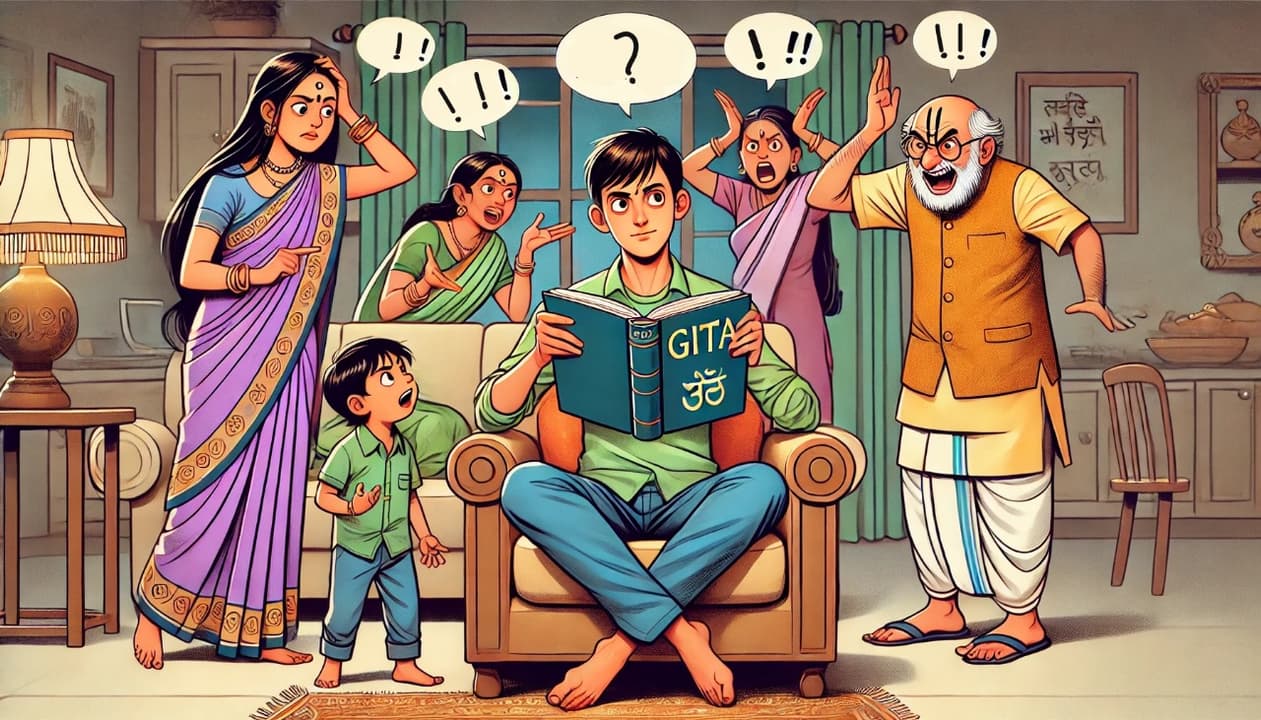
You Don't Understand the Bhagvad Gita, But You Still Claim That You Love Krishna?
The Bhagavad Gita deserves reverence not because of inherited beliefs about its author, but because of its power to dissolve falsehood and reveal Truth. Real devotion is not ritual or blind faith—it is understanding, inquiry, and living the wisdom of the Gita. Through sincere study, one discovers the true meaning of Krishna, making the Gita the most authentic path to knowing and worshipping Him.
Animal cruelty: Who deserves mercy, and who doesn’t?
Violence begins long before the knife or the slaughterhouse—it begins with the ego, the one that draws boundaries, seeks justification, and decides who deserves compassion. Laws and reforms may reduce suffering, but they cannot end violence while the ego remains intact. When the ego dissolves, exploitation ends naturally, and compassion no longer depends on regulation or moral boundaries.
Questioner: We have a question by Pooja. So people who try to become self-aware and you know knowledgeable of themselves. They usually became the black sheep of their families.
Question by Pooja is what can we do if our loved ones, that is spouse, parents, friends are not receptive to…
The resistance close ones often show towards a family member's spiritual journey comes from fear of losing them, thinking they'll turn ascetic. True goodness is never exclusive; it can't be good for one and bad for another. You have to very subtly and tactfully, demonstrate that what you’re doing or reading is for general good, not just personal.
…
Don’t unnecessarily hassle your spouse. He or she is probably as clueless as you are. He needs your support. She needs your light. Take care of yourself, and then you will be able to take care of everybody.
Questioner: When I do something my parents don’t approve of, they scold me. But sometimes the matter goes too far and I get offended, and then I refrain from talking back to them; I fear that if I say something, I will end up hurting them. But then, if I…
…
1
Not only is the kid in bad company, he is deeply identified with these two quarreling people. One is his or her mother, the other is his or her father. And what does identification mean? “I am that.” This is what identification says, right? “That am I.” In the heated moment of the quarrel, what is the mother? The mother is pure aggression. What is the father? The father is pure hatred. And the kid is saying, “That am I” because the kid is identified with the father and the mother. So, what does the kid become? Aggression and hatred. And the mother and the father will not even realize it. They will say, “We were fighting; we didn’t do anything to the kid as such.” You did do, and you did a lot. You destroyed the kid
I find so many limitations in every relationship which I make. What to do in such situations where my parents do not understand me? What to do to have them understand me?”
…
Questioner: When parents are in conflict, what happens to the child? What is the impact on the child? And how can the parents help the child be a healthy adult in the future?
Acharya Prashant: It’s a double calamity. You see, first of all, there is this basic thing regarding…
Acharya…
AP: See, it’s a very obvious thing if you would…
…
…
1
Question: Acharya ji, there is someone in my life, who is close to me. But, when I talk to that person, the person doesn’t listen to me. But, I know that deep down, he is a sensitive person, and wants Truth. How do I deal with this person?
Acharya Prashant…
Acharya Prashant (AP):…
…
…
…
Q2: Conditions of…
Share
When I say,…
1
Speaker: You see you’re young. Right? If you love somebody, do you want to chain him or her?
Listeners(everyone): No, Sir.
Speaker: Even a pet dog. Do you like to keep the dog in a closed room all the time or do you let it be free? Do you want…
1
Questioner (Q): We have so many liabilities and responsibilities family, society. Is freedom possible? What is real freedom?
Acharya Prashant (AP): What is the family? Is the family aggregation of people? Or is the family a net of relationships? The family is a net of relationships. When you say family,…
True God is the Truth right now in your heart. That is true godliness, true bhagavatta. The problem is that people want to avoid the real living Truth in their heart. Therefore, they come up with stories that place an imaginary God somewhere up in the skies. God is wonderful, but the stories and the imaginations about God are all very disrespectful towards God. When there is love for God, God is held very close to the chest, and that God is called Truth. That God is the very purpose of philosophy and the very origin.
A modern woman calls herself liberated, yet lives anxious — anxious about age, desirability, marriage, motherhood. Acharya Prashant exposes this anxiety as proof that feminism never touched the real wound: centuries of conditioning that reduced women to bodies for pleasure and reproduction. External equality isn't enough. True freedom demands she reject the entire inheritance of tradition and simply become human — not woman, not wife, not mother by decree, but free.
5
Feeling lonely on campus after being disappointed by friends? Acharya Prashant explains why loneliness should not push you into accepting the wrong company or remaining attached to relationships that pull you away from what is right. One person’s wrongdoing does not justify condemning everyone, nor does friendship mean supporting a friend in what is wrong.
Learn why the right company is the company that helps you move toward truth rather than merely giving you temporary relief from loneliness.
6
Parental expectations, peer comparison, and academic pressure can overwhelm you only when you allow others’ desires to dictate your life. As an adult, you are responsible for discovering your own potential and making choices through your own understanding. Love is not about fulfilling each other’s expectations or keeping someone happy. True love requires freedom—giving others the space to live and grow, while living according to your own inner clarity.
2
We often call something “help” or “love” while secretly expecting something in return. When that return does not come, we feel hurt, revealing that the relationship was a trade, not genuine help. The ego, being unfulfilled, cannot truly love or share. Likewise, desperation to be loved makes us controllable. Real love emerges when we stop seeking validation, work on ourselves, and become so inwardly fulfilled that we no longer need to be loved.
2
Modern life is increasingly driven by materialism, social validation, and the desire to impress, leaving authenticity behind. When image becomes more important than substance, relationships, education, and success turn into performances rather than expressions of truth. Real transformation begins with inward honesty—the courage to stop seeking approval, confront inner emptiness, and choose authenticity over appearances, imitation, and external validation.
The Bhagavad Gita is not a separate spiritual path or an escape from everyday life - it is a mirror that reveals the truth of your present life. Real spirituality begins with self-observation, not rituals or temporary practices. Lasting transformation comes when work, relationships, career, and personal growth become one integrated life driven by awareness, love, and freedom rather than ego, fear, money, or social pressure.
3
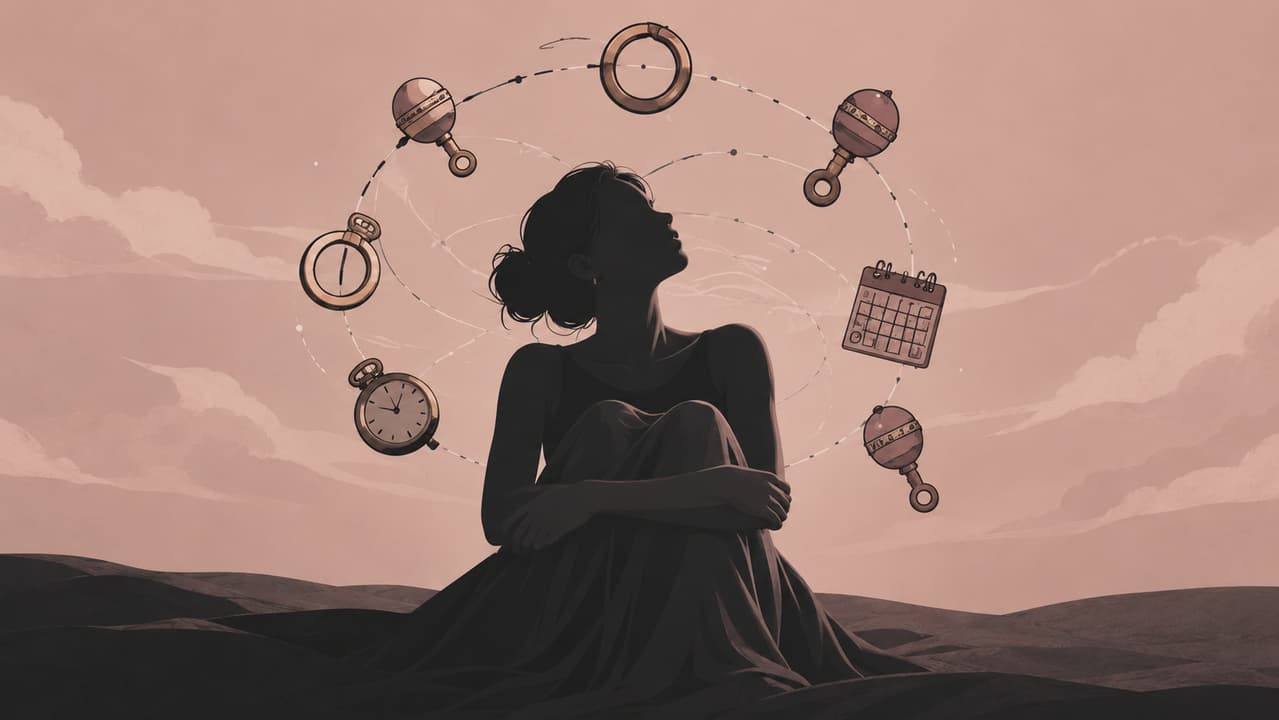
Should women choose marriage or career? Society often forces this question, but Vedanta asks a deeper one: are these choices truly yours? This discussion explores family pressure, the biological clock, gender equality, and social conditioning, revealing why freedom, consciousness, and self-awareness matter more than living according to expectations or traditional roles.
2
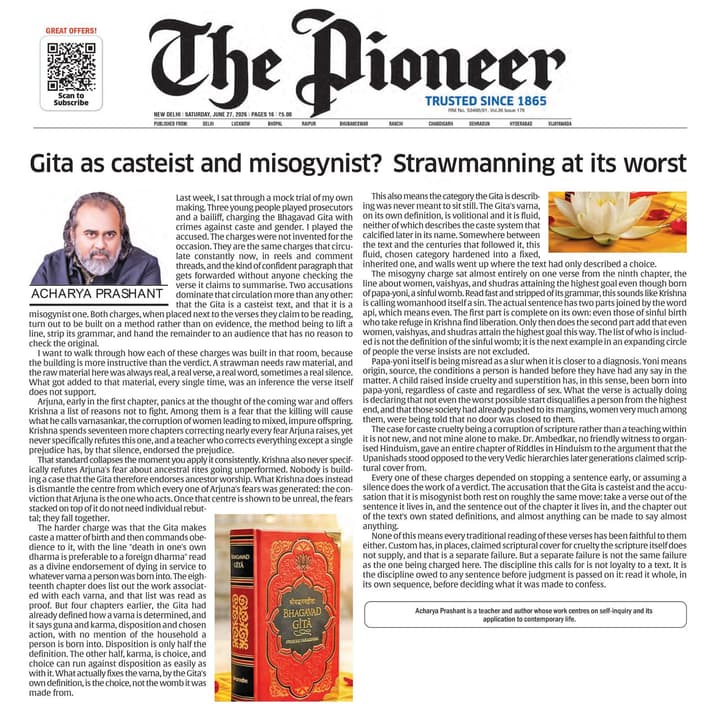
The Bhagavad Gita is often accused of supporting caste and misogyny through selective quotations that ignore context, grammar, and the text's central teachings. A closer reading shows that its emphasis is on inner qualities, conscious action, and spiritual equality rather than birth-based hierarchy or gender discrimination. Misinterpretations arise when isolated verses are detached from their broader meaning, while the Gita consistently points toward self-knowledge, freedom from ego, and the universal possibility of liberation for every human being.
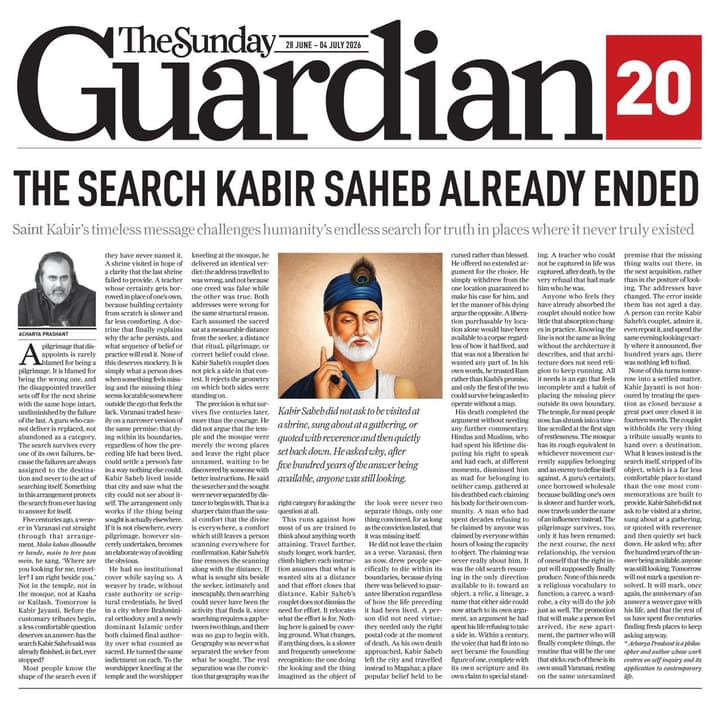
Kabir Saheb's message questions the very act of searching for fulfilment outside oneself. Whether through religion, relationships, success, possessions, or identity, people keep assuming that what is missing lies somewhere else. The problem is not the destination but the belief that fulfilment exists at a distance. Real freedom begins when the search turns inward, recognising that the seeker and the sought were never truly separate.
Women are often valued not only for their abilities but also for their appearance, desirability, and conformity to social expectations. This conditioning begins early and is reinforced through family, workplaces, media, and culture. As a result, many forms of discrimination continue not only because they are imposed from outside but also because they are accepted and normalized from within. Real freedom begins when a woman refuses to define herself through roles, approval, or standards created to keep her dependent on external validation.
Modern relationships often create more insecurity, not less, because people are conditioned to seek completion, validation, and identity through another person. Social institutions, media, culture, and tradition continuously reinforce the idea that fulfillment lies in romantic attachment. As a result, relationships become driven by dependence rather than love. Real companionship becomes possible only when one is inwardly at peace and not using another person to fill an inner void.
Women's oppression survives not only through external control but also through the internal acceptance of identities imposed by society. Freedom cannot be permanently granted from outside; it must arise from an individual's own sense of dignity, agency, and responsibility. While laws, institutions, and support systems matter, lasting liberation begins when people stop defining themselves through inherited limitations and choose to assert their own consciousness, freedom, and self-worth.