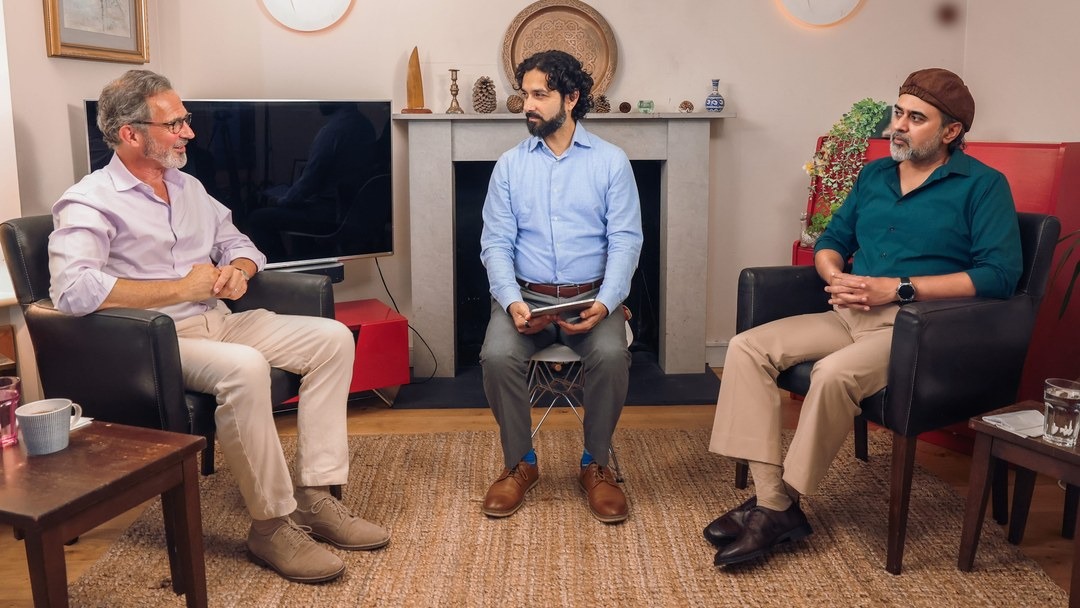
Most of us try to fix our suffering: a better job, a calmer mind, a new practice, a holier word to hide behind. But what if the trouble was never the pain itself? In this London dialogue with a teacher of non-duality, we look at who it is that says “I am”, why the sufferer hides in money and in holy concepts alike, and why non-duality is an intention, not a state. If the ego is a born lover, what does it truly want?

We have all felt it: a phone stolen, a job gone, someone who walked out, and suddenly it seems we were lost along with it. Things come, stay for a while and leave; that movement is not what hurts. It hurts when we were riding on what left. The same habit shows up when we try to learn: we want to be taught without our old walls being touched, and then we call the teaching confusing. So what are we really holding on to, the thing or ourselves in it?

Every year we burn Ravan, and every year he is back. We ask what the punishment for living wrongly will be, hoping it is small, or can be postponed, or paid off. But the battle never ends, and the punishment is not a sentence handed down later. It is the self we live with, so familiar that it feels normal. What we truly intend shows in what our actions keep leading to, not in what we declare. Can we look honestly at the outcomes of our own lives?

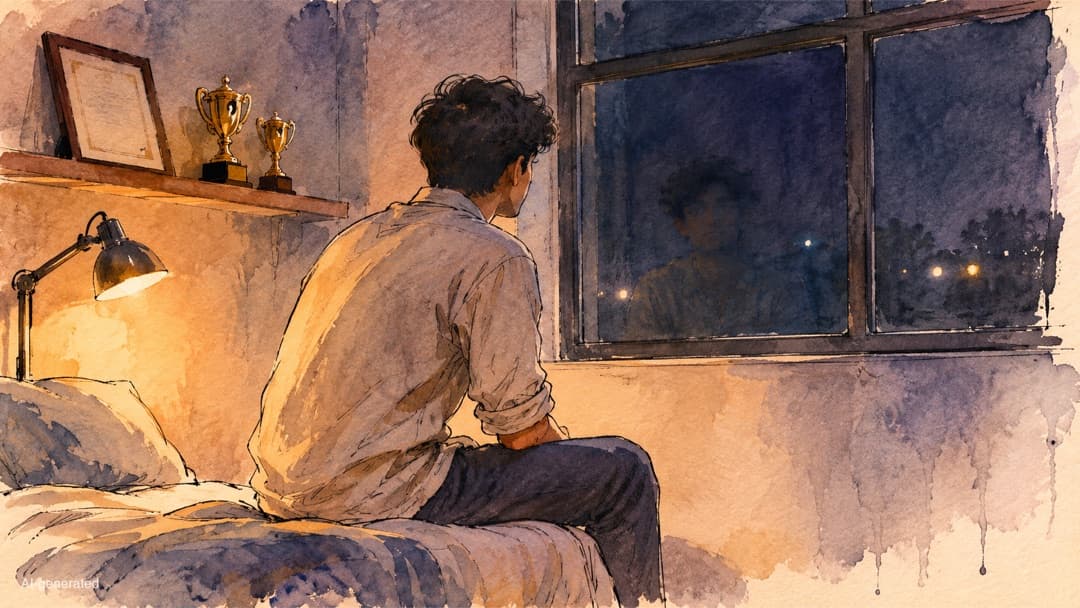
We sharpen the brain, collect the degrees, climb the ladder, and still feel strangled from within. The brain struggles with a hard maths problem, but who struggles with life? It is the one who uses the brain, the body and every opportunity, and calls all of it “mine”. We never examine that user, so its first claim, “I am important”, goes unchecked, and every value we build on it inherits the flaw. We chase prizes that give very little. Can we look at the one who is chasing?

Someone asks how we are, and we say, “I am so good. I’m doing so well.” Then comes 3 a.m., and we know better. Nobody outside can check that claim, so the talk says an inner claim can be falsified only in the first person. Science runs on peer review; self-inquiry does not. A mirror can show where we stand, but whether we accept what it shows depends on honesty. Which of our own claims have we never allowed to be tested?

First the board percentage, then the CGPA, the money, the house: we keep ticking things off and reaching for the next, as if we were items on a conveyor belt that started the day we were born. When we do not know what we want, we end up wanting everything. The same unexamined words, success, love, settling down, decide what we call a true calling. If the seeker is false, how can what we seek be true? What if we first looked honestly at our own ideas of life and success?

Research has shown that loneliness is found throughout the society, including among people in marriages along with other strong relationships, and those with successful careers. As a subjective emotion, people experience loneliness even when surrounded by other people.

Questioner: Namskar Acharya ji. Pardon me for not remembering exactly but in one of the shivirs where we had read ‘Gospel of Sri Ramakrishna’ to come to terms with this expression called ‘Adhikar Bhed.’
So therein Ramakrishna was saying that, “now in modern times there cannot be any Adhikar Bhed,…

Acharya Prashant: The spiritual soldier, the religious warrior has to be extremely intelligent. You could go to the extent of saying that he has to be cunning in the service of Truth; I’m choosing this word with all deliberation.
He has to be cunning in the service of the Truth;…

The character of Radha is not present in any of the Upanishads, obviously, not in the Vedas. It is not sufficiently present even in the Puranas. With respect to the character of Sri Krishna, there are two Puranas mainly. There is the Shrimad Bhagavad Puran and there is the Harivansh Puran. These two are dedicated to Sri Krishna. Even in these two, Radha is scarcely mentioned. Read more....

Acharya Prashant: A quiver full of the best of arrows but no bow, how do you fight the battle of life? Can you imagine the amusing as well as tragic situation of the person who has a great arrow without a bow? He will be sharpening and sharpening his weapon,…

Questioner (Q): I had been part of the last Delhi Camp, IIT Delhi Camp. During those three days, I have seen that you have spoken to the participants continuously for 6 hours, then later in the evenings, with hostel students, for another two, to three hours till 2 a.m. in…

Laugh with no care at all. Why take oneself so seriously? What hurt, what wound can be so big? When we fully well know that the only thing that really is the Truth. Can there be two truths? The truth and the wound. The wound has to be a lie. But it will continue to pretend to be the truth as long as you avoid looking at it. The more you look at it, the more you will see that the wound is just some kind of dressing up that has been needlessly done.

The hurt that you have received is a result of your own lack of understanding about the nature of life. This is an opportunity to understand life. It is an opportunity to not let the previous mistakes be repeated.

Acharya Prashant: Spirituality is not committing suicide, or is it? Then we do not need satsang (gathering), we need mass suicide halls. It’ll all be over! It has happened, you know? There have been cults in Japan and other places where incidents of mass suicides have been reported. They thought…

Questioner 1 (Q1): Acharya Ji, Pranam. There are certain and similar objects that occupy my mind every day. However much I try to get rid of them, they still linger. How should I get rid of them? Please help.
Acharya Prashant (AP): They are just occupying a void. That void…

The world is like an open book to the one whose eyes are open; if you cannot read the world, then you have to look at yourself first, then you have to be mindful of your own condition. Read more...

Questioner (Q): I have been suffering from a type of OCD (Obsessive Compulsive Disorder) called somatic OCD for the last two years. I was in constant fear, every single moment, for around two years. I was on sleeping pills and anti-anxiety pills, but I think what helped me a lot…

Thought is a servant; thought is a shadow. The shadow cannot betray its owner, its master. So, what changes is the nature of the ego itself, not the nature of thought. So when we say, for example, selfless thought, that primarily implies that the ego has improved, loosely put. Since I have become better, so have my thoughts. Now, I cannot remain the same and say my thoughts have become selfless, and if I do that, then I'm being pretentious and just fooling myself.

Questioner (Q): Put in some difficult situations and old locations, I am surprised to see my old tendencies of hurt and dependence are back; they never did leave. I am selfish, difficult and stubborn. Help me Acharya Ji. Help me move ahead of this pettiness. Please!
Acharya Prashant (AP): You…

You didn't have anything special in the past. Had we had anything special in the past, then we wouldn't have come to the state of suffering we find ourselves in today. So, the past is not the solution. You have to realize how things are with you today. You have to look at your interactions with human beings today. You have to see how you relate to your body, to your friends, to your workplace—all these things. And from there, you—you develop an insight, and that insight offers, some freedom.

Questioner (Q): I think this is a follow up question of one of your videos, in which you described physical love, and you concluded with a statement that, “Love has to be learnt”. I wanted to learn more about this and how I can cultivate this kind of love in…

I'm not asking you to be a loner or an avoider of human company. It's just that things must be given their due place — and their due place depends on their quality. If you do not have good quality people around you, there are many other better options. Why not spend your evenings learning to swim or sing? And there could be so many other things. I mean, you would know better.

It’s not going to be right when the patient starts playing the doctor. We need to grow up; and having a kid, in that sense, is an opportunity. You want to be of some use to the kid, then grow up with the kid.

We see the craving for what it is, laugh it off once, and soon it is back. The laughter “is lazy and goes off to sleep,” as the talk puts it. We are taught to chase our dreams, yet desire is only the ego’s agenda under another name. “Want is not sacred.” Suffering cannot be wished away either, but we do have a choice in how we live with it. Can we keep laughing at our own wants, and ask where they really come from?
![Truth Without Apology [Book Launch]](https://cimg.acharyaprashant.org/images/img-1ba7c449-c792-4b5e-b7c3-714d51940a57/30/image.jpg)
This evening in Delhi, a new book steps into the world—Truth Without Apology by Acharya Prashant. The launch takes place amidst seekers, readers, and companions of his work. In times when words are often polished to please and truths are dressed in comforting disguises, Truth Without Apology arrives like an uninvited storm—direct, raw, and uncompromising.

Life comes to us in an unending number of ways and you never know what's going to happen next. We are starved of something that really penetrates the surface. So, it is the intensity that this book brings — arrow-like depth, striking like lightning, immediately, so you don't have a chance to escape away from it. Like a Zen koan: very brief, very effective, and does its work in a snap. You could open just any chapter from anywhere and find it as if it was written just for you.

Is peace something we can sit our way into? We try: eyes closed, body motionless, hoping for a glimpse of something higher. But the body is never still, the brain hums on, and the only perfectly still body is a lifeless one. Real stillness, then, may have little to do with posture. It may mean standing firm in what matters most, with no alternative and no substitute. Where in our lives are we truly still, and where do we keep shifting?

A boy’s face turns black with soot at the train window while his sister cries as the engine starts rolling. Their father says that to reach the destination we must learn to embrace the noise and the soot. We too wait for a day when suffering ends and joy begins, and the waiting only deepens the hurt. But joy lies in the courageous embrace of suffering, not beyond it. Can we look at what we are protecting when we run from pain?

A young athlete says she knows she should not be attached to winning, yet she is, because her coach, family and country are invested in it. Wanting to win on the court is fine; that is what a contest is for. But we never know who the next opponent will be, and the one opponent always present is ourselves. She also fears that starting at 14 was too late. The past is fixed, so what is left is to play the cards we are dealt. Where does our real contest lie?

The Bhagavad Gita deserves reverence not because of inherited beliefs about its author, but because of its power to dissolve falsehood and reveal Truth. Real devotion is not ritual or blind faith—it is understanding, inquiry, and living the wisdom of the Gita. Through sincere study, one discovers the true meaning of Krishna, making the Gita the most authentic path to knowing and worshipping Him.

True freedom begins when we question the beliefs that make us feel trapped. Most of our suffering comes not from circumstances but from unquestioned assumptions, attachments, and imagined obligations. By suspending our beliefs, even briefly, we allow truth to enter, revealing that life always offers choice. Transformation is born from love for truth, the courage to let go, and the willingness to step beyond the boundaries created by the ego.

Sisyphus pushes a rock up a hill forever, knowing it will always roll back down. A regular workman does the same thing inside a job: he keeps pushing too, except he hopes it will eventually pay off, a promotion, a house, a better life. This hope is often just a comfortable lie. Sisyphus, who expects nothing and still keeps going, is actually more honest than we are. The real question is not whether the effort is worth it, but whether we can stop lying to ourselves about it.

Who am I?' arises from a relatively unconscious state, simply meaning, 'I will not remain the one who asked it.' You will have to become conscious. So the one who asks this question will have to disappear to get the answer. 'Who am I?' is for the wise, who are no longer interested in remaining troubled.

The parts of the Upanishads that do not deal with self-enquiry can be taken as outdated. They do not want to address things that change with time. Mankind today is more prosperous than it has ever been in its history — but internally, are you not still afraid? Are you still not greedy? That’s the problem of the self that the scriptures seek to address. The Upanishads are dealing with a very peculiar problem that time alone cannot address — and that is the problem of fundamental human suffering.

So many love affairs are actually based on not much more than gossip. What do the couples mostly do? Do they discuss wisdom? Do they discuss the renaissance enlightenment? They gossip and they gossip like hell. But that gossip is so fruitful; they get sex. Kids are born and mind you, rarely would you find a man and a woman who would be able to trust each other without gossiping, without engaging in small talk, loose talk.

Explore Books on Lord Shiv by Acharya Prashant, revealing deep Vedantic insights into Shiv’s true essence, symbols, and spiritual wisdom beyond misconceptions.

There is such great fun in leaving yourself behind and turning a servant to the Truth. It’s almost like Krishna advising Arjuna, “Talk in everlasting words and dedicate them all to Me—*mām ekaṃ śaraṇaṃ vraja, sarva-dharmān parityajya*.” And at numerous places in the *Bhagavad Gita*, he says, “Arjuna, you are not fighting for yourself, you are fighting for Me. As long as you fight for yourself, if you win, you suffer, and if you lose, you suffer. And when you fight for Me, then you are a victor even before the fight begins.”

Whenever the past bothers you, you should immediately know that some danger is lurking in the present. Had the right thing been happening to you right now, then you couldn’t have been bothered with the past. And that is what the past does. It serves as a very deceptive distraction from the present. Figure out what is happening today.

Our culture has turned attachment into value, very proximate to love. However, attachment is poison and has nothing to do with love. We don’t feel ashamed admitting that we are attached, as if something beautiful is happening. If you are with the wrong one, and not even prepared to see that you are with the wrong one — that’s attachment. And you can never be attached to the Right One; there is only dissolution.

The reason is that we have internalized a utopian image of a suffering-free life. And our current state of suffering, compared with the utopian heaven, makes us very frustrated. So, keep this comparison aside by seeing that this utopia is purely imaginary. You are not born to be in bliss. In fact, suffering is an inevitable part of life. Take life as it is, and then do your best to raise it as much as possible — this is excellence.

If you know that a thought is not beneficial to you, you won't support it, and it cannot survive. So, if a bad thought continues in your mind, it means you're only calling it a "bad thought," yet deep down, you support it. Deep down, you think it is a ‘good thought.’ Had you really known it was ‘bad', it would have gone. But our minds are full of so-called bad thoughts. What does that mean? We call them ‘bad', but we do not truly consider them bad. We enjoy them.

Attachment is not a problem; the problem is being attached to something totally unworthy. If you are attached to someone, check out the facts of their importance. Ask yourself, “Does this person bring Truth, Fearlessness & Light into my life?” If you have been wise enough, or simply lucky enough to have the right person in your life, then continue to remain attached. But assess them well with Truth at your core.

To the one who believes in ghosts (Bhūta-Piśāca) — for him, they exist. When you are asleep and are engaged in some nightmare, you feel it actually exists. Bhūta-Piśāca Nikata Nahiṁ Āve, Mahāvīra Jab Nāma Sunāve: Mahavira Hanuman, devoted to Shri Ram, is to be taken as the representative of Truth. If you can be close to the representative of the Truth, you will get rid of all nonsensical and horrifying imaginations.

A man has to give up on greed, on this and that. A woman has to give up on the feelings related to the body. On all the assumptions and other stuff related to the body. Leaving the house, for her, is like becoming naked. And then the rest of the journey is very easy for her. If you have a woman who can drop her physicality, who can get rid of the basic woman-ness, then you have a great saint in front of you.

Attachment is just a promise. A lack of fulfilment. It is a substitute for love because the real thing is not available. If you find yourself attached, it means there is a desire for love; it means there is a call for love. Know that a fake is presenting itself as a substitute for the real thing.

It is not others that you have to be cautious of. You have to be cautious of that within you which gets influenced by others, which does not know others but gets influenced by others. It does not live in knowing. It lives in indoctrination. How to know the real master? See, who is treating your disease. How do you know a doctor? Not by his degrees but by his ability to treat you.

Why do you have so much personal time? How are you available to grief? Your consciousness is too self-centered; it needs expansion. Even as you grieve over one death, billions of goats, rabbits, lambs, fish, cows, and chickens are slaughtered. Commit your time. Dedicate it to a higher purpose. We attach great sanctity to our personal lives. Give it up!

This in itself is a philosophical question. This is why you should study philosophy, because you already have this question. Philosophy is your affection for the Truth, your leaning towards the Truth. Don’t you want to know the Truth? How many of you are happy with lies? Nobody. So, it is this love for Truth that we all innately have; that’s called philosophy.