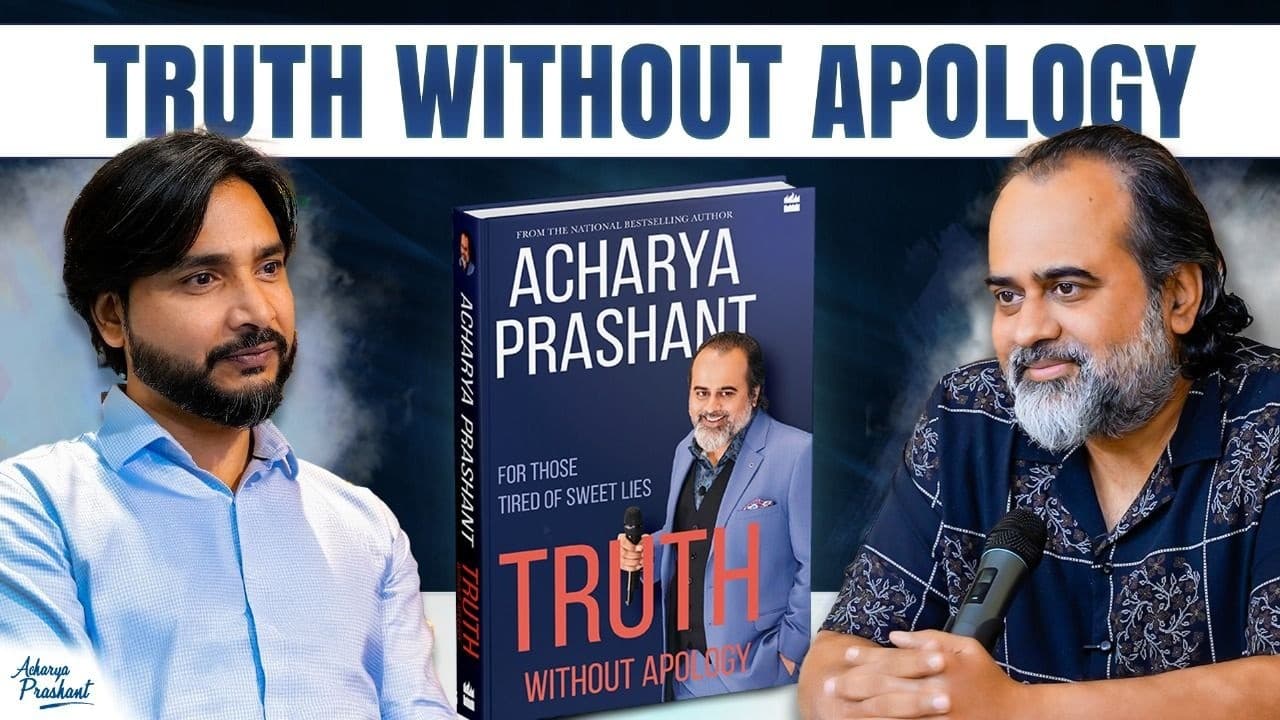
Truth Without Apology

Acharya Prashant

25 min
3.7k reads
Truth Without Apology
Life comes to us in an unending number of ways and you never know what's going to happen next. We are starved of something that really penetrates the surface. So, it is the intensity that this book brings — arrow-like depth, striking like lightning, immediately, so you don't have a chance to escape away from it. Like a Zen koan: very brief, very effective, and does its work in a snap. You could open just any chapter from anywhere and find it as if it was written just for you. This summary is AI-generated. Please read the full article for complete understanding.

HarperCollins: Acharya Ji, Namaskar. It's a pleasure and a privilege to have you. I'm going to say this for sure: we are going to miss you in Delhi because you were supposed to be in person. But I know you're working on something very, very important. Please tell us what is keeping you in Goa, sir.

Acharya Prashant: Goa to me is an absence of a lot of things that hinder my work on the book. So, I'm especially here to take the book to a height of precision and perfection that would leave nothing wanted. I don't want to have any compromises of any kind. I want to challenge any little bugs, any absence of sharpness that might have remained, and that's what I'm doing here — devoting many hours to the book daily, though technically the book is already complete, the book is complete for almost 10 days now.

But then I'm ensuring more iterations, going through more chapters again and again. And Goa helps, Goa helps in a big way, not because it offers something extra but because of the absence of many things that I otherwise face. So it's a beautiful place, and I'm really enjoying the beautiful work I'm doing in this beautiful place.

HarperCollins: And I must say, Acharya Ji, the excitement is absolutely building. It's been 3 years since you last published with us — your book with us, Ananda.

Acharya Prashant: Yes.

HarperCollins: And I am one of the few lucky ones who had the chance of reading the manuscript of Truth Without Apology.

Acharya Prashant: Thank you so much.

HarperCollins: And I must say this: this is by far the most value per page in a book that I've read this year, without any exaggeration.

Acharya Prashant: Yes, there would definitely be value per page. But the format didn't come out of that calculation. The format actually arose from the nature of Truth itself. You see, it strikes instantly, like lightning, like a sudden bolt. You don't always have to wait for it to gradually emerge after 300 pages. One sentence may suffice, one event may suffice, one action, one insight may suffice. Plus, it is multifaceted. You never know where it is going to come next from. And it can come from anywhere and everywhere.

So that's why we have 200 chapters this time, all brief, all succinct. They are all addressing the various aspects of life, but all pointing towards the same underlying Truth — not in a positive way, but in a way of disruption, in a way of challenge, of negation.

We live in an era of sweet lies, right?

HarperCollins: Yes.

Acharya Prashant: And that forms part of the title of the book Sweet Lies and Curated Illusions. So every brief chapter is like an arrow, not like an essay. It's like an arrow to deliver results instantly, to reach one particular pinpointed place, and there are just so many places in our daily lives. So therefore, we are trying to look for things wherever they are and address them as they are.

HarperCollins: Acharya Ji, there's an interesting observation that I had. When we signed you for Ananda, I think four or five years ago, you had on social media 2 million followers. I consider you the thinking generation’s icon because to us you have an image which is unlike any speaker or guru in the current parlance. People in this age and time like to be told comfortable lies. They don't want anyone’s plain-speaking, lekin aapka jo andaaz hai, aapka jo approach hai, that is absolutely, sometimes, it's almost abrasive, if not too harsh.

Now please explain this to me, from 2 million, today you have 80 plus million followers across social media.

Is it the age that people have started liking harsh Truth?

Acharya Prashant: You see, it's an interesting thing, almost mysterious. On one hand, it is true that the audiences just didn't arrive on their own. We had to chase them relentlessly, and we still chase them very passionately. That's a big part of the mission. So that is one part of the answer.

And the second part is, we talk of people seeking comfort, but beneath all the comfort and conveniences that they seek, the one thing every human being is really after is the Truth. It's just that Truth appears unapproachable and also sometimes too risky or costly. So we settle for convenient substitutes rather than the real thing itself.

But even in the convenient substitutes, it is the real thing that we are postulating, or projecting, or trying to get some kind of compensation for. So if the real thing — the naked reality as it is — if that can shine, why would, and for how long would anybody want to escape from it? So what I'm saying is, when people run away from the Truth, they are actually running away towards something that at least looks like Truth, right?

HarperCollins: It's their version of Truth.

Acharya Prashant: It's their version of Truth partly because the real thing is not available and partly because it appears too expensive. But if the real thing can be brought to them, and they can have some kind of assurance that even if the costs appear forbidding, the benefits far outweigh the costs, then they do slowly come.

And you talked of me being abrasive. It's partly because people need that. It's not just a need, it's actually a demand that comes from them. I'm not in my personal self an abrasive person, or necessarily harsh, or dominating, or whatever. None of those things. But you could call this a requirement of my relationship with the seekers. Mollycoddling they have had enough of. What they really need is the real blunt thing that exposes to them where they are stuck, and in how many different ways we are all stuck, and pointers at how we could shift from where we are.

HarperCollins: So do you also, as a result of it, get hotly worded or hate emails or threats as a result?

Acharya Prashant: Yes, that's a part of the deal that comes with the package. And that has to be accepted, not just with indifference but if possible with gratitude, though that is not easily possible, I tell you. But that's something that you sign up for when you say that you will be responding to life as it is. And life as it is today is not quite pretty.

HarperCollins: Absolutely.

Acharya Prashant: When you say, be it capitalism, be it the environment, be it the injustices of several kinds, be it religion, be it caste prejudices, be it technology, be it economics — you are going to respond to all these things in life wherever you see them. Then obviously all kinds of reactions will come your way, and you have to be prepared for it. You know it's happening.

HarperCollins: Absolutely. Acharya Ji, when we were growing up, we were used to this word in Hindi called Satya-sheel. Now as I stand, and where we stand as a society today, I think to me Satya-sheel — having Truth and also the ability to be affable. It sounds like an oxymoron in today’s day and time.

Do you know anyone who's Satya-sheel?

Acharya Prashant: I think we need to be more clear on the very definition of Satya-sheel. You see, a sheel refers more to action, approach or attitude. If we are more clear on the nature of Satya-sheel itself, we will know Satya is the Truth, obviously. Sheel refers more to action, approach or attitude. So anything that leads you towards the Truth, tamaso mā jyotirgamaya, anything that leads you towards light, that deserves to be called as sheel, and only that which reveals the Truth to you, cutting through darkness, only that deserves to be called sheel.

Sheel cannot be a code of conduct. Sheel cannot be about being sweet or affable or nice or polite, though commonly that's the way we understand it. But that needs to be challenged, debated. Sheel is about having one-pointed devotion towards the Truth and only the Truth. And if you are living that way, then you are following sheel. And if that devotion necessitates being blunt, straight, direct — then that is indeed a part of sheel.

Truth and sheel are not two separate things. Please understand. Whatever takes the organism, the ego, towards light is sheel.

Instead, the kind of conception we have conjured is that if you are decent, polite, may I say diluted, and if you are someone who doesn't like to be blunt, to hurt people, then you are Sheelvant. No, that's not the way it is. Truth is the only absolute. Truth is the only absolute, and therefore there has to be an unflinching devotion. One cannot care for anything else. One has to be like a doctor, as the Buddha used to say.

The doctor obviously seeks the patient’s consent and tries to keep it as painless as possible, and keeps counseling also. But none of these things can come in the way of true treatment. If the patient says, “This approach is going to hurt me, I don't want to go for that kind of surgery,” the doctor is not going to really listen. The doctor would speak to the patient, counsel the patient, but ultimately tell him that that is the only method possible. If you don't want to have that, then your own well-being will be compromised.

HarperCollins: Correct. Sorry, I'm just interrupting. That reminds me, there can be no tooth extraction without pain.

Acharya Prashant: Yeah. So pain is really not something that you deliberately want to inflict on the other. But what, if what you're doing is like pulling the other out of his self-inflicted numbness? When you de-sensitize yourself to life, then you stop feeling pain, don't you?

HarperCollins: Absolutely.

Acharya Prashant: And if the writer's words awaken you, make you more sensitive and more present to your own condition, then you will feel pain. Now this pain is not something that the author or teacher has inflicted upon you. This is a pain that was always present anyway in your condition, in your pre-existing ways. It is just that we suppress the pain. We have sedatives, we have all kinds of entertainments, even titillations, so that the pain can be sidelined, ignored, subdued.

The task of the author is to bring life back to life. And when that happens, that always begins with a realization that one is in pain.

Please understand — it is the realization that might be new, it is not that pain is new, pain exists already. Otherwise, the teacher is not even needed. If the seeker, if the audience is already all right, why does one need to teach, treat or write? It is because pain exists. It is because we are already suffering that certain things are said or written.

But we are clever people. So we have suppressants, we have analgesics. My task begins with having the audience realize that we are not all right, but we can be, we deserve to be. It is possible. And it's only because of something that we have excessively done, over and above what needs to be done, that we have landed in our present condition.

So can we stop doing a few things? Can we stop fearing? Can we stop chasing?

And it's that simple. You don't have to do too many extra things. A lot that is already being done has to be seen for what it is, and then probably dropped.

HarperCollins: I absolutely agree. So far I think most of us, most of the self-help literature is treating the symptom rather than the disease.

Acharya Prashant: Yes.

HarperCollins: You know, basically addressing the symptom.

Acharya Prashant: We have a few chapters on that category also — self-help — and they begin by asking,

What does self-help mean? It is the ego treating the ego, it is the ego acting doctor.

And then you just want to remain as you are without, first of all, understanding who you are and why you are in a condition that requires help in the first place.

HarperCollins: Absolutely. Acharya Ji, I have my own publisher’s bias. You know, when I was reading the manuscript, for me it works as well for a 12-year-old as it works for an 80-year-old. But when you are writing this book, obviously you are a perfectionist. You’re writing this book with a focused reader in mind. What is your perfect reader for this book?

Acharya Prashant: Anybody who is sincere about his or her own condition. I don't really have a demographic in mind. I don't have an economic condition, strata, gender or nationality in mind. But what one definitely looks for is a genuine urge to break out of chains — of bondages, of self-inflicted misery. Wherever that is, this book would be found useful. And that's the reason, you see, we decided to have just so many brief chapters.

HarperCollins: Yeah.

Acharya Prashant: Because life comes to us in an unending number of ways, innumerable, and you never know what's going to happen next. Everything is unexpected. Though we want and we try to force-fit things a lot, we want things to be predictable and well arranged and well estimated in advance. But still, life is forever afresh, and it presents just so many faces. So that's the reason we are trying to address the various aspects of life.

You could open just any chapter from anywhere and find it as if it was written just for you.

It addresses contemporary life and tries to reveal something that is contemporary yet very ancient.

HarperCollins: Exactly. In fact, that’s what I was speaking with some of my colleagues, and I said this book is a perfect fit for this attention-deficient instagram generation. Aap kahin se bhi koi chapter uthaiye, one chapter would not be more than two pages. You read a chapter, close the book, and then ponder, think about it.

Acharya Prashant: But there's another thing I would like to say. Obviously attention deficit is a thing we all see daily, it is present. But the challenge really is more the absence of intensity. We are starved of something that really penetrates the surface. There is just so much superficiality and banality. So it is the intensity that this book brings.

Obviously, the chapters are short, and that will be an advantage to this generation, dealing with reels and all kinds of short stuff on the various media. So that would be an advantage, but the real advantage lies in the piercing intensity. That's what is missing from modern life. We have all kinds of things. We have a great spread. There is a never-seen-before horizontal proliferation — this, that, diversity, abundance. What is missing is that depth, and it is depth that this book will bring.

And I come to that word again — arrow-like depth. Striking like lightning, immediately, so you don't have a chance to escape away from it. The brevity is an advantage in that sense. You cannot say, You know, I'll come to this chapter later. Before you say that, the chapter has done its thing already.

Harpercollins: It reminds me of this advertisement many, many years ago: Inke josh se bach ke kahaan jaoge.

Acharya Prashant: Like a Zen koan: very brief, very effective, and does its work in a snap.

Harpercollins: Absolutely. In fact, the change that I've noticed in the last five years in my interaction, whether I talk to an auto-wala, a philosopher, a businessman, or a celebrity, is that everyone has either heard of Acharya Prashant or has seen Acharya Prashant's videos. Most of them would say, “Han yaar, baat to khari karte hain.” That is what — that is a consensus.

Now, I've seen you talk about climate change, capitalism, veganism, social issues, youth problems, you talk on all and sundry, almost any topic you pick and you can speak with, of course, the fundamentals being Vedanta.

What are you? What is Acharya Prashant? Is he a spiritual guru or is he a public intellectual?

Acharya Prashant: No, you see, most definitely I'm not a guru, and I would also not want to call myself a public intellectual or anything else. These are all labels. Obviously, some are even pleasing or flattering labels, but they are all very limiting things. Once you accept a certain tag, then you are categorized. And life doesn't come to us in categories, does it?

Everything is happening all around us, and as a sensitive and aware individual, you would respond to it, won't you? Or would you say that there is a certain philosophy I love and I come from, therefore I would speak only on the tenets of that philosophy? No. You respond to everything, and life is everything.

From capitalism to relationships, and these things look very different, no? What do personal relationships have to do with, let’s say, the policies of the World Bank, or environmental concerns, or the way religion is shaping up nowadays. And then there is politics, there is sports, there is technology, and there is economics. But aren't they all one? Don’t they all first of all occur to us? Are we not the one experiencer of the diversity of experiences around us? If the diversity is in the experiences and not in the experiencer, how do I say that I'm not going to respond to that particular thing in life?

Obviously, if there are constraints of comprehension, then I better keep my mouth shut. I would not want to get into the technical nitty-gritties of something beyond my ken. So, that is something I would keep away from. But then there are things that you know the details of as a matter of general awareness. You see where those things are coming from. You know where climate change is coming from. You know the relationship between climate change and culture. You also know the relationship between culture and philosophy.

So you have to see and then say that the decline of philosophy is the reason behind the rot in popular culture, and that is what is exacerbating the climate crisis. Hence, all these things are interlinked. We are the link.

The experiencer, the human being, the seer lies at the center of all life. It is this one that is spoken to by everything. Therefore, he’ll respond to everything.

HarperCollins: Now, there's one question that I had and I really wanted to ask you. For me personally, the experience of walking into a bookstore is something that I would equate with the experience of a kid walking into a candy store. I get easily distracted by books, and walking into a bookstore, looking at books, and buying books is one of my favorite activities.

Now, how does Acharya Prashant buy books?

Acharya Prashant: First of all, I want to keep away from trivia. I would usually not begin with the bestsellers, though that's not a necessary criterion. Several great books have been bestsellers as well. But before I look at the book or the credentials of the author, I look at myself. When I walk into a bookstore, I already know where I am coming from. I know my situation, my needs. And it's then that I want to see what the other has to offer.

I remain open to surprises. I remain open to novelties that might come my way. But before any of that, I want to be sure of myself. If I don't know who I am and what I want, then I'll be more likely to be carried away just by marketing. You know, someone says, I have sold 2 million copies, or a book carries a big name, and that will carry me away. Or if there is a huge publisher like you, then again I'll be swept off my feet.

So, all these things are obviously important. Obviously, if a good publisher backs an author, that does mean something. But much more than all of that, I want to know my mind. And then I'll have a long list, and then a short list.

When I buy books, I spend a lot of time. It's not a casual decision because I'm going to spend hours and hours, sometimes months with a book. And if I fall in love with a book, I return to it sometimes many times over, 3 years, 5 years, 8 years. And then I might also want to teach from the book. So that's the kind of deep and intense relationship I'm going to possibly have with a book that I pick up. So I'm very careful about what I pick up.

And then I buy a lot, because I can never be certain that I'm making absolutely the right choice. I've not gone through the pages, the words yet. Right? So I give the book, the author, a benefit of doubt. If I'm uncertain about a book, I would rather buy it. I would bring it to myself, I'll begin reading it, and if it doesn't turn out well for me, maybe I'll keep it aside. Or maybe it'll be useful for someone else.

The foundation has a rich library, and a lot of books in that library have not been read by me. But they're all good books. They deserved to be there, so they were bought. It's a very important relationship fundamentally between you and the other.

You see, even commonly, we say that you must be very careful about the company you keep. There has been somebody who is probably not even alive today, and he has poured the distilled essence of his being into those pages, right? What better company can you get? What better company? And you have been liberated from what I could say of the tyranny of the immediate.

You don't have to confine yourself to the people or situations or places around you. The fellow could be from 15th-century England, or 5th-century BC China, and you have access to him. And by access I mean access to the best part of him, because every person is a spectrum. And when the author writes a book, he presents only that which is truly valuable.

Otherwise, there are a lot of things about us, each one of us, that are very ordinary, very common. They need not even be shared, because there is no benefit to the other in reading those things. So I share the best that I have to offer you, and that is coming to you from across the world, over aeons. And therefore I say it's a very important relationship that a person has with books. It's in fact more important than the relationship we have with persons.

Harpercollins: Absolutely. And I completely agree with you.

Acharya Prashant: And if one knows how to have a relationship with books, probably one would have better personal relationships also and vice versa.

Harpercollins: Acharya Ji, you know you've made a very, very important point. You see, there's a lot of effort that goes into writing a book, and you're a testament to it. You've kept everything aside. I know you have a very, very busy schedule. You work, you know, minimum 16 hours a day- commitments, speaking commitments, this commitment. You've kept everything aside, you're just focused on the book.

So your role as an author and our role as a publisher is obviously important. But there is something even more important, or a very solid link, in the author and the publisher reaching the reader and that link is the bookseller. You know, the bookseller, the distributor, I feel they're doing a noble job. It's not just commerce. There's a lot of passion in it. There's a lot of motivation.

So I know we are not going to see you in person in Delhi, but in this room we are going to have all our distributors and booksellers from across India who are listening to you. What message would you like to give them?

Acharya Prashant: First of all, a big thank you, because I have been assisted in no small measure by the operations on the floor. I remember people, I remember faces, names. And when I would be at the bookshop, and I was a frequent visitor, they would know me. And I have benefited from their suggestions, recommendations, and they are the ones who know the authors. They also have the knack to know the book reader, the buyer, and they can potentially do a marvelous job. And I have greatly benefited from some of the booksellers and their staff.

And it is my moment to convey my gratitude to them. And in fact, I would like to thank you also, because this is probably the first time such a question has come to me, and that has given me the opportunity to express thanks.

HarperCollins: And on that note, Acharya Ji, we know you have a very, very busy schedule, but we will not leave you without a request and that request is: wherever you're traveling, we will make sure that you sign as many copies of your upcoming book as possible.

Acharya Prashant: I'll be very, very glad to do that. And even as we would wind up this interview, I'm going to return to the manuscript, I assure you, because that's what fills my days and nights since the last few weeks.

Just yesterday I was thinking that once I send it over to you, there would be a void in my life for a while, almost like that postpartum experience when the mother delivers the baby. Sometimes it happens that she feels a certain blankness — what next to do? So your book has been such a companion with me. It's present even in my dreams these days. So I'll return to it.

HarperCollins: Thank you so much, Acharya Ji. And this is music to a publisher’s ears. Thank you so much.

Acharya Prashant: Thank you.

HarperCollins: Thank you. Namaskar.

The book is now available. 👉 Purchase "Truth Without Apology" on Amazon

This article has been created by volunteers of the PrashantAdvait Foundation from transcriptions of sessions by Acharya Prashant
Comments
LIVE Sessions
Experience Transformation Everyday from the Convenience of your Home
Live Bhagavad Gita Sessions with Acharya Prashant
Categories