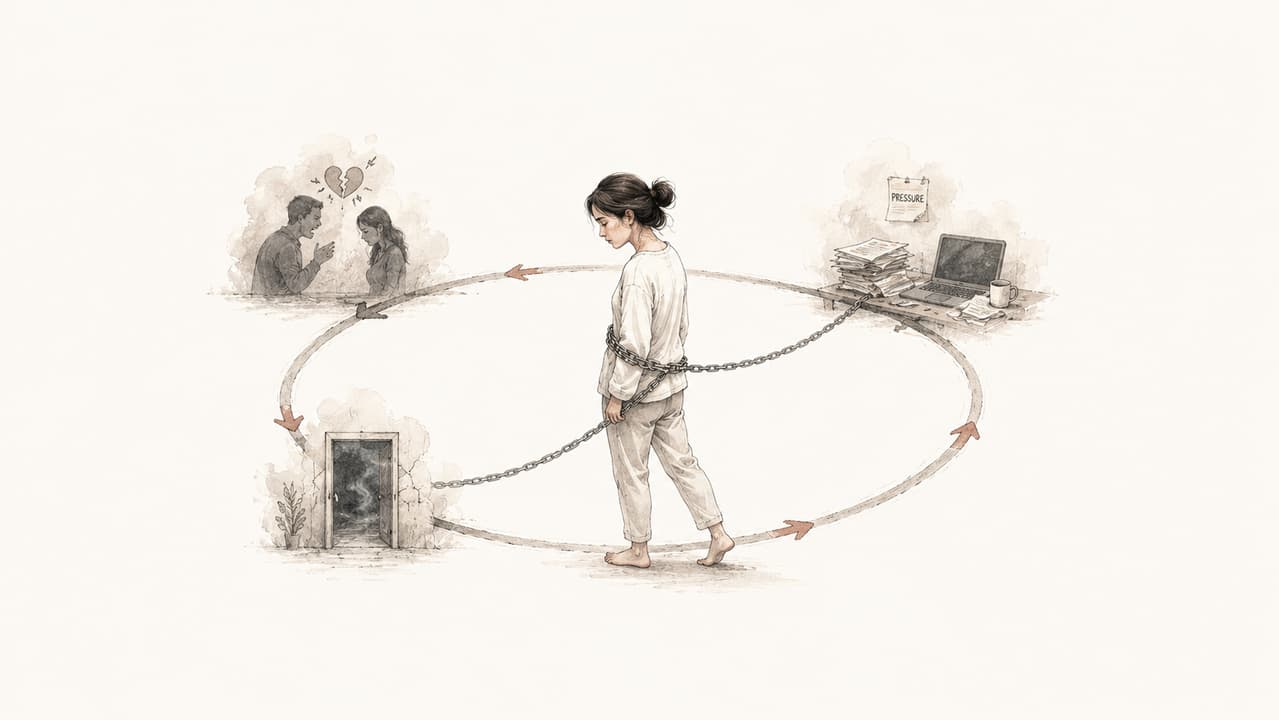
When your expectations are not fulfilled, that is the situation you call anger. Your expectation is nothing but a desire that the other person should behave according to your image of him. You create images because you are afraid. If you are not afraid, you cannot be angry. All these diseases come from a basic fountainhead — ignorance. They go away once ignorance goes away.
Acharya Prashant: It's not about anger at all. Anger is a misplaced subject of discussion, and so much has been said about anger. People keep talking about therapies related to anger. Will keep talking of anger as some kind of affliction.
Questioner (Q): I see that I want to say a lot of things but I don’t, and I just be a coward. So, for example, I saw a man whip a bull with a stick but he was doing it behind the ears, under the chin where it really hurts,
The common man aspires to be a criminal, a respectable criminal albeit. “I am a respectable government officer”—we very well know what all that implies. And we are not talking of Seshans and Khairnars here; we are talking of 99.99999% of the government officers.
Questioner (Q): Acharya Ji, I have been at a stage in life where I would get angry at God. My understanding of God at that point was, that there is an external entity out there, overseeing everything, trying to protect the entire world.
You need to pass through the entire spectrum of living. You need to experience maddening anger. You need to experience the rising force of lust. You need to experience the terrible temptation to be dishonest. You need to go through all of this without suppressing it, without being equivocal about
How do we justify our anger? We justify our anger by feeling short-changed, cheated, or victimized; by continuing to assert that we are incomplete, while simultaneously bemoaning the incompleteness. If you have grudges within, if you feel a victim of situations, or past, or persons, and if you lend credence
If you are in a railway coach, and that too an enclosed cabin with two fellow passengers, and it’s just a journey, let’s say, ten hours long, and those two guys are constantly squabbling, what would it do to you? If you are very patient, you will try to sleep.
Acharya Prashant (AP): I was asked how to get out of aggressiveness. First of all, you have to totally forget that aggressiveness is the issue. All problems arise from ignorance, all problems including aggressiveness. And it is a part of ignorance to assume that aggression is an important problem or
Anger is not a disease in itself. Anger is an indicator. Anger is a very powerful and gross indicator. Anger becomes necessary so that you may see how bad your condition is.
Yes, we are animals. We are animals, and animals can get extremely violent if they discover their mates being stolen away.
There was one board I once read. It said, “How to be cautious of dogs?” It particularly warned against disturbing dogs on two or three occasions. One, when they…
Success never quiets the anxiety underneath it. Hustle culture runs on karma — a restless cycle of chasing the next job, package, or achievement in hopes of filling an inner void. Young professionals in Bangalore who've "succeeded" on paper remain fearful, ashamed, and unsettled within, proof that success is a liar: it promises liberation but delivers only debt. Anxiety itself traces not to the future but to a present that's been neglected, and real freedom from restlessness begins only by turning inward.
Science can examine material claims, but Advaita Vedanta deals with the subjective self, ego, suffering, bondage, and liberation—areas outside science’s objective framework. Vedanta need not be accepted because of one’s religion or tradition; its value lies in whether its insights can be personally verified and help free one from suffering. The ultimate responsibility is not toward any philosophy, but toward oneself: to live a truly free life.
Superhero films appeal to our desire to escape inner inadequacy through external power. The fantasy of an ordinary, fearful person becoming extraordinary reinforces the ego’s belief that more strength, money, possessions, or status will bring happiness. Consumerism follows the same pattern, endlessly adding objects to fill an inner void. Real freedom does not come from becoming more powerful or acquiring more, but from honestly seeing and understanding the ego that feels incomplete.
Spirituality does not replace the fear of ghosts with belief in God. It asks us to question the mind that creates both fear and belief. Ghosts, gods, and stories can all become projections of imagination. The spiritual path begins by dropping assumptions, investigating “Who am I?” and understanding the source of suffering. With attention, right knowledge, and self-inquiry, fear loses its power and one becomes inwardly free.
Global conflicts stem not from geopolitical interests but from the ego's fundamental incompleteness. Nations are merely expressions of collective egoic consciousness. Leaders represent humanity's worst tendencies, not its average. The ego requires duality and boundaries to survive. True disarmament means detoxifying the ego itself. External wars reflect internal disturbance. No diplomatic solution addresses the root cause, only wisdom and self-knowledge can dissolve the ego's need for conflict and separation.
There can be no self-respect without self-knowledge. And we have been repeatedly saying that the ego survives only in lack of self-knowledge. The less you know yourself, the denser and more crystallized your ego is. Self-respect is nothing but self-awareness. The more you know yourself, the more you realize who you are not, and that brings you to who you are. That is real self-respect, knowing oneself.
Let’s drop the notion that anger is inherently evil. There is an anger that arises out of frustration—frustration that your desire could not be fulfilled. If there is one thing you may want to call bad, it is misplaced anger. There is no worse sight than a young man who cannot be angry. Be angry for the right reasons. Let your anger spring from the right center, not from your petty self.
Acharya Prashant: If anger besets you, look at your entire life, the full spectrum. Nothing short of that would do. Anger is not a disease in itself; anger is an indicator. And, anger is a very powerful and gross indicator.
Anger becomes necessary so that you may see how bad…
Anger is not a disease in itself. Anger is an indicator. If we could have anger without any side effects, how about that? Exciting? Anger becomes necessary so that you may see how bad your condition is. Anger is a message that the entire spectrum of twenty-four hours is going wrong. A message that you are not living rightly.
1
I am not talking of your confidence arising from skill or knowledge. I am talking of your confidence arising from the realization that no business is God. And that the Truth remains with you even if your business fails and the Truth does not get amplified even if your business prospers. Read more....
Excerpts from Articles
ज्योतिष कितना सच है? कुंडली, ग्रह-नक्षत्र: इनका क्या अर्थ है?
वेदांत को केवल इसलिए सही या श्रेष्ठ नहीं माना जा सकता कि वह किसी विशेष परंपरा से आता है। विज्ञान जहाँ भौतिक जगत की वस्तुनिष्ठ जाँच करता है, वहीं अद्वैत वेदांत सीधे मनुष्य के ‘मैं’, उसके दुख, बंधन और मुक्ति की पड़ताल करता है। इसकी कसौटी वैज्ञानिक प्रमाण नहीं, बल्कि अपने जीवन में इसकी सच्चाई को देख पाना है। किसी दर्शन को मान लेना नहीं, बल्कि उससे स्वयं को मुक्त करना ही उसका वास्तविक उद्देश्य है।
Climate change is more than an environmental crisis—it is a crisis of human choices. Our patterns of consumption, consumerism and endless pursuit of more are putting increasing pressure on the planet. But meaningful change does not necessarily begin with new technology or stricter policies. It begins with a deeper question: what are we willing to change within ourselves?
Animal cruelty: Who deserves mercy, and who doesn’t?
Violence begins long before the knife or the slaughterhouse—it begins with the ego, the one that draws boundaries, seeks justification, and decides who deserves compassion. Laws and reforms may reduce suffering, but they cannot end violence while the ego remains intact. When the ego dissolves, exploitation ends naturally, and compassion no longer depends on regulation or moral boundaries.
You Don't Understand the Bhagvad Gita, But You Still Claim That You Love Krishna?
The Bhagavad Gita deserves reverence not because of inherited beliefs about its author, but because of its power to dissolve falsehood and reveal Truth. Real devotion is not ritual or blind faith—it is understanding, inquiry, and living the wisdom of the Gita. Through sincere study, one discovers the true meaning of Krishna, making the Gita the most authentic path to knowing and worshipping Him.
Victory is not decided by the trophy you hold but by the battle you choose to fight. Real strength lies in making the right decisions, staying true to your deepest values, and refusing to be ruled by fear or circumstances. When your actions arise from clarity rather than ambition, the outcome loses its power over you. The moment you choose the right path, you have already won.
Struggling to choose between a secure job and the path you actually feel drawn to? This isn't really a question about careers. It's about why other people's opinions have so much power over you in the first place. Real clarity doesn't come from finding the 'right' choice. It comes from honestly looking at your own fear, again and again, until it stops running the decision for you.
कई तरह के डर—अकेले पड़ने, छवि खोने या छोटा समझे जाने—की जड़ अक्सर अतीत में बनी पहचान और कहानियों में होती है। शरीर की हाइट जैसी चीज़ों को समस्या मानकर उनसे जूझने के बजाय उनकी अप्रासंगिकता को समझकर आगे बढ़ना चाहिए। अतीत को दबाने से मुक्ति नहीं मिलती; उसके करीब जाकर अपनी स्मृतियों, धारणाओं और पुराने पैटर्न को निष्पक्षता से देखना ज़रूरी है।
Acharya Prashant: Latha is saying, why does she get angry so often even over small matters? Especially with some people, she is unable to control anger and she says she tried to change her attitude but hasn’t been quite successful. She is saying, now, how to change myself. Because anger…
Question: How to deal with a short-tempered person?
Acharya Prashant: Why are you only asking about how to deal with those who are very short tempered? There are different people in the world, some are short-tempered and some are long-tempered (laughs).
People have different natures. If you’re aware, attentive,…
If somebody gets angry, he is called psychotic. Is…
…
Question: Moving from opinions to the realm of facts, I feel an intense need to look very closely at my mind’s desires but there is anger. What is this anger and why is it there? I want to understand it.
Speaker: Realization becomes anger in absence of action. You get…
Questioner: Acharya Ji, we use anger as a weapon and it's a weakness too. How to stop anger from becoming a weakness and why do we get angry?
Acharya Prashant: When desire is not fulfilled Parul (Questioner) then one gets angry, you know that. So, it's not about anger. It's…
The common man himself takes pleasure…
Share
Acharya Prashant:
There is no need to stop yourself, you are already stopping yourself. I don’t think so you have ever smashed your bike against any car. So, when
…
He gets angry, so do you. Maybe the objects of anger are different. Maybe the intensity is different. He is lustful, so is he. Maybe the objects are different. Maybe the intensity is different. She is possessive, so is she. He is suspicious, so is he. He is ignorant, so…
Acharya Prashant:
There are two parts: One, how do we control or anger? Second, how do we react when somebody hurts us? You see in both these parts you are describing
…
…
Question:
Sir, I asked you a question during Samvaad that how can I get rid of my anger. You said that we feel pleasure while getting angry. You said I need to think before getting angry that to whom am I showing anger. I need to think of relation with
…
…
…
Questioner (Q): When I am not able to complete a task or meet a deadline, I feel the need to punish myself. I will maybe skip a meal, or if I have planned to do something with my friends, like going out or cycling or something, I will skip that;…
Brahm
is truly greater by manifolds, then what motivation would I have to perform the mundane duties, chasing worldly desires like wealth etc.? I cannot just sit doing nothing, thinking that my kids will have an education and
…
…
Subtle signs of discomfort and bad living are always there, but one misses those signs. Because you miss
…
Acharya Prashant:
There is very little that you can do, when you are already in the middle of a crowd. Stimuli are raining upon you from all sides, responses are demanded. Every
…
Share
Do you see what is violence? To forget God, to forget the Truth. What is non-violence? To fight that which makes you forget the Truth.
So, non-violence actually means you have to fight. If you are not a fighter you cannot be non-violent. The false is to be fought, and…
Struggling to choose between a secure job and the path you actually feel drawn to? This isn't really a question about careers. It's about why other people's opinions have so much power over you in the first place. Real clarity doesn't come from finding the 'right' choice. It comes from honestly looking at your own fear, again and again, until it stops running the decision for you.
Climate change is more than an environmental crisis—it is a crisis of human choices. Our patterns of consumption, consumerism and endless pursuit of more are putting increasing pressure on the planet. But meaningful change does not necessarily begin with new technology or stricter policies. It begins with a deeper question: what are we willing to change within ourselves?
Reaction is an instinctive, unconscious response rooted in ancient survival mechanisms, while response arises from consciousness and understanding. Our biological instincts evolved for survival, but modern life demands that we move beyond them. Emotional reactivity makes us predictable and controllable, allowing others to manipulate our emotional triggers. True freedom lies in pausing before reacting, examining emotions, thinking deeply, and responding consciously rather than living as slaves to instinct.
कई तरह के डर—अकेले पड़ने, छवि खोने या छोटा समझे जाने—की जड़ अक्सर अतीत में बनी पहचान और कहानियों में होती है। शरीर की हाइट जैसी चीज़ों को समस्या मानकर उनसे जूझने के बजाय उनकी अप्रासंगिकता को समझकर आगे बढ़ना चाहिए। अतीत को दबाने से मुक्ति नहीं मिलती; उसके करीब जाकर अपनी स्मृतियों, धारणाओं और पुराने पैटर्न को निष्पक्षता से देखना ज़रूरी है।
A true relationship is not built on need, possession, or emotional dependence, but on a shared commitment to Truth and inner growth. A worthy companion reflects your reality like a mirror rather than performing a role to please you. Real love is effortless, rooted in one's nature, not expectations. When your highest commitment is to excellence and Truth, relationships become a natural outcome—not the purpose of life itself.
5
Bullying hurts deeply only when it is allowed to define one's inner identity. External abuse may wound the body, but lasting psychological wounds require inner participation. While OCD, anxiety, depression, schizophrenia, and other mental health conditions deserve proper treatment through psychiatry, lasting freedom demands self-knowledge.
Science and philosophy arise from different kinds of inquiry. Matter seeks continuity of state, while the ego seeks continuity of existence and constantly changes identities to preserve itself. Fear, danger, and suffering are rooted in the ego’s sense of “I,” not in material reality itself. Questions are valuable because they expose hidden beliefs, and genuine learning requires challenging assumptions through inquiry, dialogue, and self-examination.
6
Sixty million followers do not necessarily indicate a transformation in consciousness. Large numbers may reflect persistent outreach rather than deep commitment. Truth is often avoided not through opposition but through indifference, convenience, and self-deception. Real change requires sustained effort, inner honesty, testing one's understanding, and the courage to face uncomfortable truths instead of seeking comfort, validation, or easy inspiration.
Fear, social conditioning, and painful memories often shape how people live and make choices. True growth begins by questioning inherited beliefs, refusing to remain trapped by past wounds, and acting from understanding rather than conformity. What appears to be sacrifice is often just the abandonment of conditioned habits. Freedom comes not from external systems, but from the courage to see clearly, learn, and move beyond fear.
1
Question: Sir, people these days emphasis on the idea of the ‘Power of now’. But you say that the present is different from the now. Please elaborate.
Speaker: This whole talk about the power of now is a great sham. It is deep materialism disguised as spirituality. The present is…
Our mood is always dependent on others and situations. Results have not been up to your expectations. So now you require a morale booster, some motivating speaker. The moment that fellow is gone, your energy also goes away. But there is another way of living. Deep within myself, I find a point that no external situation can touch. Whatever happens, happens on the surface. That will remain stable, uninvolved, a non-participant. Then you are really free.
The only principle that truly runs this world, created by all of us, is the principle of greed and power. What do you think that fellow has earned his billions for? He didn't become a politician to be noble. The only thing that separates us from animals is the intellect, not the center the intellect is operated from. Don't locate the problem and the responsibility somewhere out there. We change ourselves; the world changes.
A thousand feelings: envy, fear, hatred, competition will come to you. You cannot fight them all, and there is no need to fight them. Be courageous when that feeling comes, and sit down like friends and talk. Be honest that you are the one who is nurturing that feeling all the time. Be aware that it is coming. Let it not enter like a thief. And when it comes, don’t feel small. You only need to understand, not control.
Every living being, from humans to the smallest species, is trying to change the world to suit its own needs. But this is not intended to do any good to the world, it is just coming from the little ego. And the ego will not say, “I'm not all right;” it will try to change the world. So, if your idea of ‘good’ is only relative to your personal self, is it right to impose it on others? You must be clear about why you aspire to change the world, and whether you have brought about any change in yourself first.
6
Joy is not a problem. Suffering is a problem. I am the sufferer. And if this ‘I’ is the problem, the sufferer, then firstly the ‘I’ itself has to be approached. And when I find that my efforts are getting saturated, I will have to go to a book that talks exclusively of the ‘I.’ The Upanishads are such books, because their subject matter is nothing but the ‘I.’ So, if you come across something that is dealing in stories, beliefs, and deviating from the self, you must know that it is not Vedanta at all.
The theoretical reply would be that if condemnation hurts you, then somewhere you are looking for praise. Even if it’s implicit praise or subtle praise, there is some hunger for praise. Or the inner condition that the ego has set is, don’t give me praise, but don’t condemn me either. So there is some condition that the ego is setting on the world. The fact is, the world has a movement, a flow of its own. You cannot set any condition on it. If you are getting hurt, it means there is an expectation, a condition.
At the level of the body, this world will have an influence on you, and there is no need to even contest that. Let it happen, because it is going to happen anyway. But inwardly, let there be a place so sacred that nobody is allowed to enter — not even you. And when that is there, you can freely participate in the world because you'll no longer be afraid. You'll say, “Come what may, I'm secure within.” Then you will live in deep security, and we all know how pleasing security is.