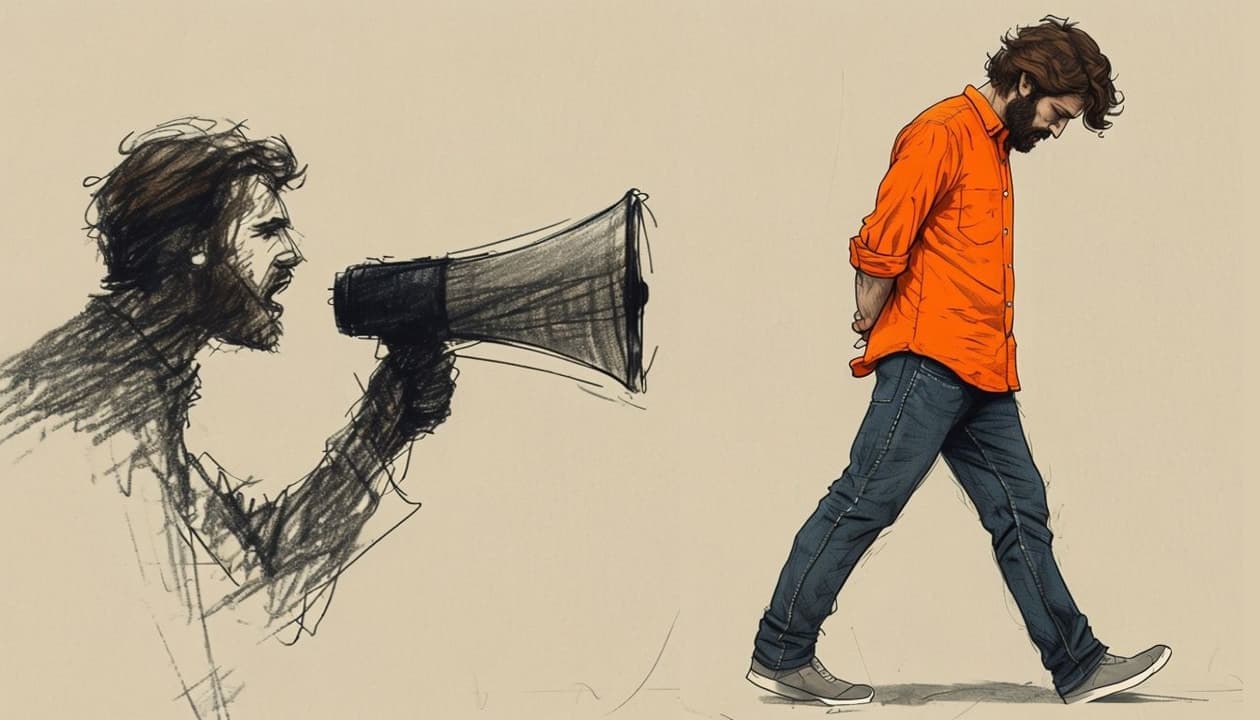
It's probably a blessing when we commit blunders that can no longer be hidden or justified because only then are we forced to admit to ourselves that we are operating from the wrong centre. When this happens and our act of ignorance harms a loved one, we cannot undo it, but there is something within us that can be undone — that's the opportunity. When guilt is real and complete, it shows you the completeness of your unconsciousness and becomes an agent of change. When it is superficial, it becomes an agent of defence.
Speaker: Rohit is asking, ‘What is it about pornography and various other kinds of expressions of suppression?’ Why is there so much in our lives that we hide, that is done behind closed doors hidden from someone, and yet we all know that it is a norm that everyone engages
Has there ever been a new mistake? How funny. That which piques you today, is it not the same thing that brought you down five years back? Oh, the names and forms change, faces change, situations change—has the tendency changed? The place where you fell, the time of the fall,
If you are fighting a battle, if you are involved in something, and somewhere along the way that thing, the process, the result of action starts hurting you, it only means that you started from a position of inadequacy, incompleteness in the very first place.
Question: Two years ago, I left my job, my girlfriend and my home. Since then, I am okay but now I don’t know whether it is okay to run away? I wonder at myself.
Many Indian parents keep their children, and especially their daughters, away from sport, even where coaches and facilities exist. The barrier is often not outside but in the parent’s own ideas: poor returns, uncertainty, and fixed notions of what a girl’s life must be. Blaming our own parents does not help either; our life is now our responsibility. Parenting is a decision of the greatest responsibility, and it begins with self-love. Can we love a child if we cannot love ourselves?
Superhero films appeal to our desire to escape inner inadequacy through external power. The fantasy of an ordinary, fearful person becoming extraordinary reinforces the ego’s belief that more strength, money, possessions, or status will bring happiness. Consumerism follows the same pattern, endlessly adding objects to fill an inner void. Real freedom does not come from becoming more powerful or acquiring more, but from honestly seeing and understanding the ego that feels incomplete.
True love is not a biological instinct, emotional attachment, or social conditioning. Biology and science explain the body's drives, but they cannot explain the self that seeks freedom. Love is the inner restlessness to move from ignorance and bondage toward truth and liberation. Religion is not rituals or inherited beliefs but this personal journey of understanding. Freedom—not possession or conformity—is the essence of both love and religion.
Truth cannot be forced upon anyone, but neither should falsehood be entertained. Genuine love is not about preserving relationships at any cost; it is about helping oneself and others break free from illusion, even if that means risking the relationship itself. Spiritual growth begins by questioning conditioning, examining falsehood without bias, and choosing authenticity over comfort. Real relationships are built on the courage to seek freedom, not convenience.
Guilt says, “I am better than my mistakes.” But for most people, it is very important to accept that they are not accidentally making mistakes; what they call mistakes is their standard state of being. So, guilt can be a great alibi against improvement. Far better than guilt is the honest and silent realization of one’s actual state. And this realization is highly transformative.
1
Questioner (Q): Acharya Ji, I want to talk about sexuality. Are there ways in which a person can healthily express sexuality?
Acharya Prashant (AP): Whatever we do is an expression. Breath is an expression, eating is an expression, these hand gestures they are an expression, and the way…
Guilt can either free you from your limitations or become a powerful defense of the ego. If you really love heights, guilt will assist you; but if you’re comfortable being pulled down, it will merely offer consolation. Far better than guilt is the realization of your actual state. Once you truly see what you’ve turned yourself into, transformation happens spontaneously.
If you see that certain things happen through you in your so-called unintentional state, then affirm to yourself, be resolute that you will never allow things to happen unintentionally through you. This resolution is the best repentance. Now you are not merely atoning for the mistake; now you are no more remaining the mistaken one. To fight against the mistake is a small battle. Totally transform the mistaken one, let him not be, let him not exist at all.
Excerpts from Articles
ज्योतिष कितना सच है? कुंडली, ग्रह-नक्षत्र: इनका क्या अर्थ है?
वेदांत को केवल इसलिए सही या श्रेष्ठ नहीं माना जा सकता कि वह किसी विशेष परंपरा से आता है। विज्ञान जहाँ भौतिक जगत की वस्तुनिष्ठ जाँच करता है, वहीं अद्वैत वेदांत सीधे मनुष्य के ‘मैं’, उसके दुख, बंधन और मुक्ति की पड़ताल करता है। इसकी कसौटी वैज्ञानिक प्रमाण नहीं, बल्कि अपने जीवन में इसकी सच्चाई को देख पाना है। किसी दर्शन को मान लेना नहीं, बल्कि उससे स्वयं को मुक्त करना ही उसका वास्तविक उद्देश्य है।
Climate change is more than an environmental crisis—it is a crisis of human choices. Our patterns of consumption, consumerism and endless pursuit of more are putting increasing pressure on the planet. But meaningful change does not necessarily begin with new technology or stricter policies. It begins with a deeper question: what are we willing to change within ourselves?
Justice Without Boundaries: Why Compassion Cannot Stop at Species
Oppression should not see caste, gender, creed or colour, and it should not see species either. The moral threshold is sentience, not intelligence. An animal feels pain as fully as a human does, whether or not it can explain its suffering.
Struggling to choose between a secure job and the path you actually feel drawn to? This isn't really a question about careers. It's about why other people's opinions have so much power over you in the first place. Real clarity doesn't come from finding the 'right' choice. It comes from honestly looking at your own fear, again and again, until it stops running the decision for you.
कई तरह के डर—अकेले पड़ने, छवि खोने या छोटा समझे जाने—की जड़ अक्सर अतीत में बनी पहचान और कहानियों में होती है। शरीर की हाइट जैसी चीज़ों को समस्या मानकर उनसे जूझने के बजाय उनकी अप्रासंगिकता को समझकर आगे बढ़ना चाहिए। अतीत को दबाने से मुक्ति नहीं मिलती; उसके करीब जाकर अपनी स्मृतियों, धारणाओं और पुराने पैटर्न को निष्पक्षता से देखना ज़रूरी है।
Life must be lived in your own light, in your own intelligence and that is ‘right’, and that is the only absolute ‘right’. And the only mistake that a young man and a young woman can make is to live life according to others. That is the only wrong that you can do. Avoid that wrong for your own sake. And then you won’t have to regret later on.
Speaker:
We often use the term ‘spiritual growth’. It is alright if it is used loosely, just to indicate something. But it is not alright, if you mean ‘spiritual growth’, as actually the
growth
of some entity. There is
…
…
“I was just fifteen years old, so I had the license to be stupid.” And when you are fifty-five, you look yourself at thirty-five and say, “You know, I was still young. I was thirty-five, so I was stupid!” And then you can laugh at yourself with abandon: “Oh, I…
2
It is when you give without having much that you realize that you have much. You must give from empty pockets. It is only then that you realize your pockets are not empty.
You have to fight without strength. It is only then that you realize you are not without…
…
Acharya Prashant:
What is shame? Can shame exist without ideals and comparison? Does shame cure and heal? Is there shame in love? Does shame lead to betterment? These and more are the questions we want to talk over.
Man is the only creature that experiences shame.…
9
Questioner (Q): When I am not able to complete a task or meet a deadline, I feel the need to punish myself. I will maybe skip a meal, or if I have planned to do something with my friends, like going out or cycling or something, I will skip that;…
2
EXCERPT: Come face to face with the fact of your being. Grand notions, or petty notions, any notions, will not work. They are not evil, they are just useless. It is just that in my dictionary, the useless is the evil. There is no other evil. That is the definition…
1
We do not deserve to celebrate. What is there to celebrate in our life? Every festival is like an examination day.
Yes, certain people do have all the rights to celebrate on an examination day; but who will be those people? Who have prepared well for those exams, who have…
Fight for the right cause…
Acharya Prashant: But do you have an obligation to not to run away? What…
Acharya Prashant (AP): Guilt is a dangerous thing, you know. A little bit of it is useful if it can lead to self-correction, but a lot of it just weighs upon the mind.
Questioner (Q): It’s like I feel really not like guilty but like ‘I could do this!’.
AP:…
2
Physical weakness does not stay physical. It becomes mental weakness, and the ego, which turns everything into an identity, starts saying “I am weak” because that line brings support and spares it responsibility. Visible strength works even unused: it keeps the opponent outside wary and silences the one within, who can no longer claim to be helpless. Keeping the body strong is therefore a spiritual matter, not vanity. Are we holding on to weakness because it is convenient?
1
A world champion asks why she cannot sleep when a teammate outperforms her, and why even big wins leave her restless. The restlessness is not a problem but unspent energy, a sign that we have more to give. When every bit of our time and attention goes to what we have chosen, there is no surplus left to worry with. The right fight is never only against an opponent; it is against the ego within. What would it mean to fight so fully that nothing is left to celebrate or mourn?
1
We often defend a bad choice by pointing to a worse one: stay dishonest or starve, keep the wrong grip or stop playing. But the real trouble is not the option we picked. It is the option we never let ourselves see. Action does not need greed or attachment to find its energy. The third way begins by rejecting both false choices, without knowing what comes next. Which of our everyday choices are really false dilemmas?
6
Oppression should not see caste, gender, creed or colour, and it should not see species either. The moral threshold is sentience, not intelligence. An animal feels pain as fully as a human does, whether or not it can explain its suffering.
1
Climate change is more than an environmental crisis—it is a crisis of human choices. Our patterns of consumption, consumerism and endless pursuit of more are putting increasing pressure on the planet. But meaningful change does not necessarily begin with new technology or stricter policies. It begins with a deeper question: what are we willing to change within ourselves?
1
Science can examine material claims, but Advaita Vedanta deals with the subjective self, ego, suffering, bondage, and liberation—areas outside science’s objective framework. Vedanta need not be accepted because of one’s religion or tradition; its value lies in whether its insights can be personally verified and help free one from suffering. The ultimate responsibility is not toward any philosophy, but toward oneself: to live a truly free life.
2
We often call something “help” or “love” while secretly expecting something in return. When that return does not come, we feel hurt, revealing that the relationship was a trade, not genuine help. The ego, being unfulfilled, cannot truly love or share. Likewise, desperation to be loved makes us controllable. Real love emerges when we stop seeking validation, work on ourselves, and become so inwardly fulfilled that we no longer need to be loved.
1
The Bhagavad Gita is not a separate spiritual path or an escape from everyday life - it is a mirror that reveals the truth of your present life. Real spirituality begins with self-observation, not rituals or temporary practices. Lasting transformation comes when work, relationships, career, and personal growth become one integrated life driven by awareness, love, and freedom rather than ego, fear, money, or social pressure.
2
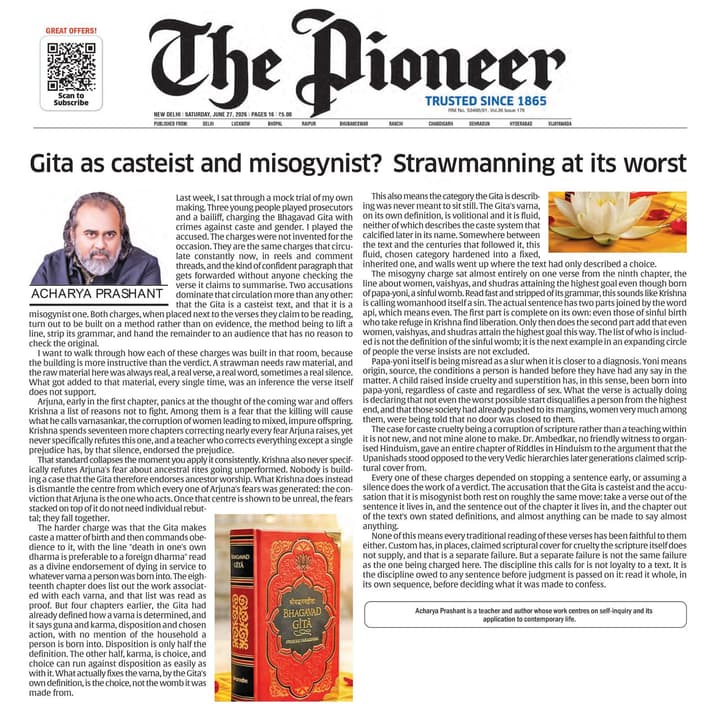
The Bhagavad Gita is often accused of supporting caste and misogyny through selective quotations that ignore context, grammar, and the text's central teachings. A closer reading shows that its emphasis is on inner qualities, conscious action, and spiritual equality rather than birth-based hierarchy or gender discrimination. Misinterpretations arise when isolated verses are detached from their broader meaning, while the Gita consistently points toward self-knowledge, freedom from ego, and the universal possibility of liberation for every human being.
Love is not a special emotion reserved for selected people or relationships but a way of relating free from self-interest, possession, and psychological dependence. Most relationships become transactions driven by insecurity, where the ego seeks completion through ownership and exchange. Genuine companionship arises without the urge to control or claim another, allowing affection to exist naturally, freely, and without conditions or expectations.
3
Human beings are born into uncertainty, surrounded by beliefs, identities, and social conditioning that offer ready-made answers to fundamental questions. Real spirituality begins not with accepting collective or personal beliefs, but with honestly examining one’s own suffering, fears, and false identities. The journey is not toward comforting ideas, but toward self-inquiry, where truth is discovered through questioning, observation, and the gradual rejection of illusion.
Science and philosophy arise from different kinds of inquiry. Matter seeks continuity of state, while the ego seeks continuity of existence and constantly changes identities to preserve itself. Fear, danger, and suffering are rooted in the ego’s sense of “I,” not in material reality itself. Questions are valuable because they expose hidden beliefs, and genuine learning requires challenging assumptions through inquiry, dialogue, and self-examination.
2
Modern relationships often create more insecurity, not less, because people are conditioned to seek completion, validation, and identity through another person. Social institutions, media, culture, and tradition continuously reinforce the idea that fulfillment lies in romantic attachment. As a result, relationships become driven by dependence rather than love. Real companionship becomes possible only when one is inwardly at peace and not using another person to fill an inner void.
1
Love is not attraction, possession, dependency, or a transaction driven by personal gain. As long as relationships arise from insecurity, ownership, or the desire for psychological completion, they remain centered on the ego. Love is simple, natural, and free of self-interest, flowing without preference or exclusion. The ego seeks security, continuity, and suffering because they preserve its identity, while freedom and joy threaten its existence. A meaningful life begins when one stops repeating old patterns, accepts uncertainty, and chooses freedom over the comfort of familiar cages.
1
Climate change, population policies, and social conflicts often arise from a common source: narrow love. People, communities, and nations justify actions that benefit their own group while overlooking broader consequences for humanity and the planet. True care is not exclusive or identity-based; it is expansive and inclusive. Even motherhood, patriotism, and family concern can become limiting when reduced to narrow self-interest rather than guided by wisdom, freedom, and universal responsibility.
The climate crisis is not merely an external environmental problem but a reflection of inner human greed, desire, and psychological disorder. Drawing from the Gita’s idea of yagya as desireless action, it says real ecological healing requires inner transformation. Outer pollution, exploitation, and destruction mirror the ego’s inner confusion, making personal consciousness and planetary health deeply inseparable.
Global conflicts stem not from geopolitical interests but from the ego's fundamental incompleteness. Nations are merely expressions of collective egoic consciousness. Leaders represent humanity's worst tendencies, not its average. The ego requires duality and boundaries to survive. True disarmament means detoxifying the ego itself. External wars reflect internal disturbance. No diplomatic solution addresses the root cause, only wisdom and self-knowledge can dissolve the ego's need for conflict and separation.
The one who is religion-less. A real Hindu does not have any religion. To go beyond all religions is to be a Hindu. There are religions that are on one plane, and then there is Sanatan Dharma, which is another dimension — the eternal religiousness. Liberation from religion is religiousness. Sanatan Dharma is awakened intelligence.
1
Listener: (Reading a quote of Acharya Prashant from a quote-calendar)
What lies beyond mind?More mind.What is more mind?What and lies and mind.Questions, perceptions on the concept of the mind.
Acharya Prashant: Any question about beyondness would be a useless question because the question itself is coming…
Love has to be seen as the need of the mind, the attraction of the mind towards Peace, towards rest. All attraction is there only with a desire; the hope is of fulfilment. So when the mind says ‘love’, along with love it has a picture of love. How do you know that somebody loves you? Only if he behaves according to set patterns. When real love comes to us, we close our gates to it. Love is not with a particular man or woman; Love is the natural state of the mind.
The kinds of meanings that we associate with love are actually quite demeaning. It’s not your own self-interest that you think of in love. Love is not an emotion; love primarily is a spiritual understanding. Saint Valentine would not be quite pleased with the meanings we have associated with his name and his day. The saints laid down their lives so that our faulty definition of love could be corrected, and that is probably the best use this day can be put to: correcting the definition of Love.
The only principle that truly runs this world, created by all of us, is the principle of greed and power. What do you think that fellow has earned his billions for? He didn't become a politician to be noble. The only thing that separates us from animals is the intellect, not the center the intellect is operated from. Don't locate the problem and the responsibility somewhere out there. We change ourselves; the world changes.
Superficiality offers pleasures. Superficiality offers cheap salvation. Therefore, it is easy to be attracted to superficiality. On the other hand, true spirituality challenges you to pay a heavy price. So, you see, all this knowledge has existed since antiquity. Yet there are people who do not want to read the Gita.
Real Love is a very pure thing. It is pure and it purifies. If you really love her, forget about the families, you won’t even bother whether she loves you, because Love does not demand anything in return. Forget about marriage or anything else. You love, you know love, and that is all, sufficient. Love unconditionally, and then a way will emerge. Unconditional Love is very, very intelligent, and knows no fear. It knows where the solution is, it will find a solution.
If you are religious, then shouldn’t you be truly religious? Religion is about a total commitment to the Truth. You’ll have to recognize that the objective of religion is not to attain heaven, not to please a holy figure, but to come to your own inner Truth. All good books exist to awaken your consciousness. When it comes to you and the Truth, do you want somebody in between? And wherever you spot fakeness, falseness, hollowness or ignorance, drop it.
There is a search within the human being, always for the greatest, the absolute, and that is what differentiates humans from animals. India was fertile, and there was abundance. You had ample leisure, and in that leisure there was space for intellectual inquiry. The sages and the seers would talk to each other purposelessly. And from that purposeless discussion, from silent observation of life for hours, days, months, and years, came those insights that you today recognize as Indian philosophy.
There is no revolution possible without the Gita. That’s the reason why even those who are not remembered particularly for their spiritual inclination, people like Subhash Chandra Bose, even they founded their core on Gita. What kind of revolution can you do if it’s the body that’s always at the top of your mind? You require a Gita to tell you that this body is perishable and would anyway go. Gita only teaches you, "Endure and fight."
This has always been a hugely profit-making sector of all economies, just that it has always been a small sector controlled by the priestly class. Now the attempt is to make this sector really big and on an organized scale, because the profits are very tempting, and there is no quality control. There can be no external auditor. All kinds of objections, audits, and scrutinies are ruled out. Getting it? So it’s a very tempting sector.