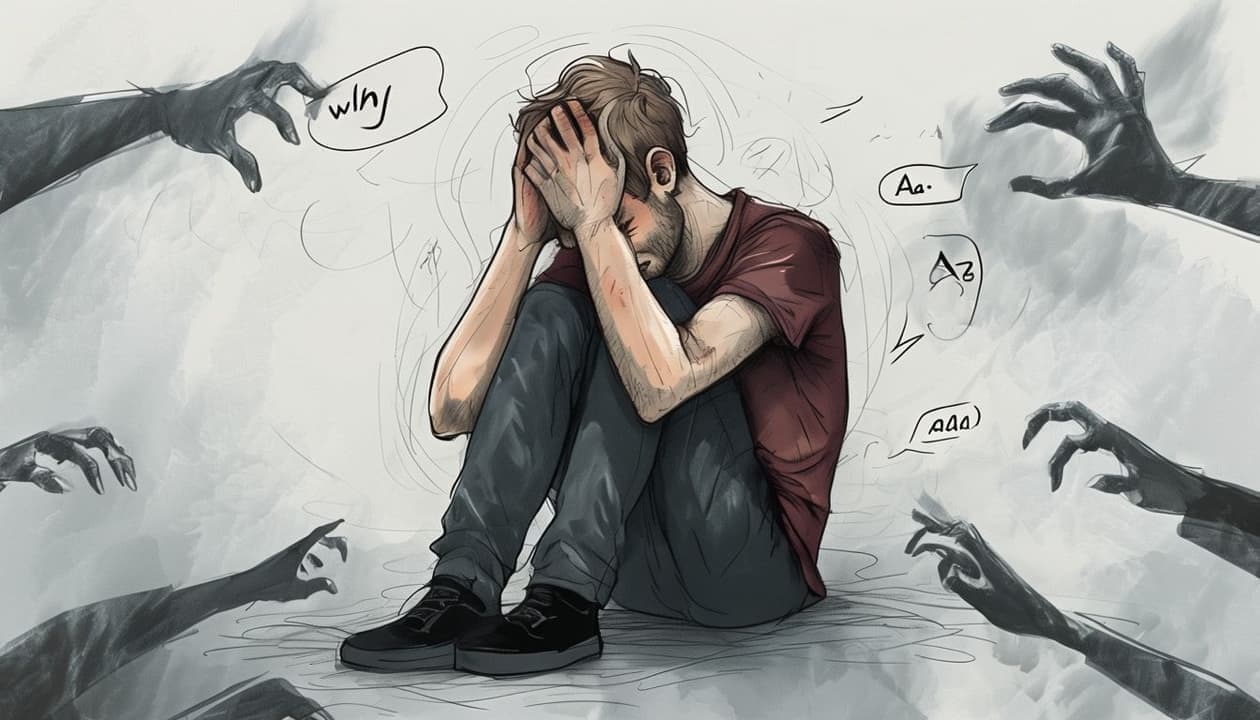
Many of us promise our parents high marks, and when the result falls short, the guilt can feel heavier than the exam itself. But no one controls results; they depend on far too many things outside us. What is in our hands is our intent, our effort and our honesty with what we study. The Bhagavad Gita says the same: our right is to action alone, never to its fruit. What if the only promise we made was to study honestly and with love?
Break it down. Just ask yourself, “How much is to be done right now,” and that’s all. Beyond that I don’t bother. You know, how the Upanishads put it? They say, “Yes, it’s infinite but it’s also very immediate; very, very far, but I also know that it’s also very immediate.” So, I’ll focus on the immediacy. Why horrify myself with the thought of the infinite? I would rather remain humble and think only of the immediate.
Questioner (Q): Life comes with so much chaos and sometimes exposes the order. So when there is chaos, we feel challenging, and we try to overcome them, and then we try to look for orders. But even when there is so much order, we feel like something is not happening
Acharya Prashant (AP): I was asked how to get out of aggressiveness. First of all, you have to totally forget that aggressiveness is the issue. All problems arise from ignorance, all problems including aggressiveness. And it is a part of ignorance to assume that aggression is an important problem or
Sisyphus pushes a rock up a hill forever, knowing it will always roll back down. A regular workman does the same thing inside a job: he keeps pushing too, except he hopes it will eventually pay off, a promotion, a house, a better life. This hope is often just a comfortable lie. Sisyphus, who expects nothing and still keeps going, is actually more honest than we are. The real question is not whether the effort is worth it, but whether we can stop lying to ourselves about it.
The mind is not an independent entity but a structure built and maintained by the ego through thoughts, memories, beliefs, and experiences. Most spiritual practices fail when they become distractions from examining the ego itself. Experiences, emotions, and preferences are often conditioned and unreliable. Real inquiry begins with observing the experiencer, admitting facts without distortion, and applying the same rigor to inner life that science applies to the external world.
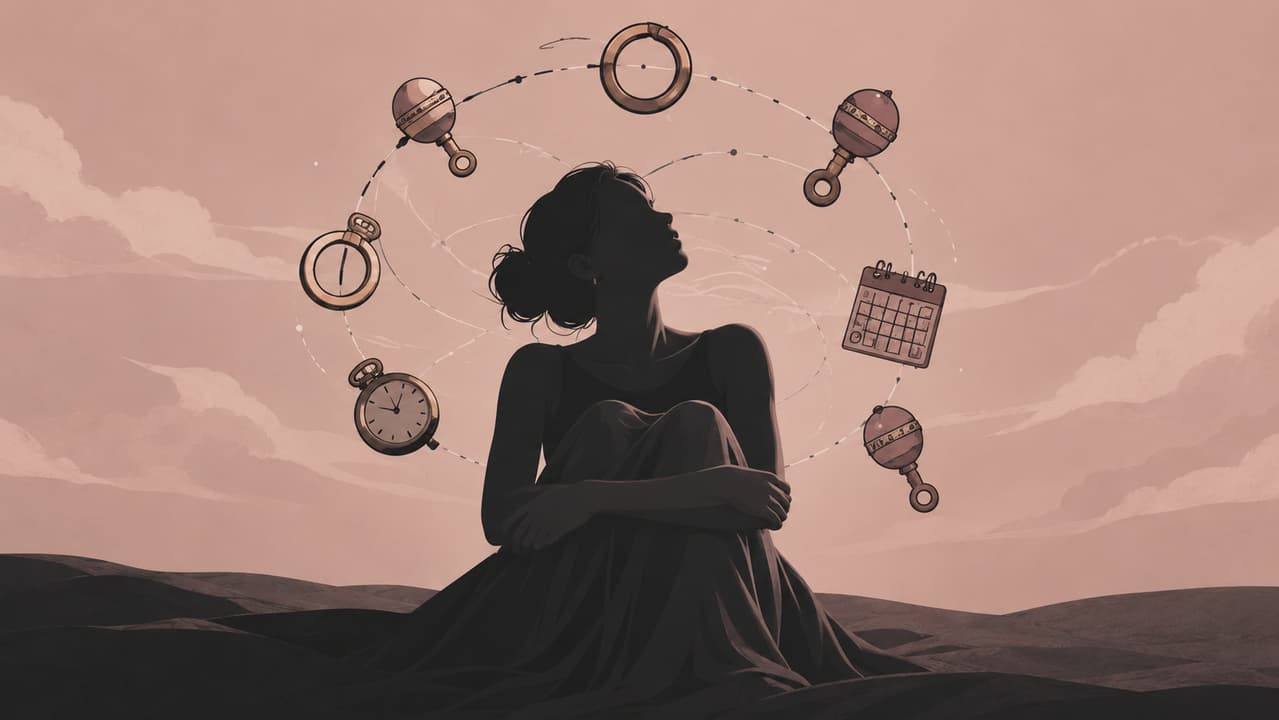
A modern woman calls herself liberated, yet lives anxious — anxious about age, desirability, marriage, motherhood. Acharya Prashant exposes this anxiety as proof that feminism never touched the real wound: centuries of conditioning that reduced women to bodies for pleasure and reproduction. External equality isn't enough. True freedom demands she reject the entire inheritance of tradition and simply become human — not woman, not wife, not mother by decree, but free.
1
Questioner (Q): Man is typically a social animal who seeks to coexist with the society around him. I am a vegan but many people around me are not, and that creates a difficulty for me. I want to speak out my thoughts on animal cruelty and get into animal activism,…
1
Questioner: I am a research scholar. I am in my fourth year of PhD, and it is kind of my second inning. Earlier I was a teacher, I was teaching at a university, but I’ve left that and I have started my PhD.
I’ve been suffering from a condition for…
Excerpts from Articles
ज्योतिष कितना सच है? कुंडली, ग्रह-नक्षत्र: इनका क्या अर्थ है?
वेदांत को केवल इसलिए सही या श्रेष्ठ नहीं माना जा सकता कि वह किसी विशेष परंपरा से आता है। विज्ञान जहाँ भौतिक जगत की वस्तुनिष्ठ जाँच करता है, वहीं अद्वैत वेदांत सीधे मनुष्य के ‘मैं’, उसके दुख, बंधन और मुक्ति की पड़ताल करता है। इसकी कसौटी वैज्ञानिक प्रमाण नहीं, बल्कि अपने जीवन में इसकी सच्चाई को देख पाना है। किसी दर्शन को मान लेना नहीं, बल्कि उससे स्वयं को मुक्त करना ही उसका वास्तविक उद्देश्य है।
Justice Without Boundaries: Why Compassion Cannot Stop at Species
Oppression should not see caste, gender, creed or colour, and it should not see species either. The moral threshold is sentience, not intelligence. An animal feels pain as fully as a human does, whether or not it can explain its suffering.
Struggling to choose between a secure job and the path you actually feel drawn to? This isn't really a question about careers. It's about why other people's opinions have so much power over you in the first place. Real clarity doesn't come from finding the 'right' choice. It comes from honestly looking at your own fear, again and again, until it stops running the decision for you.
Climate change is more than an environmental crisis—it is a crisis of human choices. Our patterns of consumption, consumerism and endless pursuit of more are putting increasing pressure on the planet. But meaningful change does not necessarily begin with new technology or stricter policies. It begins with a deeper question: what are we willing to change within ourselves?
कई तरह के डर—अकेले पड़ने, छवि खोने या छोटा समझे जाने—की जड़ अक्सर अतीत में बनी पहचान और कहानियों में होती है। शरीर की हाइट जैसी चीज़ों को समस्या मानकर उनसे जूझने के बजाय उनकी अप्रासंगिकता को समझकर आगे बढ़ना चाहिए। अतीत को दबाने से मुक्ति नहीं मिलती; उसके करीब जाकर अपनी स्मृतियों, धारणाओं और पुराने पैटर्न को निष्पक्षता से देखना ज़रूरी है।
Acharya Prashant: They still have a lot of hope. They feel that suicide would redeem them. They have not given up everything. They are still carrying a lot of hope. If I do not know what is beyond life, how can I enter that…
I watch video of yours, and I feel that I am getting addicted to your videos. Your videos and your talks have lit a fire in me to search for the Truth. But I carry on with the things which I am doing from the past
…
Acharya Prashant:
Even to reach the sanctroum of the temple, one has to pass through the peripheries, the stairs, the doors. The peripheries, the initials are all important as mediums, as methods but they must be given only that much significance. One
…
1
Question: How do I cope with the stress that is likely to come in the next four years?
Acharya Prashant: Let’s understand this situation right now.
(Acharya Ji is talking to the first year students of a premier Engineering institution of India. The duration of the entire course is four…
Questioner: How to stop the immediate reaction when we feel hurt?
Acharya Prashant: Why stop it? You don't like that reaction, right? Who is this one who doesn't like that reaction Manish (questioner)? You have said, “The reaction comes when you get hurt.” I am asking you to consider, “Is…
…
…
1
Questioner (Q): Good evening, sir. In many places, especially in college, it is seen that the person starts drinking or smoking just because of peer pressure because he has a fear that if he doesn't do this, his group will throw him out. So, what are your views regarding this…
6
Oppression should not see caste, gender, creed or colour, and it should not see species either. The moral threshold is sentience, not intelligence. An animal feels pain as fully as a human does, whether or not it can explain its suffering.
Our mood is always dependent on others and situations. Results have not been up to your expectations. So now you require a morale booster, some motivating speaker. The moment that fellow is gone, your energy also goes away. But there is another way of living. Deep within myself, I find a point that no external situation can touch. Whatever happens, happens on the surface. That will remain stable, uninvolved, a non-participant. Then you are really free.
“Immersing myself in deep meditation.” What do you mean by meditation? And who is being immersed? Please tell me, beyond a trick of words, what is this? But you’ll never ask these questions, because some Baba-ji totally dominated your faculty to question with his get-up and demeanour. Real spirituality is not about something that sounds elevated or respectable. Whenever you are bombarded with high-sounding fluff, learn to ask this question; what exactly does that mean?
This breath-in, breath-out, stomach-in, tummy-out; this is not meditation. Even animals do not need training in breathing, and we are being taught how to breathe. What’s going on? You know, you should breathe mindfully. Why? Is there anything wrong with your breath? Meditation is nothing but an observation of the naked inner fact. That is meditation. To stand naked and honest in front of what is, that is meditation.
As a doctor, can we limit our responsibility to the one particular body or to the set of few bodies that come to us for treatment? Or is the patient actually a representative of an entire society, an entire ecosystem? Can I really be a good doctor of the lungs, if I support a society that pollutes the environment in the name of development? So, if I'm a doctor, then health is my responsibility in the holistic sense, not just one patient.
2
It’s not going to be right when the patient starts playing the doctor. We need to grow up; and having a kid, in that sense, is an opportunity. You want to be of some use to the kid, then grow up with the kid.
A suicide is a sad event because it prevents us from realizing our possibility and potential — there was an opportunity to live, learn, grow, realize, and be liberated, but it was wasted. But how many of us actually manage to realize our potential even if we live to 80 years? Hardly anybody. For our species, the extent of aliveness is proportional to the freedom and height of our consciousness. So ask yourself honestly: How close am I to the best I could have been?
1
Realization is your essential nature, and that nature means nothing. That nature is neither solid nor liquid. That nature is not hot nor cold. That nature is not beautiful, not ugly. That nature is not expansive, not limited.
9
Stray dogs need garbage, and with waste reducing, their populations in urban areas are bound to decline. Not just humans, even dogs suffer — crushed by vehicles, beaten up, falling ill, etc. They can either be integrated into our homes with care and responsibility or face extinction from our streets. It is heartwarming to see humans supporting one species, but why doesn’t our heart bleed for the crowds of animals we are slaughtering every day, making many of them extinct forever? Climate change is the biggest threat and is responsible for the maximum misery to animals.
8
In Zen, the student asks a question to the master, and the reply brings sudden enlightenment. It means something had long cluttered the mind, and in one deft stroke, like a genius, the master cuts the relationship between the ego and its belief. What Vedanta does through persuasive argument, the koan does through an abrupt shock.
A dirty plate is a dirty mind. It is carrying traces. It is carrying stuff from somewhere else. Go clean the plate. If your plate is clean, if your mind is clean, what is left to be done? But cleaning the mind, making it lighter, comes like a threat. “Oh! Something in me is getting reduced. I am under attack. My notions are getting shaken up.” That’s what Zen is all about, a total shake-up! Such a shake-up that clears away all the rubbish.
6
Acharya Prashant: That's why the rājasika mind is better than the tāmsika mind. The rājasika says, “I’m not alright. I need to do something to become better. I feel inferior. I feel incomplete. I need to rise. I need to achieve.” That’s the rājasika mind. The rājasika mind at least…
14
The hurt that you have received is a result of your own lack of understanding about the nature of life. This is an opportunity to understand life. It is an opportunity to not let the previous mistakes be repeated.
8
I'm not asking you to be a loner or an avoider of human company. It's just that things must be given their due place — and their due place depends on their quality. If you do not have good quality people around you, there are many other better options. Why not spend your evenings learning to swim or sing? And there could be so many other things. I mean, you would know better.
For change to happen, somebody has to be a change agent. But if that agent starts thinking, “I’m not exploited; I benefit from this discriminatory system too,” then who will demand change? My employer earns 11X from my intellectual labor, pays me X, and saves 10X. But that X enables me to run my household and fulfill my dreams. So, will I ever rise and rebel? The system bribes you into submission. The exploiter incentivizes the exploited to stay exploited.
7
The parts of the Upanishads that do not deal with self-enquiry can be taken as outdated. They do not want to address things that change with time. Mankind today is more prosperous than it has ever been in its history — but internally, are you not still afraid? Are you still not greedy? That’s the problem of the self that the scriptures seek to address. The Upanishads are dealing with a very peculiar problem that time alone cannot address — and that is the problem of fundamental human suffering.
When you look into the eyes of an animal, and if you are really awake, you will only see your own deep innocence, which might be hidden from you. It is impossible to see anything or anybody else when you really look. That thing that you look at, and that which looks back at you is most prominently visible in the eyes. Look at the animal, pause and meditate for a while — and then go ahead and slaughter it, if you can. You’ll only be slaughtering yourself.
If God stands for innocence, trust, surrender, then animals are closer to God. But man values himself by his ability to exploit. If you always feel hollow and hungry, then the entire universe is but a resource for you. One then wants to exploit the man, the woman, the child, the animals — everything. So, someone who does not want to look at the universe as a resource will not want to kill or consume anything in a violent way.
Whenever the past bothers you, you should immediately know that some danger is lurking in the present. Had the right thing been happening to you right now, then you couldn’t have been bothered with the past. And that is what the past does. It serves as a very deceptive distraction from the present. Figure out what is happening today.
The reason is that we have internalized a utopian image of a suffering-free life. And our current state of suffering, compared with the utopian heaven, makes us very frustrated. So, keep this comparison aside by seeing that this utopia is purely imaginary. You are not born to be in bliss. In fact, suffering is an inevitable part of life. Take life as it is, and then do your best to raise it as much as possible — this is excellence.
The truth that we all inwardly love without even knowing we are in love. That truth is independent of time. It is independent of everything that's temporal, geographical, spatial, cultural. Spirituality has nothing to do with the clothes that you choose to wear, the language you speak, the way you behave, whether you address someone as this or that. facing a particular direction while eating or sleeping. No.
Question: What do I do to cross the river? To me, it is such a challenge.
Acharya Prashant: Crossing the river is easy. Just hold the hand of someone who knows the other side, and cross. You have already crossed the river a thousand times with me. Your failure is…
The same suffering that we hide behind so many things— entertainment, even knowledge, so-called distractions, achievements, pleasures, accumulations, prestige, sanctions, and approvals from all around. We hide that fact of human suffering behind all these things. So, it's a big problem. It's a big problem that we want to address. So now, I want to look at — why am I suffering? Why am I suffering?
There has never, ever been anybody 100% sorted. There are always challenges, and those challenges arise from the body itself; your enemy is within you, and it will remain as long as you are alive. So, learn to revel in this situation — it's called life. And instead of asking for a final victory, start asking for a good battle — battles where, even in your pain, you can say, “This one was good!”
And with human beings becoming more powerful technologically, economically, the little being at home is even more staggeringly at the mercy of the grown-ups. The little one is absolutely at the mercy of everybody else. And these grown-ups, they have so much today. Don't you see how human consciousness and the corruption within it is manifesting itself in a 100 ways and sexual exploitation of vulnerable sections is just one way this corruption is manifesting itself.
You didn't have anything special in the past. Had we had anything special in the past, then we wouldn't have come to the state of suffering we find ourselves in today. So, the past is not the solution. You have to realize how things are with you today. You have to look at your interactions with human beings today. You have to see how you relate to your body, to your friends, to your workplace—all these things. And from there, you—you develop an insight, and that insight offers, some freedom.
If you know that a thought is not beneficial to you, you won't support it, and it cannot survive. So, if a bad thought continues in your mind, it means you're only calling it a "bad thought," yet deep down, you support it. Deep down, you think it is a ‘good thought.’ Had you really known it was ‘bad', it would have gone. But our minds are full of so-called bad thoughts. What does that mean? We call them ‘bad', but we do not truly consider them bad. We enjoy them.
Shallow philosophies and false treatments do not work for anybody. It's another matter if we want to keep fooling ourselves. There has to be self-love. There has to be courage. One has to say it's all right to be devastated and destroyed but it's not all right to keep yielding moment by moment the way I do.
Outgrow. Outgrow your past. Look at your past and say, ‘Oh, she's a different girl. She's not me. And, I find no pleasure even looking at her. I mean, all right, she's a younger self, some kind of a younger sister— cute, all right, but nothing of much interest to me now. I have better things to look at. I have more important stuff to attend to.’
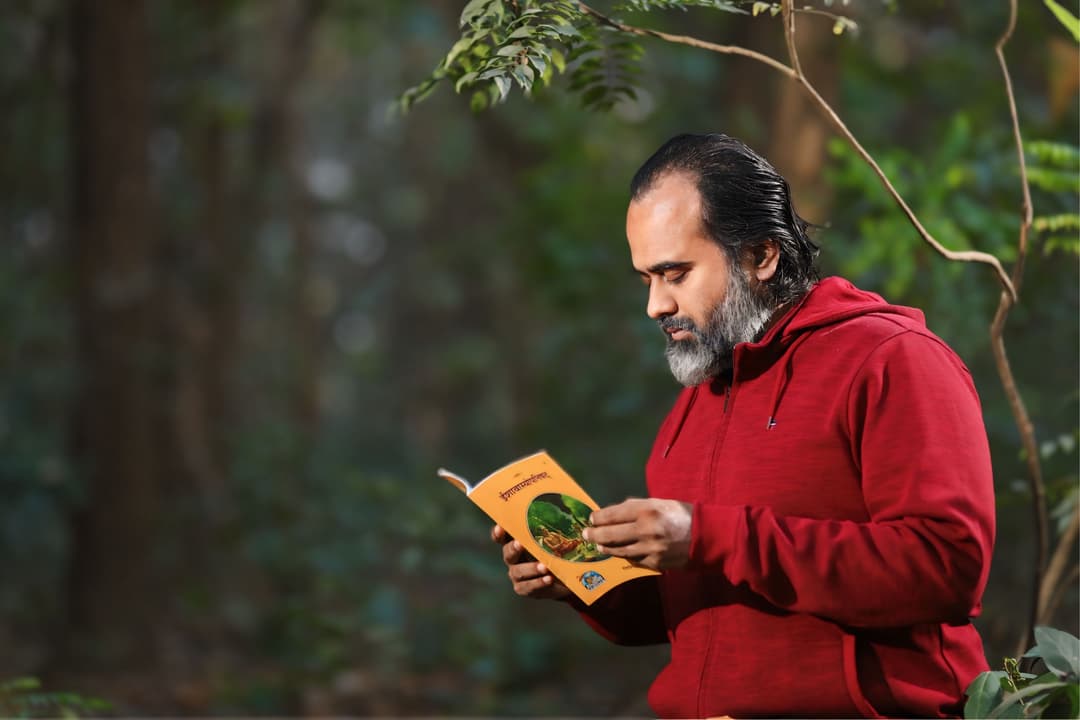
The Gita is useful because its setting is extremely relatable. Just like us, Arjuna does not know himself—he's a victim of multiple identities and all kinds of conditioning. Therefore, the Gita is about letting Arjuna know who he is, and this illumination enables him to do what he must. So, first of all, see that you are Arjuna. Then, step by step, verse by verse, there will be some resolution.
All words have existential connotations to the ego. That existential connotation is the meaning. If that connotation is removed, words will do nothing. All words carry something that impinges on your very existence. If you can clear the word of that, then words will remain just words, and no words will have the power to shake you up or disturb you.
It's a very, very dangerous notion if you say—"You know, all the fun, all the pinkness, all the tenderness lies in stupid kind of notions. And everything that is conscious, elevated, sublime—is dry." It's very dangerous and you are becoming a victim of the propaganda of the juice sellers. There is nothing more fascinating than the truth. Go ask that to those who have dedicated their lives to the service of truth—exploration, discoveries.
No, no, you don't have to be empty of anything. You just have to be empty of the choice to use anything in your defense. You are born with ammunition; you don't have to keep the ammunition aside. Let the gun be there with you—just don't fire at the teacher. That's all that Shri Krishna is saying. You don't have to empty the gun. Keep it loaded; it's all right.
Meditation is the submergence of the ego in its essential nature. It is at the root of all self-knowledge and wisdom. However, most often, what we call meditation is just escapism—using some ‘method of meditation’ to superficially soothe our restlessness or gain temporary and deceptive relief from stress.