Acharya Prashant: Second sutra says, “Knowledge is bondage.” To know too much is hell!
Listener 1: Ignorance is bliss!
A.P: Ignorance does not exist; only knowledge exists. Great knowledge is called ignorance. When you know a lot, then you are called ignorant. There is nothing…
Even when you want to worship Shiva, you only worship him with his eyes half-closed, deeply absorbed in meditation. You do not want to look at the tāṇḍava mudra (dance of destruction form) of Shiva. Yes, there are a few temples, there are some infrequent references, but largely you do
Detachment and ambition are not opposites. Both arise from clear insight into what is truly valuable. Detachment means naturally dropping what is seen as false, futile, or harmful, while ambition means pursuing the highest and most meaningful truth with complete intensity. Spiritual surrender is continuous: as understanding deepens, false attachments are repeatedly abandoned, until renunciation becomes natural and almost choiceless.
True freedom begins when we question the beliefs that make us feel trapped. Most of our suffering comes not from circumstances but from unquestioned assumptions, attachments, and imagined obligations. By suspending our beliefs, even briefly, we allow truth to enter, revealing that life always offers choice. Transformation is born from love for truth, the courage to let go, and the willingness to step beyond the boundaries created by the ego.
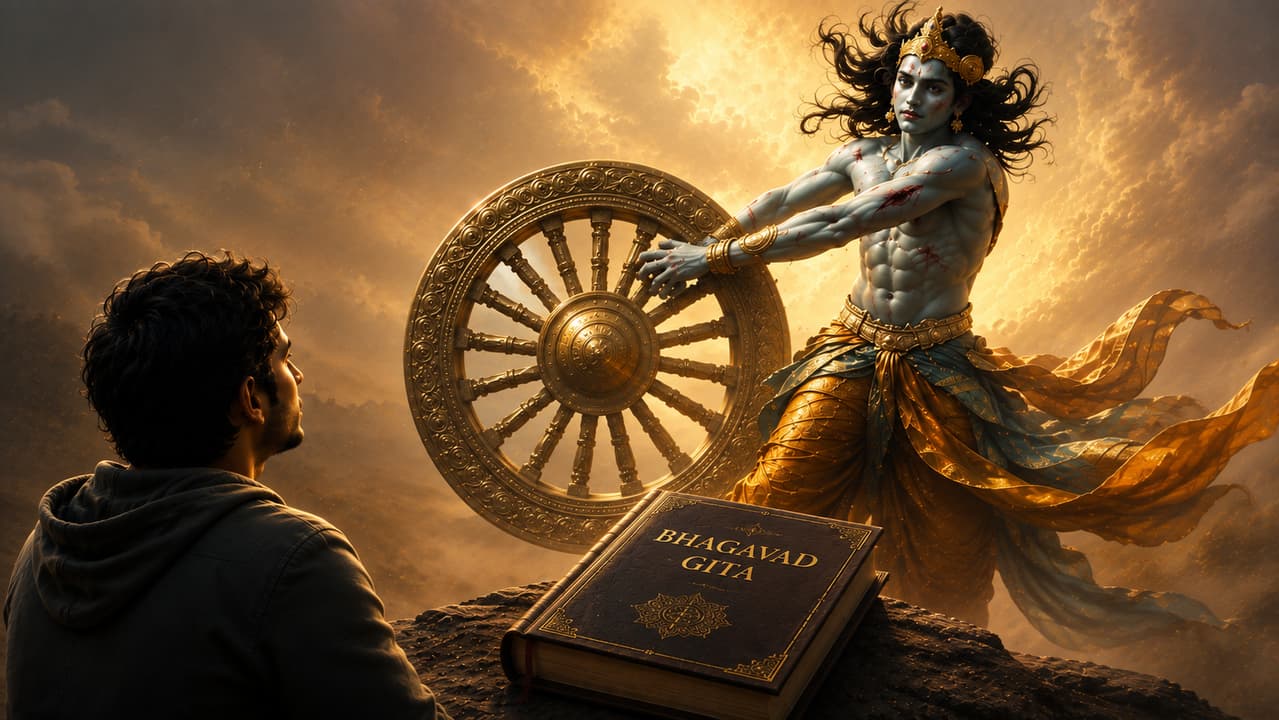
The Bhagavad Gita deserves reverence not because of inherited beliefs about its author, but because of its power to dissolve falsehood and reveal Truth. Real devotion is not ritual or blind faith—it is understanding, inquiry, and living the wisdom of the Gita. Through sincere study, one discovers the true meaning of Krishna, making the Gita the most authentic path to knowing and worshipping Him.
Vedanta reveals that freedom is impossible as long as the ego seeks to preserve itself. Meditation may bring temporary calm, but real transformation begins only when the false sense of individuality dissolves. Whether through devotion or knowledge, every genuine spiritual path culminates in the complete dissolution of the seeker into Truth. Liberation is not the experience of Truth by an individual—it is the end of the individual who wants to experience Truth.
Real change begins not by changing the world alone but by understanding the one trying to change it. Laws, technology, policies, and scientific progress have value, yet they cannot solve problems rooted in human consciousness and endless desire. Truth remains the same across cultures and disciplines, requiring only a change in language, not in essence. Lasting solutions emerge through honesty, self-inquiry, and inner transformation, because no external system can replace a change in the human mind.
You can tell someone, “Kid, this is the path of destruction. Leave it!” But you cannot forcefully pick the kid up and take her away. You know something is not right for the other person, and yet you can’t help her from doing it. You can’t give up, you can’t get angry, and you can’t stop what is happening. Great powerlessness. That’s how a Teacher feels.
That’s what the entire spiritual process is about, collecting the airfare. So that you can rise up, otherwise, you stay crawling on the highway. Life is not so that you just remain a crawler, a creeper. Life is so that you can take off.
Translation: The basis, the foundation, the substratum of consciousness, which is knowledge, is the mother, the origin.
~ Shiva Sutra: (1.4)
Acharya Prashant: Atman is the mother of mind.
Awareness is the mother of consciousness.
The Source is the Atman.
The manifestation is Prakriti.
Prakriti — this existence,…
1
जाग्रत्स्वप्नसुषुप्तभेदे तुर्याभोग्सम्भवः। (1.7)
Knowing what looks like, as the difference between the three states of consciousness, one finds himself located in the joy of the fourth.
This is a little technical, so we will have to…
This is state of consciousness (pointing towards the whole surroundings). This is Jagrati; the…
…
2
Acharya Prashant: Shiv Sutras are the basic, canonical aphorisms of Advait. They come from a ninth century sage called Vasugupt from Kashmir. Very brief, very secant, they contain everything that there is to the understanding of non-duality. The first sutra says:
Chaitanyam aatma
Consciousness is the Self.
If we go…
Excerpts from Articles
The Secret to True Victory
Victory is not decided by the trophy you hold but by the battle you choose to fight. Real strength lies in making the right decisions, staying true to your deepest values, and refusing to be ruled by fear or circumstances. When your actions arise from clarity rather than ambition, the outcome loses its power over you. The moment you choose the right path, you have already won.
Animal cruelty: Who deserves mercy, and who doesn’t?
Violence begins long before the knife or the slaughterhouse—it begins with the ego, the one that draws boundaries, seeks justification, and decides who deserves compassion. Laws and reforms may reduce suffering, but they cannot end violence while the ego remains intact. When the ego dissolves, exploitation ends naturally, and compassion no longer depends on regulation or moral boundaries.
Climate change is more than an environmental crisis—it is a crisis of human choices. Our patterns of consumption, consumerism and endless pursuit of more are putting increasing pressure on the planet. But meaningful change does not necessarily begin with new technology or stricter policies. It begins with a deeper question: what are we willing to change within ourselves?
ज्योतिष कितना सच है? कुंडली, ग्रह-नक्षत्र: इनका क्या अर्थ है?
वेदांत को केवल इसलिए सही या श्रेष्ठ नहीं माना जा सकता कि वह किसी विशेष परंपरा से आता है। विज्ञान जहाँ भौतिक जगत की वस्तुनिष्ठ जाँच करता है, वहीं अद्वैत वेदांत सीधे मनुष्य के ‘मैं’, उसके दुख, बंधन और मुक्ति की पड़ताल करता है। इसकी कसौटी वैज्ञानिक प्रमाण नहीं, बल्कि अपने जीवन में इसकी सच्चाई को देख पाना है। किसी दर्शन को मान लेना नहीं, बल्कि उससे स्वयं को मुक्त करना ही उसका वास्तविक उद्देश्य है।
Struggling to choose between a secure job and the path you actually feel drawn to? This isn't really a question about careers. It's about why other people's opinions have so much power over you in the first place. Real clarity doesn't come from finding the 'right' choice. It comes from honestly looking at your own fear, again and again, until it stops running the decision for you.
You Don't Understand the Bhagvad Gita, But You Still Claim That You Love Krishna?
The Bhagavad Gita deserves reverence not because of inherited beliefs about its author, but because of its power to dissolve falsehood and reveal Truth. Real devotion is not ritual or blind faith—it is understanding, inquiry, and living the wisdom of the Gita. Through sincere study, one discovers the true meaning of Krishna, making the Gita the most authentic path to knowing and worshipping Him.
कई तरह के डर—अकेले पड़ने, छवि खोने या छोटा समझे जाने—की जड़ अक्सर अतीत में बनी पहचान और कहानियों में होती है। शरीर की हाइट जैसी चीज़ों को समस्या मानकर उनसे जूझने के बजाय उनकी अप्रासंगिकता को समझकर आगे बढ़ना चाहिए। अतीत को दबाने से मुक्ति नहीं मिलती; उसके करीब जाकर अपनी स्मृतियों, धारणाओं और पुराने पैटर्न को निष्पक्षता से देखना ज़रूरी है।
Acharya Prashant: The source and the manifestation-the progeny and the material, the body and the actions of the body-the kala, are all one.
The ‘source’ refers to…
(
Unconsciousness and lack of self-awareness create the illusion of deep sleep
)
~Shiva Sutra (1.10)
Acharya Prashant: Tenth Sutra, “अविवेको मायासौषुप्तम्” – Unconsciousness and lack of self-awareness create the illusion of deep sleep. That which we called as ‘deep sleep’ is the final…
1
Operating from the highest inner point means living with honesty rather than self-created illusions. The ego becomes “higher” not through mystical growth but by dropping false self-images and testing its claims against reality. When honesty weakens, lower motives take control, creating inner conflict and disorder. Real growth lies in continuously questioning oneself, facing uncomfortable truths, and preventing the ego from being driven by comforting but deceptive beliefs.
It’s far easier to sit on a greatly decorated stage and talk about the virtues of Rudrākṣa, and what kind of water to drink, and why copper is useful; and all kinds of pseudo-scientific nonsense. But to really speak upon a Kabir or an Ashtavakra requires a tremendous understanding which does not come to everybody. If you are a spiritual teacher and you are saying you have not read any scripture, that raises questions on your love for the Truth.
Acharya Prashant (AP):
The question is, "Why do we forget? Why forgetting is a property of the mind?"
Do not ask, "Why do we forget?" Just remember that we forget. Because when you forget then you don’t ask this question that, "Why do we…
Shiv isn’t a person who existed at some point in time. Shiv isn’t confined to a specific place. Stories are sometimes useful pointers to the truth, but in our ignorance, we take the pointers themselves as history, facts or Truth. Shiv is the joy of pure consciousness. When false identifications and attachments are dropped in the light of self-knowledge, what remains is called the untainted essence of Shiv.
All of us want a new future. But the brain cannot want anything new. How many of you would want to taste a dish like Kakatua? Forget about tasting it, you haven’t even heard the name before. So, there is a golden rule: all desire is nothing but a stale repetition of memories. Ambition is nothing but a repetition of the past. What you didn’t know in the past, you can’t want in the future. New is new only when it is totally unrelated to the past. The truly new comes as a surprise.
We teach our kids to write applications: “Humbly I beg to submit that today I have an ache in my tooth.” “Humbly I beg to submit!” If you are stating a fact, if the toothache is real, why the hell are you groveling? If that is the Truth, why are you begging? Drool, drool, drool. That’s become our culture. If your philosophy tells you to submit and surrender to several masters, you will never be a truthful person, because in Truth there is no authority but the Truth.
A thousand feelings: envy, fear, hatred, competition will come to you. You cannot fight them all, and there is no need to fight them. Be courageous when that feeling comes, and sit down like friends and talk. Be honest that you are the one who is nurturing that feeling all the time. Be aware that it is coming. Let it not enter like a thief. And when it comes, don’t feel small. You only need to understand, not control.
2
This in itself is a philosophical question. This is why you should study philosophy, because you already have this question. Philosophy is your affection for the Truth, your leaning towards the Truth. Don’t you want to know the Truth? How many of you are happy with lies? Nobody. So, it is this love for Truth that we all innately have; that’s called philosophy.
Drop the center of confusion, come to the center of clarity. Drop what the masses practice, come to the direct route of self-realization. That’s what it means.
In the rule books of the courts, there are offenses of a thousand kinds, but when it comes to life, there is just one offense, ‘Did you live by the Truth or did you betray it?’ Remember that chap called Bhagat Singh and his associates. The courts declared they were guilty, and they were still joyful because they were absolutely not guilty in front of life. Live rightly, and then don’t apologize. That’s it.
The Bhagavad Gita, in essence, is a struggle of mukti (liberation) against sanskriti (culture). Shri Krishna urges Arjun to discard misogyny and cultural superstitions; the only thing that matters is mukti — liberation. Culture and traditions are time-bound; they hold meaning only when they point towards Truth — timeless, Sanatan. Have great traditions, and always be careful that your traditions are pointing towards the Truth. Only then do the traditions have life.
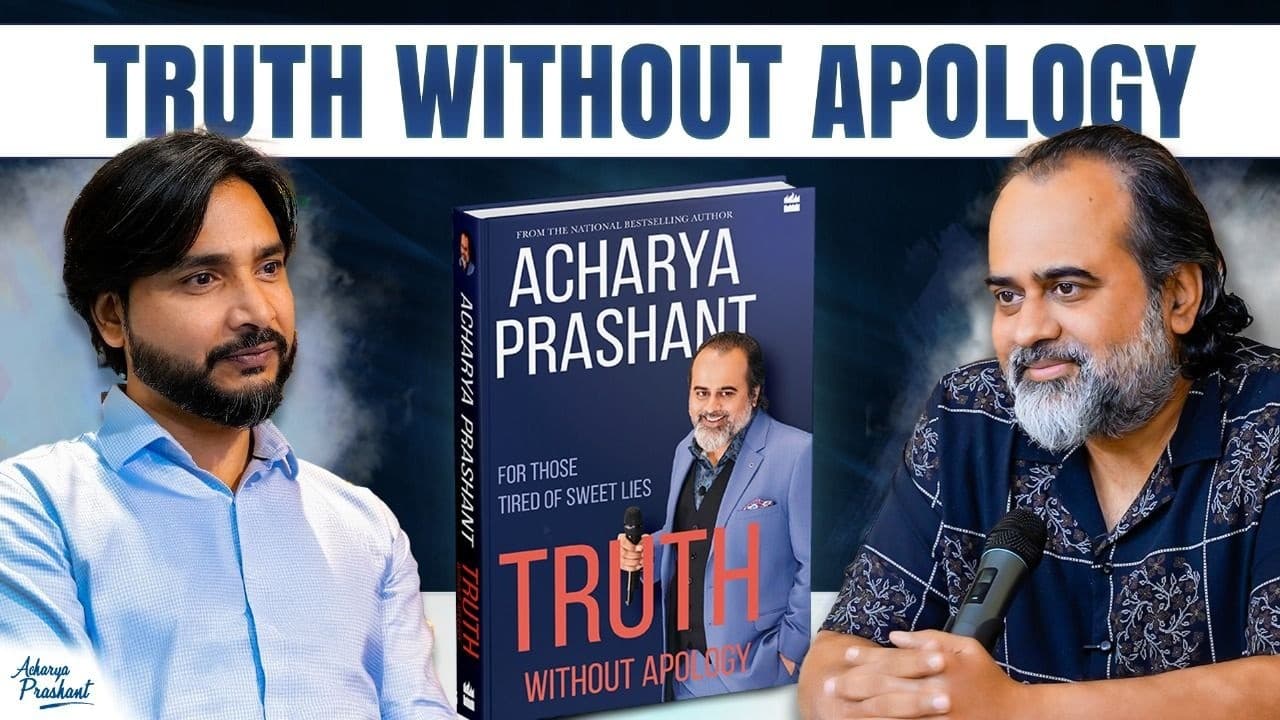
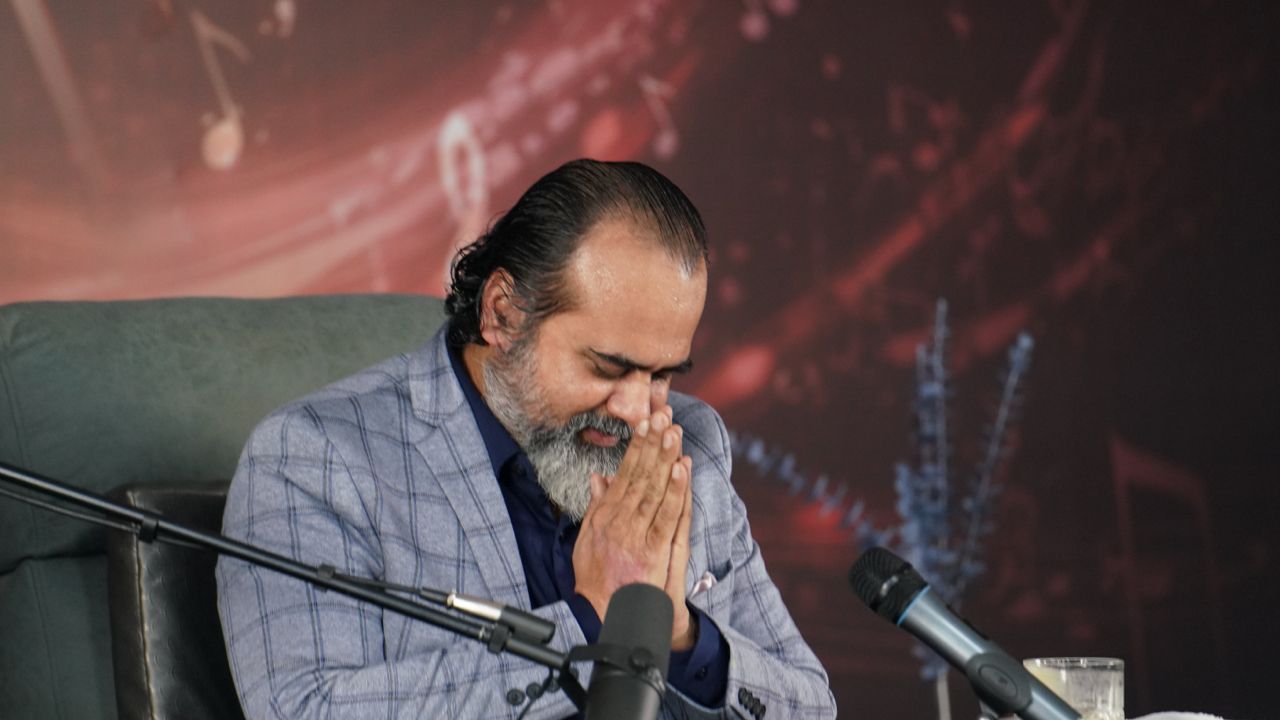
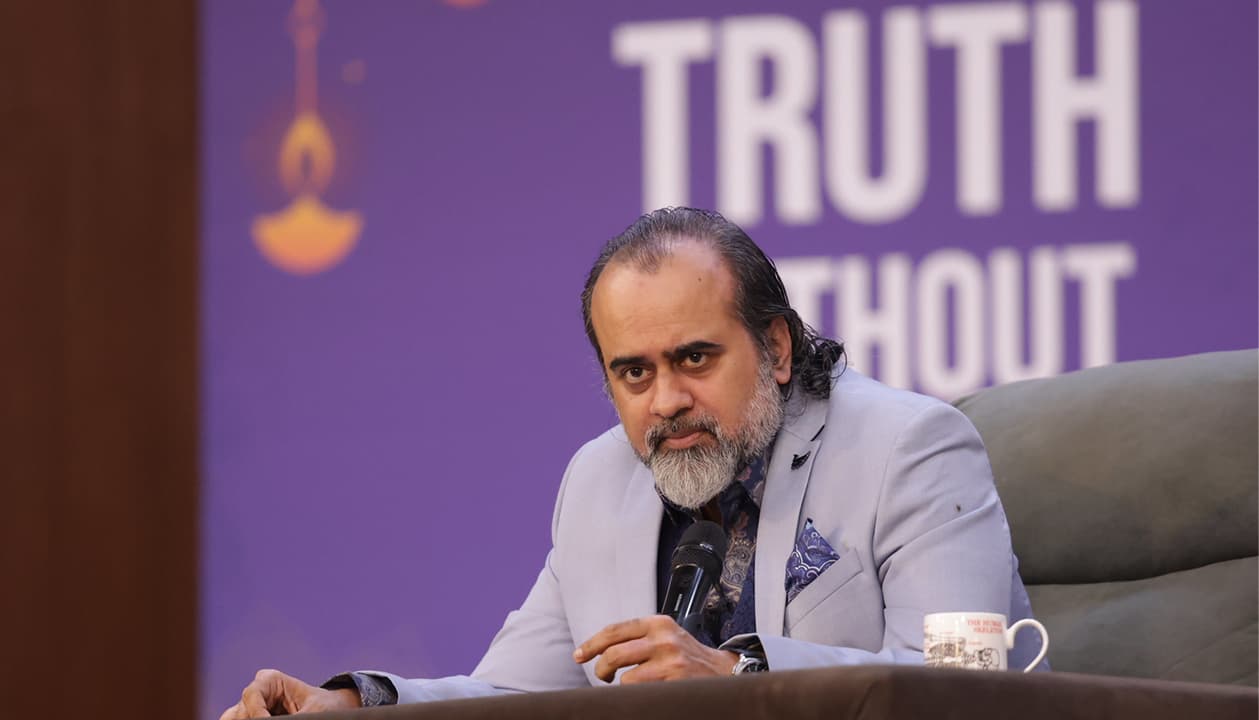
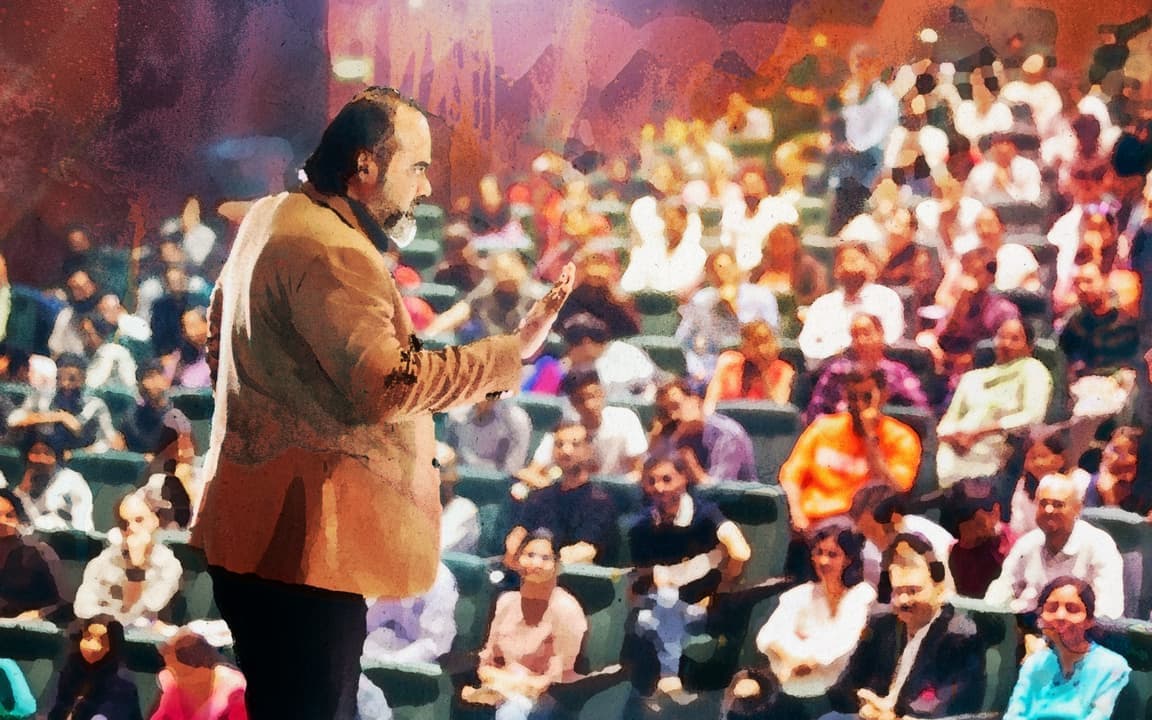
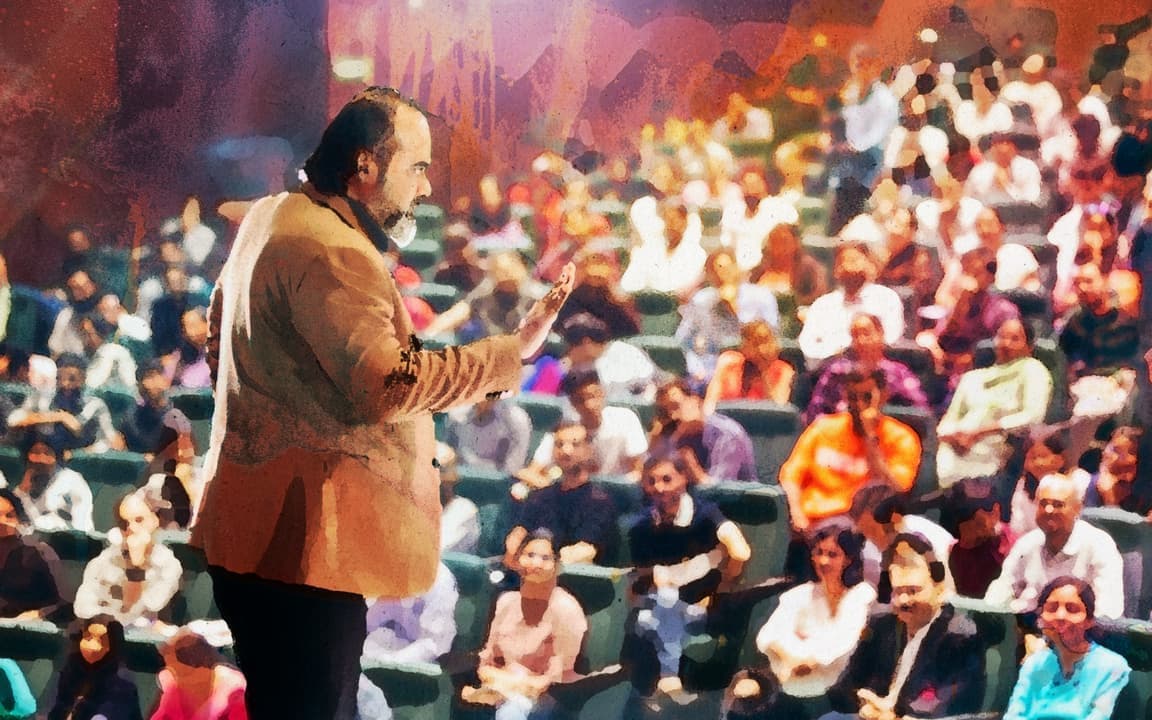
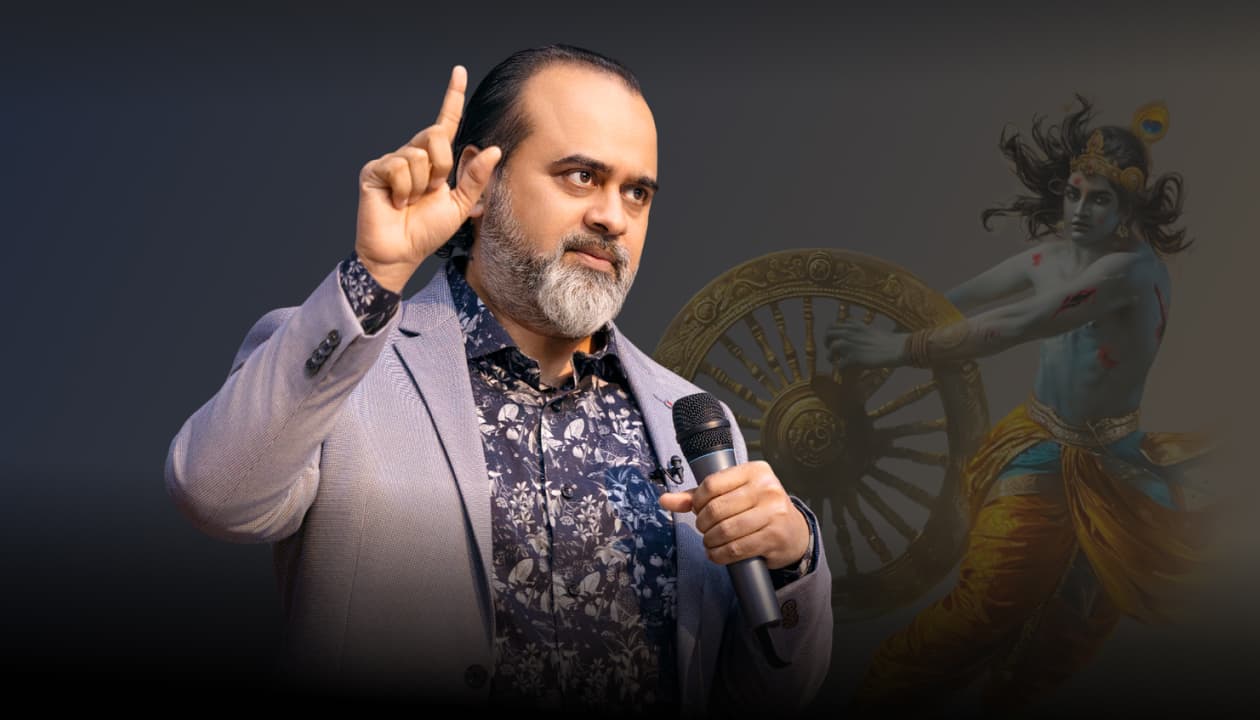
This evening in Delhi, a new book steps into the world—Truth Without Apology by Acharya Prashant. The launch takes place amidst seekers, readers, and companions of his work. In times when words are often polished to please and truths are dressed in comforting disguises, Truth Without Apology arrives like an uninvited storm—direct, raw, and uncompromising.
Life comes to us in an unending number of ways and you never know what's going to happen next. We are starved of something that really penetrates the surface. So, it is the intensity that this book brings — arrow-like depth, striking like lightning, immediately, so you don't have a chance to escape away from it. Like a Zen koan: very brief, very effective, and does its work in a snap. You could open just any chapter from anywhere and find it as if it was written just for you.
The Truth is not a complicated puzzle. Everything is laid open, right in front of you. So, if it is not happening even now, then it is just because of your own mischief. We give preference to the trivial and miss out on the important. We drift from one thing to another, with no thing meaning anything to us. You are not missing the secret; you are missing the obvious.
The distinction between spiritual life and worldly life is a false distinction. Spirituality is not morality or a set of commandments. It is never instructive. You do not need great formulations or special practices. Spirituality is basic honesty. Just see and acknowledge what is going on, and then the right action follows. Nothing else is needed.
Adi Shankaracharya goes to his teacher and is asked to introduce himself, and he says, “Cidānandarūpaḥ Śivoham Śivoham — I am pure blissful consciousness; I am Shiv, I am Shiv." My real identity is not at all related to the body. The great teacher is very clearly telling us that Shiv is the one who has nothing bodily about himself. But because we are bodily, our ego does not allow us to admit that there can be anything beyond who we are. And that’s also the cause of all human suffering.
Explore Books on Lord Shiv by Acharya Prashant, revealing deep Vedantic insights into Shiv’s true essence, symbols, and spiritual wisdom beyond misconceptions.
All forms of gods and goddesses have emerged from man's mind — they are our own projections. Even if you show a god in the form of an animal, the animal will still be anthropomorphic, very closely related to human beings. So, this proves that we are worshipping our own form. Therefore, if any form does not remind you of a Truth beyond the form, then the form has not succeeded on you. This is why the highest spiritual philosophies have always said that the Truth is formless.
Shakti represents everything in motion, everything that can be experienced, everything in space-time. We move in search of a final destination. That point is symbolically represented by Shiva. Those who are inclined towards having the right kind of movement worship Shakti. Those who have fallen in love with the destination itself, worship Shiva. The fact is that the two are inseparable.
If you have not been benefitting from the Guru, either you are too full of yourself or you are not really devoted and putting in the right efforts. Ashtavakra puts it very simply: Even if Brahma, Vishnu, or Shiva are your teachers, yet if you cannot get rid of yourself, you will not benefit. Only somebody who has seen the total failure of his ways is so determined to get rid of suffering that he can sacrifice anything, anybody — only such a person, such a mind, can be helped by the Guru.
The moment you utter the word ‘Guru,’ the image of a sober, realized master sitting and teaching his students comes to your mind, but Guru is a continuity, taking different forms at different times. The Guru can appear in front of you even as a competitor, or somebody with whom you have a conflict, or even as a tempting person of the opposite gender. Do not try to predict his ways; the ways of divinity are unfathomable. In fact, if you ever come across a Guru in a very planned way, then rest assured — that Guru is not a Guru.
To the one who believes in ghosts (Bhūta-Piśāca) — for him, they exist. When you are asleep and are engaged in some nightmare, you feel it actually exists. Bhūta-Piśāca Nikata Nahiṁ Āve, Mahāvīra Jab Nāma Sunāve: Mahavira Hanuman, devoted to Shri Ram, is to be taken as the representative of Truth. If you can be close to the representative of the Truth, you will get rid of all nonsensical and horrifying imaginations.
Practice means incremental improvement, daily improvement, moment-to-moment improvement. That's what we started this session with. Step by step you have to move — even towards the absolute. No one step can take you to the absolute. Not even a million steps can take you to the absolute. But still, there is no way except the million steps.
Please — in the world of the guru, in the dimension of the guru, in the eyes of the guru, there are no walls or houses or doors at all. So he cannot throw you out. But in the world of the student, doors and houses and separations and barriers and walls do exist. So the student can ensure that there is a separation between him and the teacher.
What you call as God is a concept; Truth is not a concept. Therefore, you can have stories about God, various religions, and their miscellaneous beliefs. But you can have no story at all about Truth because it is that which is invariable. Time cannot change it, and it doesn't vary from person to person. Irrespective of your subjective state, it remains as it is. Truth just turns you silent.
The Truth cannot be objectified as a thing, place, person, or book. So, don't be too quick to accept your own assessments, judgments, likes, dislikes, and experiences. Whatever you're seeing is seen by "you" — the Ego — and you are no absolute. Everything must be available to enquiry, investigation, and questioning — and questioning cannot happen if you declare that you’ve already come to the Truth. Never believe that the journey has ended or that the ego itself is the Truth.
Now comes the deeper symbolism of Shivlinga. It says—look, if you have taken birth, then you are there in the body. But even while living in the body, you have to live as if you are without a body. So, the shape of the Yoni that you see in the Shivalinga is actually the world or the body, and this Lingam that you see in the middle of it is the Consciousness—the Consciousness which is located in the body.
Liquor consumption or flesh consumption or other kinds of unwise gratifications of the body, merely increase the obstacles that one faces. So, therefore, those kinds of things must not be practiced — even if it is observed that a realized man is practicing them.
Never forget who you are — you are someone in prison. Talk of exits, and if doors do not exist, blast the damn walls. That's the reason why you need power. You should honestly and realistically seek freedom from your current bondages. Your responsibility is not to acquire something more. Your responsibility is to drop a lot of things. Drop what you know to be needless and harmful.
Expression is a relationship you establish with the world. It becomes a gift you give to others. What gets expressed, gets amplified. Anger expressed is anger amplified; attachment expressed is attachment multiplied. Do you want to gift chains and shackles, or something that helps and liberates?
When feelings surge in your mind and body, be careful and pay attention! This is the moment when you lose the plot. The initial surge of energy that a feeling has is beyond your consciousness and control; it is determined mostly by your conditioning and partly by your genes. So, don't add conscious energy to the unconscious uprising. The most important mark of a wise man is that he does not live by feelings.
The most common thing in spirituality and science is 'an honest urge to know the Truth.' Science observes the external universe, and spirituality observes the mind. These two have to be in tandem. The one thing that enables true knowledge in any field is honesty and integrity.
Acharya Prashant: We want to look at ‘ambition’. So, as I enter, I see that we have been singing Kabir; Kabir talking about achievement, about ambition, about greed and desire and he seems to be taking a clear position, it’s unmistakable. Let us not leave it ambiguous, there is a…








![Truth Without Apology [Book Launch]](https://cimg.acharyaprashant.org/images/img-db3ddbf9-ebdf-4baa-8b47-9373d316d478/30/image.jpg)