Acharya Prashant: If your purpose is coming from your beliefs and not the Truth, what good is the purpose? Just because you have been following certain practices since long, do those practices become equivalent to the Truth or a substitute for the Truth?
Also, what you call your culture varies from city to city. I'm not even talking about north and south. I'm saying it varies from city to city. Also, what you call your current culture is simply the culture you have been following since the last 1500 years. Before that, the culture was very different. And if you go five centuries back, the culture was entirely different. So what do you mean by your culture? You mean the culture of the 19th and the 20th century, right? Believe me, you don't follow the culture of the 17th, 18th century. Why don't you follow that culture? If value lies in everything that is in the past, why don't you go further back in the past? Why go back only one century? Why not ten centuries?
The clothing, for example, is a part of culture. Look at the stuff you are wearing. Where did it come from? It is not in your culture. Why are you wearing this? The language we are talking in is not a part of your culture. Why are you communicating to me in this alien language? In fact, even the pose you are sitting in is not coming from your culture. It is very western. Why are you sitting in that pose?
Chips. Where have they come from? Pizza. Okay, chips and pizza we anyway scoff at because of their western origins. How about the dress that you wear in your festivals? Where is kurta pyjama coming from? It was not there ten centuries back. It is coming from the same invaders. Oh, so bad. Aloo, potato and tomato. They were not there in the Vedic times. Invaders brought them very recently. Both tomato and potato. But you enjoy aloo like anything. So bad. Aloo was not a part of our culture. No sir. No aloo. For all those who keep talking only of Sanskriti. Keep aloo away, first thing. Aloo is a foreign thing. The invaders brought it actually.
What do you mean exactly by rich culture? What is this richness in culture? To me only Satya is rich. Only the Truth is rich. All else is nothing.
The fireworks that you celebrate so much in Diwali, do you think you were having fireworks three centuries back? Again, that is something that has a foreign imprint on that, but today you say it's an inalienable part of my culture. What do you mean by your culture? What you call your culture is largely the culture of those who invaded you, but today you worship that as your own culture. And the thing that deserves to be worshipped — Satya (Truth) — you have totally forgotten.
When a woman wears sari and covers her head, you say, "Look, lajja, this shyness, this modesty is Indian culture." Were Indian women covering their heads in pre-Islamic times? Figure that out. How is your culture now? It is the culture of the invaders, the same invaders that you hate so much, and you use your culture to hate them. The fact is, even your culture is coming from the invaders.
Pulao. Where is pulao coming from? Most of the food items on your plate today, you'll not like it when you hear where they are coming from. And many food items that you do not like today, they were originally a part of your culture. For example, somras. Today you say all the sanskritivadis will say alcohol is so bad, alcohol is so bad. The thing is, if you go to the Vedas continuously, even there the rishis are praising soma. Indra was especially fond of soma.
It was Islamic morality in which alcohol was banned. It is Islam that detests alcohol a lot. "Alcohol is bad, alcohol is bad." So do you know where your aversion to alcohol is coming from? It is coming from the invaders. In your culture, alcohol was great. Not that everybody was a drunkard, but nobody was taking the issue of alcohol very seriously. It was all right. Let there be some soma. And it used to be a part even of religious offerings. So rishis have gathered, and there you have somaras.
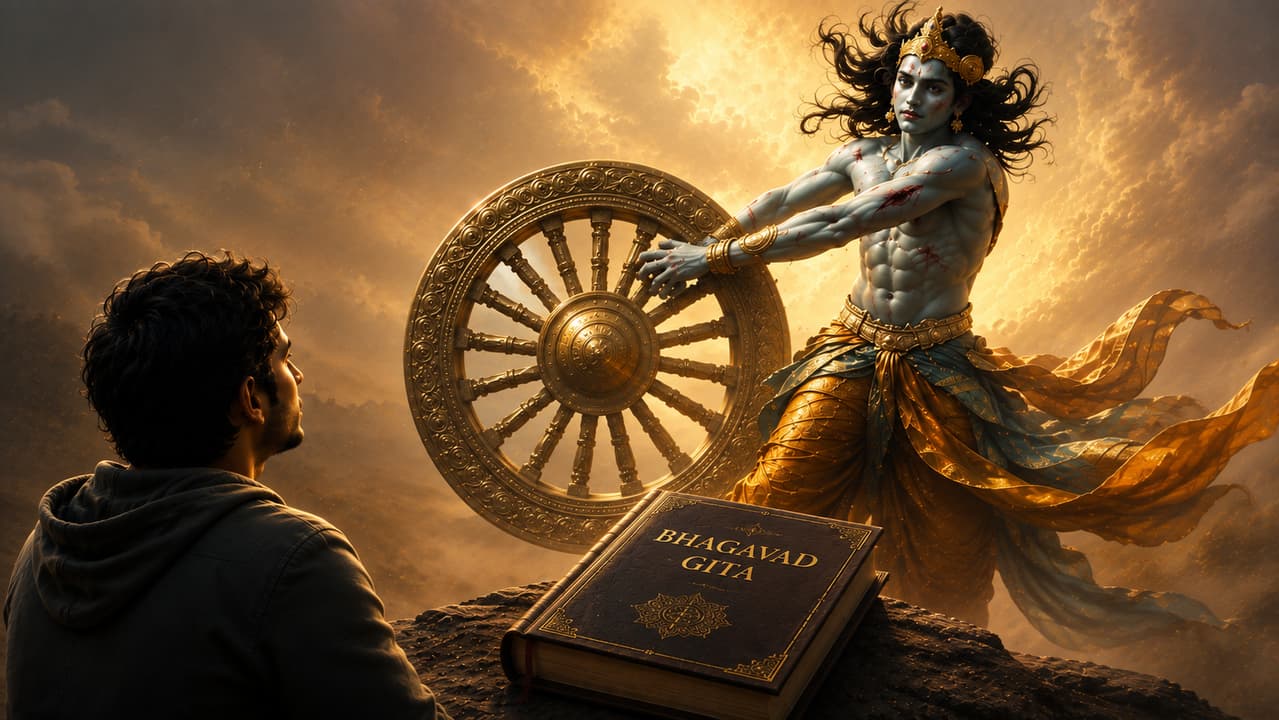
What is your culture? The real man, the man of Truth, is devoted to Mukti and Satya, not to sanskriti. In some sense, the entire Bhagavad Gita is a struggle of mukti against sanskriti. Arjun is quoting all the things related to sanskriti, — culture. He's saying, "You know, if we fight then all the kshatriyas will die. So all the kshatriya women will then marry people from the lower castes, lower varnas, and varna-sankara babies will be born.” This is sanskriti. “And if those are born, then the homage that they will offer to the dead ancestors will not be accepted, and the souls of the dead ancestors will remain thirsty and restless.”
And Shri Krishna says, "Keep all this trash aside. To hell with your culture. I'll tell you that the only thing that matters is mukti — liberation. And liberation is what I stand for. So be devoted to me and do as I say. Keep all your misogyny and your superstitions aside."
And do you see all these things in what Arjun is saying? He's saying, "Women, you know, they should not marry lower castes." Men were allowed to marry lower-caste women, but women should not marry non-kshatriyas. And superstition, a lot of superstition in what Arjun is saying. All that is in chapter one of Bhagavad Gita. So what you call your culture has a lot of superstition as well. Why do you want to venerate that?
Culture is man-made, and it should keep getting refined episodically, timely, continuously rather, not even episodically.
Culture is something that pertains to a particular place at a particular moment in time. Culture is time-bound and must change with time, and it is already changing with time. Hundred years back, you would have said caste system, untouchability, not even untouchability, unseeability. There were certain people you were saying they cannot even be seen. These are great parts of our culture. Didn't you change that? Weren't there social reformers?
Today we worship those social reformers. In their time, those social reformers, you threw mud at them and you abused them and you even wanted to kill them. And you said these people are destroying our culture because they are talking of abolishing child marriage, and they are talking of widow remarriage. And no, no, widow remarriage cannot be done. In our culture, no widow remarriage. And in our culture, kids should be married at the age of five. And in our culture, the woman should be burnt on the pyre of the husband. These things were part of your culture? No.
We are proud that we reformed and refined our culture. Aren't you proud of that? We are proud that we have a better culture today. Similarly, culture should always keep getting refined with a view towards the Truth. Do not take culture as sacred or holy. Satya is holy, not sanskriti. Are you getting it? Satya is sanatan. Sanskriti is not sanatan. Sanatan means timeless. Sanskriti is time-bound. Getting it?
So I am not discounting the importance of culture. What I am saying is remember the place of culture vis-à-vis the Truth. Culture should be a shadow of the Truth. Culture should be a follower of the truth. Do not place culture in a position where it becomes the absolute. Only the Truth is absolute. Culture is not absolute.
The Upanishads do not sing of sanskriti. They sing of Satya. The saint poets did not sing of sanskriti. They talked of Satya. Unfortunately, in today's India, there is a very unfortunate kind of cultural aggression taking shape. Everybody is talking of culture, and nobody is talking of the real thing — Truth. They have started equating culture with religion. But religion is not culture. Religion is something in service of the Truth. Are you getting it?
Have great traditions, and always be careful that your traditions are pointing towards the Truth. Only then the traditions have life.
Otherwise, the traditions fall dead, and there is no point carrying dead load over the centuries. I am not discounting traditions. There can be beautiful traditions, but only when you know the meaning of those traditions, only when those traditions arise from your heart. Just ritualistically and blindly obeying traditions will take you nowhere.
If traditions have to exist, let there be lively traditions. In fact, with an eye on the Truth, with a mind devoted to the Truth, you can even begin new traditions, because all traditions began at some point in time. So why can't new traditions begin today? New great sacred traditions can begin today. And even the traditions that begin today must end at some other point in time, because today's traditions will be applicable to today's man, today's environment, today's society, today's economy.
200 years later, those traditions might not be useful. So then those traditions can be reformed or totally disposed away, and new traditions should come up. Traditions are not sacred. Traditions can be dropped, and new traditions can be started. And even ancient traditions can be continued if there is meaning in them. And that meaning, you do not need to superimpose on the tradition, because that is also a trend these days. Take some random tradition and superimpose meaning on it. Say, "No, no, no, this tradition is not random. It has this meaning." No. The tradition has no meaning at all. You are needlessly imposing meaning on the tradition. That kind of pseudo-scientific thing — do not attempt, please.
Let the tradition have real meaning, and then it can continue for long. Otherwise, drop it.