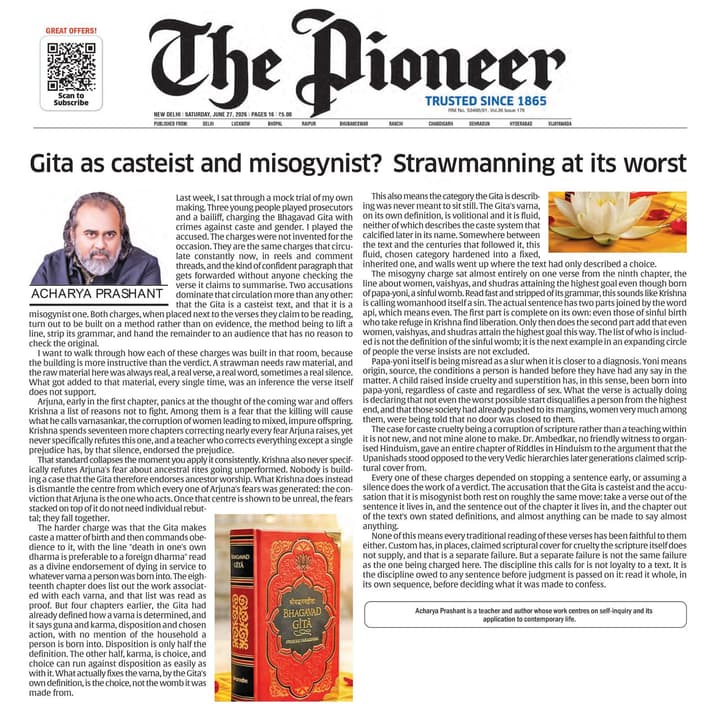
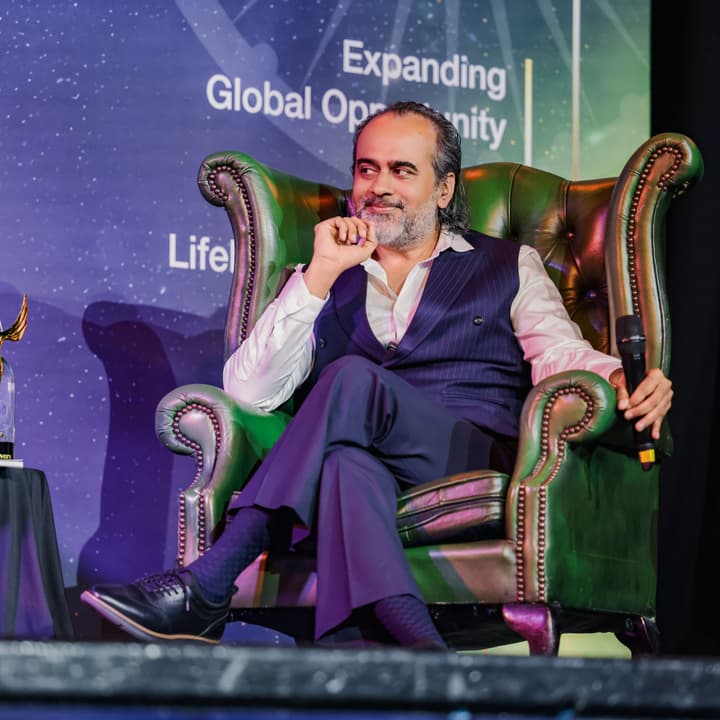
IISc Students Debate the Gita with Acharya Prashant in Bangalore

Acharya Prashant

24 min
1.1k reads
IISc Students Debate the Gita with Acharya Prashant in Bangalore
Drop the center of confusion, come to the center of clarity. Drop what the masses practice, come to the direct route of self-realization. That’s what it means. This summary has been created by volunteers of the PrashantAdvait Foundation

Questioner: Namaste Acharya Ji. My name is Prashant. I am a PhD first-year student in the Material Engineering Department. So my question is from *Bhagavad Gita,*Chapter 2, Verse number 37.

हतो वा प्राप्स्यसि स्वर्गं जित्वा वा भोक्ष्यसे महीम्। तस्मादुत्तिष्ठ कौन्तेय युद्धाय कृतनिश्चयः॥

Hato vā prāpsyasi svargaṁ jitvā vā bhokṣyase mahīm। Tasmād uttiṣṭha Kaunteya yuddhāya kṛta-niścayaḥ॥

Acharya Prashant: Lovely.

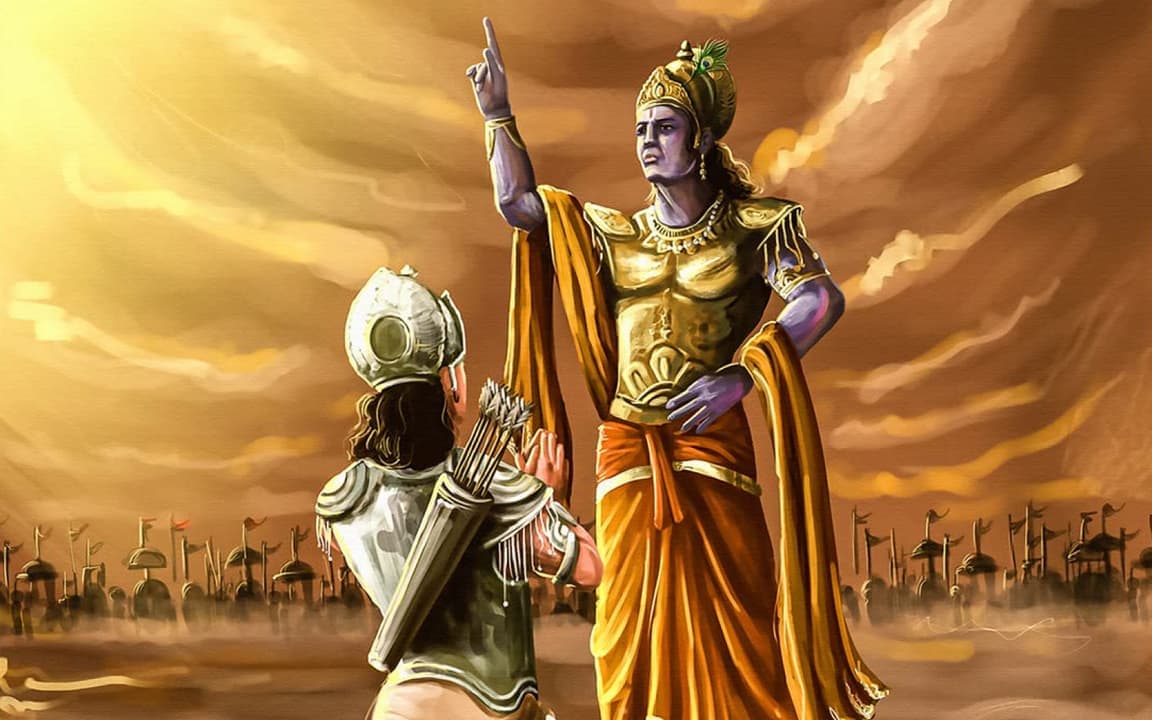
Questioner: So, Shri Krishna is saying to Arjuna, “If you fight, you will either be slain on the battlefield and go to the celestial abodes, or you will gain victory and enjoy the kingdom of earth. Therefore, arise with determination, O son of Kunti, and prepare to fight.”
So my question is: what is ‘Swarga’ here?

Acharya Prashant: Great. It has to be seen in context. You see, Chapter 1 of the Bhagavad GitaViṣāda Yoga — is all about Arjuna narrating his own concepts. And what are Arjuna’s concepts? Arjuna is a great believer in Lok Dharma. The things that he says, you have to understand them, before you can have some real perspective on the Gita, because the remaining 17 chapters are a response to the first chapter.

It’s only in the first chapter, or mostly in the first chapter, that Arjuna comes up with his side of the story. At other places, Arjuna is either reacting, or just requesting, “You please tell me more,” or saying, “No, no, what you are telling I don’t believe in this. Why are you confusing me?” He doesn’t come across in detail. Only in Chapter 1 do you find that Arjuna is doing bulk of the talking.

What does Arjuna say? Arjuna says, “I don’t want to fight.” Why? If I fight, then most of the Kshatriya men will die. Because from across the subcontinent, armies have assembled here, either that side or this side, and it’s going to be a battle to the last man. Everybody will die. And if everybody dies, what happens to the women?

You see, the women are young, because these are young soldiers, all of them, and the women are young, and all these Kshatriya men will die. So the women will go to the lower varṇāḥ. Please understand where Arjuna is coming from. In the middle of the battlefield, he is thinking about what will happen to the women. And it doesn’t stop here. He says the women will go and mate with or marry the other varṇāḥ; What he means is the lower ones, the so-called lower ones in Arjuna’s eyes.

And out of that kind of meeting or union, varṇaḥ saṅkarāḥ will be born. That’s the word he uses — varṇaḥ saṅkaraḥ, (a kid born outside the prescribed rules of marriage), prescribed not by Vedanta but by Lok Dharma, the Dharma Shastras.

Dharma Shastras do not come under Shruti, so they do not belong to the league or dimension of Vedanta. So that’s a separate thing.

So these kids will be born. First of all, that’s a very bad thing. Why should kids be born like that? And the problem is now that our forefathers, their Jīvatmānaḥ, their disembodied bodies are all floating around, and they need to be offered water and other offerings in order to keep them happy and placated. But they will not accept anything if these varṇaḥ saṅkarāḥ offer them. So what will happen?

The Jīvatmānaḥ of all our forefathers, they will become unhappy, and also they will remain hungry and thirsty. They’ll not accept any offerings, and this is the problem that Arjuna is narrating to Shri Krishna. And it is to rebut this problem that the entire Bhagavad Gita is spoken. Bhagavad Gita is a great rebellion against Lok Dharma, against the popular social culture. So, the answer will be a prolonged one, you’ll have to be patient.

Another problem that he says is: you know, these are the people there, and I am prepared to even die for them. Even my Guru is standing there. What will I do by gaining a kingdom by killing all of them?

Now that’s very peculiar, because Shri Krishna is standing next to Arjuna, and Arjuna is saying, “My Guru is lined up on that side.” Do you fathom the depth of ignorance? Shri Krishna is standing next to Arjuna, and Arjuna is saying, “My Guru is there, and how do I fight against them?” Are you getting it?

So, social custom and inner fear — the body and the society — both are being quoted as reasons for not taking up the battle. Both are being quoted as reasons for not taking up the battle. And then, the remaining seventeen chapters are to prove that these things that you believe in the varṇaḥ Vyavasthā, the “women should not…” You see a peculiar attitude towards women here, do you see that? Do you also see a peculiar attitude towards the so-called “lower varṇāḥ?” Do you see that? Do you also see superstition here?

The Bhagavad Gita is a stunning statement against all of these — this attitude towards women, this attitude towards your brothers from the other varṇāḥ (which loosely translates into caste today), and your deep belief in superstition. That’s what the Bhagavad Gita is for — to demolish these social concepts.

Unfortunately, even millennia after the Bhagavad Gita was uttered or composed, the same things continue to exist in society, the same attitude towards women, the same attitude towards other castes, the same prevalence of superstition, and the same inner ignorance. Arjuna will not say that “I am arrested, paralyzed because of my physical attachments.” He will not say. He is talking about all these things. And the same kind of mental superstition and physical attachments exist even today. That’s why the Gita continues to have its relevance.

Now, how does Shri Krishna begin to explain Arjuna and drive away all these random concepts from his mind? Chapter 2 is Sāṅkhyayog, the highest exposition of knowledge.

Shri Krishna says, he didn’t intend probably, if you look at the situation and if we accept that it has at least a historical dimension to it, even if it’s not accurately historically depicted, if we accept that there is a historical dimension to it, I don’t think that in the battlefield or even near the battlefield, the narrator would have aimed to narrate 18 chapters. You are in the middle of a battle. You are not here to educate someone. It’s not a particular ashram, it’s not a university where you are lecturing.

So, he probably wanted to finish it off fast. So he gives it his best shot right away, early on. Chapter 2 is the highest, and it fails on Arjuna. Arjuna says, “No, no, no, I don’t understand anything. I don’t agree. I’m not going to fight. This is not good.”

Shri Krishna sees that. He sees a practical narrator. He sees, it’s not succeeding on him.

Chapter 3 — things are diluted, and the concept of Karma come in. Chapter 2 is all about realization. In Chapter 2, he doesn’t say, “This particular action you must embrace, Arjuna.”

In Chapter 3, he starts talking of niṣkām Karma, the level of action. He says realization is presently not working on him. He probably is right now not ripe enough, so he talks at the level of action. Even that fails.

In fact, Arjuna starts saying, you know, after Shri Krishna educates him on Gyan. Do you know what Arjuna says? He says, “If Gyan is everything, if realization is everything, then why are you pushing me into this terrible battle? Gyan to mil gaya, and you say Gyan is the highest. So now you have given me Gyan, Now let me go away. I don’t want to fight.”

Shri Krishna says, “You know, it’s complicated.” So then comes Chapter 4, and in Chapter 4 he says, “I’ll have to get down to where Arjuna is.” And Arjuna is a firm believer in varṇāḥ vyavasthā, the concept of being honorable, respectable, noble. So here we find Shri Krishna using all these tools. He says, “If you don’t fight, what will people say of you? You believe so much in the concept of Jīvatmā and Swarg and *Narak, so why don’t you fight and honorably proceed to swarg if you die fighting?”

And then he says, “You know, either agree to this or this or this.” What are these three levels? These are the three levels of Vedanta. The top level is Paramārthik level. At Paramārthik level, dude, nothing exists at all. So why are you so full of grief? Nobody’s going to die because there is nobody. This Arjuna refuses to understand.

We are talking of Chapters 4 and 5 here. Arjuna refuses to understand the top-notch argument. The top-notch argument is that at the highest non-dual level, everything is an illusion. Nobody exists. So who are you mourning for? Nobody is the killer, and nobody gets killed. Let spontaneous action unfold. Why are you so much in grief and guilt? Nothing. Arjuna refuses.

Then comes the Vyāvahārik level. At the Vyāvahārik level, there is just nature — the Prakriti. All this is there, sans that imaginary thing called the ego. And in nature, in Prakriti, birth and death are continuous.

Waves arise, waves fall. Trees are shedding leaves all the time, and all the time new leaves are appearing on trees. So, birth and death are a continuous process. So again, there is no reason for grief.

Arjuna refuses to understand even this argument, or probably he is understanding, but he’s so full of attachment and so full of what the social concepts, the manyatas, the beliefs have been that he just doesn’t want to act. Then Shri Krishna gives this Prātibhāsik level argument, “You are a Kshatriya.” He has to tell him, “You are a Kshatriya,” because he does not understand that he is the Ātman, the Truth.

He also refuses to understand that he is just one of this species, where all are just like waves of the sea, with no genuine material difference between them. If you look at the ocean, waves are rising and falling, and in some way every single wave has an individuality. No wave is exactly like other waves. Yet we know that fundamentally all waves are the same. So thereby there is no reason to grieve the death of a particular wave, because all waves are alike, Arjuna refuses to buy even that.

Then, as a tactician, as a rannitikaar, Shri Krishna comes to where Arjuna is standing. He says, “Fine, you are not Ātman, you are not even Prakriti, then you are a Kshatriya, right Arjuna? That’s what you take yourself to be, Kshatriya, right? Fight. Because if a Kshatriya does not fight, then it is not honorable and noble for him. You die fighting, or you emerge victorious.”

So it is in that context that the concept of swarg come in. That does not mean that Shri Krishna is endorsing the concept of swarg and *narak. He is just bringing it down to Arjuna’s level. Getting it?

And these arguments, they follow each other one after the other. These verses, they come right one after the other. But one particular verse would be chosen selectively to prove that the Gita is what it is just not. Similarly, when he says that “I am the one who has decided varanas based on your guna and your chetna, karma,” then it is forwarded as an argument that the varṇaḥ vyavasthā is divinely ordained, whereas it is exactly the opposite.

Shri Krishna is saying it depends on your quality and your choices. It depends on you. Who am I? He does not say that “I have said that you will be this, you will be that.” He says, “You decide what you want to be, it’s all yours. If you want to fall into a rut, that’s your choice. If you want to fly there, you decide. Your nature is to fly, but you can turn yourself into an earthworm and just become a crawler.” Getting it?

So, whenever you find Upanishads, Gita, any other scripture, and not just an Indic scripture, even stuff from outside, or even philosophers including modern philosophers — Russell, Sartre, anybody, when you find them being quoted, quotations, you must always be very skeptical of them. Quotations are very, very dangerous things, because a quotation means that out of the entire work, the entire oeuvre of a writer or a speaker, somebody has selectively picked up two lines and is presenting them to you with some specific purpose.

Be a reader. Don’t be a quote hunter.

You know, quotes, “See this quote!” Quotes are always suspicious, especially when they are not accompanied by references. Always ask for references. Where is it coming from? What is the context?

Listener: Since you have elaborated from Chapter 1 to 5, I just want to go back and ask, somebody wanted to ask about Chapter 2.47 — “karmaṇy evādhikāras te mā phaleṣu kadācana” (कर्मण्येवाधिकारस्ते मा फलेषु कदाचन।). Can you just elaborate on the context of it? Maybe I have quoted it properly for you.

Acharya Prashant: Two words, you have quoted. And “Quoted it properly.” Yeah, that’s part of the problem, the Sanskrit language. Not that the language is a problem, the fact that it’s not a mainstream language today. It actually was never a mainstream language, partly because it is difficult to master and secondly because it was a matter of connivance that the language does not reach the masses.

So there was a Sanskrit stream, and there was a Prakrit stream, and the Prakrit stream later on became what we call most of the Indian languages today. Not really the Dravidian languages, but to the north of the Narmada, the Vindhyas, even Marathi to a great extent, Bengali. They all owe a lot to Prakrit.

Yeah “karmaṇy evādhikāras te.” Which chapter? Chapter 2.

Here is the way to read it, the key. Whenever you come across the word Karma in Bhagavad Gita, at least in the initial chapters, Karma refers to niṣkāma karma. Whenever you come across the word Gyan in Bhagavad Gita, It refers to *Atma Gyan, (self-knowledge). So Karma would mean niṣkāma karma, Gyan would mean Atma Gyan. Not Gyan about geography or history. Similarly, Karma does not mean any kind of blind action; it means action arising from?

So I find it very representative that Chapter 3, which is Karma Yog, follows Chapter 2, which is Sāṅkhya Yoga or Jñāna Yoga, which means action follows realization. What Shri Krishna is saying is — when your action emanates from realization, then action itself suffices. You will not be worried about the fruit of action.

But this verse has been greatly, criminally misinterpreted to mean that you take up any kind of work, X, Y, Z, and don’t care about the result. But that’s not going to be possible. The fact is, as normal human beings, we first conceive the result and then design the action to achieve that result. How will you forget the result?

That action would not have been initiated had the desire for the result not been there. Is that not so? Do you just aimlessly do something? Never. You always have an aim, which means a target, a result in mind. I need to clear that exam and hence I’m picking up my textbook to read. Is action coming first, or is the desire for result coming first?

Listener: Desire.

Acharya Prashant: So if you say in your misinterpreted way that “just do something and don’t care about the result,” is it practical? Is it something that you see happening anywhere? Is it something that you see happening in your own life? It neither happens nor can happen. It is impossible to happen because when you are operating from the center of ignorance, which is the center of desire, then desire for result comes first. How can you then say, “I’m acting without any concern for the result?” It is impossible.

But that’s what it has unfortunately come to mean, and people say, “You know, I’m doing my nonsense without bothering about the result.”

You’re eating so much. Are you carrying enough cash or card? No, no “karmaṇy evādhikāras te.” Why should I bother about the result? You’re smoking so much. What will happen? Sir, what you are doing is a crime. The law will catch up with you. “karmaṇy evādhikāras te.” What will happen tomorrow? We’ll see. Do it, abhi. Let me ingratiate myself. Why worry about the results?

This has become emblematic of consumerism. “I will do, and whatever I do is for the sake of my desire. So I’ll do whatever I feel like doing for the sake of my desire. And then Shri Krishna told, “Don’t worry about the result. So why should I worry about the result?”

The fact is, when you are operating from the center of desire, you should worry about the result. The Upanishad (Ishavasya Upanishad - 17) says, kṛtaṁ smara krato smara (कृतं स्मर क्रतो स्मर), remember that the same thing we have done a thousand times and remember the result. And if this, that you are entering into right now, is dimensionally the same as what you have previously done, how can the results be different? And you suffered last time, you’ll suffer this time as well. Give up all your nonsensical hope that this time is going to be different. You are only repeating what you have been doing all your life and what mankind has been doing over the centuries. And if everybody has suffered, you too will suffer operating from this center.

But there is another center possible. And when you come from that center, then “mā phaleṣu kadācana.” Then the desire for result doesn’t occur at all. Why? Because the action itself is deeply joyful, like when you are playing with your kid. Have you played with kids, or nephew, or niece, or somebody at home? Or playing with your pet? What can your pet do? Does it pay you per hour for playing with him? You take your dog out for a walk, do you get points for that?

Do you understand this? There are actions. See, you don’t take your dog out for a walk because of self-realization. It is just to, you know, give some kind of a vague example. So don’t punish me for that.

Listener: Sir, do you see? It’s right in front of you, sir. You still do not see the limitation of Vedanta.

Acharya Prashant: See, if I do not see, then it’s a great thing of fortune for me that you can see. I have succeeded.

Listener: He needs to hear first before seeing.

Acharya Prashant: You have asked many questions, sir. I want to give a chance to others.

Questioner: So everyone is talking about the Gita shloka, so I am jumping into the 18th chapter where,*sarva-dharmān parityajya mām ekaṁ śaraṇaṁ vraja (सर्वधर्मान्परित्यज्य मामेकं शरणं व्रज।). So can you explain this, because I think I am in wrong way of.

Acharya Prashant: What’s the way you perceive?

Questioner: So, sab kuch chhodkar Shri Krishna ki sharan mein chale jao. Who is Shri Krishna? Shri krishna means I don’t know.

Acharya Prashant: Sab kuch chhodne ko nahi, “sarva-dharmān parityajya” bola. So that which you take as your dharma is not your dharma. That is Lok dharma.

“Arjun, that which you are taking as dharma is not dharma at all. All these are blind duties. Drop them. Whatever has been brought to you, told to you as a measure of dharma, that is not dharma at all. So you drop it and come to me.”

Where is its status? Right at the end. “Me” then means what “me” has expressed till the end, Bhagavad Gita. So drop all the other nonsense that you have been carrying and the nonsense that you have expressed in chapter 1. Rather, now the Gita is coming to a closure. It’s the last chapter. Listen to what I have told you. Drop the center of confusion, come to the center of clarity. Drop what the masses practice, come to the direct route of self-realization. That’s what it means.

Questioner: So it ends with, “Main tumhare saare paap har loonga.” Still he is thinking that Shri Krishna...

Acharya Prashant: The only paap, when we look at our condition as the backdrop of everything, the only paap is suffering.

Questioner: So my question is: after explaining the whole Gita to Arjun, Shri Krishna has this thing in mind that Arjun does not understand?

Acharya Prashant: No. It’s just that after understanding, your vocabulary doesn’t change, but the words take on new meanings. So “paap” — what it meant in chapter 1 is not what it means in chapter 18.

Questioner: So what does it mean in 18?

Acharya Prashant: I just explained to you, the only paap is ignorance. The only punya is realization and therefore liberation.

Questioner: Self-realization.

Acharya Prashant: Yes.

Questioner: Namaste Acharya Ji. My question is related to the word “varṇaḥ saṅkaraḥ.” So in chapter 1, Arjun mentioned the same word, and in chapter 3, Shri Krishna also mentioned the same word. So is that different? The Shri Krishna says, or the Arjun says, or it’s the same context?

Acharya Prashant: Arjun has to be brought to a point. The Bhagavad Gita is a very practical document. Remember, it has not been uttered in the idyllic surroundings of a monk’s ashram. Shri Krishna didn’t have the luxury of time. Shri Krishna couldn’t have afforded Arjun going astray because it was not just about Arjun’s illumination. The fate of an entire nation was at stake.

It was not a thing personal to Arjun — his relatives, his emotions, his beliefs. Almost the entire Aryavarta was engaged in the battle, and Hastinapur happened to be one of the most important kingdoms. I’m putting the whole thing in historical perspective. Everybody, almost everybody had assembled, this side or that side. There was no neutrality. And the one who would have been the conqueror would have been the de facto supreme of India itself.

And that was not a democratic system. You didn’t have very powerful councils or senates to exercise control over the king or to check or mitigate the powers of the king. The king was the absolute supremo. If the king wanted something, there were councils, obviously the ministers were there and the advisers were there. But the king could have his way even against them, even in spite of them.

So had Duryodhan become the king, it is said he had a hundred brothers; maybe a hundred is an exaggeration, maybe those hundred were coming from different women, it’s possible. But there were definitely a hundred kings.

We also know from the narrative that Duryodhan was not very respectful of the advice given to him by the two or three people who still had retained some sanity — Bhishma, Vidur, etc. He was not listening to them. He was not even listening to his father.

The consequences of Duryodhan winning that battle would have been devastating for India itself. That’s why it is called Mahabharat yuddh. It’s not given any small name. It was a battle for the destiny of this nation, and Shri Krishna couldn’t have afforded a defeat.

Therefore, the Gita very practically tries out everything. That’s why you see 18 different kinds of yogas. Don’t you see what is happening there? Shri Krishna is trying out everything. And in that “everything” are included these three levels of explanations — paramārthik, vyāvahārik, pratibhāsik.

So the highest level is there, but the beauty of the Gita is there. You also have the pratibhāsik level, so that you can appreciate the height of the paramārthik level. You also see where the student is standing. You don’t just witness the grandeur of the teacher; you also see the compassion of the teacher, because the student is just so far away. And you realize what a Herculean task it is for any teacher. The teacher is standing there sitting atop the skies, and the student is not at all ready to leave his earthly associations and ignorance.

So what is the teacher then doing?

The teacher is climbing down. The teacher first of all extends his arm, “Come on, come on, come on, come on.” The student says, “No, no, no, I’m all right here. This is my home. My relatives are all here. I’ll not come to you.” So out of his compassion what does the teacher do? He says, “Fine, if you will not come up, I’ll come down.”

That’s where you find these verses. These verses are a tribute to the compassion of the teacher — Shri Krishna — and that’s how they must be understood. But without putting them in context, we start quoting them, and that’s why there is so much confusion.

Questioner: Thank you.

This article has been created by volunteers of the PrashantAdvait Foundation from transcriptions of sessions by Acharya Prashant
Comments
LIVE Sessions
Experience Transformation Everyday from the Convenience of your Home
Live Bhagavad Gita Sessions with Acharya Prashant
Categories