So Far, Yet So Near

Acharya Prashant

16 min
305 reads
So Far, Yet So Near
When words arise from an honest observation of life, then those words are called "divine." This summary is AI-generated. Please read the full article for complete understanding.

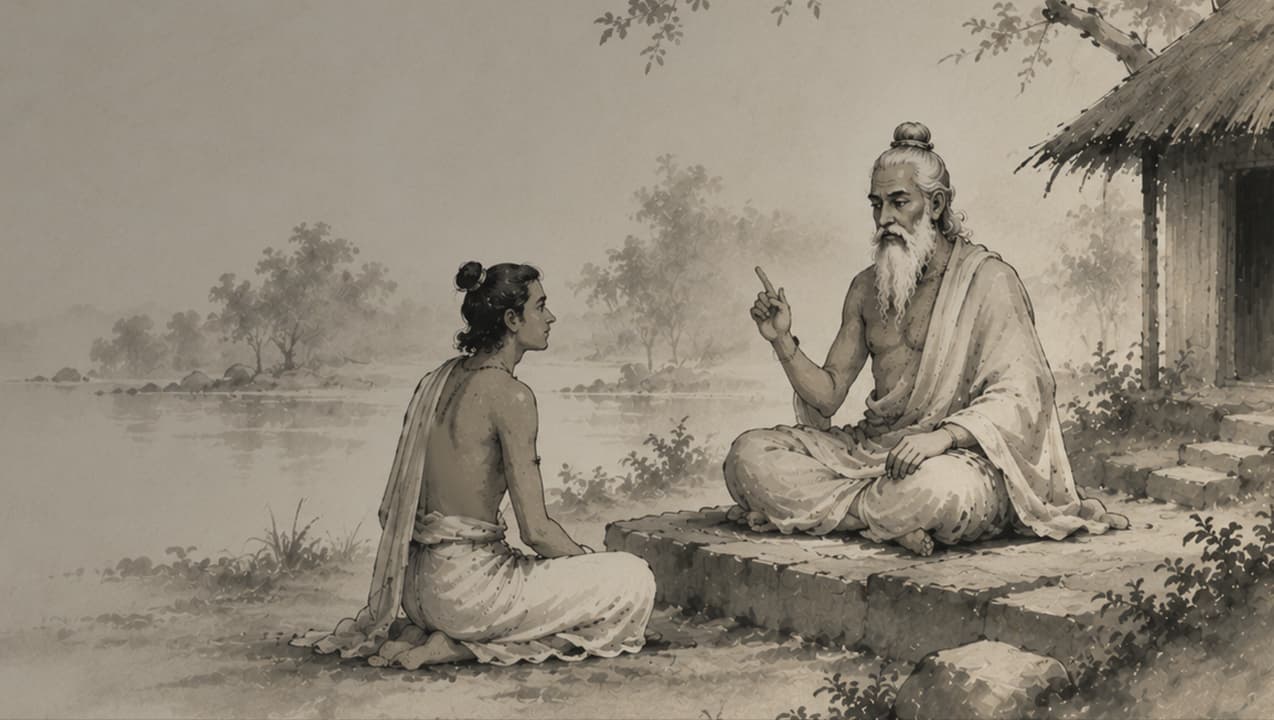
Acharya Prashant: “tadū dūraṁ tadanantiko,” It is far, it is near — so says Isa Upanishad. It is one of the pramukh (main) Upanishad. It has been called poetic Upanishad, and it is easy to take its utterances as poetic delight. A poet is entitled to flights of fancy, so one may look at this paradox. The Upanishads says — it is within, it is without; it moves, it moves not; it is near, it is far. One may look at these paradoxes and take them to be merely poetic in nature. That would be to miss the point. Let's go into it.

What is it that keeps on appearing far to us? It's a very common, very simple word, ‘far.’ What is far? What do we mean when we say something is far? How is it known that something is far? The Upanishads says, “It is near, it is far.” What is it that appears far? Is it not simple? That which cannot be reached, that which is difficult to reach, right? That which demands effort to reach. That which demands time and method to reach. The further it is, the more effort, time, and concentration it requires. That is what we call far.

And after all the effort and time that you put in, if it is really far, it still cannot be reached. Is there something in our life which is similar, which meets this criterion, something in which a lot of time is invested, something towards which goes a lot of effort, and yet it remains perpetually unreachable? Is there something of the kind? We seem unable to figure out whether there is actually something like this, all right.
Time, all the while, all our life we have been striving, we have been trying to get, reach, attain, obtain. And that effort is continuing, is it not? The point of cessation has not arrived, the point of stopping, non-doing has not arrived. There's something that we want, and all effort, all aims are directed towards that. Apparently, we are chasing aims, but all aims are chasing that. And even after chasing aims, we do not seem to be getting it, and the proof is that after one aim, there is always the next aim to be chased, to be achieved, is there not? There is always.

What is it that is far? What is it that is so far that the investment of an entire lifetime proves insufficient? What is it that is so far that in spite of running all our life, it remains as distant as it ever was? We are probably not acquainted with that which we are chasing, that which appears to be so far. But because we are living, we are at least familiar with the facts of our life, with the facts of our consciousness. And the fact is that, as far as we are concerned, life is a continuous movement. Far and near make sense, hold meaning only when there is movement. Without movement, there is no farness, no nearness for us.

Life is a continuous movement. Why are we moving? Towards what are we moving? Surely, if you're moving, there is something that you want, and that which you want is so distant that in spite of all your movement, you are no closer to it. Whenever you have moved, have you not moved towards it? Different occasions, different situations, different times, different ages, different reasons. You appear to be moving towards different things and different objects. You appear to be having different motivations, but what is behind all the motivations that we want?

Surely, at times, we seem to have reached the goal. Surely, in terms of the material, in terms of the world, we are not always a failure. Sometimes we have succeeded. But even when we have succeeded, have we really succeeded? If success is attainment, where is attainment? Is the achiever not as hollow, as thirsty, as needy as the non-achiever? The one who is failing, is he any more desperate for success than the one who is succeeding?

What is it that remains so far that man keeps working all his life, traveling milestone after milestone, conquering challenge after challenge, striving, fighting, hurting, getting hurt, succeeding, meeting failure, and yet at the end of the day, the moment of his physical demise, if he's honest towards himself, all he can say to himself is, "Ah! it's all gone to waste."

Where there is a chase, surely there is a goal, at least an assumed goal. Can we come to the fact of this, that since we are chasing, hence there has to be a goal, and that goal presumably cannot be the goal that we assume it to be? Because had it been that, at least somebody would have chased it down.

So, while it is true that we are thirsty, while it is true that there is an internal hollow, while it is true that we want something, it is equally true that what we want is not that which we are chasing. That which we are chasing appears to be so far that we are not chasing it at all. That which we really want appears to be so distant that we have no concept of it at all. We are chasing proxies, we are running after dummies, we are targeting substitutes.

There is something important, real, immense that you wanted. Your heart cried for it, but because you could not conceptualize it, because it was too far in that sense, in the sense of being infinite, being immense. You substituted it with a petty proxy and started chasing the proxy. Now, you may succeed or you may fail, but in either case, you have actually failed, have you not?

Look at that which appeared to give meaning to life. And we have all been through such events, we have all lived through such occasions: a college degree, a job, a prestigious award, a love affair, beautiful. It appears you have obtained what you wanted. It appears the end has arrived. It appears this is the full stop of all craving. But it betrays, does it not? It does not deliver what it promised. Every love affair is doomed to fail because the lover promises what he can never deliver. Because you are searching in the other, what the other is not qualified, neither entitled to deliver. In fact, the other can never really know what you are looking for.

Instead of looking for what is real, which you really, really want, you try to find a substitute in an award, in progress, in money, in all the games of the ego. Does it not happen? The rishi of the Upanishad is not coming from imagination, it is not a mental output. He is watching, he is really observing life. He's looking all around and within. He's seen the ways of life and mind, and from there arise his words.

When words arise from an honest observation of life, then those words are called "divine."

That itself is divinity. Then you are rightly entitled to claim that the Upanishads are not works of the human mind. Yes, because the mind, in its habitual pattern-based functioning, can never really observe. If honest observation is taking place, it is taking place only when the mind has gone still. And if the mind has gone still, then the utterances can be rightfully, justifiably called "divine utterances." Whatever is uttered from a still mind will be "divine." Whatever is heard with a still mind will only reveal the “divine.”

So, the rishi is looking at the mind of man, the mind of man which is constantly in a want, and he says, "For centuries, since millennia, you are wanting, and not only you are wanting, you are actively trying to fulfill that want, and yet you have not succeeded. Surely, that you, that which you want, is very, very far. What is it that you want? What is it that you want?"

The moment this question is asked, "What is it that you want?" The mind realizes that it cannot look at its own wants while it is running. To the running mind, the rishi is asking, "Sir, you're indeed a hard worker, a go-getter, and you're indeed putting in the maximum effort with the maximum cleverness, intactfulness. But with all due respect to you, would you please tell me what is it that you want, and what is it that is so unreachable that you never seem to be reaching it?"

Because the question has been asked, because the challenge has been posed, the mind must answer it. To answer it, the mind finds that it must stop. Difficult to answer while running, difficult to observe while running. To have a clear view, to have a still view, to have a nice view of itself, the mind says, "All right, let me pause, let me consider the question, let me consider my own situation."

Mind pauses and finds it has reached. The mind pauses and finds that it had never gone away. The mind pauses and finds it has always reached. The mind didn't pause with the expectation of finding it instantly, finding it so near. The mind paused because the ego was posed with a challenge. The pause is always indirect. The mind cannot pause with the promise of the infinite because it cannot know the infinite in advance. Because there can be no imagination, no image, no presumption of the infinite. So, it is only through some trick, some chance, which some people call "grace," that the mind pauses. It pauses to ask, "What is it that is far?" And it pauses and finds that, that which it thought of as far is very, very near when there is no thought. For thought itself is the movement of the mind.

Rishi playfully says, "Yet again it is far, it is near.” It depends on who you are. If you are the ambitious man, the runner, the achiever, the go-getter, it is far, and it will remain far. It is quite strange — those who want it never get it, those who are determined to get it, they too never get it, those who chase it, they chase it away, and those who simply pause find that the pausing is it. The pausing, the non-movement, the stillness, the cessation, the dissolution — that is that.

What we have just talked of, it is not something that belongs to the rishi. We are not discussing scripture here. We are not discussing theory or concept here. We are discussing your life here, which you call your intimate, personal life. There's nobody here, nor in the streets, and not in the entire world, who is not engaged in a chase, who is not desirous, who does not want.

And if you want, then it is your responsibility towards yourself to know what you really want. Otherwise, is it not kind of stupid to keep wanting? Or have you been tutored and conditioned to believe that perpetual thirst is your destiny, that you are condemned to keep asking and never receiving? No, that is not our destiny. We have made that our life. We, nobody else is responsible. The very fact of desire is an indication and an invitation.

The very fact of wanting, wanting anything, wanting to understand, wanting to settle down, wanting to grow up, wanting to get attached, wanting to get detached, wanting more, wanting to quit, wanting to gain, wanting to renounce — the very fact of wanting is an indication of an unease with your present situation. And if I am uneasy with my present situation, must I not know what the situation is about? Must I not understand who I am and where am I standing?

"I constantly feel afraid and run hither-tither. Must I not pause for a while and ask, 'What is it that terrifies me?'" But you cannot look over your shoulder. You cannot see whether there is anything to be afraid of if you are running away all the time. You may say, "No, I'm not always running away. I'm running towards something." Yes, you are running towards security, security that is always elusive. Proof, you're always running. We claim to be intelligent beings. We are called homo sapiens. Where are the sapiens? Nothing in existence acts more stupidly than us. Everything seems to be settled, only we appear so homeless, so uprooted, so restless.

Have you seen more stress and tension on the faces of animals, insects, birds, fish than you see on the face of men? Surely, not all is all right with the way we take ourselves to be. Surely, we must stop deceiving ourselves. Surely, we must stop believing in the script; the tension, stress, and pull is the stuff of human life — the enabler of progress. Look at the movement of an animal, look at how it eats, sleeps, and look at the face of a man. And if you can really look, you'll feel pity and disgust.

What is it that we have assumed to be so far that we never seem to reach it? Why is it so that we, through all our myths, all our religions, all our education, all our propaganda, seem to have convinced ourselves that something is missing in life? Why do we insist on teaching the child that he is inadequate, that he must become something? Why is our mind so habituated to compare? Why are we so ungrateful?

And that is when the fact of physical death is so clearly in our knowledge. I mean, what is it that we are thinking of and planning, living like this, and then just dying one day like the way we have lived: dissatisfied, burning, wounded, hurt, angry, dissociated, planning, hoping, conspiring, running, and assuming that we will reach someday? Is that the bigger plan? Is that our grand arrangement for ourselves, to die this way?

Let's honestly ask ourselves: is it really that far, or is it so that there is something within me that swells up when I run? There is something within me that feels good only when it achieves, and does not feel good when it receives freely. Is there something within me which, for its own sustenance, is killing me? Maybe something is simply, obviously, by virtue of grace, available, but I want to make it distant so that I can have the credit of chasing it down. "I obtained it, I am the go-getter, I am the achiever, I did it." Is there a tendency within us to be bloated with that claim, and to be able to claim we are keeping ourselves deprived?

Our situation is like that of the hungry man who insists that he knows where, in which particular restaurant is food found in the city. He says, "I already know. I have knowledge, and because I'm a knowledgeable man, I will only eat at places that I have chosen, and I have reached, walking on my own legs, planning with my mind, deciding with my discretion." And he is hungry, and the place that he is aiming actually does not exist. It is his fancy, his illusion, his drunkenness.

In chasing that place, he's going past one eatery after the other, one restaurant after the other, ignoring them. He can pause and fill himself up at any moment. The city is full of eateries, but he's saying, "No, I know where I would get it, and I must go there." What is the fun in eating at all these places that have come to me just incidentally? I cannot accept that which is just coming to me free of cost, because if I take it, then where is the pleasure of claiming? Where is the pleasure of achieving? How will I claim that I am somebody? So let me remain hungry, but I'll chase that mirage. That is our situation.

How long do we intend to remain hungry? Can we be a little sensitive and compassionate towards ourselves? Can we hate ourselves a little less? Can we be a little less concerned with what others are thinking about us? Can we be a little more honest and look at our life? The answer to all these is "Yes, yes, most definitely yes." But it doesn't seem to be happening. Why?

It is near, it is far. The rishi is laughing. It depends totally on you whether it is near for you or far for you.

This article has been created by volunteers of the PrashantAdvait Foundation from transcriptions of sessions by Acharya Prashant
Comments
LIVE Sessions
Experience Transformation Everyday from the Convenience of your Home
Live Bhagavad Gita Sessions with Acharya Prashant
Categories