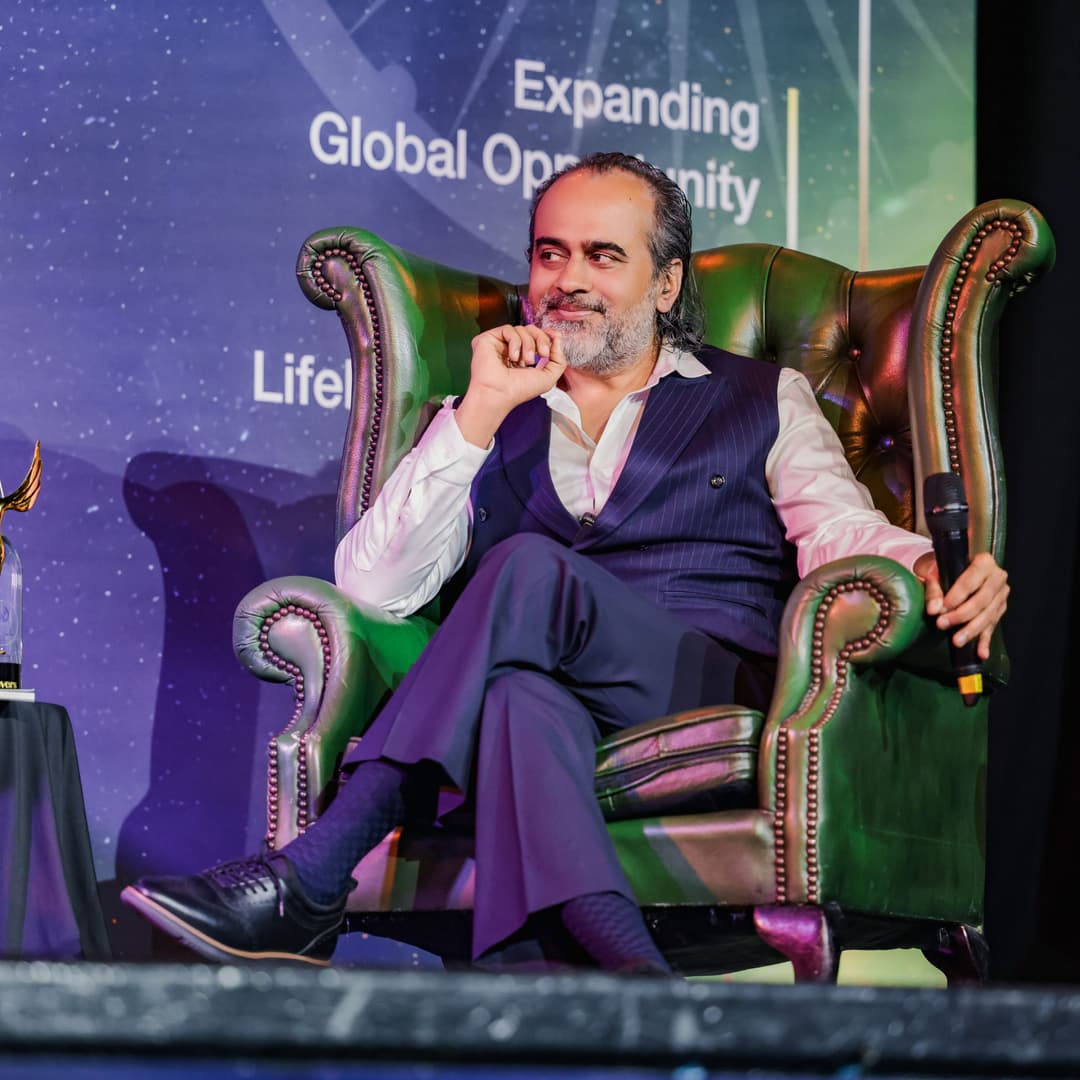
Questioner: Moments ago inside the House of Lords of British Parliament, you recited, "you recited,
“Asto mā sadgamaya Tamaso mā jyotirgamaya.”
lead me from the unreal to the real, from darkness to light." What does this Upanishadic prayer, spoken in the heart of British democracy, have to say to lawmakers and power holders?
Acharya Prashant: This has to say something that will be a bit uncomfortable to all lawmakers, whether British, Indian, or from any other place. See, as a lawmaker, you want to legislate your way out of problems. As a lawmaker, you are looking at people, systems, objects, and trying to put them in some kind of order, with the hope or objective that if I can do things with stuff as it appears on the outside, problems can be solved.
Please look at the structure of the verse,
“Asto mā sadgamaya Tamaso mā jyotirgamaya Mṛtyor mā'mṛtaṃ gamaya॥”.
This is a prayer. And what does prayer, by definition, mean? It means there are things that you cannot do with power. And that's where something else other than power is needed.
So the prayer is saying that the lawmaker has to realize that not all problems can have legal, policy, or technical solutions. The lawmaker has to realize that. Otherwise, the lawmaker will be okay with letting the darkness within remain, whether it's the darkness within the lawmaker's own interiors, or the darkness within the population in general. The lawmaker will say, "I'm fine with darkness, and I want to solve the problems of the world using legal measures because I'm a lawmaker. That's the tool that I have, the law."
The lawmaker will fail, and precious time will keep ticking away, like in the case of the climate catastrophe. We are trying legal problems. No. Certain problems are not problems of material problems or substance problems of external order. The climate crisis, for example, and the lawmakers have to acknowledge that, is a problem of internal order. It is not an emissions problem; it is a consciousness problem.
So that's what the verse has to say.
Prayer here simply means honesty. Prayer here simply means, "I have surrendered when it comes to external pursuits because I have realized that there is something that cannot change by external chase." And who's that one? What's that thing? The chaser.
How will the chase change the chaser?
So for this chaser to change, and this chaser is at the center of the most critical problems facing mankind today, for the chaser to change, what we need is prayerful intent, honesty. And that's what I hope lawmakers all over realize.
Questioner: Cambridge, Oxford, and now the British Parliament, scholars, students, and legislators. So you have been addressing them all. Does your message change with the audience, or is the Truth the same for all?
Acharya Prashant: It does, and it does not. So it's a beautiful evening in London right? This moment. Does the sun change for different places, different people, different countries, different races, different ethnicities, or different campuses or parliaments? No, the sun does not change. But yes, the clouds do change, the weather changes, and the time of the day keeps changing.
The Truth is all right with changing costumes because no costume can touch the Truth.
So when I speak to people at different places, people from different backgrounds, I realize they come from different contexts. So I change the words. At Cambridge, for example, they were all coming from a background of logic, professors of philosophy, professors who were doing research towards sustainable living. So I could speak to them the language of logic.
There are other audiences, and I speak to them in different registers, sometimes in different emotional registers as well, and obviously in different languages. So all that keeps changing, but the Truth cannot change.
See, the Truth is not a product that I can redesign differently for different markets. The Truth, by definition, is that which is unchangeable and untouchable.
So yes, it can be, and it has to be, presented in a way that is suitable to a particular audience, but the core message does not change. And if the core message is changing, then it's salesmanship, not scholarship.
Questioner: In the next few days, you will sit with leading Western minds, a London School of Economics philosopher, a Cambridge-Harvard biologist who once dialogued with J. Krishnamurti and David Bohm as well, and a Harvard psychologist. Where do Western science, philosophy, and Vedanta meet?
Acharya Prashant: In one single question: "For whom?" They do not meet in the way it's being commonly practiced today, with Vedanta being presented as a material science and people trying to put in quantum physics and all kinds of things to prove Vedantic theory. Not in that way. Nor is it needed that science be put to the inner world. But the meeting has to be there.
You see, at some point in the last quarter of the last century, physics met this peculiar problem: the observation could not be separated from the observer. Right? So the question, "For whom?" has now become a question of the empirical sciences as well.
We talk of reality, but all this is for whom? Is this an objective Truth in itself? Science takes all this as an objective Truth. Vedanta asks the question, "No, no, no. All this appears to you. Therefore, all this is for you. But are you real?" If that is something that you experience, and that is something that appears to be real only by the dint of your verification, first of all, is the verifier real?
How do you know that the experience here is real?
So that is where science and Vedanta have to meet. Science talks about the objects, and Vedanta goes into the subject that is experiencing all the objects. And you cannot have an honest study into the objects without considering the subject as well.
I cannot know anything out there to be totally real if the only proof that I have is my own experience, and the experiencer has not been tested. Right? If I'm tipsy, if I'm drunk, these can appear to be like six or seven fingers, and that would be a matter of my experience. So does everything in experience bear out as real? Not really.
So that's the question Vedanta keeps asking. And that's a question not just at the interface of Vedanta and physics, but also at the interface of Vedanta and psychology, Vedanta and philosophy, Vedanta and neuroscience, Vedanta and all sciences that probe the external world. So Vedanta is inevitable. You cannot progress in any field, any science, anything academic or personal, without meeting the question, "Ko'ham?" "Who am I?" For whom is all this?
Questioner: So you have two invitations at London Climate Action Week. You are at the largest climate gathering with policymakers, financiers, and business leaders. At Cambridge, your point that the real climate solution is mass self-education was received remarkably well. So do you expect the climate establishment to be as receptive?
Acharya Prashant: Yeah. See, my responsibility is to present the Truth with utmost honesty and not count the applause, and obviously not the brickbats or abusers. Right? I do not see myself exercising any sovereignty over how the other would receive me. Right?
So you see, there are places. For example, I just mentioned Cambridge. Cambridge, it was received well because the professors there, the academic fraternity, the whole audience there, could follow a line of argument right to the end without flinching. So I could speak to them, and that involves honesty.
There is a chain of logic, and you are probing each link of it, and if it appears to be fine, then you continue walking along. So that's what I can present, something that is not deniable, something that is irrefutable. But whether or not the other would still honestly accept it, acknowledge it, let alone surrender to it, that is not in my province.
Though, well, you see, there is something beyond responsibility. I said my responsibility is to present the naked Truth. But beyond responsibility is the matter of love. And love sometimes makes me guilty of trying to make other people responsible, trying to make other people receptive. Though, as a matter of principle, that's something I cannot do. That's something nobody can do because that is something that has to be done by each individual for herself.
I cannot force somebody to acknowledge the Truth. I can, at most, present the Truth, stand there patiently saying, "Please, this is how it is. This is the mirror. Look into it. Acknowledge it." But beyond that...
I would also like to add something here. You see, you said "climate fraternity." There is a lot of funding. There are a lot of careers there, and just so many conferences continuously. There is just so much at stake. So much at stake. And all of that is going in the direction of proving that egoic solutions can eventually work, that you can change one sector of the external world while keeping all the others as they are; that you can change the world without changing yourself. So there's a lot of money involved there, and there is a lot of respect involved there. There is so much at stake there.
So if what I am saying is acknowledged, then a lot would be threatened, and a lot might collapse. So I guess it's going to be difficult for entrenched and vested interests to acknowledge, accept, what I'm saying.
**What I'm saying is: your policy measures won't work.
What I'm saying is: without mass self-education, you are not going to succeed.
What I'm saying is: all the green technologies put together are not going to be the answer to the climate crisis.**
You can make every single engine in the world many, many, many times more efficient, and that is not going to have any impact on the hunger of human desire. In fact, as you make machines more efficient and technologies greener, you will find human desire rising not just in proportion, but beyond proportion, to consume the world even faster. The net aggregate result, you will find, like it happens in the Jevons paradox, is that with every gain in efficiency, you are only increasing pollution beyond what the efficiency gain could reduce.
So the evidence is there. But because there is so much personal interest at stake, I don't think that they are going to easily acknowledge that. I'm not saying that you should not have EVs, that you should not have green technology, that you should not have green tax and other policy measures. I'm not saying that. What I'm saying is: all that is going to prove insufficient in the face of insatiable human desire.
And I don't think that's going to be easily acknowledged, though I really pray that it is acknowledged because the very future of the planet, and not just our species, but billions of other innocent species is at stake. So I pray that they do see Truth for what it is.
Questioner: Watkins is one of London's oldest bookstores and, for nearly 130 years, a doorway to Eastern wisdom for Western seekers. It has named you among the world's most influential spiritual philosophers. So what would you want a young British seeker to find in your books?
Acharya Prashant: Not Eastern wisdom. Not exotic jewels from the Orient. Not mystical gems from India that he can wear on his traditional British lifestyle, you know. No, not that. If I am to gift something to a young person from Britain, it's a mirror I would gift.
So I'm not bringing any particular principle here. Information? No, no hidden knowledge at all. I'm not claiming I have any hidden knowledge. In fact, the rooms I've been speaking in, they are terribly well-informed.
They carry more knowledge than most other places, and information is not what is in scarcity. What is lacking is honesty. Honesty.
So that's what I'm bringing here, and I'm saying that there is no alternative to that. That honesty that I sometimes call love, sometimes intent. I'm here to disappoint people. I want to tell them that without that love, without that honest intent, your other ways are just not going to succeed.
So yes, I'm here to make people feel uncomfortable. Though I'm surprised that they are saying that they wanted to be made uncomfortable. They are saying that they have had enough of saccharine, and they wanted to hear the naked Truth, even if it tastes bitter. So that's my job, the mirror.
Questioner: Parliament today, Oxford and Cambridge behind you, LSE, King's, London Climate Action Week, and what ahead. If you had to sum up this UK journey in one sentence for people watching in India, what would it be?
Acharya Prashant: I would request, and gently tease, my Indian brothers and sisters. Now Europe is listening. Now the academics are listening. Now the writers and philosophers are listening. Cambridge, Oxford and LSE are listening. When will India listen?
But, that was the lighter part, just in a joking way.
See, the real thing is this: yes, we all feel a certain pride when somebody comes from India and carries the message of India to a foreign land. We feel that pride. That pride is all right. But I want you to feel something more important, something more deeply real, real gladness, real joy. And real joy lies in seeing that it is not a principle, but the very awareness of the self that is reaching foreign shores. It is not about something sectarian. It is something universal that is coming from India and going out to all places. And since it is something universal, therefore it dissolves all kinds of narrow divisions.
So I do not want Indians to remain as they are because, you see, when we Indians look at ourselves, often it is with a lot of distortion in the mirror that we look at ourselves. Right? And that includes me as well. Right? So we need to look honestly at ourselves. And the things that I am speaking here, we need to ask ourselves: are these things, first of all, being understood by the native land itself?
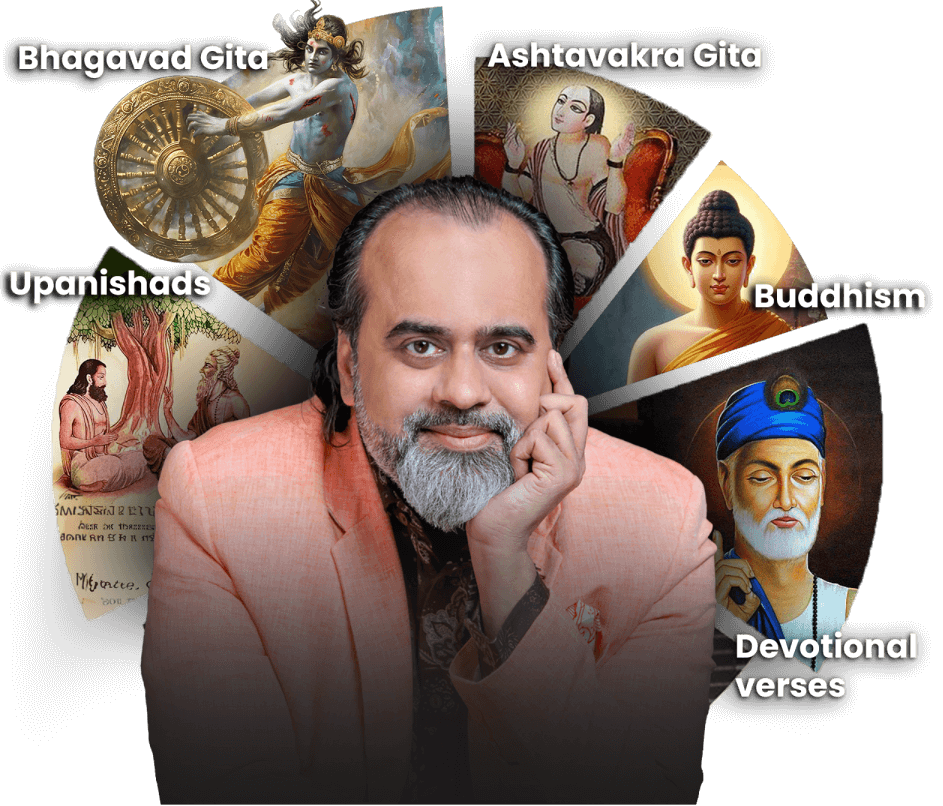
For example, to make it concrete, everywhere I go here in the UK, I speak of the Upanishads. I speak of Vedanta. I speak of the Bhagavad Gita. I also speak of my own evolving philosophical framework. So that's fine. That's beautiful. And we do say that the Upanishads and the Gita come from India. But my request is: to what extent does India actually understand the Gita, Vedanta, and all the other philosophies, including Buddhism, Jainism, and the host of other works that we have had in our land?
So it would be a very strange, even absurd situation, if as an Indian, I do not understand my own important works of philosophy, but I rejoice when the same works of philosophy are taught by an Indian at a foreign university. So I taught the Ishavasya Upanishad at Oxford, and India rejoiced. And I want to join the celebration. Yes. But along with the celebration also comes the question, you know.
Yes, here Oxford is understanding the Ishavasya Upanishad. But does India celebrate the Ishavasya Upanishad equally? Or, for us, has popular religion come to mean simply a lot of stories, myths, borrowed principles, beliefs? Or do we want to go down to rigorous philosophy?
If we do not do that, we'll find that, yes, we are celebrating, and everybody should be entitled to celebrate, but we'll find that the real thing is reaching foreign shores, and they are not just appreciating it but also imbibing it, also allowing it to penetrate them. And that would change them in return. That's a principle. And India, in spite of being the land where the great works of wisdom and philosophy came from, will find that it has not been able to benefit equally.
So that's a situation that I dislike to think of. And I want my country, my land, my Indian brethren, to really give credit where it is due. I want India to respect its most important contribution to the world, which is the philosophy of Vedanta. I want India to be honest in looking at itself. The mirror that I talked of with respect to the British boy, India needs that mirror in equal measure.
Questioner: Thank you so much.