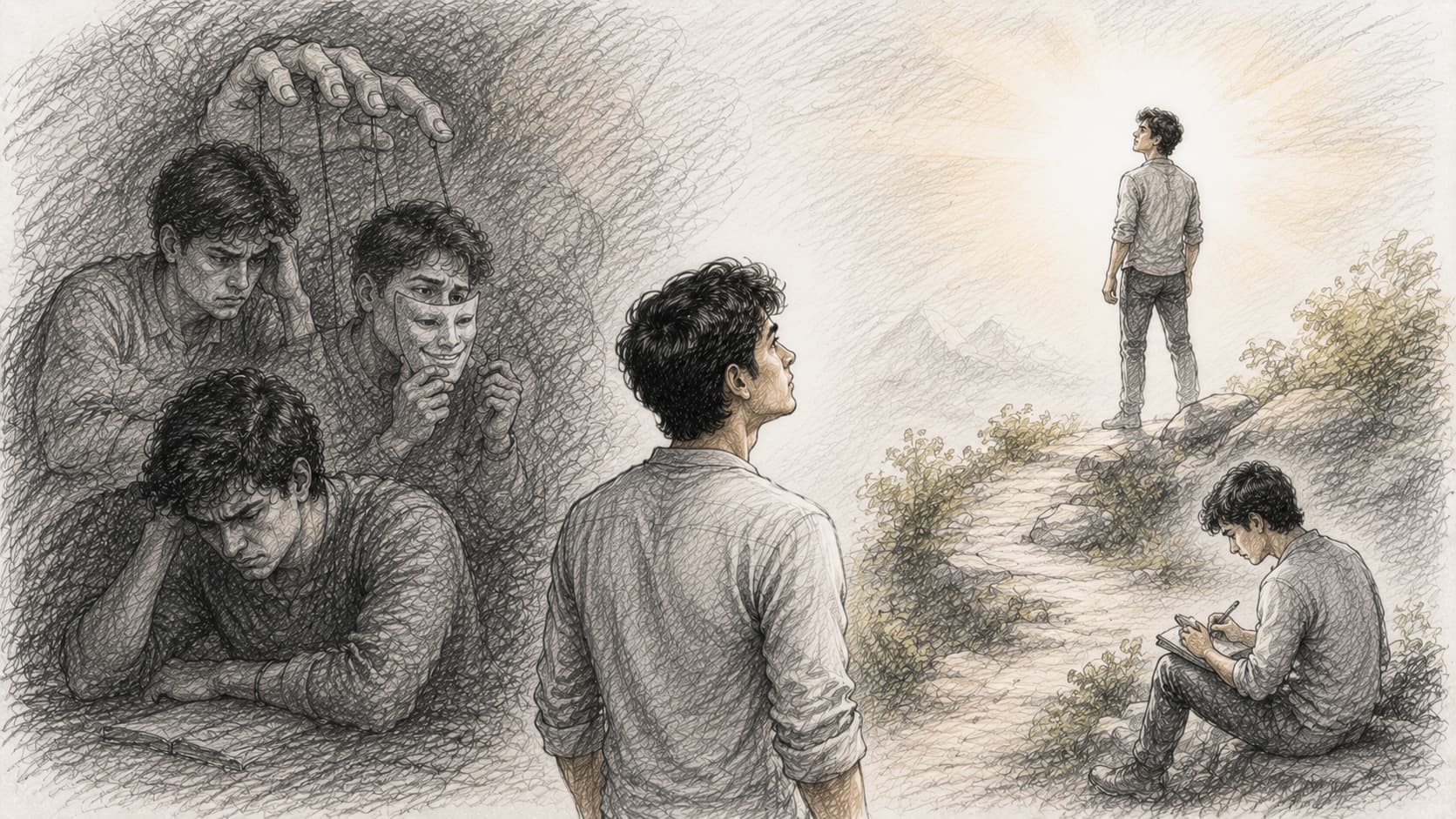
Acharya Prashant: When it comes to the normal human being, his legs don't walk. They are walked by the ego. His eyes don't see. They are rolled and blinked by the ego. Every part, every little fiber of the physical machinery is under the domination of the ego. Thoughts don't float. They are moved around by the ego. Feelings don't arise. They are pulled up and driven around by the ego. That's how the system in the human being works, right?
Eyes don't fall asleep. The ego makes them feel weary, tired, and tells them to doze off. And once the session is over, you again pop up. Even sleep is controlled by the ego. Bad news, and you lose appetite. Why? Does the body no longer require food? But the ego says, "I'm so afraid."
Stomach, intestines, even in this moment, you want to eat, and the poor things, in the dominion of the ego, they say, "Okay, no, no, nothing. Nobody is hungry. Who is hungry? That rascal liver was talking for some. Nobody will eat anything.” The ego is depressed, so the stomach will not get anything. Seen that in families? Tauji is upset, and then you prance around with some chips. That won't happen, would it? That won't happen. Tauji is upset, so nobody eats anything, at least not in front of him.
So this entire system is run by the…
Listener: Ego.
Acharya Prashant: Not that it must be. It is fully capable of running itself. It is fully capable of running itself functionally and beautifully without the ego. But that's not how, practically, it is. Practically, everything is controlled by the…
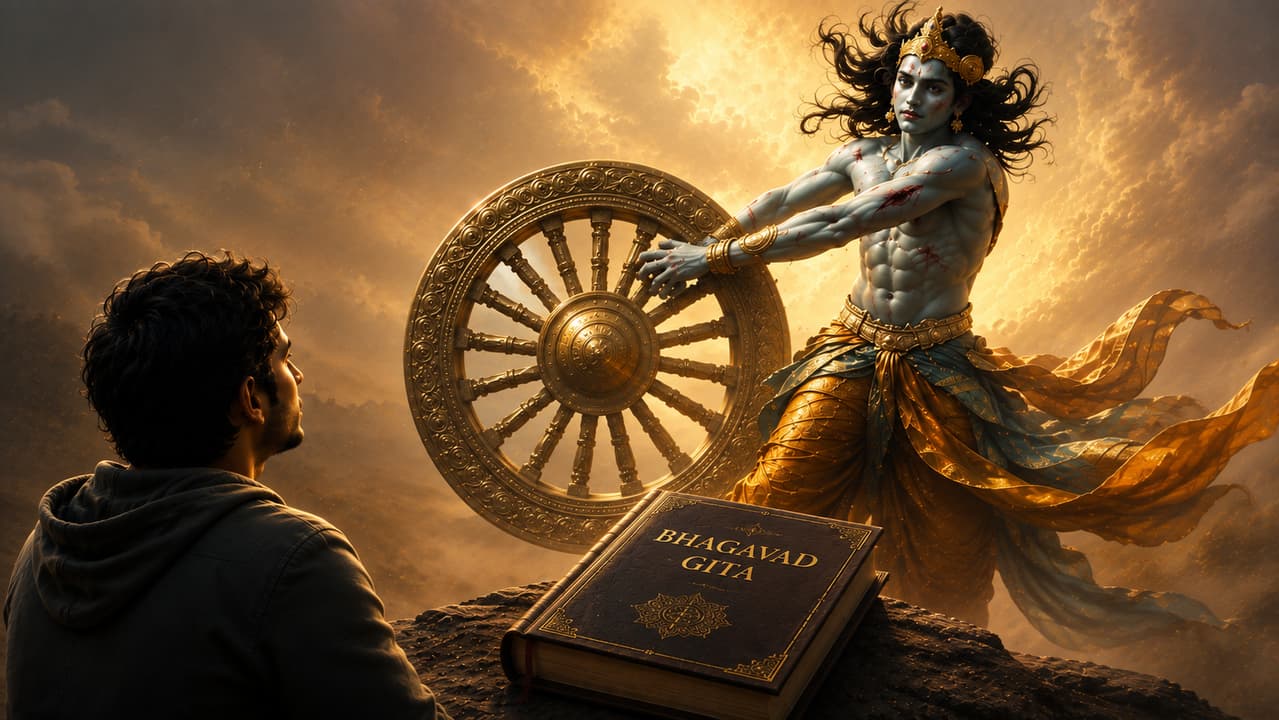
So this is the ego, the range, the range, topmost possibility of the ego, as the topmost possibility of the ego, right? So that's the point Shri Krishna is talking from, right? This ego, this range, is what controls the body. This is the body.
There's the body. (Places a doll, a donkey, a Minion, and a pig toy on the table.) Teeth, cheek, tummy, other parts. So all these are being run by the ego. Shri Krishna is saying, "If I don't run this, it falls, it stops." Why? Because if this point doesn't run this system, some lower point would, because ultimately something from here will run this. It's not that the highest point withdraws and this system becomes autonomous, totally prakritik. No, that won't happen.
If the highest won't run this, then the lower or the lowest would run this. Do you get this?
If the highest, this is the ego, the range Shri Krishna is speaking from, the top of the building, if he doesn't run this system from there, something from here would run this. And when something from here runs this, this collapses. This collapses. And that's the reason why, even from his liberated height, a Shri Krishna always has to keep acting. Withdrawal is not an option. If he withdraws, somebody else steps into his shoes.
If the teacher says, "I do not teach," that doesn't mean the student won't be taught anymore. Just that the student will now have his own ego as the teacher. Therefore, the teacher doesn't have the option to withdraw. The teacher has to keep chasing the student because the student, being a student, will be impressed by someone. He will be controlled and conditioned by someone. Are you getting this?
If not the highest point here (at the top), some other point here (at the bottom) will start running the show. And prakriti does not tolerate the lowly ego running its show nicely. No, this show actually does not belong to the ego at all. The maximum concession prakriti can give is, "Let this be run by the highest point. Fine." That's the concession that can be given.
But if a lowly ego starts running the physical show, the system collapses. And that's what we are seeing in the individual, and in the institutions, and the global order, the system being run by lowly places, lowly people, and therefore the system is collapsing. And so Shri Krishna is saying, "The highest one has to remain in office. The highest one must keep discharging his duties, not because he's obliged to, but because if he vacates, he must know who would step in."
If not here, then where? Were you not here this moment? Where would you have been? Sitting like this, squatting in front of the Gita, listening carefully, then sleeping, snoring, something, some randomness, some nonsense. And for some of you, these are wicked hours. Not that the teacher withdraws and the student is left on his own. The teacher withdraws and the student is colonized. The student is taken away. The student does not know that, but the teacher does. And that's such an asymmetric situation.
The student, being the student, does not even know what happens to him when the teacher is gone. So the student is bound to take the teacher casually. But the teacher, being the teacher, knows fully well what happens to the student after him. So the teacher does not want to afford that chance.
Do you get this?
And that has brought us already to the outer direction of the meaning. The inner direction is: if you are not operating from your topmost point, then obviously you must be operating from some lower point. And that would mean that the entire system that you have…
Listener: Collapse.
Acharya Prashant: Are you getting it? Stay on top. Be at the top of your game. That is the only way you will not be in conflict with your own physical system. That is the only way your thoughts, your emotions, even your bodily functions, will have some harmony.
Operate from the topmost inner point. Otherwise, all you will experience is a lot of conflict, broken thoughts, infighting among emotions.
You experience that? That's not a flaw in thought or emotion. That's actually the level of the ego that is running the thought and the emotion. The lower the level of the ego running the thought, the more conflicted your thoughts would be, more conflicted, more unclear. And we'll repeat to ourselves: that's not a flaw in the thought itself. That's got to do with the controller of the thought.
Are you getting it?
Questioner: Namaste Acharya Ji. My question is with respect to the inner direction meaning that was given and basically how we understand displacement in the vertical axis when the ego keeps dissolving, that is, when you reach higher and higher points. But here we said that if the higher point of ego doesn't run the physical body or other things, then the lower or the lowest point would run it.
Acharya Prashant: Something will run. Yes.
Questioner: Right. So here we also mentioned that the highest cannot withdraw in that case. So how are we to consolidate the dissolution of the ego with the higher point acting on...?
Acharya Prashant: Dissolution of the ego simply means the ego getting more honest to itself. What is the ego? An unverified claim, and the claim holds only as long as the ego refuses to honestly scrutinize it. That's it. So, the ascension of the ego, or the vertical rise of the ego, what do all these mean? Simple. Am I truthful to myself, or do I believe in my images and self-concepts? Nothing more than that.
What is a lowly ego? A lowly ego is a loaded ego. Right? That's a nice picture. Just as when you get loaded, you refuse to rise. If you are very loaded, rising becomes difficult. So you want to unload and unburden so that you can… So, a lowly ego is a loaded ego. Loaded with what?
Questioner: Beliefs.
Acharya Prashant: It’s claims about itself, and from that follow a lot of claims about the world also. But all those claims are centered in the ego's self-concept, self-definition. Dishonesty is self-referentiality. If I want to know whether I have solved a problem rightly, I cannot be my own assessor and auditor. I have done something; I'll give it to somebody else to check, review, evaluate. No?
What does it mean that the ego is self-referential? It claims and verifies its own claims. It makes claims about itself and then rises as the auditor to verify those claims. It is a black box. It does not want to admit anything outside of itself. I will decide what is wrong, what is right. And this is where the dishonesty is.
So, the elevation of ego is not something metaphysical or mystical, or even very complicated. It simply is: the fellow is getting honest. The fellow is not scared of the mirror anymore.
Nothing more than that. As simple as that. Are you getting? So now, you could operate from a lowly point where you are just a bundle of inner lies, or you could operate from a higher point where the lies have thinned out.
Questioner: With the concept of referential, as you go high, your ego is obviously self-referential. So, at the lower level, it is justifying its own claims. As you go higher, what happens? The honesty level...
Acharya Prashant: There is so much outside that you can use to verify your claims. Right? So, you, for example, in your inner world, are the most courageous woman history has known. Who am I? The most courageous person history has known. But outside of you exists this (Pointing towards the toy pig), right? This lion. So why not use it to verify your claim?
See, Oop!
Now self-referentiality has been obstructed. Otherwise, I can keep sitting within myself and say, "I'm brave, I'm courageous, I'm afraid of nobody." Fine, let's face a lion then. Doesn't a lion exist? And that experiment can break the inner circuit of lies. Otherwise, there is that inner loop that remains unchecked.
Use external situations to verify your inner claims. And the dirty trick there is: you will never want to get into situations where your inner lies are exposed. You will actively, deliberately avoid situations where you run the risk of facing the mirror. You'll say, "No, no, no, no. I don't want to attend that session. I don't want to attend the session."
Self-referentiality being threatened, session being avoided. Simple, simple.
"I don't want to write the exam. I have anyway understood everything." Let's check that. But you will not write the exam, precisely because the exam will expose how much you know. Do you get this?
The ego wants to carry the claim, "I have topped the Gita," not just understood it, mastered it, topped it, aced it. There is that, you know. The percentage is good, 98 or something, but what is that little thing there? I mean…
So there IT pretty lousy, for sure. It's some little bug. Can we raise it? Do you get this?
That's all that there is to the elevation of the ego. Elevation of the ego is not some sadhana where something rises within, or that. Nothing. You're just getting more honest with yourself. It's that simple. And because it's that simple, therefore the ego can simply dodge it. Had it been complicated, it would have been complicated for the ego as well. But because the process is so simple, it is simple to dodge also.
After all, even being honest, if you see, is in some sense self-referential because only you can know whether you are being honest. So even honesty is self-referential. Have you not seen dishonest people swearing? Dil se bolna. Indian legal system, we all…
Nobody else can know, not the man up there on the judge's chair, not anybody else in the courtroom. Nobody can know whether you are being honest. Nobody can. And the Gita doesn't speak. You can put your hand there and say, "No, I'm not lying. I swear by the Gita."
That's the thing. First of all, the ego is self-referential. It feels very confident of its claims. And when it's told to be honest, even in that there is a creeping self-referentiality because only you can know whether you are honest.
"I'm not afraid anymore." How to really verify that? How to really ascertain?
"Acharya Ji I'm very honest towards the system."
And even if somebody does attempt to verify that, there would always be some subjectivity in the external assessment. And subjectivity means a certain chance of imprecision, right? And then the ego gets to claim, "Ah, he assessed me, and the assessment was all wrong."
First of all, tell me, why was there a need for somebody outside of you to assess you? Because you are dishonest. And now that an external agency is assessing you, it is inbuilt in the system that the assessment will have some flaw. Bear that flaw.
Maybe instead of minus 98%, you deserve minus 92%. Maybe. But does that entitle you to dismiss the result in toto? No. "The system is flawed. See, minus 98. No way." Do you get this? Niyat ki kharabi ka koi ilaz nahi hai. That's it.
And that's what is about the rise of the ego. Kya? Intent, niyat. Purely put love. No system, no method can guarantee love. What to do? It comes. It comes. It doesn't come. Getting it?
Questioner: So, Acharya Ji, being Prakritistha will also be a higher level of honesty.
Acharya Prashant: Being Prakritistha simply means not being there. Prakritistha is for the physical system. Prakriti running its own system is best for the system. Let Prakriti take care of your hair, of your eyelids, or your lips, or such things. You don't need artificial elements and this, that, whatever.
Questioner: So, in the inner dimension, what is the highest form of ego actually authorizing?
Acharya Prashant: Highest form of ego?
Questioner: For highest, wherever highest level...
Acharya Prashant: Honesty has no limits. Ultimately, theoretically, the limit of honesty is: the ego says, "I am not," and becomes Atmastha. But that's too much to ask for, so we don't even talk of that possibility.
I keep on telling you that the ego will never totally vanish and finally vanish. Not totally and not finally. It can be thinned out to very microscopic levels, maybe. How thin is the ego? "Well, I have a nanometer ego now." That is fine. But that's right now. And for now, that nanometer can very quickly become a kilometer.
So, the theoretical limit of honesty is: even the honest one is gone. The honest one became so honest that he disappeared. All this honesty we are talking of is for the ego. Right? And the final statement of honesty would be: "I am not. I am my own construct. I'm an error. I am an illusion." That's the final statement of honesty. And then the ego is gone. But we don't want to consider that possibility.
From where I look at it, that possibility is simply a fantasy created by the ego for itself so that it can say, "I am enlightened. I am dead. I am gone." So, instead of saying, "The ego is finally gone for good," kindly limit yourself to saying, "I am constantly vigilant that I remain as thin as possible. I am continuously attentive that I don't fatten myself up. I want to remain a little thin."
And I won't be dishonest enough ever to say that I am gone. As long as this is there, I am there. I'm there. The physical ego, anyway, cannot go. Psychological ego can, at most, be thinned out, reduced to a very little thing. That is the maximum you can get. Don't hope for anything beyond that.
Any aspirants asking for some transcendental magic...
Questioner: So Acharya Ji, the highest, cannot withdraw. It would mean that you cannot be dishonest. You always have to be honest. Is that how you have to look at it?
Acharya Prashant: That's a choice.
Questioner: So, if you're not choosing honesty, then you are choosing the lower form, which is...
Acharya Prashant: If you're not choosing honesty, you are choosing some false statement about yourself. Simple. False, but pleasing. False, but comfortable. False, but nice. Sweet, sweet.
Questioner: For those who are tired of sweetness.
Acharya Prashant: Sweet lies.
Questioner: Thank you.