प्रश्नकर्ता: प्रणाम आचार्य जी, मेरा प्रश्न है कि भगवान महावीर आत्मा को मानते हैं और भगवान बुद्ध आत्मा को अस्वीकार करते हैं। एक आत्मा को सत्य बोलते हैं और एक असत्य बताते हैं तो इन दोनों के बीच में अंतर क्या है?
आचार्य: जब कोई बात हमको बताई जाती है…
The Bhagavad Gita is often accused of supporting caste and misogyny through selective quotations that ignore context, grammar, and the text's central teachings. A closer reading shows that its emphasis is on inner qualities, conscious action, and spiritual equality rather than birth-based hierarchy or gender discrimination. Misinterpretations arise when isolated verses are detached from their broader meaning, while the Gita consistently points toward self-knowledge, freedom from ego, and the universal possibility of liberation for every human being.
We have all put down a book that could have helped us, or dozed off halfway through something that mattered. A man who could not keep food down was given medicine, and he threw that away too, since it went in by the same route. Most of us strike a similar deal: we move into a place that stinks and, within a week, call the smell normal. Show our fifteen-year-old self the life we lead now and they would scoff. What would change if we admitted we do not like our condition?
On the evening of November 15, just hours before a scheduled Gita session, a message arrived from Gauri Maulekhi, a prominent animal rights activist. She requested Acharya Prashant to join her in Patna the following morning to meet the Chief Secretary of Bihar and address the press about the Gadhimai festival in Nepal. This was no ordinary request. It was a plea to save thousands of animals and to raise a voice against a centuries-old practice of cruelty disguised as tradition.

Your only obligation is your liberation. These are just loveless social customs and economic structures where a woman is seen as a factor of production that produces babies. There’s no need to go to the husband’s place or even stay at your father’s if you are unloved and unwanted. The world is a vast opportunity. Live anywhere, stay anywhere, do whatever is the right work, and fly free—simple.

Acharya Prashant: Hell is a place where you get a lot of sympathy, consolation, condolence, and commiseration. You're told that we agree that you are in a miserable state. Your neighbor comes to you, puts his hand on your shoulder, and with a grave face tells you that you are…

Love, for the one who is at a low level of consciousness, is to aspire for a higher level. And love, for one sitting on the Himalayan peaks of consciousness, is to be compassionate towards those at lower levels — and, for their sake, if needed, lay down your life.

Questioner (Q): My question is regarding abortion. Broadly, there are two schools of thought regarding abortion. The first one is, because it is the woman’s body, she is the one who gets to decide whether to abort or deliver the child. The second school of thought says that the woman…

The character of Radha is not present in any of the Upanishads, obviously, not in the Vedas. It is not sufficiently present even in the Puranas. With respect to the character of Sri Krishna, there are two Puranas mainly. There is the Shrimad Bhagavad Puran and there is the Harivansh Puran. These two are dedicated to Sri Krishna. Even in these two, Radha is scarcely mentioned. Read more....

The word for a Guru does not really exist in the English language. So, they have borrowed Guru itself, Guru. But they have borrowed the word Guru and rather misunderstood it and misapplied it. So, anybody who seems to be an expert at anything, can be justifiably called a Guru in the English language. Now that's not the proper usage in spirituality or in Sanskrit.

Questioner (Q): Good afternoon, Sir. I have a doubt. In the market, there are a number of Bhagavad Gitas available. Somebody told me that there are eighty varieties of the Gita. Even though the slokas are the same, from what I have seen, the explanation was not making sense. In…

Acharya Prashant: You have to ask yourself what your primary identity is. If your primary identity is that of the body, then do what the body commands you to do. Good. The body has an inbuilt software of its own, and it’s a self-improving software. Its capacity to keep improving…

Acharya Prashant: I know it's a fad currently, “the in thing” to say, be your own light, don’t depend on anyone, decide for yourself, whatever. It's a very ignorant thing to say with all due respect to the Buddha.
Such advice is meant only for very selected disciples. And even…

In our daily lives, we find people using the word Ji as an affirmative statement or while addressing people. Though, it has just become as social norm, there is a profound meaning behind it that conveys of beauty and auspiciousness. It is a reminder that one is beyond the body and the mind; beyond all names and forms. And instead of being identified with the body and the mind, there is something better to be identified with—‘Sri’- a Sanskrit word standing for Ji in vernacular.

Vedānta is about the person gaining liberation from both of these—body identification and mental conditioning. So, ideally spirituality should be the woman’s best friend. But practically, evidence has been rather mixed; in fact, evidence has been that religion historically has been on the side of the oppressors when it comes to the women, oppressors of the women. The reason is that religion itself has not been well understood. Religion itself has been a victim of contamination, and when religion is contaminated then religion becomes a tool towards exploitation of women.

There is a search within the human being, always for the greatest, the absolute, and that is what differentiates humans from animals. India was fertile, and there was abundance. You had ample leisure, and in that leisure there was space for intellectual inquiry. The sages and the seers would talk to each other purposelessly. And from that purposeless discussion, from silent observation of life for hours, days, months, and years, came those insights that you today recognize as Indian philosophy.

Remember, it is not as if Krishna did not try with Duryodhana. Krishna goes to Duryodhana and what does Duryodhana do? He tries to arrest him. Krishna goes as the messenger of peace and Duryodhana says no, no, no! The action of Love is still taking place. He is not saying that I will leave Duryodhana to his fate. He says it is my responsibility to teach even Duryodhana. But when Duryodhana proves it beyond doubt, that he is incorrigible, then Krishna says, “Fine, now that the battle is destined, let the blows rain.”

There is only one Dharma. And that is to attain liberation or peace, to gain freedom from your bondages, to gain freedom from your inner chaos and noise, to gain freedom from your inner falseness. Gaining freedom from inner falseness is more commonly known as Truth realization. It is a euphemism—a very decorated euphemism. It’s not really Truth that is really realized; it is falseness that is dropped.

Questioner: Acharya Ji, recently I had a small argument with my parents regarding marriage. They have been pushing me for the last seven years, trying to somehow convince me to get married. I’ve got kind of really sick of it. I’m trying to push it, saying that I don't need…

A woman is murdered—even that is just a two-inch thing in some newspaper. But if it is a sensational rape case, then the entire country joins in.
Are we really concerned about women? Had we been concerned about women, how is it that the common man of this country is…

Questioner (Q): A very good evening, sir. According to the world bank, out of the total economic growth of India, women contribute only seventeen per cent. However, their Chinese counterpart country put forty per cent into their nation’s growth, as we are aiming to be a five trillion economic country…

“The will to live.” “The will to just continue.” That, he said, is the basic human existential tendency. I’m asking, “Don’t animals have that tendency?” At the root of all consciousness; is the will to survive and continue. We don’t want to die; the animals, too, don’t want to die, right? We feel pain, we suffer; so do animals. The reasons might be very different. Often the reasons are, in fact, not too different. Separate a human mother from her baby and you see the suffering. It’s very apparent. Separate a cow from her calf, and the suffering is much the same. Read more...

Questioner: All the forms of multimedia, the film industry and advertisements, have presented images of both sexes that are very often unrealistic and debatable. The very quality of femininity has been portrayed in the film industry, ironically, as victimizing them, merely pretty faces, and sidekicks. Why do you think women…

You never take out a candlelight vigil on India Gate when a little girl is being badly conditioned by media, by society, by the school, by all the websites, by all the influences upon her. Have you ever seen a candlelight vigil against all the corrupting forces on the little…

Many Indian parents keep their children, and especially their daughters, away from sport, even where coaches and facilities exist. The barrier is often not outside but in the parent’s own ideas: poor returns, uncertainty, and fixed notions of what a girl’s life must be. Blaming our own parents does not help either; our life is now our responsibility. Parenting is a decision of the greatest responsibility, and it begins with self-love. Can we love a child if we cannot love ourselves?

Many of us look for role models of our own gender and hope to succeed as a man or as a woman, yet no one great was ever great as a gender. The moment we tie our aims to being a woman or a man, we tie them to the body, and much of our attention goes into how we look and how we are seen. So much around us keeps reminding a woman of her body, from songs to the fear of a street at night. But the body has never achieved anything by itself. What might we attempt if gender stopped mattering?

We gladly worship Krishna the cowherd of Mathura and Vrindavan, yet the Krishna of Kurukshetra, who speaks the Gita, is rarely welcome. Much of what we call religion is a request: we pick a favourite deity, place and ritual, then ask for a car, money or a cure. The Gita values rituals done for desire as little as a pond beside the ocean. Popular religion says, "I want, therefore I act." The Gita says, "Know who you are and then simply let things happen." Which of the two do our prayers come from?

The baby arrives, the income rises, and a short break from work quietly becomes permanent. The home is comfortable, so why go back? Behind that comfort sits a belief we absorb from media and culture: that “we exist not for our liberation, but for consumption.” If consumption comes free, “why work at all?” The talk calls a life with no purpose worth exerting ourselves for hell, and asks what freedom is possible when someone else feeds us. Can we look honestly at what we have been taught to want?

A world champion asks why she cannot sleep when a teammate outperforms her, and why even big wins leave her restless. The restlessness is not a problem but unspent energy, a sign that we have more to give. When every bit of our time and attention goes to what we have chosen, there is no surplus left to worry with. The right fight is never only against an opponent; it is against the ego within. What would it mean to fight so fully that nothing is left to celebrate or mourn?

Physical weakness does not stay physical. It becomes mental weakness, and the ego, which turns everything into an identity, starts saying “I am weak” because that line brings support and spares it responsibility. Visible strength works even unused: it keeps the opponent outside wary and silences the one within, who can no longer claim to be helpless. Keeping the body strong is therefore a spiritual matter, not vanity. Are we holding on to weakness because it is convenient?

“I lust after your body” is the ego speaking plainly. Tell it the ego is false, and it rephrases: “It’s not lust, it’s love. And I’m not the ego, I’m Atma.” So the Buddha said even this Atma is false, and we turned Neti Neti into one more belief. A PhD student asks which of the two works better. The answer: neither teaching was weak. “You give poison to the ego, that becomes nourishment.” Which holy word is doing that work for us today?

The point always to be proven and maintained is that the woman is weak and fragile, because that is exactly what patriarchy always sought to prove: “She can’t work.” Coming from a man it will appear harsh, but being a human being much like a woman, what I can broadly say is that I will not trade away my freedom for the sake of avoiding physical inconvenience. Even if favors are offered to you for free, refuse. There are no free lunches.

We have images of peace. When you look at the image of Shri Krishna rushing towards Bhishma to attack him personally, going beyond his brief as a charioteer, you don’t think that this is peace. You feel as if Shri Krishna is being violent. The expression of peace often looks very much like violence. Truth, Peace, Love, Freedom — these must never be searched in ‘actions’. Peace and Truth are no different. Peace is about the right action.

There is such great fun in leaving yourself behind and turning a servant to the Truth. It’s almost like Krishna advising Arjuna, “Talk in everlasting words and dedicate them all to Me—*mām ekaṃ śaraṇaṃ vraja, sarva-dharmān parityajya*.” And at numerous places in the *Bhagavad Gita*, he says, “Arjuna, you are not fighting for yourself, you are fighting for Me. As long as you fight for yourself, if you win, you suffer, and if you lose, you suffer. And when you fight for Me, then you are a victor even before the fight begins.”

To those who articulate that women should mind their clothes and dressings, the question arises: what kind of person are you, man or woman, if anything is able to disturb or provoke you so easily? The allegation is that when watching a woman dressed skimpily, it becomes a disturbance, a distraction, even a provocation. How will you insulate yourself, and how much will you insulate yourself from the world? And what are the limits to what you want to see and not see? Today, it is said that a woman’s legs or thighs provoke you. What prevents you from saying tomorrow that her ankles and fingernails provoke you? Would you then demand that she should cover up from head to toe?
The usual feminism always proceeds keeping the man at the center. The woman is saying, “The man is alright and I want to be like the man.” This is such a low standard to set, whereas true feminism would proceed keeping the person that the female is, her real potential at the center. Real feminism is raising to your own individual center, called the true self or Atman.

You have ample gurus who come over and say, “You know, you do this and then you can do whatever you want to do.” Now the moment you hear this kind of philosophy that Yoga will help you do better whatever you want to do, I suppose one must run away. Because that’s exactly antithetical to Yoga. Yoga is not about doing whatever you want to do; it’s the ego that says that, not the dedicated, devoted, wise mind. That does not come from there.
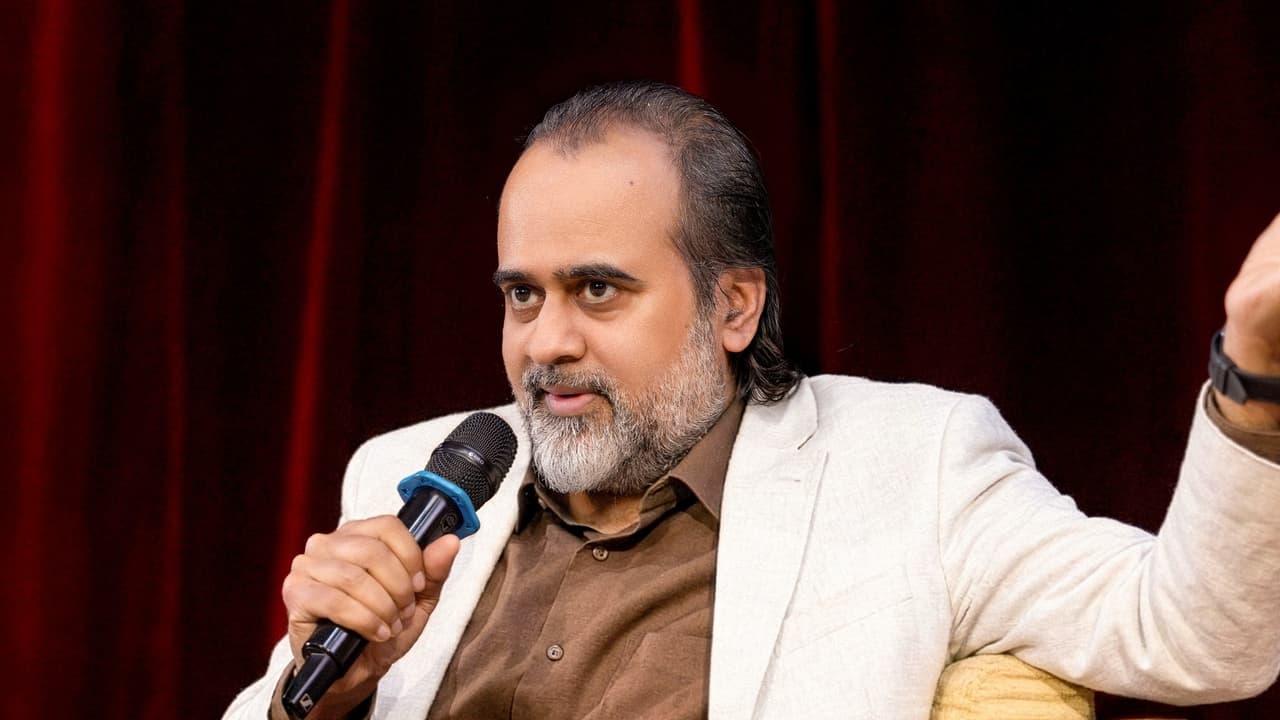
A man has to give up on greed, on this and that. A woman has to give up on the feelings related to the body. On all the assumptions and other stuff related to the body. Leaving the house, for her, is like becoming naked. And then the rest of the journey is very easy for her. If you have a woman who can drop her physicality, who can get rid of the basic woman-ness, then you have a great saint in front of you.
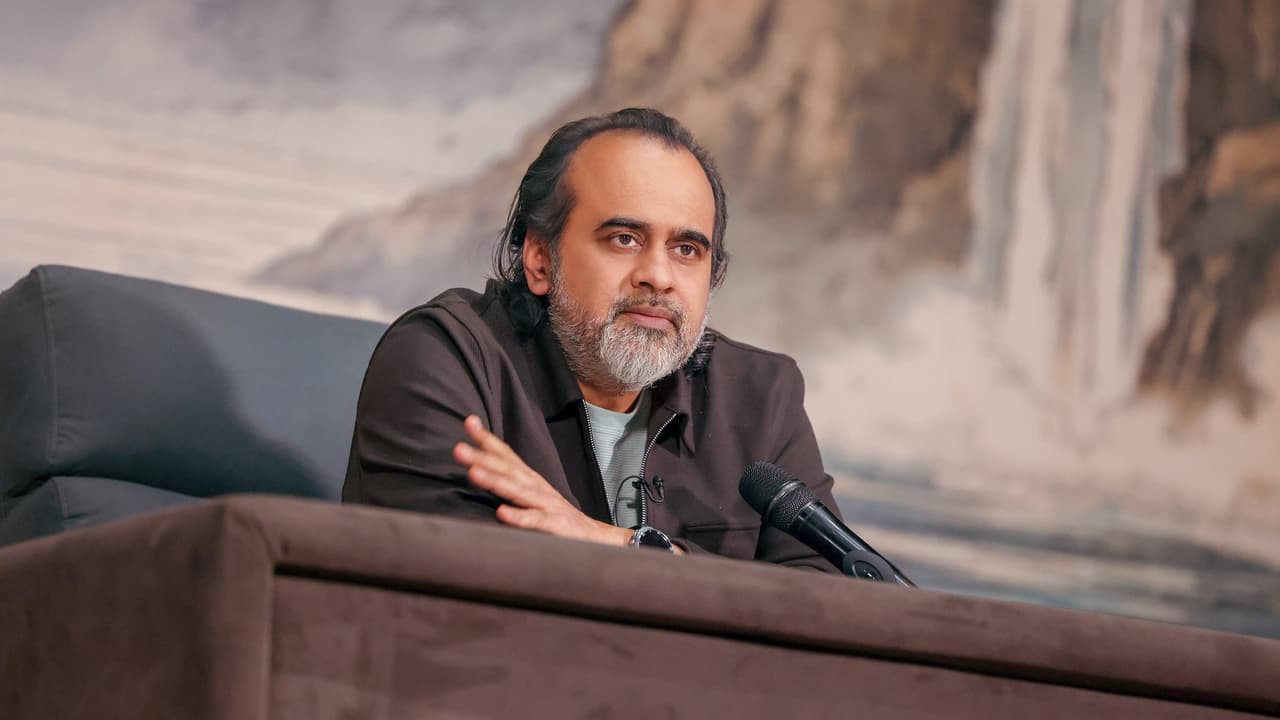
The one who is religion-less. A real Hindu does not have any religion. To go beyond all religions is to be a Hindu. There are religions that are on one plane, and then there is Sanatan Dharma, which is another dimension — the eternal religiousness. Liberation from religion is religiousness. Sanatan Dharma is awakened intelligence.

The human mind suffers because it does not understand what’s going on within itself. The mind longs for understanding and liberation from bondage. And the responsibility is on the human being to gain that understanding and that freedom from bondages. This responsibility is called Sanatan Dharma — founded on self-inquiry, ‘Atma-Jigyasa.’ It is a philosophy of the mind that gives a purpose to life.

Sanatan Dharma is not about following traditions in the name of Dharma. It is about constantly moving towards that which will take you beyond your mind: the Sanatan. All our beliefs and rituals might be religious, but they are not Sanatan because they are just mind stuff. Since both Sanatan Dharma and Vedanta discard mind stuff as trivial, one cannot be a Sanatani if one is not a Vedanti.

Women are physically a bit weaker, and men could coerce them using sheer muscle power. But those days are behind us, because now we have institutions, the law, and the police — systems that do not listen to muscles. There is something in you that agrees to the demands being made by the patriarchal system — question that. What is it in you that surrenders — and that thing is called greed and fear. So that's what you need to fight against — your greed and fear.

If the woman really understands herself and therefore her choices, why would there be a need to be affected by others? But we bother. That happens because we have borrowed our sense of self from history, tradition, and society. When dependence is glorified, be it physical, financial, emotional, or psychological, it definitely coexists with bondage. If you feel bulldozed or forced, there is only one reason: you’re not walking on your own legs. Go out and earn. No price is too big for freedom.

Before you go to the Quran, you must first be in a condition to understand what it is saying. The center of the Quran is Tauheed – Oneness. The Quran can be understood only when you, as the ego-mind, are connected to the same source that blessed the Prophet. Otherwise, you will misinterpret it. You are so full of ego that you want to remain what you are. By remaining what you are, if you apply your intellect to the scriptures, you will obviously distort them.

Irrespective of her station in life, it has been drilled deeply into the Indian woman that her life is foremost about the husband, kids, bed, and meals. But how can this be the primary reason for a conscious human being's existence? We use decorated phrases like “Queen of the House”, but the moment the "queen" gets some money, all her queenly tasks are dumped onto somebody else. So, we are just deceiving ourselves. Give yourself the courage to question things and not accept them blindly — it will give you a blossomed personality and a great life.

Women do not need sympathy, reservation, or compensation; they need awakening. Victimhood may offer temporary advantage, but it slowly erodes dignity and strength. Education that stops at jobs and numbers fails both men and women. Unless education addresses the inner fear, insecurity, and ignorance that sustain oppression, no policy can truly empower the girl child.

Millions of working women are continuously carrying the guilt of neglecting an important duty in the household. This is emanating from centuries-old conditioning. In the jungle, it often did happen that, especially during long periods of pregnancy, the woman couldn't really gather for herself, so the man became the provider. But where is the jungle today? Why are we still behaving as if we are still in the jungle? There is no disadvantage that the woman has today, so there is no need for her to feel that her primary commitment is at home.

Oppression should not see caste, gender, creed or colour, and it should not see species either. The moral threshold is sentience, not intelligence. An animal feels pain as fully as a human does, whether or not it can explain its suffering.

A modern woman calls herself liberated, yet lives anxious — anxious about age, desirability, marriage, motherhood. Acharya Prashant exposes this anxiety as proof that feminism never touched the real wound: centuries of conditioning that reduced women to bodies for pleasure and reproduction. External equality isn't enough. True freedom demands she reject the entire inheritance of tradition and simply become human — not woman, not wife, not mother by decree, but free.

Women cannot be truly liberated through education, income, or legal rights alone if they remain psychologically identified with socially conditioned ideas of “womanhood.” While external barriers may fall, inner bondage persists through inherited identities, roles, and expectations. Real freedom begins not by rejecting the body, but by seeing oneself primarily as a conscious human being rather than a gendered identity, because lasting liberation starts at the root of self-identification.