Questioner: Namaste Acharya Ji. It is a personal question. Myself and my husband, we both are working, and working hours are almost the same for us.
When I come home, I feel responsible that I want to do this, that, and I don't have time to do that. Even my husband doesn't have time to do that. But, during the work also, I keep in mind that I have that to do at home. Means household work keeps me pushing back from my work also, that I have that to do at home.
Even at home, nobody is there except myself and my husband. Who will pick me that you are not doing but still, because I come from Haryana, where everything should be done by a woman. And I'm not blaming my husband for this — that he is not doing.
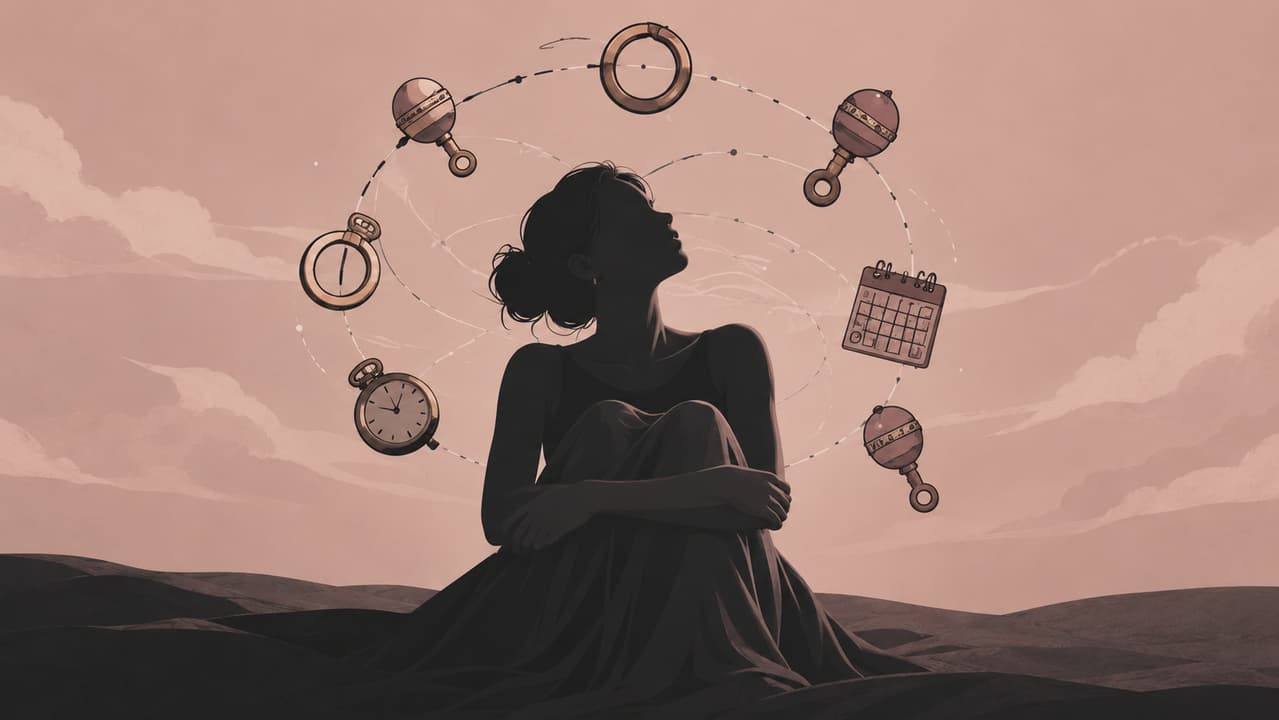
I am asking a question about why the thing is triggering me all the time that I should do this, and I'm not able to do this. I'm failing in becoming a woman, and this is my particular question. Why I'm mentally not able to come out of this guilt?

Acharya Prashant: It's a very common situation, and thank you for raising this question because a lot of working women face this guilt. They remain working, but they also feel guilty that there is an important duty that they are neglecting, that there is some kind of morality they are violating.
Yeah. It's simple to see. We may move out of a place, but it doesn't easily happen that the place moves out of us. You may move out of a place, but the place doesn't move out of you. The place remains within you.
And we have been told — I do come from a place, you know, not very far from Haryana so that’s fine. We have been told, especially in North India, in South India as well, most of the Orient, actually in the entire world — only the degree varies; the dictum is much the same.
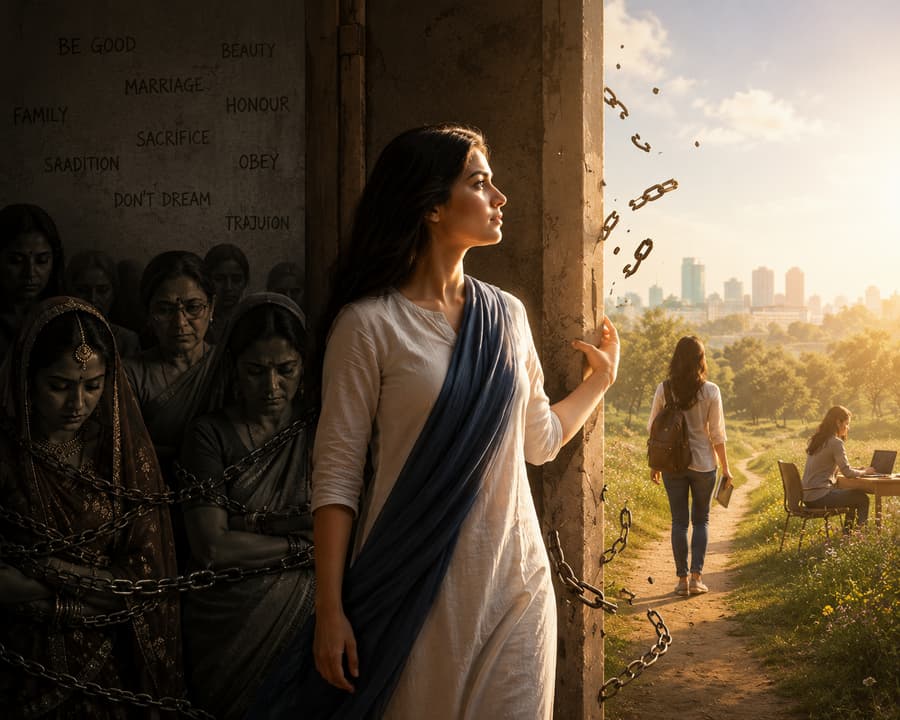
At some places it has been enforced with a greater intensity, to a greater degree. At other places, it has not really been enforced that much. But the centerpiece of the conditioning remains the same. The woman belongs to the home. That's all. And the roots are in the jungle. Where is this perception, this piece of conditioning coming from? The jungle.
In the jungle, it often did happen that, especially during long periods of pregnancy, the woman couldn't really gather for herself. We were a gathering species. We call ourselves hunter-gatherers. We were not even so many hunters, we were gatherers. And even if you are hunters, a pregnant woman would find it much more difficult to hunt down an animal. So she would become kind of immobile. And obviously there was no protection against pregnancies. So she was almost continuously pregnant.
And the child mortality rate was extremely high. Obviously, there is no vaccination. There is no care during childbirth, so extremely high child mortality rates. Kids were taking birth and kids were dying. And that would incentivize the next birth, because the previous kid has passed away. So the woman, even if she was young and strong of build, was immobilized because of pregnancy. So the man became the provider.
The roots of the whole story are in the jungle. The only difference is, where is the jungle today? Why are we still behaving as if we are in the jungle?
And then from the jungle, from being the gatherers, we became the farmers, right? We cleared land and we had gained some knowledge. Oh, this grain, this seed, this crop, this weather, these conditions, this much water — some knowledge we had gained. So with that knowledge, we started growing our food for the first time. And that's pretty recent, just around 8-10,000 years back.
And now the role of the woman became even more confined to the household, because now, for the first time, because there was farmland, there was also a house next to the farmland. When you are a gatherer, you don't need to have a house because you can go anywhere together. In fact, you want to go anywhere together. In this particular area, this season, we don't have much fruit. So, let's go away to that place. And the entire tribe would walk to a place 30 miles to the north, where there is still some better picking to be had.
But now you have land, and you cannot parcel land and take it with you. So land is a fixed asset. Because land is fixed here, so you also fixed your house. For the first time, we became householders. And once you become a householder, the house needs to be taken care of.
And we now got into a means of production that was more energy intensive. Please tell me — what requires more energy, gathering fruits and leaves and veggies, those things, or tilling, harvesting, cultivating those things? What requires more energy? Farming requires more energy. And we didn’t have nuclear fusion as fuel then. The industrial revolution is just so recent. We didn’t know where we could get our energy from.
So the only source of energy was muscular energy. This thing that is happening in your cells and in the cells of animals. But even animals are not machines. They too need to be caught, and then the animal husbandry has to be taken care of. And then those animals have to be grazed and raised and fed. And even all that requires muscular energy.
And first of all, as our physical build goes, muscular energy is more with the man. And secondly, the woman is always pregnant. She gives birth, the kid usually dies, and the husband is always ready to have sex. And there is no protection of any kind.
In fact, the whole process of reproduction — even that is not very well medically understood. We do not even exactly know how reproduction happens. So, continuous pregnancy. Now what can she do? She's sitting at home, taking care of this one. That one is not well. That one is crying for food. Some elderly kid has run away and has to be brought back. And all the random nonsense of the...
And the man goes out and works on the fields. And when he returns, he's even hungrier for sex because the entire day he has been sweating away on the fields. So he comes back and says, you know, some entertainment I need. And the woman happens to be the only entertainment. There was no Netflix. So, that was how it was happening. Please understand.
And she has tender fingers. So when it comes to doing work that requires some delicate movement, she does it better. So you say, you know, she is the expert in the house. She knows how to stitch. She also chops vegetables really well. And obviously the kids — she has to take care of their needs. And the man is so irritable. If the kid comes to him, he simply just slaps him and says, "Go away." But the woman has more patience, and she cares better. So she takes care of them.
So that's where we are coming from. Please understand, it's thousands of years of past sitting inside you. And that's what makes you feel guilty.
The only question is, today is muscular energy the dominant energy available to mankind? How much is your daily energy consumption? Have you seen or calculated or read — every day, how much energy do we consume? Please figure that out. And then try to estimate, how much of that is muscular? We are consuming energy even right now, right? Energy, energy, energy — everything is energy. How much of this energy is coming from a muscular origin? How much?
Listeners: Negligible.
Acharya Prashant: Negligible. So, the energy advantage that the male had has been neutralized long back since the steam engine. And forget about coal and steam being the source of energy, and later on fossil fuels, and then nuclear energy, and now we have all kinds of green energy.
Forget about these. Zero comes from muscular energy, so how is the man now superior when it comes to commanding energy? And today, the origin of energy lies in intellect. And the intellect of the woman is much the same as that of man. So there is no disadvantage that she has there. None at all.
You don't fight your wars with a mace and a sword today, right? It's not like we have to fight with a mace now (Gada yuddha to nahin karna ab.) You fight through guns and missiles. And you don't require terribly big biceps to fire a missile or first of all, design and build a missile. What do you require? Intellect. So there is no disadvantage that the woman has today. So there is no need for her to feel that her primary commitment is at home. Are you getting it?
But the past, it never becomes the past. We say gone by, but it never goes by. The past is such a living thing. It doesn't allow the present to be fully alive. The past suffocates the present. Are you getting it? That's all. There are no complications in the story. This is it.
Millions of women are continuously carrying this guilt. Even if they go out, they feel, "We have to." Somebody told me, in Mumbai, it often happens when women are returning from work in the Mumbai locals. Because they know it will take an hour to reach their place, in the bus itself, they start chopping vegetables which is cute, but for the point that men never do it.
And this is a working woman, probably earning as much as the man does, contributing as much to the household economy as the man does. But she necessarily has to undertake two jobs. She works two shifts. When the office shift is over, then the second shift starts, because that inner thing is there.
The first responsibility is obviously the husband and the kids and the house. Other things come later. You know what the result of carrying this obsolete piece of conditioning is? So many organizations hesitate giving roles of responsibility and seniority and leadership to women, because they know that for the woman the primary responsibility is the home.
They know, you know — alright, basic junior-level, beginner operations jobs — women are very good. More disciplined than men, committed, loyal, everything. And they are seen to not create as much trouble as men do.
So organizations like to employ women at those levels, at the lower levels. But when it comes to leadership, they say, 'She'll get pregnant tomorrow and leave the company. What will happen to the company?' (Kal pregnant ho jaegi, abhi chhod degi, company ka kya hoga?)
They'll not put that in writing because that's not taken fashionable to be said, but that's the concern of everybody who is responsible for the performance of an organization. They’ll say, here is this individual and this work is not her first love. Her first love is the house. How do we then rely on her?
Because, you would have heard of the term "the glass ceiling." That's the reason fewer women rise to leadership positions in organizations because they keep displaying that the husband and the kid and the household is their first love. And if it is your first love, so it be. The company says, "Fine. Then you take care of your first love."
On one hand, we talk of the Bhagavad Gita, and Shri Krishna says action should emanate from your deep clarity. On the other hand, we find that our actions as women is emanating from centuries-old conditioning. Forget morality. Religion is the big baap of morality. That which you are doing is not even religious. Even Shri Krishna would not agree with the mindset most women carry.
What is the Bhagavad Gita saying? Your action must come from your deepest self-knowledge. Whereas, as women, our action is not coming from deep self-knowledge. Instead, it is coming from primitive conditioning. Would Shri Krishna be happy looking at the way we think and behave as women? No. He'll disapprove.
The house is a nice thing. We all need to have a house. I'm not asking you to bulldoze your house, please. But there needs to be a sense of perspective. What is important is important. What is less important is less important. And what is equally important for both husband and wife is equally important.
Pardon me for saying something a little harsh — then there are women who want to justify their continuous presence within the four walls of the house. They say, "You see, meals take 8 hours a day.” Why must my breakfast, lunch and dinner take 8 hours, lady, please? "No, you know, dinner itself takes 4 hours. I start preparing at 4 p.m., and then I put food on the table at 9:00 p.m." But why such an elaborate arrangement, lady? Or is it so that you are trying to invent the whole process because you have loads of time? That's the reason you have invented a long process?
Why do you want to cook meals that take 4 hours or 4 weeks to cook? Such cumbersome recipes. Long-drawn recipes. Take special chickpeas, sourced from Namibia, only through the Afghan route. Then soak them in water for 32 days. Then add special spices sourced from the Vijayanagar Empire. Why? Just to justify the fact that you really aren't being true to life that you are missing out on life. So, you want to fill up the hollow with recipes. Come on.
And I know I'll be hated for saying this, but that's fine. I've already hit the saturation level, sir. Any more hate doesn't really count. Already trending here.
Or this fetish with having a zero-bacteria house, "With the most advanced electronic microscope, I'll hunt for the last speck of dust and clean it," and say then, "You know, dusting consumes 26 hours a day. What can I do?"
Why do you need to be so particular about dusting? It's a commode, not the stove. It will have bacteria. Let them be.
They too have a fundamental right to exist somewhere. I'm not asking you to not flush or not clean. But please understand, there are limits to everything. And then, you know, you have to do the cleaning, right? It takes 8 hours. (Safai to karni padti hai na, 8 ghante lagte hain) Kyon lagta hai? Then the common aspiration is , “This fellow has no respect for household work.” That's how you want to see or put it, I mean fine.
The house is a place we come to take rest so that we can work again. We talked of Shri Krishna. It's 'Yuddha Kshetra, Ran kshetra, Kurukshetra,' and house is the camp we return to in the evenings just so that we can resume the battle the next day. We are not born to decorate the house, just as a warrior is not born to decorate the camp. The camp should be just basic enough, simple enough so that it recharges us, revitalizes us. That's all.
We don't need anything more from the camp. We don't have to put flowers here and there, you know, lilies here and lotuses there, and yeah nice. All the time is going into that. And if you can't do that, you feel guilty. “Hubby loves fresh lilies. I couldn't put them in the right place. Now my love is at stake.”
On one hand, we venerate the Bhagavad Gita, right? On the other hand, we do not see where the Gita is coming from. Is Shri Krishna teaching Arjuna to go and enjoy leisurely in a camp? Why would he tell him to fight? He'll say, “You return to your palace and it has been very nicely kept for you. It's a five-star palace. Go and enjoy it.” No. Man is born to fight. And by man, I mean woman.
Woman, you're born to fight. You're not born for housekeeping.
The house is okay. We all need a place to return to and relax and eat and sleep. That's all. That's my, you know, description of hell. A beautifully kept and well-maintained house where you have all the time to relax and no great purpose to accomplish. Beautiful house, huge television, great amenities, all luxuries — everything to pamper you and comfort you and no purpose, no real battle in life. That's my definition of hell. Not a place where you are deep fried in oil. But a place where you are offered all comforts and luxuries.
Have you seen some of those luxury beds? I wonder, I mean, how much human effort has been wasted on this? Why does one need such an elaborate bed like this? You just have to sleep, right? After you sleep, will you remember what bed you have fallen asleep on? So why not be sufficiently tired and just fall asleep anywhere? Because you're anyway not going to remember, right?
And once you get up, again you have to rush somewhere. So you'll again not remember where you slept. But such elaborate beds, and they become people's ambitions. “One day, I'll earn so much that I'll have such a bed.”
The earth is going to be the final bed. And you will sleep for a very long time there. Nobody to wake you up.
As long as you're alive, why care so much about beds and sleeping? Get up. Rush. Work. Have a purpose.
Tell me, if you don't move out of four walls — any four walls, any four walls. Will that develop your knowledge or intellect or consciousness? Please tell me. Isn't it so obvious what it is doing to the mental status of our women? If they are continuously just confined in the household, and the only thing that they look at when it comes to gaining knowledge of the outer world is the television. And what kind of stupid material is streamed there, especially for women? Have you not seen that? As if we are still in the jungle.