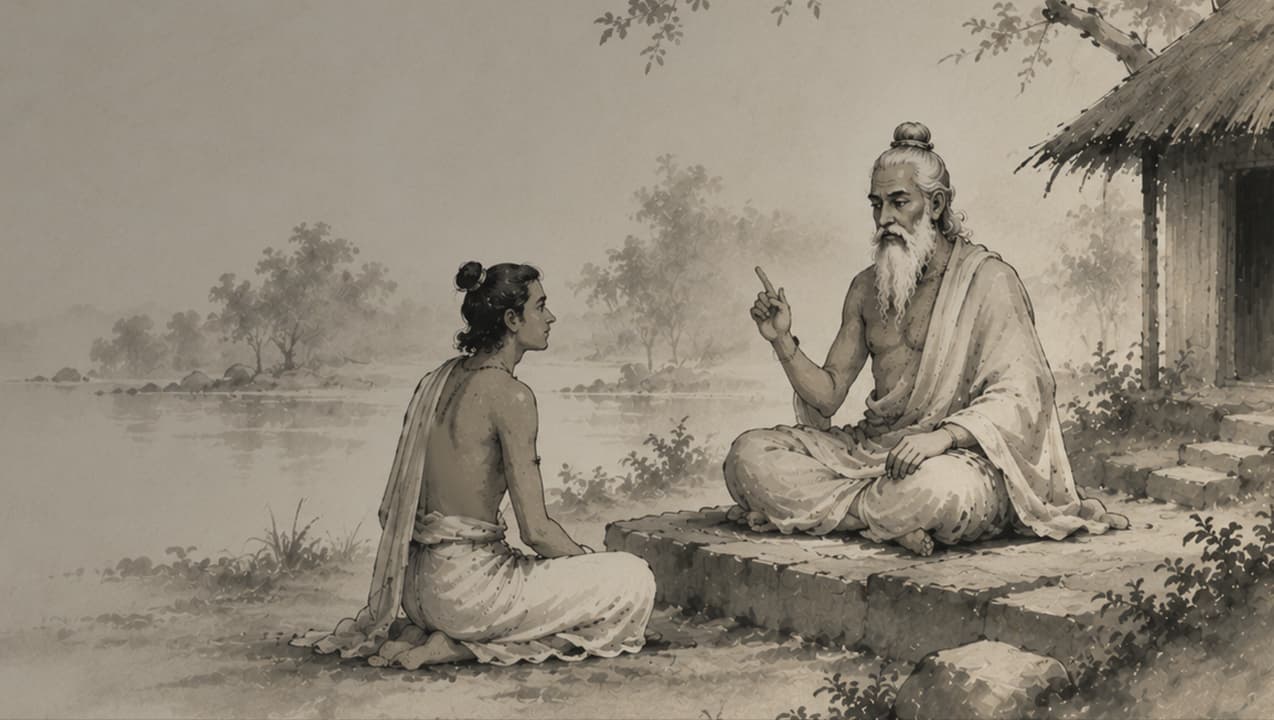
“I have no body. I have no distinctive traits. Neither do I have a cause. I have no fourth state. One who is rooted in oneself is called a jivanmukta.”
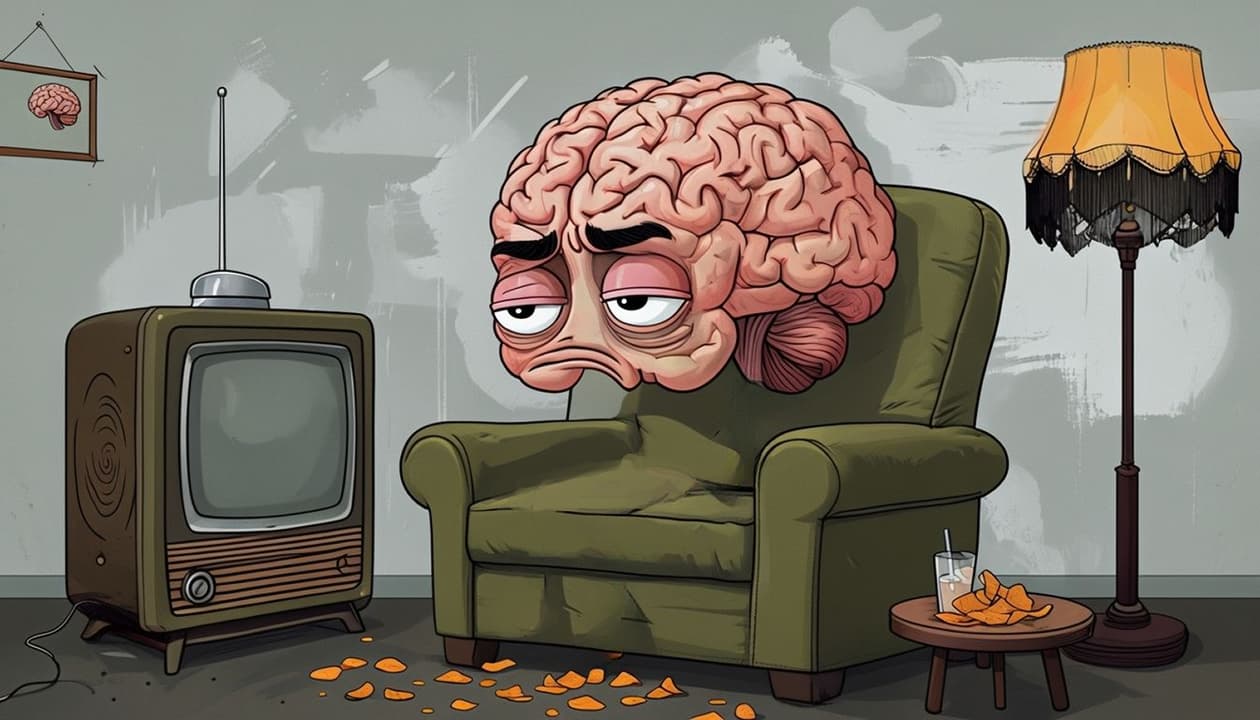
Thinking, thinking, continuously thinking, you comfortably let days, months, years, decades slip away, and then you are so thankful that death arrives.
Our relationship with the world is one of affixation, attachment, clinging, and at the root of that false relationship with the world lies a false conception of oneself. Because we perceive ourselves as limited, therefore we must cling to the world. Because the question ‘Who am I?’ has been answered
Hacking down forests is a compulsion with us. You cannot have the kind of civilization and values that we have and not hack down forests. Given the way we shop in the markets, we will necessarily hack down forests. Given the way we choose brands, given the way we choose
You are drunk and driving towards north. There is some probability of an accident, and you are warned of that. So, you take a U-turn and start driving towards south. Now you say, “I was doing the wrong thing; now I am doing exactly the opposite of the wrong thing,…
We all are going down very, very well-set paths. Therefore, our destinies are going to be no different from the millions and billions who have already walked down those same paths. But we want to feel that we are special. We want to feel that the same road that took…
Questioner (Q): Acharya Ji, my hormonal imbalance overpowers my ability to continue with conscious behaviour and forces me to continue with compulsive behaviour. How to be more conscious of my actions?
Questioner (Q): All the wisdom is available to us only after a certain age. But the dye is prepared early in the childhood. How does one change his dye at an advanced stage of his life?
Everything that you are doing every day, every hour is an invitation to cancer. But don’t worry—you will have savings! In your last six months, you will duly transfer all your savings to the hospital, the fruit of your hard work all your life, and you will feel vindicated. You…
Questioner: Sir, why is it that we cannot suppress nature’s call but we keep on suppressing our expressions for a lifetime? Is it that the body has a separate consciousness that cannot be held on?
Acharya Prashant: No, we suppress all that as well. It is just that in the…
Speaker: Mind has stored so much that it does not even know that how much it has stored. There are two portions of its storage. One part is where you know that I have stored something. The other part is where you have stored it but you have forgotten that…
Success never quiets the anxiety underneath it. Hustle culture runs on karma — a restless cycle of chasing the next job, package, or achievement in hopes of filling an inner void. Young professionals in Bangalore who've "succeeded" on paper remain fearful, ashamed, and unsettled within, proof that success is a liar: it promises liberation but delivers only debt. Anxiety itself traces not to the future but to a present that's been neglected, and real freedom from restlessness begins only by turning inward.
Science can examine material claims, but Advaita Vedanta deals with the subjective self, ego, suffering, bondage, and liberation—areas outside science’s objective framework. Vedanta need not be accepted because of one’s religion or tradition; its value lies in whether its insights can be personally verified and help free one from suffering. The ultimate responsibility is not toward any philosophy, but toward oneself: to live a truly free life.
Superhero films appeal to our desire to escape inner inadequacy through external power. The fantasy of an ordinary, fearful person becoming extraordinary reinforces the ego’s belief that more strength, money, possessions, or status will bring happiness. Consumerism follows the same pattern, endlessly adding objects to fill an inner void. Real freedom does not come from becoming more powerful or acquiring more, but from honestly seeing and understanding the ego that feels incomplete.
Success and failure matter less when your work is driven by love rather than outcomes. Setbacks are opportunities to reflect, not reasons to quit, and true failure comes only when you stop trying. Regret and guilt become meaningful only if they transform you into a different person instead of becoming excuses for self-pity. Real growth begins by questioning your assumptions, facing reality honestly, and living with awareness rather than mechanical habit.
The mind is not an independent entity but a structure built and maintained by the ego through thoughts, memories, beliefs, and experiences. Most spiritual practices fail when they become distractions from examining the ego itself. Experiences, emotions, and preferences are often conditioned and unreliable. Real inquiry begins with observing the experiencer, admitting facts without distortion, and applying the same rigor to inner life that science applies to the external world.
Global conflicts stem not from geopolitical interests but from the ego's fundamental incompleteness. Nations are merely expressions of collective egoic consciousness. Leaders represent humanity's worst tendencies, not its average. The ego requires duality and boundaries to survive. True disarmament means detoxifying the ego itself. External wars reflect internal disturbance. No diplomatic solution addresses the root cause, only wisdom and self-knowledge can dissolve the ego's need for conflict and separation.
There can be no self-respect without self-knowledge. And we have been repeatedly saying that the ego survives only in lack of self-knowledge. The less you know yourself, the denser and more crystallized your ego is. Self-respect is nothing but self-awareness. The more you know yourself, the more you realize who you are not, and that brings you to who you are. That is real self-respect, knowing oneself.
karma and the subconscious exist, and they play their own game. Karma is the cause and effect chain: the ball goes up, it comes down. But whether the ball goes up or down, you remain free. The material world follows this cause-effect chain, but you are not material. For example, if you exercised hard yesterday, your body might ache today, which is karma in action. But let the body ache; you must not become mentally or spiritually sick. The physical consequences don’t affect your inner freedom. Let the fruits of karma be for the one who was the doer of the karma.
You see, you must first respect the facts of your addictions; they are doing you some good. These things exist because there is nothing better in your life. Addictions fill a deep inner void. The TV shows, videos, drugs, or other things didn’t force themselves into your life; you sought them out. The videos don’t suddenly pounce at you after midnight—you are the one clicking the app, scrolling, choosing, and binge-watching.
~ Ashtavakra Gita
Question: What is the relationship between unconscious and awareness? Does unconscious dissolve in awareness?
Speaker: Only thought…
Thought serves a great purpose: it eats away your time. Otherwise, time will become such a burden.
Someone comes to you and demands, “Now is the time to…
Excerpts from Articles
Animal cruelty: Who deserves mercy, and who doesn’t?
Violence begins long before the knife or the slaughterhouse—it begins with the ego, the one that draws boundaries, seeks justification, and decides who deserves compassion. Laws and reforms may reduce suffering, but they cannot end violence while the ego remains intact. When the ego dissolves, exploitation ends naturally, and compassion no longer depends on regulation or moral boundaries.
कई तरह के डर—अकेले पड़ने, छवि खोने या छोटा समझे जाने—की जड़ अक्सर अतीत में बनी पहचान और कहानियों में होती है। शरीर की हाइट जैसी चीज़ों को समस्या मानकर उनसे जूझने के बजाय उनकी अप्रासंगिकता को समझकर आगे बढ़ना चाहिए। अतीत को दबाने से मुक्ति नहीं मिलती; उसके करीब जाकर अपनी स्मृतियों, धारणाओं और पुराने पैटर्न को निष्पक्षता से देखना ज़रूरी है।
Climate change is more than an environmental crisis—it is a crisis of human choices. Our patterns of consumption, consumerism and endless pursuit of more are putting increasing pressure on the planet. But meaningful change does not necessarily begin with new technology or stricter policies. It begins with a deeper question: what are we willing to change within ourselves?
Victory is not decided by the trophy you hold but by the battle you choose to fight. Real strength lies in making the right decisions, staying true to your deepest values, and refusing to be ruled by fear or circumstances. When your actions arise from clarity rather than ambition, the outcome loses its power over you. The moment you choose the right path, you have already won.
Struggling to choose between a secure job and the path you actually feel drawn to? This isn't really a question about careers. It's about why other people's opinions have so much power over you in the first place. Real clarity doesn't come from finding the 'right' choice. It comes from honestly looking at your own fear, again and again, until it stops running the decision for you.
You Don't Understand the Bhagvad Gita, But You Still Claim That You Love Krishna?
The Bhagavad Gita deserves reverence not because of inherited beliefs about its author, but because of its power to dissolve falsehood and reveal Truth. Real devotion is not ritual or blind faith—it is understanding, inquiry, and living the wisdom of the Gita. Through sincere study, one discovers the true meaning of Krishna, making the Gita the most authentic path to knowing and worshipping Him.
ज्योतिष कितना सच है? कुंडली, ग्रह-नक्षत्र: इनका क्या अर्थ है?
वेदांत को केवल इसलिए सही या श्रेष्ठ नहीं माना जा सकता कि वह किसी विशेष परंपरा से आता है। विज्ञान जहाँ भौतिक जगत की वस्तुनिष्ठ जाँच करता है, वहीं अद्वैत वेदांत सीधे मनुष्य के ‘मैं’, उसके दुख, बंधन और मुक्ति की पड़ताल करता है। इसकी कसौटी वैज्ञानिक प्रमाण नहीं, बल्कि अपने जीवन में इसकी सच्चाई को देख पाना है। किसी दर्शन को मान लेना नहीं, बल्कि उससे स्वयं को मुक्त करना ही उसका वास्तविक उद्देश्य है।
Giving birth is not for kids. Law just says that there is a legal age—eighteen, twenty-one and such things. First of all, giving birth requires that there has to be mental maturity. Unfortunately, 99% of the world’s population is not at all mentally mature enough to be parents. The funny…
…
…
Acharya Prashant (AP): How do we begin?
Questioner (Q) (Nitesh): Yes, we’re here again. I know we spoke in the past about different topics. But I decided to use your help, or use your insight, into leadership and management side of things of life, and so we arranged this for…
Share
Acharya Ji, why do I slip back to my old habits even after an intense camp with you?
Acharya Prashant Ji: The momentum of your tendencies is still very strong. You will need to be careful for at least a few months, and you will need to reboot…
Share
Share
Acharya Prashant (AP): So, there is the type of behaviour that we call as ‘compulsive behaviour’, and she’s rightly…
Acharya Prashant (AP): The dye is no good. The dye does not help you.…
Share
Listener:
Subconscious.
AP: And what is there?
L: That which is not in conscious.
AP: (Smiles) and are they two related?
L: Yes.
AP: So, the conscious is talking of the subconscious, at least that much…
1
Acharya Prashant (AP): There is a difference between a stupid mind, a dull mind, and a wise mind. A stupid mind is very used to it’s being, the stupid mind is very well adjusted to life. It sees no paradox there, it sees no contradictions, it's a very nicely patterned,…
Share
Share
Climate change is more than an environmental crisis—it is a crisis of human choices. Our patterns of consumption, consumerism and endless pursuit of more are putting increasing pressure on the planet. But meaningful change does not necessarily begin with new technology or stricter policies. It begins with a deeper question: what are we willing to change within ourselves?
Reaction is an instinctive, unconscious response rooted in ancient survival mechanisms, while response arises from consciousness and understanding. Our biological instincts evolved for survival, but modern life demands that we move beyond them. Emotional reactivity makes us predictable and controllable, allowing others to manipulate our emotional triggers. True freedom lies in pausing before reacting, examining emotions, thinking deeply, and responding consciously rather than living as slaves to instinct.
Victory is not decided by the trophy you hold but by the battle you choose to fight. Real strength lies in making the right decisions, staying true to your deepest values, and refusing to be ruled by fear or circumstances. When your actions arise from clarity rather than ambition, the outcome loses its power over you. The moment you choose the right path, you have already won.
2
Wrong career choices, unhealthy relationships, and endless entertainment are often symptoms of escaping oneself rather than seeking happiness. Self-deception, ego, and inner dissatisfaction drive people toward temporary relief through social media, gaming, movies, and distractions. Real transformation begins with self-inquiry, honest awareness, and the courage to face reality instead of running from it, leading to clarity, freedom, and meaningful living.
5
Bullying hurts deeply only when it is allowed to define one's inner identity. External abuse may wound the body, but lasting psychological wounds require inner participation. While OCD, anxiety, depression, schizophrenia, and other mental health conditions deserve proper treatment through psychiatry, lasting freedom demands self-knowledge.
Success achieved under pressure or conditioning is not true success because the goal was never truly one's own. Before chasing any achievement, one must ask whether the desire is authentic or borrowed from society. Real change comes not from becoming stronger but from gaining clarity and honesty about oneself. Young people are already capable; what keeps them trapped is the comfort of obeying external expectations. Life is too short to spend serving invisible masters instead of pursuing what one genuinely loves and understands.
2
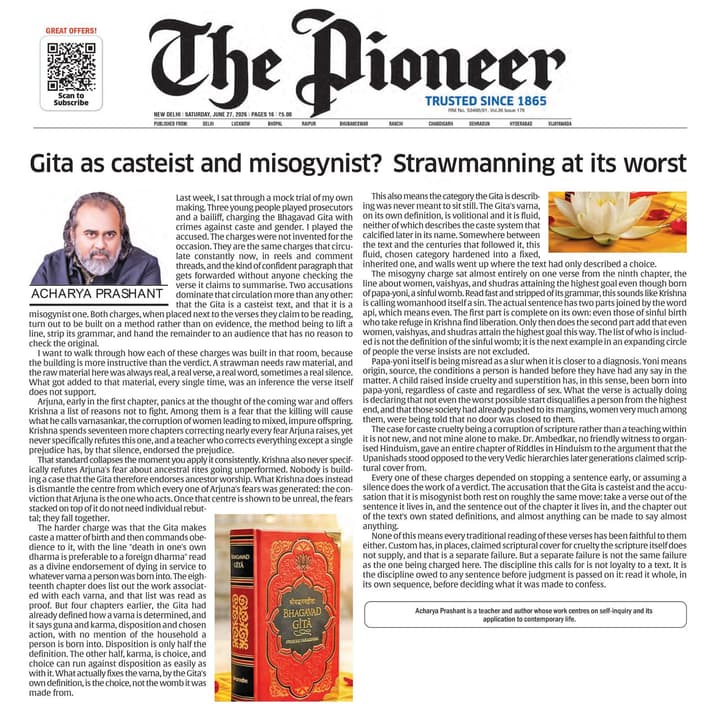
The Bhagavad Gita is often accused of supporting caste and misogyny through selective quotations that ignore context, grammar, and the text's central teachings. A closer reading shows that its emphasis is on inner qualities, conscious action, and spiritual equality rather than birth-based hierarchy or gender discrimination. Misinterpretations arise when isolated verses are detached from their broader meaning, while the Gita consistently points toward self-knowledge, freedom from ego, and the universal possibility of liberation for every human being.
Science and philosophy arise from different kinds of inquiry. Matter seeks continuity of state, while the ego seeks continuity of existence and constantly changes identities to preserve itself. Fear, danger, and suffering are rooted in the ego’s sense of “I,” not in material reality itself. Questions are valuable because they expose hidden beliefs, and genuine learning requires challenging assumptions through inquiry, dialogue, and self-examination.
The climate crisis is not merely an external environmental problem but a reflection of inner human greed, desire, and psychological disorder. Drawing from the Gita’s idea of yagya as desireless action, it says real ecological healing requires inner transformation. Outer pollution, exploitation, and destruction mirror the ego’s inner confusion, making personal consciousness and planetary health deeply inseparable.
Do you get stuck between hope and fear while thinking about the future? The problem isn’t the future, but your intention. Most people look ahead just to remain who they are. The right approach is to use the future as a chance to change. When the goal is truly challenging, there’s no time left to worry or expect results—only to act fully.
1
Saurabh Netravalakar, a software engineer and cricketer, discusses balancing multiple pursuits with Acharya Prashant. They explore how hidden wastage of time and energy prevents genuine progress. The conversation extends to team sports teaching ego-dissolution, broadening identity beyond self-interest, and addressing planetary crises through inner transformation. They examine how religion's core purpose—freedom from suffering—unites humanity despite different practices, and discuss practical solutions to environmental exploitation through proper pricing and intent.
Overthinking trivial matters stems from inner emptiness. Fill your life with something genuinely important, a worthy cause, a meaningful pursuit. When you're truly immersed in what matters, random anxieties lose power. Develop strong inner immunity through purpose, not by fighting thoughts. Like Bhagat Singh, marry yourself to something noble. Immersion in the essential is the best meditation and antidote to mental suffering. Without importance, life becomes scattered doing nothing in particular.
1
Question: Sir, people these days emphasis on the idea of the ‘Power of now’. But you say that the present is different from the now. Please elaborate.
Speaker: This whole talk about the power of now is a great sham. It is deep materialism disguised as spirituality. The present is…
Our mood is always dependent on others and situations. Results have not been up to your expectations. So now you require a morale booster, some motivating speaker. The moment that fellow is gone, your energy also goes away. But there is another way of living. Deep within myself, I find a point that no external situation can touch. Whatever happens, happens on the surface. That will remain stable, uninvolved, a non-participant. Then you are really free.
The only principle that truly runs this world, created by all of us, is the principle of greed and power. What do you think that fellow has earned his billions for? He didn't become a politician to be noble. The only thing that separates us from animals is the intellect, not the center the intellect is operated from. Don't locate the problem and the responsibility somewhere out there. We change ourselves; the world changes.
Superficiality offers pleasures. Superficiality offers cheap salvation. Therefore, it is easy to be attracted to superficiality. On the other hand, true spirituality challenges you to pay a heavy price. So, you see, all this knowledge has existed since antiquity. Yet there are people who do not want to read the Gita.
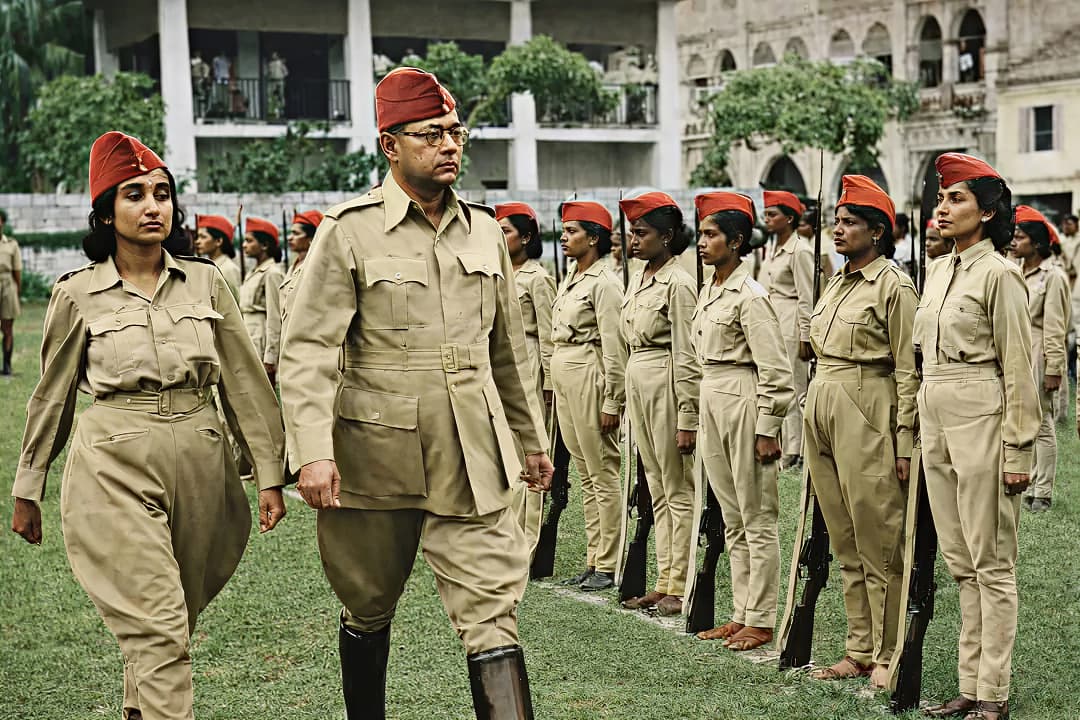
There is no revolution possible without the Gita. That’s the reason why even those who are not remembered particularly for their spiritual inclination, people like Subhash Chandra Bose, even they founded their core on Gita. What kind of revolution can you do if it’s the body that’s always at the top of your mind? You require a Gita to tell you that this body is perishable and would anyway go. Gita only teaches you, "Endure and fight."
5
Shri Krishna is saying: the mind is conditioned to move towards objects and perceive only their surface, periphery, or form. Develop the practice of penetrating further. Let Truth be your practice. The moment you would look at something, and you are in no position not to look at things being embodied, you would look at things. Nobody said that you have to practice lust. Lust just comes. You might be a total fool, an utter retard, and still you will find yourself getting sexually excited once you reach a particular age. Did you need some practice? No, you didn’t. It just happened. But if you are to understand lust, if you are to cross over, if you are to be a master of your body, then it will require a lot of practice, and that will necessarily and obviously tell you about your predicament.
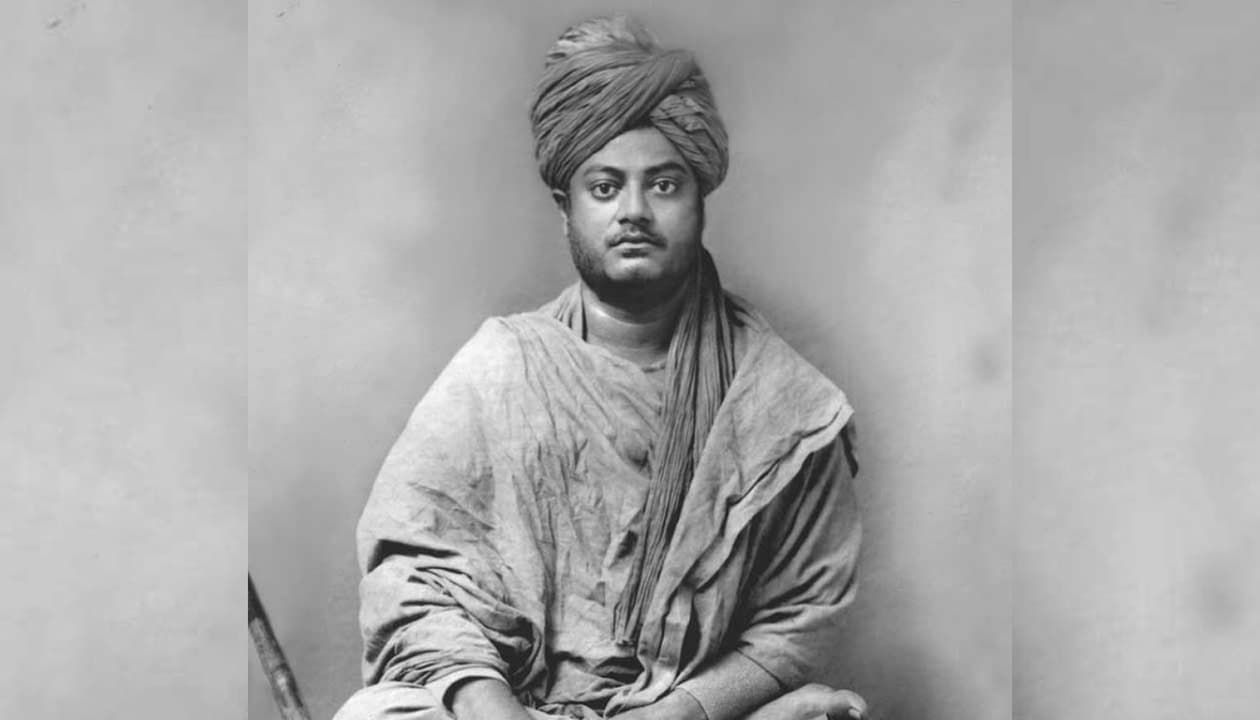
We love to talk of Swami Vivekananda as a youth icon. And I am asserting that were he to be here today, it is the youth that would resist him the most. When he returned from the United States, a huge procession greeted him, right at the port. But when he asked for just a hundred people who could be his soldiers, he was denied. Nobody wants to accept a Swami Vivekananda. He was resisted then, he would be resisted even today.
2
“Immersing myself in deep meditation.” What do you mean by meditation? And who is being immersed? Please tell me, beyond a trick of words, what is this? But you’ll never ask these questions, because some Baba-ji totally dominated your faculty to question with his get-up and demeanour. Real spirituality is not about something that sounds elevated or respectable. Whenever you are bombarded with high-sounding fluff, learn to ask this question; what exactly does that mean?
This breath-in, breath-out, stomach-in, tummy-out; this is not meditation. Even animals do not need training in breathing, and we are being taught how to breathe. What’s going on? You know, you should breathe mindfully. Why? Is there anything wrong with your breath? Meditation is nothing but an observation of the naked inner fact. That is meditation. To stand naked and honest in front of what is, that is meditation.
It totally depends on what you're using AI for. You use AI to educate yourself about the climate, and then if AI takes energy to run on the net, still the deal is beneficial. Maybe by educating yourself using AI, you have consumed x units of energy, but the education would mean that you will now save 5x units of energy. So, on the whole it's a favorable deal.
Every living being, from humans to the smallest species, is trying to change the world to suit its own needs. But this is not intended to do any good to the world, it is just coming from the little ego. And the ego will not say, “I'm not all right;” it will try to change the world. So, if your idea of ‘good’ is only relative to your personal self, is it right to impose it on others? You must be clear about why you aspire to change the world, and whether you have brought about any change in yourself first.