Acharya Prashant: You can not win the mind, you can not cater to the mind, you can not control the mind. And you are not responsible for everything that this ancient mind does. A thousand squirrels are sitting here, and five hundred monkeys, and the extinct dinosaur, and all the…
Questioner: While writing the questions about our lives, we were silent and it feels very peaceful right now. But how to maintain this silence? How to make sure that this silence holds, that it is not momentary?
Question: Acharya Ji, Pranaam! People’s faces and vocal tonality show what they mean in actuality. But people like Toohey (one of the principal characters in Ayn Rand’s novel ‘The Fountainhead’) have control on their emotions like an actor. They dumb down our intellect using emotions.
Questioner: Pranaam Acharya Ji! A month back I asked a question on ‘numbness’, and how it affects my life. You gave me a good lesson on self-centeredness and explained that if I am not able to do much for myself, then I should start working for others so totally, that
Questioning pseudo-science and superstition is the first step toward genuine freedom. Beliefs such as *Vastu, Kundli,* and *Muhurat* should not be accepted merely because they have been followed traditionally. Fear and attachment to privileges often prevent people from questioning authority. A truth-seeker must be willing to challenge age, status, and authority. Human progress has come through curiosity, inquiry, experimentation, and reason—not through blind obedience.
Desires and beliefs may keep changing, but the deeper tendency to believe, think, choose, and seek fulfilment often remains unchanged. Real transformation begins by examining this constant inner pattern rather than changing superficial preferences. Instead of seeking conclusions about greed or desire, honestly observe recurring behavior and support the truth you already recognize. Expressing that truth can dissolve false identities, relationships, and habits, creating space for genuine change.
Real love is not measured by comfort, agreement, or preserving relationships at any cost. It is revealed when one has the courage to challenge falsehood, embrace uncomfortable truths, and even risk a relationship for another's freedom and growth. Truth is not a fixed destination but a continuous rejection of illusion. Genuine relationships, mature guidance, and authentic scriptures all serve as mirrors that help us see and dissolve our own falseness.
Search
Acharya Prashant: It is apparent that this silence is conducive to understanding. It…
1
Acharya Prashant: A king once asked his favorite painter, the royal painter to paint him the face of the most beautiful individual in the kingdom. So, the painter set out looking for the most innocent face in the kingdom. And he chanced upon a little girl, he chanced upon a…
Acharya Prashant: You are walking along an empty street in the middle of the night—nobody around you, nobody to really disturb you, nobody to talk to you, nobody to point to you, nobody to intercept you, nobody to remind you of anything, and still do you see how much keeps…
Acharya Prashant:
Chandogya Upanishad — Chapter 3, part 11, verses 2 and 3:
न वै तत्र न निम्लोच नोदियाय कदाचन ।
देवास्तेनाहंसत्येन मा विराधिषि ब्रह्मणेति ॥ ३.११.२ ॥
na vai tatra na nimloca nodiyāya kadācana |
devāstenāhaṃsatyena mā virādhiṣi Brahmaṇeti || 3.11.2 ||
Never does this happen there; never did…
Excerpts from Articles
Climate Change: The Solution Is a Choice
Climate change is more than an environmental crisis—it is a crisis of human choices. Our patterns of consumption, consumerism and endless pursuit of more are putting increasing pressure on the planet. But meaningful change does not necessarily begin with new technology or stricter policies. It begins with a deeper question: what are we willing to change within ourselves?
Animal cruelty: Who deserves mercy, and who doesn’t?
Violence begins long before the knife or the slaughterhouse—it begins with the ego, the one that draws boundaries, seeks justification, and decides who deserves compassion. Laws and reforms may reduce suffering, but they cannot end violence while the ego remains intact. When the ego dissolves, exploitation ends naturally, and compassion no longer depends on regulation or moral boundaries.
कई तरह के डर—अकेले पड़ने, छवि खोने या छोटा समझे जाने—की जड़ अक्सर अतीत में बनी पहचान और कहानियों में होती है। शरीर की हाइट जैसी चीज़ों को समस्या मानकर उनसे जूझने के बजाय उनकी अप्रासंगिकता को समझकर आगे बढ़ना चाहिए। अतीत को दबाने से मुक्ति नहीं मिलती; उसके करीब जाकर अपनी स्मृतियों, धारणाओं और पुराने पैटर्न को निष्पक्षता से देखना ज़रूरी है।
Victory is not decided by the trophy you hold but by the battle you choose to fight. Real strength lies in making the right decisions, staying true to your deepest values, and refusing to be ruled by fear or circumstances. When your actions arise from clarity rather than ambition, the outcome loses its power over you. The moment you choose the right path, you have already won.
ज्योतिष कितना सच है? कुंडली, ग्रह-नक्षत्र: इनका क्या अर्थ है?
वेदांत को केवल इसलिए सही या श्रेष्ठ नहीं माना जा सकता कि वह किसी विशेष परंपरा से आता है। विज्ञान जहाँ भौतिक जगत की वस्तुनिष्ठ जाँच करता है, वहीं अद्वैत वेदांत सीधे मनुष्य के ‘मैं’, उसके दुख, बंधन और मुक्ति की पड़ताल करता है। इसकी कसौटी वैज्ञानिक प्रमाण नहीं, बल्कि अपने जीवन में इसकी सच्चाई को देख पाना है। किसी दर्शन को मान लेना नहीं, बल्कि उससे स्वयं को मुक्त करना ही उसका वास्तविक उद्देश्य है।
Struggling to choose between a secure job and the path you actually feel drawn to? This isn't really a question about careers. It's about why other people's opinions have so much power over you in the first place. Real clarity doesn't come from finding the 'right' choice. It comes from honestly looking at your own fear, again and again, until it stops running the decision for you.
You Don't Understand the Bhagvad Gita, But You Still Claim That You Love Krishna?
The Bhagavad Gita deserves reverence not because of inherited beliefs about its author, but because of its power to dissolve falsehood and reveal Truth. Real devotion is not ritual or blind faith—it is understanding, inquiry, and living the wisdom of the Gita. Through sincere study, one discovers the true meaning of Krishna, making the Gita the most authentic path to knowing and worshipping Him.
The world is like an open book to the one whose eyes are open; if you cannot read the world, then you have to look at yourself first, then you have to be mindful of your own condition. Read more...
Questioner: So, do you teach any Sādhanā through which your disciples and followers can access this inner Witness through which they can constantly de-attach themselves from the world which they are experiencing.
Acharya Prashant: Know what you are doing currently, first of all, that’s what is needed. Anything begins when…
How to recognise such people…
Acharya Prashant (AP):
There is no need to define ‘the inner voice’. You just have to see that it too is only just a voice. As there are so many voices all around you, this
…
Acharya Prashant:
Prasanna
(a very young listener)
is asking, who is the first-first God in this world? Why am I like this? Why did God make me?
Why did we start today’s session by talking of God? Why are we starting this session by talking of God? It could have…
Love is not a want, and love is not an obligation. Love is not at all related to the world around you. Love is, first and foremost, your own state of being.
Forget that love has to do anything with anybody outside. Forget about loving somebody. Turn inwards, look within,…
…
Question: How to find the right action when the mind is saying aloud:
“You should not do this,” or “You have to do this.” One part of the mind is saying, “You have to do
this
,” other part is saying, “It is okay, you can do
that
.”
There…
Question: Sir, what can I do to change my lifestyle?
Answer: Lifestyle is just the collection of all the small things you do throughout the day.
To understand your lifestyle, watch daily, continuously, as much as possible:
With whom are you spending time? What is the effect that the company…
1
Question: Desire is the memory of pleasure, and fear is the memory of pain. Both make the mind restless. Moments of pleasure are merely gaps in the stream of pain. If our natural state is joy, then why do we slip out of this state?
Speaker: When you have slipped…
True God is the Truth right now in your heart. That is true godliness, true bhagavatta. The problem is that people want to avoid the real living Truth in their heart. Therefore, they come up with stories that place an imaginary God somewhere up in the skies. God is wonderful, but the stories and the imaginations about God are all very disrespectful towards God. When there is love for God, God is held very close to the chest, and that God is called Truth. That God is the very purpose of philosophy and the very origin.
2
वेदांत को केवल इसलिए सही या श्रेष्ठ नहीं माना जा सकता कि वह किसी विशेष परंपरा से आता है। विज्ञान जहाँ भौतिक जगत की वस्तुनिष्ठ जाँच करता है, वहीं अद्वैत वेदांत सीधे मनुष्य के ‘मैं’, उसके दुख, बंधन और मुक्ति की पड़ताल करता है। इसकी कसौटी वैज्ञानिक प्रमाण नहीं, बल्कि अपने जीवन में इसकी सच्चाई को देख पाना है। किसी दर्शन को मान लेना नहीं, बल्कि उससे स्वयं को मुक्त करना ही उसका वास्तविक उद्देश्य है।
2
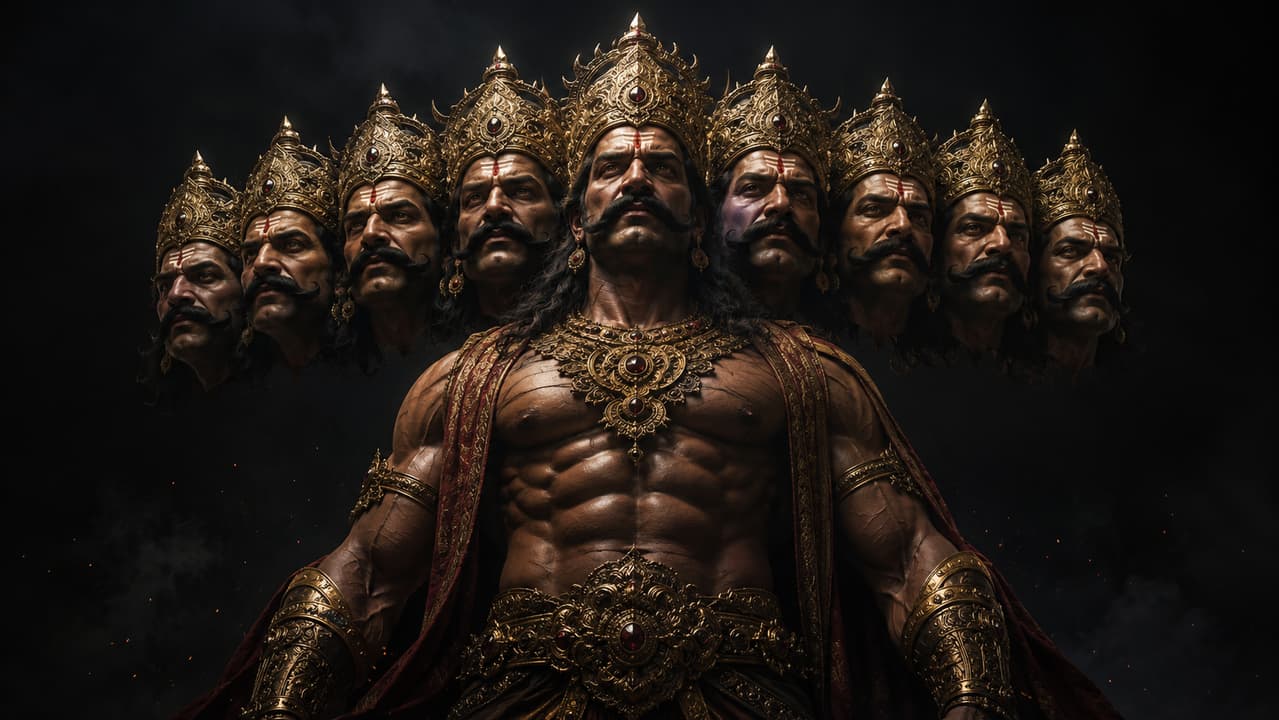
Knowledge alone cannot transform life; it can become another object of the ego. True knowledge is self-knowledge—a mirror that exposes and destroys false ideas about oneself. Ravana may have been knowledgeable, but without self-knowledge, knowledge can become a tool for exploitation. Wisdom is not something to acquire; it is innate. Self-knowledge is the process of unbecoming unwise by clearing away the nonsense we have gathered.
1
Question: Why do I feel lost?
Acharya Prashant: Because, you are asking this question.
We ‘think’ that we are lost, equally, we ‘think’ that we are not lost. The same place from where the thought, the perception of being lost, or not lost arises, that place is the same place…
2
Friendships naturally change as people follow different paths in life. When you remain focused on your true purpose, you stop clinging to those who only accompany you briefly. Instead of dwelling on memories or fearing others' intentions, examine your own expectations and self-deception first. Honest self-awareness brings clarity, wiser relationships, and the freedom to move forward without resentment or attachment.
The biggest weakness of modern education is not that it fails to keep pace with technology, but that it neglects self-knowledge. Students are trained to build identities around qualifications and careers, making them rigid in a world that demands constant change. Real adaptability, innovation, and lifelong learning come not from acquiring more skills, but from understanding oneself and letting go of fixed identities.
Modern life is increasingly driven by materialism, social validation, and the desire to impress, leaving authenticity behind. When image becomes more important than substance, relationships, education, and success turn into performances rather than expressions of truth. Real transformation begins with inward honesty—the courage to stop seeking approval, confront inner emptiness, and choose authenticity over appearances, imitation, and external validation.
Humanity's greatest crisis arises from the imbalance between immense external progress and inadequate inner understanding. While technology, wealth, and knowledge have expanded unprecedentedly, unchecked desires and ignorance continue to fuel conflict, inequality, and environmental destruction. Sustainable change requires mass-based education of the self so individuals understand their motives and use science, technology, capital, and power with wisdom, responsibility, and inner clarity rather than unconscious craving.
What is the relationship between quantum physics, consciousness, and the ego? This dialogue explores where scientific inquiry ends and self-enquiry begins. Through Vedanta, Acharya Prashant explains why the ego clings to its own existence, how beliefs and superstition shape our lives, and why lasting freedom lies beyond conditioned thinking.
Vedanta reveals that freedom is impossible as long as the ego seeks to preserve itself. Meditation may bring temporary calm, but real transformation begins only when the false sense of individuality dissolves. Whether through devotion or knowledge, every genuine spiritual path culminates in the complete dissolution of the seeker into Truth. Liberation is not the experience of Truth by an individual—it is the end of the individual who wants to experience Truth.
Superstition does not begin with rituals alone; it begins with unquestioned beliefs about the self. Science can remove many false beliefs, but complete freedom requires Self-knowledge. Vedanta, philosophy and meditation help expose the ego, making awakening possible. Religion becomes meaningful only when it encourages Self-knowledge rather than blind belief. Real freedom comes not from accepting inherited ideas but from understanding oneself through direct observation and awareness.
The ego is not a real, independent entity but a bundle of conditioning that creates the illusion of a separate "I" and becomes the source of suffering. Self-observation is not introspection or analysis but moment-to-moment honesty about what is happening within. Real freedom comes when this false center is seen through, allowing life to function naturally without the burden of psychological ownership.
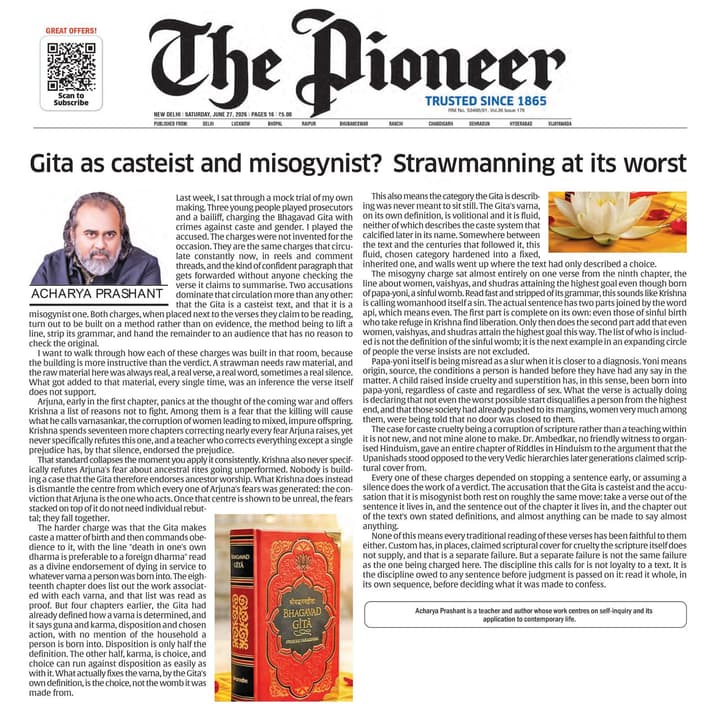
The Bhagavad Gita is often accused of supporting caste and misogyny through selective quotations that ignore context, grammar, and the text's central teachings. A closer reading shows that its emphasis is on inner qualities, conscious action, and spiritual equality rather than birth-based hierarchy or gender discrimination. Misinterpretations arise when isolated verses are detached from their broader meaning, while the Gita consistently points toward self-knowledge, freedom from ego, and the universal possibility of liberation for every human being.
Life cannot be transformed by knowledge of the external world alone; it also requires understanding the one who experiences it. Science, technology, and logic are powerful, but they remain incomplete without self-knowledge and inner honesty. Lasting solutions to personal and global crises emerge when the same rigor used to study the world is turned inward, examining one's motives, intentions, and consciousness with equal seriousness.
Most people move through life unconsciously, mistaking inherited beliefs, ambitions, and social conditioning for personal choice. Careers, relationships, goals, and even identities often arise more from habit and circumstance than from conscious understanding. Real freedom begins by questioning the actor rather than the action, examining the assumptions behind one’s choices, and awakening from the psychological “coma” in which life is merely happening rather than being consciously lived.
Materialism and emotionality are not opposites; emotions themselves often arise from material desires, fears, and biological conditioning. The real distinction is between the material-emotional world and spiritual understanding. Spirituality is not another belief, emotion, or acquisition but the clear observation of thoughts, desires, and assumptions. Many personal and social crises stem from unexamined beliefs, and meaningful change begins by questioning them, speaking truthfully, and paying attention to what occupies the mind.
Do you get stuck between hope and fear while thinking about the future? The problem isn’t the future, but your intention. Most people look ahead just to remain who they are. The right approach is to use the future as a chance to change. When the goal is truly challenging, there’s no time left to worry or expect results—only to act fully.
Many so-called spiritual practices falsely promote intoxication as a path to higher consciousness. In reality, this only deepens confusion. True spirituality is about clarity and self-understanding, not external experiences or blind belief. Neither gurus nor media can offer truth. It must be discovered within by honestly observing and rejecting inner falseness, with awareness and sincerity.
Gen Z isn't rebellious or individualistic - they're simply following their generation's conditioning, just as previous generations followed theirs. Real rebellion begins with honest inquiry into why you live as you do. The primitive restlessness driving all humans remains unchanged; only its expression differs. True freedom requires questioning borrowed desires, recognizing that your ambitions, tastes, and choices aren't genuinely yours. Vedanta teaches this: stop chasing false questions and confront who you actually are beneath all conditioning.
Overthinking trivial matters stems from inner emptiness. Fill your life with something genuinely important, a worthy cause, a meaningful pursuit. When you're truly immersed in what matters, random anxieties lose power. Develop strong inner immunity through purpose, not by fighting thoughts. Like Bhagat Singh, marry yourself to something noble. Immersion in the essential is the best meditation and antidote to mental suffering. Without importance, life becomes scattered doing nothing in particular.
Question: A gentleman was saying that a person, who is drinking or is drunk, he still has got some kind of stability on mind, and he too, can judge. That is what I felt to be perhaps wrong. A person who is drunk probably loses his judgement and whatever we…
Acharya Prashant: There is nobody who does not recognises. Everybody recognises. They just don’t speak about it, it’s a secret. It’s a well kept secret. If you speak about it you will be ostracized.
Why am I so attracted to the personality and mannerisms of all my teachers, often curious about their lives than the truth of their teachings? When I read Jiddu Krishnamurti(JK), am I conditioned by him? Is JK’s method really ‘via negativa’ all the time?…
I am asking you, who is more important? The mobile phone or the man holding the mobile phone more important? Unfortunately, your education is such that it will tell you everything about the mobile phone, but nothing about the man. They ask you to keep looking outwards but they never tell you to look inwards. Self-education is more valuable than the rest of your education put together. Has your education ever brought you close to yourself? Now you decide what is more important.
The universe does not care for any human being. The universe is a very, very neutral place and a very random place. We are all products of randomness. Do you get this? The universe is not going to have any specific intention towards a specific individual. All that we are experiencing is episodes and events of random distribution. That’s all. Please understand the philosophy.
Shri Krishna is saying: the mind is conditioned to move towards objects and perceive only their surface, periphery, or form. Develop the practice of penetrating further. Let Truth be your practice. The moment you would look at something, and you are in no position not to look at things being embodied, you would look at things. Nobody said that you have to practice lust. Lust just comes. You might be a total fool, an utter retard, and still you will find yourself getting sexually excited once you reach a particular age. Did you need some practice? No, you didn’t. It just happened. But if you are to understand lust, if you are to cross over, if you are to be a master of your body, then it will require a lot of practice, and that will necessarily and obviously tell you about your predicament.
Most of us look outwards for reasons of security, of prestige, because we want to have career progress, or because we are just curious and we do not even know what’s behind the curiosity. And then there are those who want to know the curious one itself. If there is no conscious point behind your choices or actions, then the default point is biology. The other center is when you are coming from an illuminated point that wants to know, not because it does not know why it wants to know, but because it is interested in knowing, and therefore the knower itself.
It’s a great thing not to be submissive to authority. One doesn’t needlessly bow down, because that would be detrimental to one’s interests. So, it’s all right if you are careful. But being careful is one thing, and becoming psychotic about that is another thing. Obviously, let’s try on one’s own first. But we all know how limited we are beyond a point. And when we come to that point, one needs to look beyond herself, that one needs to seek help.
The mind has been living for long in patterns. It knows no other way of being. The movement of patterns is gross. The movement of egoless action is very subtle, and the habituated mind will initially fail to notice it. You will have to wait like one waits for a lover. Do not expect that the new action, the new voice, the new guide will be of the same type, the same nature as the old one. This will be new, really new. Be ready to be surprised.
Beliefs can’t talk to each other. You will say, ‘The world was created on a Sunday.’ He’ll say, ‘No, on a Monday.’ He’ll say, ‘Tuesday.’ He’ll say, ‘Wednesday.’ Now talk, how will you reconcile this? You can only fight. Why do you need to believe? You look at the question, "What should I believe in?” Well, nothing.
If you close your eyes and write, do you need to see what you have written? Observation is an honest acknowledgement: “This is what I’m writing.” It is a subtle thing of honesty that happens on its own. What obstructs it is your determination, your stubborn resolve not to see the inner fact. That’s what you have to dispense with. “I refuse to buy the arguments of the false.” Once you refuse that, then the inner fact is obviously visible.