There is nothing that can continue in time unchallenged, untested, undefeated. The moment anything starts journeying in time, it is bound to be defeated and die. So, how is immortality or eternity possible at all? It is possible only when your association with things in time is deep. Eternity lies in the quality of time, not in the expanse of time. And the depth of association is known by seeing how we usually superficially relate, without attention or inquiry into what they really are. This superficiality is mortality.
The things that happen within you — anger, lust, disappointment, greed — are conditioned chemical reactions. It is the mark of a wise person not to be driven by one’s own reactions. Chemicals are reactive; consciousness can wait. Let the elements do what they are doing — 'I am not wedded to the limitations of this chemical godown.' This is what the knowers have called ‘detachment'. They have also called it ‘witnessing'.

![How SMP* Are Crushing Your Soul [*Small-Minded People]](https://cimg.acharyaprashant.org/images/img-32df55d2-004d-4f93-b97c-f20d14a723cd/30/image.jpg)
If dogs were to write a holy text, would they say that “We are inferior to humans”? If chickens were to write a Bible of their own, would they say that “We exist so that we may be slaughtered in factories and packed”? Read more....


Living fully does not mean adding something to life. It means recognizing that life is already complete, and you must not disrespect that fullness. It is not about going out and consuming life. The volume or quantity of experiences doesn’t matter; what matters is the quality. There is nothing but fullness—just go close to it.
Happiness is just a glimpse of the absence of suffering. Real happiness comes when you cultivate it, just like a gardener cultivates his flowers. Our normal happiness is ephemeral, preceded and succeeded by sorrow, whereas Ananda (Joy) is freedom from both. Real happiness is freedom not merely from sadness, but also from superficial happiness.
Acharya Prashant : If it was possible for one man to move toward greatness, it was possible for everybody. Even if you have collected great numbers, all those numbers mean nothing in front of the one person who is demonstrating that something could have been done. So, they get hurt.…
Here is a quote from the essay “Listen, Little Man!” And it’s the great man or the big man talking to all the little men:
“I have known you, shared your experiences; I’ve known you in myself. As a physician, I’ve freed you from what is small in you; as…
The Bhagavad Gita is often accused of supporting caste and misogyny through selective quotations that ignore context, grammar, and the text's central teachings. A closer reading shows that its emphasis is on inner qualities, conscious action, and spiritual equality rather than birth-based hierarchy or gender discrimination. Misinterpretations arise when isolated verses are detached from their broader meaning, while the Gita consistently points toward self-knowledge, freedom from ego, and the universal possibility of liberation for every human being.
The climate crisis is not merely an external environmental problem but a reflection of inner human greed, desire, and psychological disorder. Drawing from the Gita’s idea of yagya as desireless action, it says real ecological healing requires inner transformation. Outer pollution, exploitation, and destruction mirror the ego’s inner confusion, making personal consciousness and planetary health deeply inseparable.

The debate around nudity and movements like “Free the Nipple” miss a deeper issue: true freedom is not about clothing, but freedom from psychological conditioning and body-based identity. Clothes themselves neither oppress nor liberate. A truly free society is one where the body becomes ordinary and irrelevant, not a source of obsession, shame, validation, or social control.

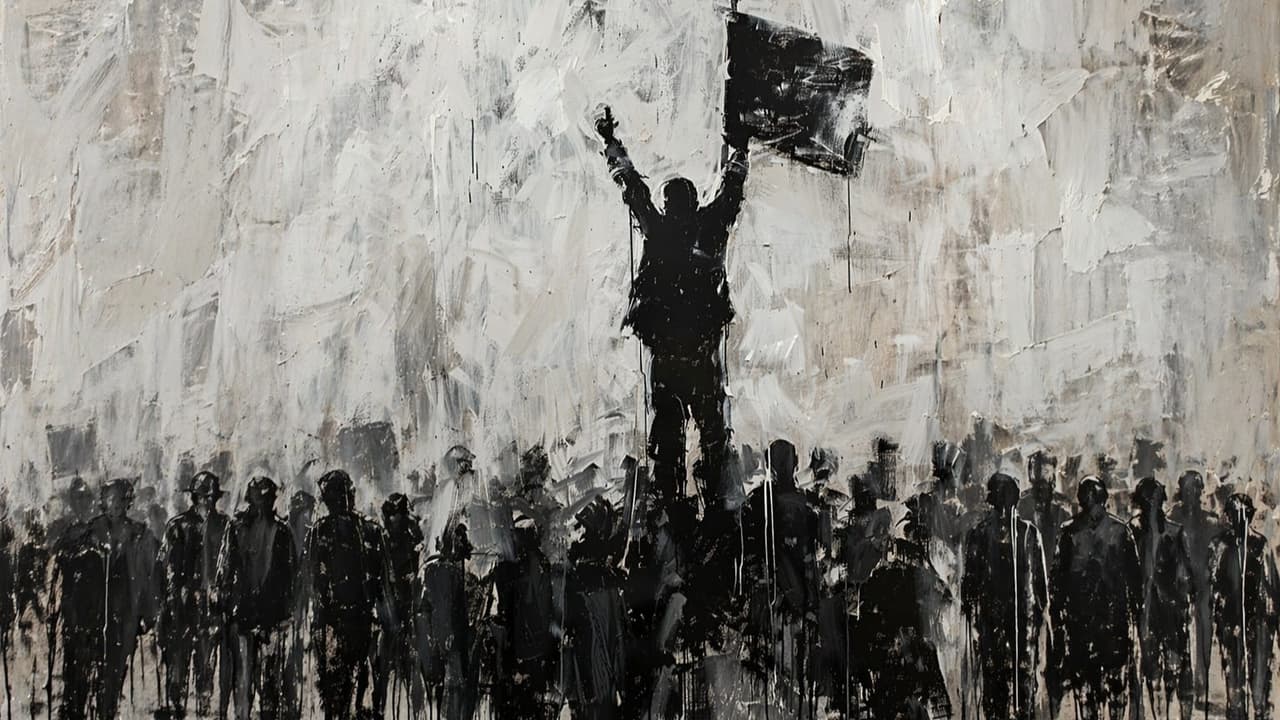
You look at Iran, at revolutions, and ask: can systems really bring freedom? Revolutions keep replacing one system with another, yet the chaos remains. The real question is rarely asked: what within us creates these systems? Real freedom is not political or social; it is inward. Without inner change, every revolution only rotates power, never resolves suffering.

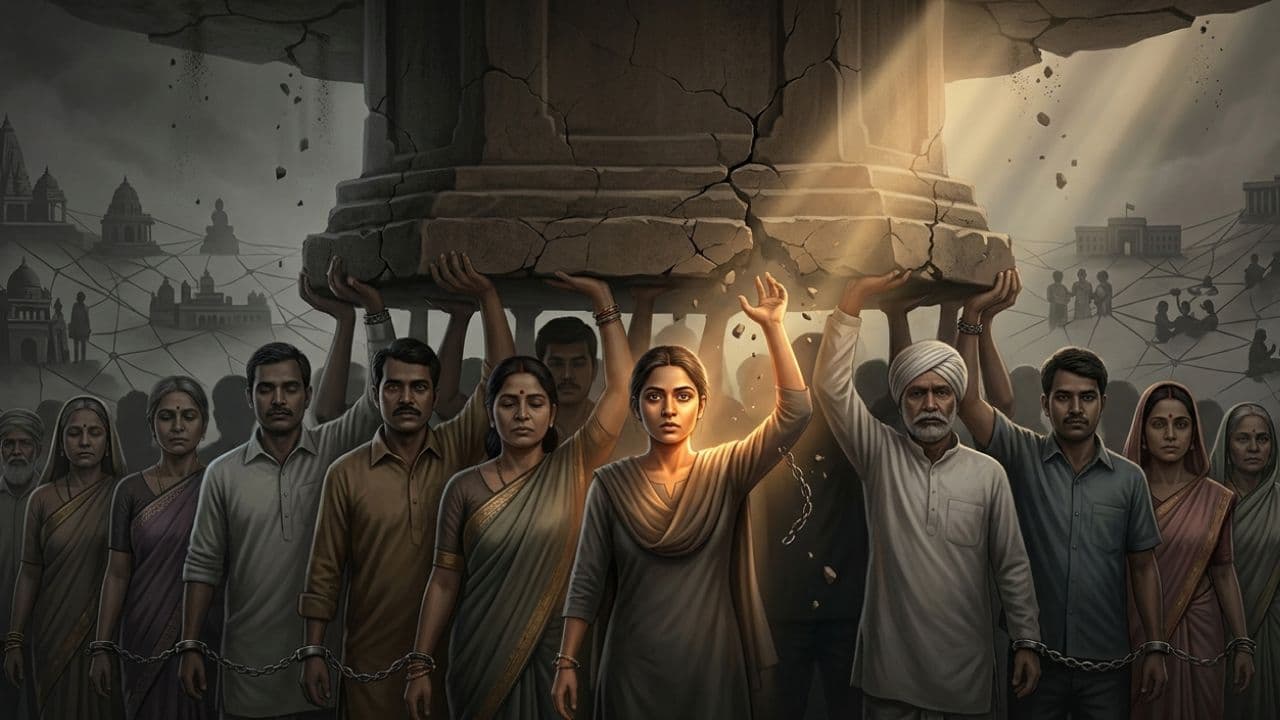
If most people are oppressed, why do unjust systems still survive? Because the oppressed themselves unknowingly support them through inner ignorance. No structure can sustain without the participation of those it exploits. Real change cannot begin outside; it must begin within. When individuals see clearly and refuse to remain complicit, the system collapses. Blaming the system is easy, but transformation demands responsibility for one’s own life.

Superficiality offers pleasures. Superficiality offers cheap salvation. Therefore, it is easy to be attracted to superficiality. On the other hand, true spirituality challenges you to pay a heavy price. So, you see, all this knowledge has existed since antiquity. Yet there are people who do not want to read the Gita.

Often, in the name of financial pressure, what we are really kneeling down to is something else. But because that something else is not nice enough to be named, what we quote is financial pressure. Nothing is ever forced in a tangible way. The way is kept gentle in appearance. But there is something else at work inwardly. What is that thing? That is what you have to uncover. You have to be honest towards yourself, very honest.

Let’s separate two things clearly. One, physical harm. If you are in a jungle, you must know how to protect yourself from the beasts, right? That’s a matter of basic intelligence and rationality. Two, feeling inferior, that does involve your consent. Nobody can make you feel inferior if you are not participating in that phenomenon. Somebody abuses you, slaps you, insults you; that is something he can do. But feeling inferior, that is something you do to yourself.

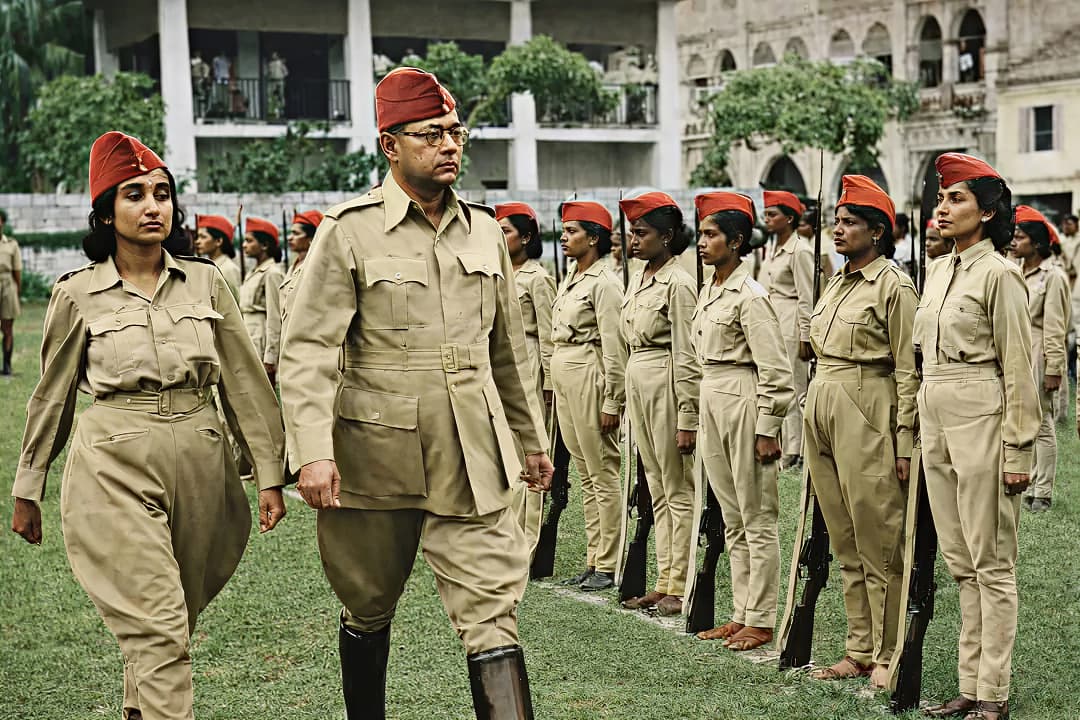
There is no revolution possible without the Gita. That’s the reason why even those who are not remembered particularly for their spiritual inclination, people like Subhash Chandra Bose, even they founded their core on Gita. What kind of revolution can you do if it’s the body that’s always at the top of your mind? You require a Gita to tell you that this body is perishable and would anyway go. Gita only teaches you, "Endure and fight."

Shri Krishna is saying: the mind is conditioned to move towards objects and perceive only their surface, periphery, or form. Develop the practice of penetrating further. Let Truth be your practice. The moment you would look at something, and you are in no position not to look at things being embodied, you would look at things. Nobody said that you have to practice lust. Lust just comes. You might be a total fool, an utter retard, and still you will find yourself getting sexually excited once you reach a particular age. Did you need some practice? No, you didn’t. It just happened. But if you are to understand lust, if you are to cross over, if you are to be a master of your body, then it will require a lot of practice, and that will necessarily and obviously tell you about your predicament.

Drop the center of confusion, come to the center of clarity. Drop what the masses practice, come to the direct route of self-realization. That’s what it means.

For you to benefit from the darshan of Shri Krishna's statue, you should already have a relationship with Shri Krishna and the Gita. If you have had no prior connection with the Gita, then darshan makes no sense. Darshan is a great way to immediately bring back all that has been hidden under the dust of time. You could either re-read the entire Gita or simply look at Shri Krishna’s statue. It’s a fantastic method — but only for Gita lovers.

Acharya Prashant: That's why the rājasika mind is better than the tāmsika mind. The rājasika says, “I’m not alright. I need to do something to become better. I feel inferior. I feel incomplete. I need to rise. I need to achieve.” That’s the rājasika mind. The rājasika mind at least…

Overview
Fighting Duryodhana is Dharma. Fight Duryodhana in the way you can, that is swadharma. Dharma is the same for everybody, but swadharma varies according to your physical, social, temporal conditions.
But remember that swadharma can never be in contradiction of Dharma; swadharma will always be something…

Do not consume that which will poison you, even if it appears attractive. Now that is spirituality.

It was Guru Nanak who said, "You may try as hard as you can, but you will never get to know the mind of the liberated one." That's from the Adi Granth. You keep trying. You keep speculating. And the ego has a serious urge to know what is going on in the mind of the Buddha. But you'll never know what's there in the mind of the Buddha. Being who you are, how will you know the mind of the Buddha?

Acharya Prashant: You will see that I'm repeatedly stressing on Shri Krishna as the demolisher, on Shri Krishna as someone who not only does not accept our prevalent definitions of right-wrong, true and false, humility, authority, right action, non-violence but, in fact, unabashedly and actively demolishes them. It is one…

The Gita has nothing to do with sāttvikatā. Even sāttvikatā is to be rejected as destiny, while even rājasikatā is to be embraced if it serves as a means to freedom. Everything and anything is fine if it is usable in the context of liberation. Even sattva can become an object of consumption — don’t we see learned people whose knowledge becomes their identity? The Gita is about getting rid of all traps — be it sattva, rajas, tamas, or anything.

You look in the mirror, and if there is a speck or blemish on your face, you want to change something. If you look at the Gita and that doesn't result in changes in your life, then you are misusing it. Anybody who holds the Gita must be ready to look within and discard all that which is unnecessary, borrowed, antithetical to life. If that is not happening, then that's disrespect to the Gita.

We all have our moments, our episodes of failures. We all let ourselves down at some time or the other. What to do then? Rule number one – do not go down tamely. If there is an inner conflict, and you know which side should win, fight hard to ensure that the right side prevails. Rule number two – keep fighting till your victory and keep fighting in your defeat. Even in defeat, remain a winner.

Acharya Prashant (AP): Great things are happening on the screen, don't get so excited, it's just the screen. Irrespective of what happens on the screen, it's not real. That's how you have to look at things. Great silence on the screen. Is it silence? No, it is the silence of…

We often feel that the Mahabharata war was about avenging the atrocities that Duryodhana had been committing. But in fact, the war was to stop Duryodhana from wreaking havoc on the entire country in the future. If the state policies themselves promote Adharma, then the effect on the population would certainly be derogatory. Therefore, despite the likely great loss of lives, it was still important to fight the war.

Obsession with the future is a compulsion with the ego. The only way to be free of the future is to be free of yourself. Be free of yourself and flow like the wind. But will the right things happen to me then? Can you assure me? Is there a guarantee? So desireless, motiveless action and faith, they always go together. Somebody who's asking for guarantees, somebody who is craving for assurances, he is unfit to even touch the Bhagavad Gita. This is only for the courageous ones.

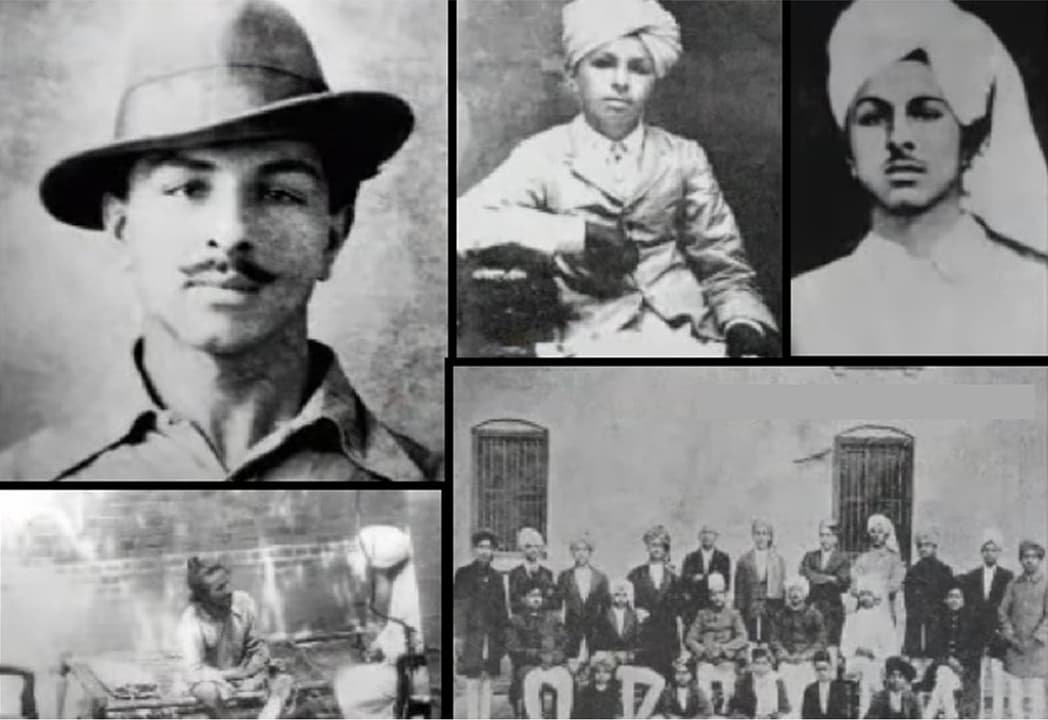
Bhagat Singh was just twenty-three when he laid down his life, yet he remains immortal, while those who lived up to ninety years are just the dust of time. Who cares for them? That's the difference. He had no time for trivial things. Even on the eve of his hanging, he was reading the Bhagavad Gita, and that copy is still preserved. A voracious reader, well-read at a young age, he never wasted time. Does such a life not excite you?

No wise man will ever take your problem seriously, believe me. For the wise one, all your problems are bad jokes—not even worthy of a sound laughter. But then he says, "You know, I can see through. You cannot. So, I'll give up my right to laugh at you. I'll instead pretend to be serious." "Yes, yes, yes, of course! We have a problem!" He says, "You know, there was a time I was so much like you. These same things were big issues even to me. But I know they can be outgrown.

The question should be which one is relevant to you? What will you do by enquiring about Shri Krishna’s grace? That’s Shri Krishna’s prerogative, right? Shri Krishna will take care of his grace if he has to offer grace. Whatever he has to do, we do not know what grace is. We do not know who Shri Krishna is. How does it concern us to go into matters of his grace? What is it that’s in your control? Your own preparation, your own willingness. So, you take care of that.

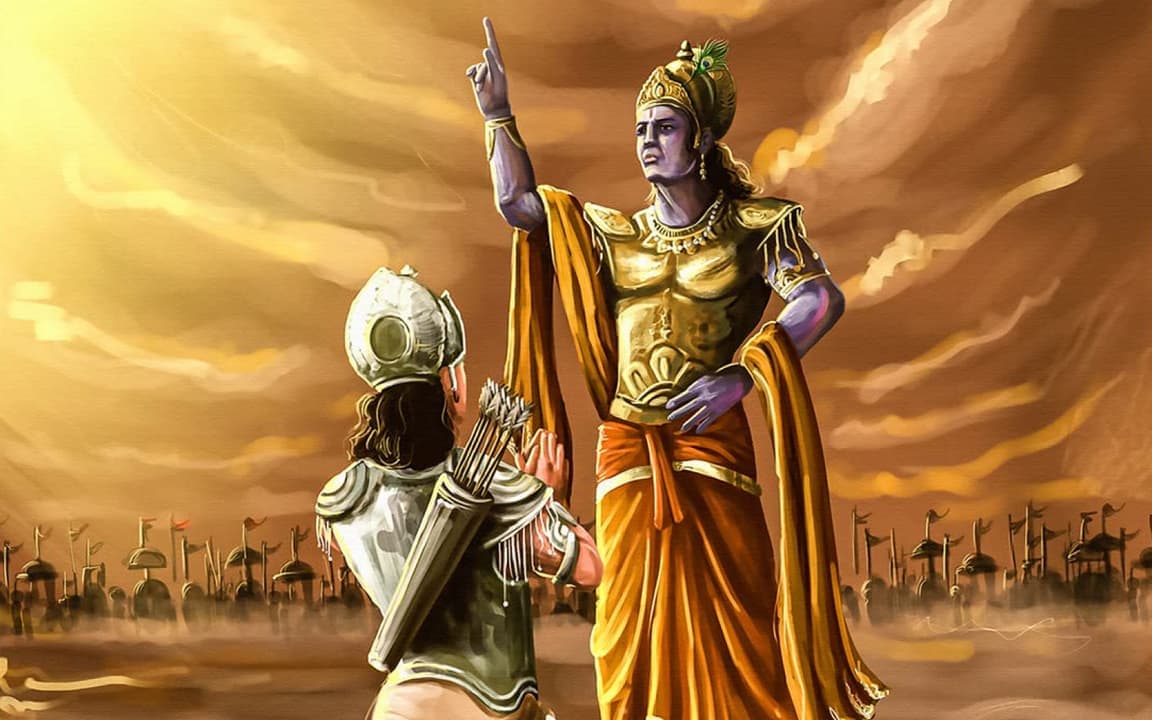
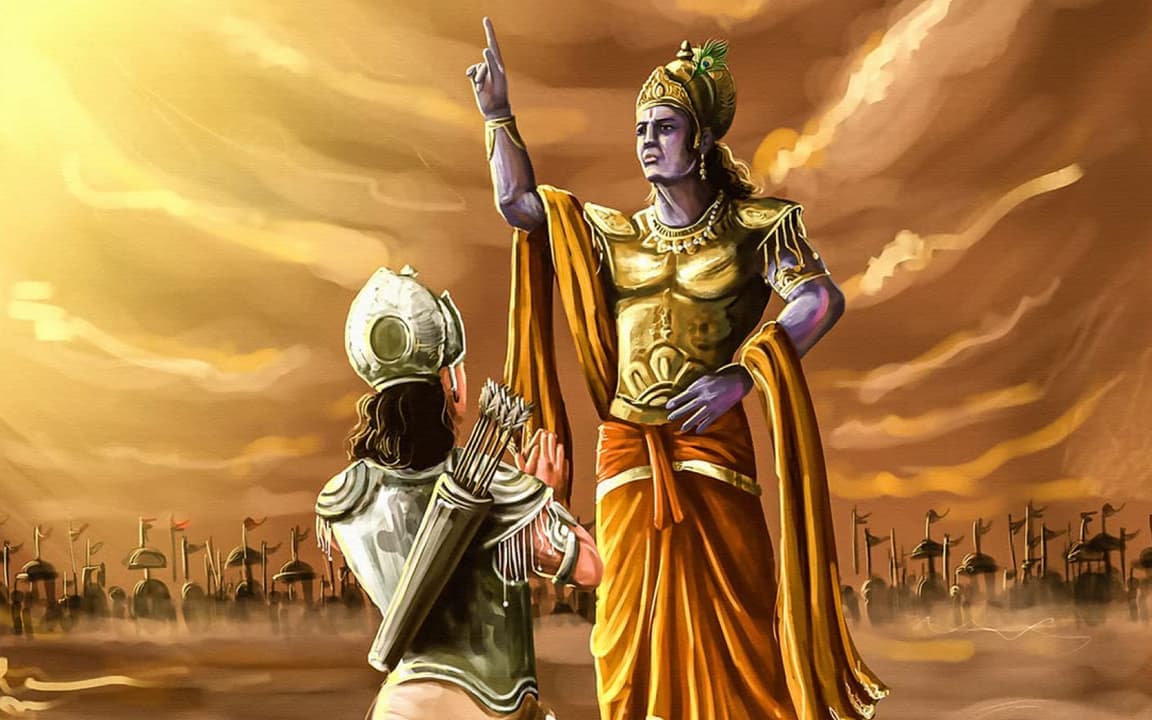
The Gita is useful because its setting is extremely relatable. Just like us, Arjuna does not know himself—he's a victim of multiple identities and all kinds of conditioning. Therefore, the Gita is about letting Arjuna know who he is, and this illumination enables him to do what he must. So, first of all, see that you are Arjuna. Then, step by step, verse by verse, there will be some resolution.

देवान्भावयतानेन ते देवा भावयन्तु वः। परस्परं भावयन्तः श्रेयः परमवाप्स्यथ।।
~ श्रीमद्भगवद्गीता, अध्याय 3, श्लोक 11
अर्थ: यज्ञ से देवताओं को आगे बढ़ाओ, तो वो दैवत्य तुम्हारी उन्नति करेंगे। इस तरह परस्पर (आपस में) उन्नति करते हुए तुम परम श्रेय प्राप्त करते हो।
काव्यात्मक अर्थ: *यज्ञ से देवत्व बढ़े देवत्व से…

No, no, you don't have to be empty of anything. You just have to be empty of the choice to use anything in your defense. You are born with ammunition; you don't have to keep the ammunition aside. Let the gun be there with you—just don't fire at the teacher. That's all that Shri Krishna is saying. You don't have to empty the gun. Keep it loaded; it's all right.

Who are the people who never understand Shri Krishna? The ones whose minds are full of Karmakand. If your mind is full of Karmakand, Shri Krishna himself has very clearly said, you will never understand the Gita because Karma Kand deals with desire, because whatever you do, you do for the sake of desire.

If all that the Ego wants is liberation from itself, which means coming to see its own non-existence, then the only way to see its non-existence is by paying attention to itself. The more the Ego pays attention to itself, it sees that it does not exist. The more the Ego remains attached to this and that, all the sensory inputs, the Ego feels that is real and this is real.

The center of the Gita is 'Nishkamta'—desireless action stemming from self-knowledge. Whereas popular religion is all about the fulfillment of desire. We go to a supernatural power and beg him to grant our desires. That is popular religion. You can either have the Gita or the entirety of religion as practiced in common culture. They are totally incompatible.

Do the utmost that you must in any situation, and you will find only the joy of right action. Tears are for those who turn away from their responsibility. If you were truly dedicating your energy rightly, how would you have any left to weep? So fight so hard that you either win or perish. If you win, the glory is yours. If you perish, at least all suffering is gone.

One has to come to a certain purposelessness with respect to what one has always been doing. And when one comes to that purposelessness, that’s now like being with a clean slate. One does not like the words futility. So something within us just silently conspires from inside. So there is futility but then in that futility some meaning will be found. And that’s a conspiracy. There is purposelessness but some meaning will be attached to the word purposeless and that defeats the whole thing.

The word for a Guru does not really exist in the English language. So, they have borrowed Guru itself, Guru. But they have borrowed the word Guru and rather misunderstood it and misapplied it. So, anybody who seems to be an expert at anything, can be justifiably called a Guru in the English language. Now that's not the proper usage in spirituality or in Sanskrit.

In modern times, reading and respecting the Shastras is often seen in a derogatory light. An Asura disregards the scriptures, saying, “What I know is right. My own experience determines the Truth,” rejecting them because they will not allow him to do what he wants. We have come to a point where we are not merely ignoring but actually insulting the scriptures. If you're sincere about knowing life, why avoid a document with deep insights into it?

Does the person you are with encourage you to read? You have to ask, “What does he bring for me, roses or books?”
Be very cautious of those who bring roses for you, especially red roses. Books are what we all need, and books are dangerous. Books are dangerous because…

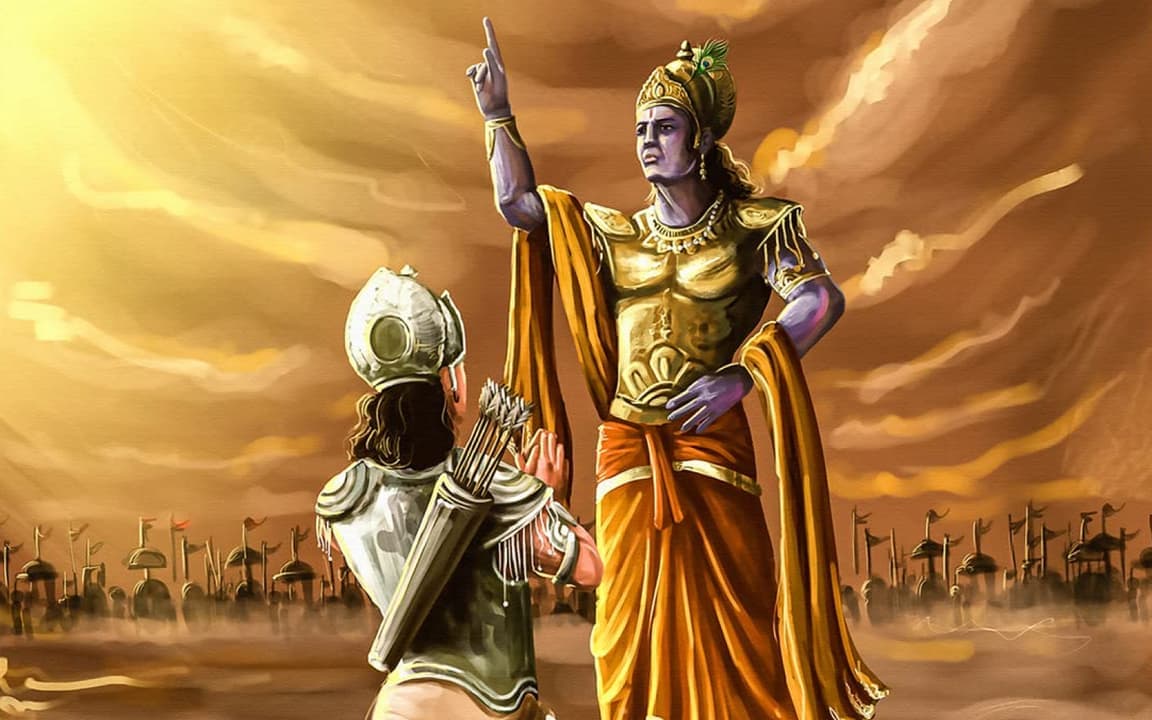
You have to fight. The world is the battlefield. To be born is to be born as a warrior, to be born is to be born with weapons and armour. That is the message: you cannot run away. Shunning action is not possible.

When you feel inferior, even a harmless touch can hurt you. No one can hurt you without your consent. It has nothing to do with the intention of the other person; it has much more to do with your self-concept. The deeper you go into yourself, the more you are devoted and surrendered to the Truth, the less significant this tendency to get hurt will become.

Most of the times, we are preoccupied with the first kind of hope, which says, “Get something, get something.” That kind of hope will keep me dependent and afraid. The second kind of hope which says, “I just want to get rid and discover my true nature, discover my aloneness and freedom." In this hope you say, “I am already a diamond. Just that a lot of dirt has gathered on the diamond, and I want to get rid of the dirt.

To qualify an entrance exam, and work towards it, without thinking of the results, that’s not what Karma Yoga is. Karma Yoga is not about setting tangible worldly targets and going after them. It’s a moment-to-moment thing in which you are very conscious whether the objective of your action is personal ingratiation or larger welfare. You are acting all the time, you are not acting merely when you act towards a distant and a larger cause.

Realization is extremely powerful. You cannot realize and not act. It is impossible. You cannot realize and not act. Action follows realization. So if you come and say, “I realize, I understand but I cannot act,” then you are mistaken; you actually do not realize at all! The action after realization is not time-bound; it does not even have a time lag. It is instantaneous and spontaneous.

In the name of yagya, if you continue to burn wood, you are doing no good to anybody. Yagya must be understood in its true spirit. Shri Krishna says, “Do not act for yourself or for your personal gain. Act for a higher cause; higher than yourself, beyond yourself. Do that action that takes you to your Niyati, which is your end. Yagya is that which dissolves you; that which reduces you.”