Questioner: Sir, after I started listening to you, I listened to more revolutionaries or so-called revolutionaries, people like Karl Marx, and I couldn't help but realize that these conversations that we have about self-knowledge, about self-inquiry, about understanding things, come from a place of privilege. I have a certain comfort in my house where I can sit down and think about, “Okay, this is religion. This is what spirituality means. This is wisdom literature,” and so on and so forth.
But if I go outside in the real-life scenario on the ground and I meet, for example, a Dalit person, statistically speaking, 92% of sanitary workers in India are of that caste, and I go up to him and he asks me this question: “I go through suffering every single day. Systemic oppression. Not because it's my fault, not because it's my friend's fault, but because this is the norm that exists. This is the society that we exist in.” And anytime I ask someone, “What should I do?” They tell me, “This is society. There's nothing you can do about it.”
I go up to him and I tell them, “Look, the answer to all your problems is actually self-knowledge, self-inquiry.” I can't help but think he would slap me across the face and tell me, “I have a million things to do, a million oppressions to suffer, a million people telling me why I'm not supposed to exist in this world and I'm not worthy of life.”
How do we reconcile that? So, the question, if I were to frame it correctly, was: if exploitative structures of class and economy exist beyond one person's ego, can inner transformation alone address them? Should Truth also entail actively confronting these structures, as Marx would argue, or is systemic injustice best met through personal change?
Acharya Prashant: Who would confront these structures? Who would the brick in the wall contribute to the demolition of the wall? Does that ever happen? Does a cog in the machine ever bring the machine down? Does that happen? How long has casteism and the oppression associated with it survived in India? Last five years? Last twenty five years? Or dozens of centuries, right? How do you think it was able to survive?
You talked of Dalits. They are referred to as outside the Varna system, right? They constitute around, uh, 20 to 25% of India's population, the Scheduled Castes and the Scheduled Tribes. That's a big bulk, 20 to 25% of the population. Right? Then within the Varna system, they are Shudras. They are what you today call as the Other Backward Castes, and they constitute around 50 or 55% of the population. When you talk of oppression, these are the people you are referring to. How much do they add up to? 75%.
And when you talk of oppression, obviously you cannot miss the most oppressed class of all, women. So even among the remaining 25%, 12% has remained oppressed since centuries. So how much does the oppressed class now total up to? 87%. No, no. What kind of system was it that was able to oppress 87% of the population since centuries? Who was making the system and who was supporting it? If 87% are the sufferers, who was keeping the system afloat and going? Ah! who was keeping it going? Obviously, 13% might have been beneficiaries. Not all 13%; maybe 10, 12, some percentage. We don't know.
But this system could not have survived without keeping the 87% in inner ignorance so that they do not actively resist the system. Please understand. Otherwise, the system would have crashed long back. These 87% were made to somehow, directly or indirectly, actively or passively, support the system. Women were made to support patriarchy and even the oppressed classes were made to support caste discrimination. Now, how was that happening? At gunpoint? No, that was happening through the perpetuation of inner ignorance.
The ones who had been confined to traditional caste-based menial jobs were told that this is the best that they can get from life and this is what God has ordained for them, and they accepted it. Otherwise, there would have been a revolution long back. Now you tell me why the revolution never came. Not because people were subjected to hunters or physical coercion. It was because of inner slavery, right? And that's why inner empowerment, inner ignorance, elimination of inner ignorance, has to be the first step.
Otherwise, the oppressed one would himself or herself keep the cycle of oppression going. It becomes a very strange situation, very pathetic, very miserable, when you become a contributor to your own enslavement. When you say, “You know, I'm born a woman, that too in a so-called lower caste, because I did something wrong in my previous birth. So God has punished me by making me a woman, that too a woman of an underprivileged caste. No, no, no. No revolution is needed. I'm just paying for my own sins.”
Now, will she ever raise her voice? If she is suffering, that is rather atonement. If she is suffering, that is actually good news for her next birth. Through her suffering, she is washing her sins. Now, in next birth, she'll be born clean as a higher caste male, maybe. Why will there be any resistance? No system can really stand without some kind of support of those it oppresses.
So few Englishmen were able to rule India. How was that happening? It was because the Indians were supporting the English. Otherwise, how would they have survived for so long? You imagine the size of this subcontinent and you look at the British Isles. And they came from that place navigating half the world, and they were ruling a country that was more than 10 times as populous as theirs. How was that happening?
It was a continent-sized country that the British were controlling from Afghanistan, modern Afghanistan till Burma, as populous as Europe; and that’s what they were controlling from that distance because the Indians themselves were contributors to the system. They had stakes in the system, or at least they were made to believe that they had stakes in the system. They were made to believe that they had stakes in the system.
So, probably the Dalit would be told, "You know, there is the Brahmin, and if you are respectful enough and if you call him to conduct your ceremonies and if you do all the nice things as prescribed in tradition, then some superpower would be happy with you and maybe bless you with a son."
Questioner: Sir, but this dominant class, whether it was the upper castes in ancient times or today the capitalist billionaires of the world, I mean, a handful group of people are able to starve the entire Gaza Strip in today's world just because of their own decisions they made; just a handful group of people could stop all this in a matter of days if they wanted, but that is still happening in Palestine and other places as well. This always exists, this dichotomy between the upper class that handles all the oppressed. How do we reconcile?
Acharya Prashant: What I’m saying is that the oppressed ones are always more numerous. You agree?
Questioner: But isn’t it too much to ask of them to...
Acharya Prashant: Why is it too much to ask of them, sir? And if they don't empathize with their own condition, we are saying it is too much to tell them to empathize with their own condition? Why would some other external third party come and help them? If you are suffering, the onus is on you to understand the reasons and rise and break the chains. If you don't want to help yourself, why would somebody else? No? Maybe I'm trying my level best and then somebody else comes to help me. That’s fine. But first of all, I need to really know what keeps me down.
There is the housewife, and I go to her, not directly, not physically, but through my books, and she says, “No, no, no. You’re not offering me help. You’re breaking my house.” And I can see that she is a living corpse subjected to oppression, humiliation daily. But she says, “No, no, this is what I must do. I’m a pious lady and this is my sacred duty. Don’t derail me.” Her condition will continue like this for another 2,000 years.
Structural change cannot happen because the structure is never conscious of its own. You make the structure, right? This is a structure, this building. Suppose this is not right and you say, "We need structural change," and you keep shouting and petitioning to these walls and to the ceilings; will they change?
Because the structure is an unconscious thing. Man makes the structure. So, if the structure is to change, first of all, man has to change.
But you keep talking of structure; "The structure is such that, you know, we need policy changes." Who will make the policy? The policy doesn’t drop from the heavens. You make the policy. No climate change can be taken care of by having right policy decisions; who will take those decisions? You are the voter.
All this is somewhat a relinquishment of one’s individual responsibility. I’m abdicating my responsibility and I’m putting it on the system. Now, the system is such that what can I do? You have your own one single precious life to live. The system won’t live it for you. The responsibility is all yours because it is your life. Whose life is it? Your life. So why are you believing the system? Get out, run away, do whatever you can. And if you can’t do anything, then at least fight and die in the attempt. That much you can do, right?
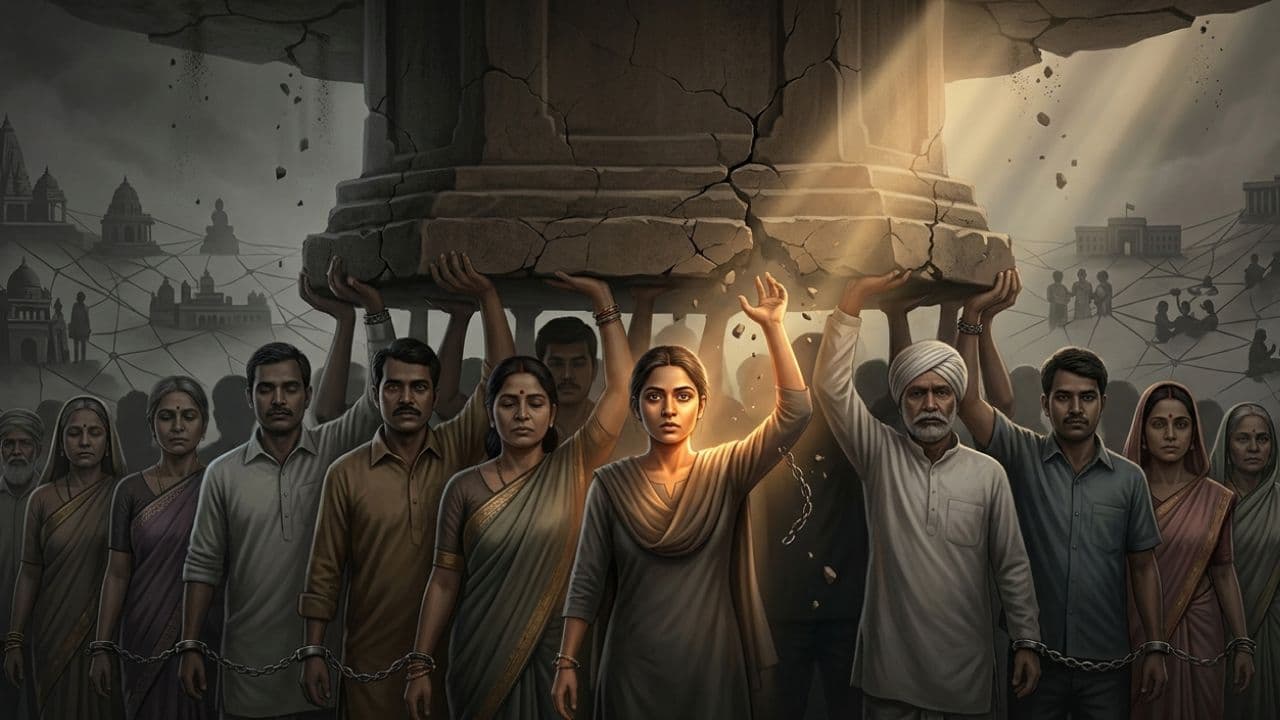
But you won’t fight. You will simply say, "You know, the system is like this." Forget about fighting. The fact of the matter is, as we said in the beginning, we actually support our own oppressors. All systems that oppress us stand on our own backs as we are made to lie on our stomachs. Picture that: the system that you are blaming, its pillars are standing on your back as you are lying on your stomach.
The day you decide to get up, the system would come crashing down. But lying there, prostrating there, you keep saying, "You know, the system has to change." How will the system change? What are you doing? And don't do anything to change the system; please, do something to change your own life. At least that much is your responsibility, or you want to run away from that also?
Questioner: Good evening, sir. I'm pursuing my B.Tech degree from the same campus, and I guess my question concludes all this. For context, I'm a Christian by faith, but I don't keep belief in the scriptures, in all the religious texts that I have been taught in my church.
So, the scriptures are all the fundamentals; all the are flawed fundamentals that we have been taught to clear the dilemma of existence. Why don't we work towards ending it completely? Like, I have been following many philosophers like you and many others; they are against religions and the scriptures, but they only support it vocally. Why don't we actively step to end it, like with the ministries?
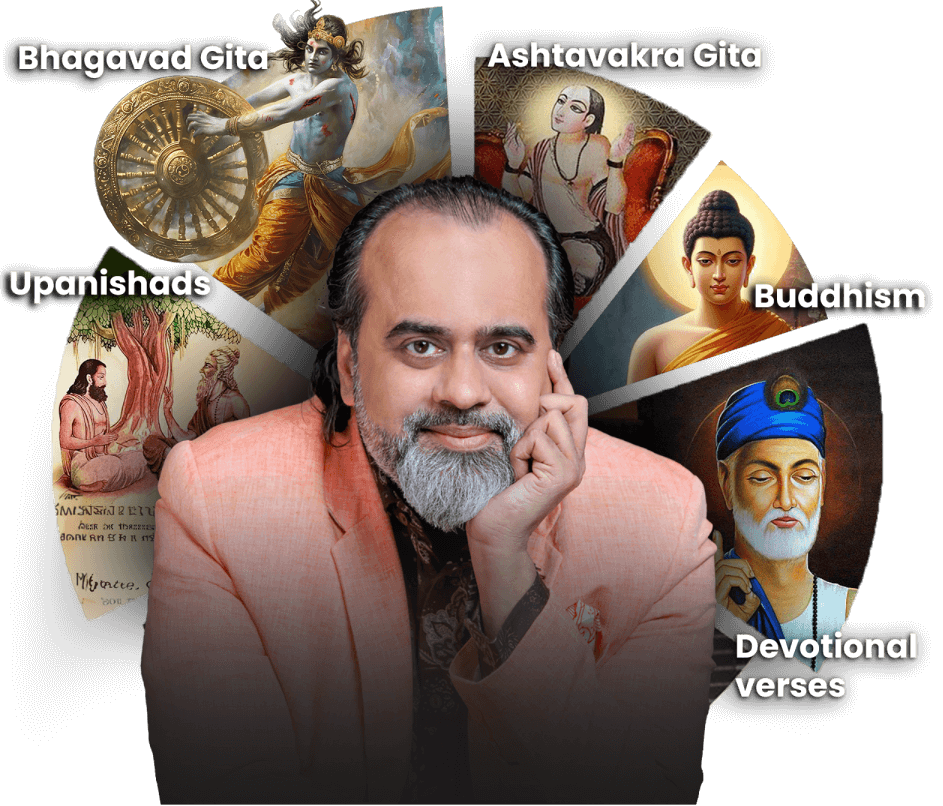
Acharya Prashant: Because, you can't throw the baby out with bathwater. I have never said scriptures are evil. I teach scriptures, actually. I teach the Bhagavad Gita, Upanishads, Buddhist scriptures, Zen literature, Sufi stories. They are beautiful, all of them. Why do you want to ban the scriptures? Rather, let's be very clear in defining what to call as scripture. Not all old books deserve to be called scriptures. Just because something is old, it doesn't become sacred, or does it?
Yes, something can be historically very significant or culturally very powerful; give it its due place. Place it in the library, sometimes in the museum, maybe. But you can't place it on the high altar of what truly deserves to be called as religion.
What is scripture? Only that which addresses the fundamental condition of mankind, only that deserves to be called a scripture. That's the change you need.
You don't need to reject all old books. A lot of them contain deep wisdom, very, very relevant to all times, not just these times. You don't need to reject them, but you need to have a sifting mechanism, a refining mechanism. Right?
You have entire libraries full of religious material. Not all those books have any worth, or at least equal worth. Do not call, for example, storybooks as religious books. They are not scripture. Any book that contains beliefs does not deserve to be called a scripture. Any book that tells you, "Unless you believe in something like this and this, you are not devoted, you're not religious, you're not pious;" that book is not a scripture.
A scripture, by definition, is one that takes you inside, asks you, "Who are you?" and "Why do you suffer?" and "How to be free of this suffering?" That's what scripture is. Getting it? So, we need to be discreet in defining and selecting a scripture. Throwing away all scriptures, that's very unwise. And a lot of people, in the garb of modernity or atheism, do that. That's not wise at all. No. You take the Upanishads to them, they'll say, "No, no, no. Why are you bringing me this bullock-cart stuff?”
And even within scriptures, there are portions that deal with timeless wisdom and there are portions that deal with beliefs. You must be able to differentiate there as well. And in stories, sometimes there are deep symbolisms embedded. You must be able to read those stories rightly, not literally, but symbolically, figuratively. Getting it?
So, two levels of discrimination: One, where there is deep philosophy pertaining to the self, existential questions, ontology, questioning belief, epistemology. Yes, that deserves to be called scripture. Then there are books of stories, this happened, then that happened, then that happened, and all kinds of stories. Don't take them as history.
Some of the stories are very, very powerful codes. Decode them, interpret them wisely and rightly, and they too can help, deeply help, in your modern life. And then there are some stories that are just stories. The so-called religious book commands you to accept that story as some historical fact; that's what can be discarded. Totally discarded.
Questioner: Referring to your book, I'm glad I got my hands on it. Why can't we have a social structure which sidelines religion but keeps it, but takes the facts and the scientific temper and practices the scientific temper as a whole?
Acharya Prashant: Right. Let's have that in a Goa structure again, once again: Who will build it? Why do you always tend to move away from yourself? Or will the structure drop from somewhere? Why can't we have a structure? Almost like ordering something in a restaurant: "Can I have a strong cappuccino?"
Who will bring it? You take it upon yourself. And it starts with your own life and then radiates outwards. Sitting as you are, remaining as you are, no greatness will just descend on the outside because you are the mover, you are the doer, you are the conscious entity, you are the actor. You say, "I will remain as I am, but let there be something." If you remain as you are, the world will remain as it is.