Questioner: You have said that individual liberation is not possible: that either we go together, or nobody can go. So, we have to help others to cross over. But I can’t help even the people close to me; they are caught up in routine work or indulge in entertainment; no…



Science can examine material claims, but Advaita Vedanta deals with the subjective self, ego, suffering, bondage, and liberation—areas outside science’s objective framework. Vedanta need not be accepted because of one’s religion or tradition; its value lies in whether its insights can be personally verified and help free one from suffering. The ultimate responsibility is not toward any philosophy, but toward oneself: to live a truly free life.

Superhero films appeal to our desire to escape inner inadequacy through external power. The fantasy of an ordinary, fearful person becoming extraordinary reinforces the ego’s belief that more strength, money, possessions, or status will bring happiness. Consumerism follows the same pattern, endlessly adding objects to fill an inner void. Real freedom does not come from becoming more powerful or acquiring more, but from honestly seeing and understanding the ego that feels incomplete.



Global conflicts stem not from geopolitical interests but from the ego's fundamental incompleteness. Nations are merely expressions of collective egoic consciousness. Leaders represent humanity's worst tendencies, not its average. The ego requires duality and boundaries to survive. True disarmament means detoxifying the ego itself. External wars reflect internal disturbance. No diplomatic solution addresses the root cause, only wisdom and self-knowledge can dissolve the ego's need for conflict and separation.

Questioner (Q): Acharya Ji, please explain what Shri Ramakrishna meant by the following:
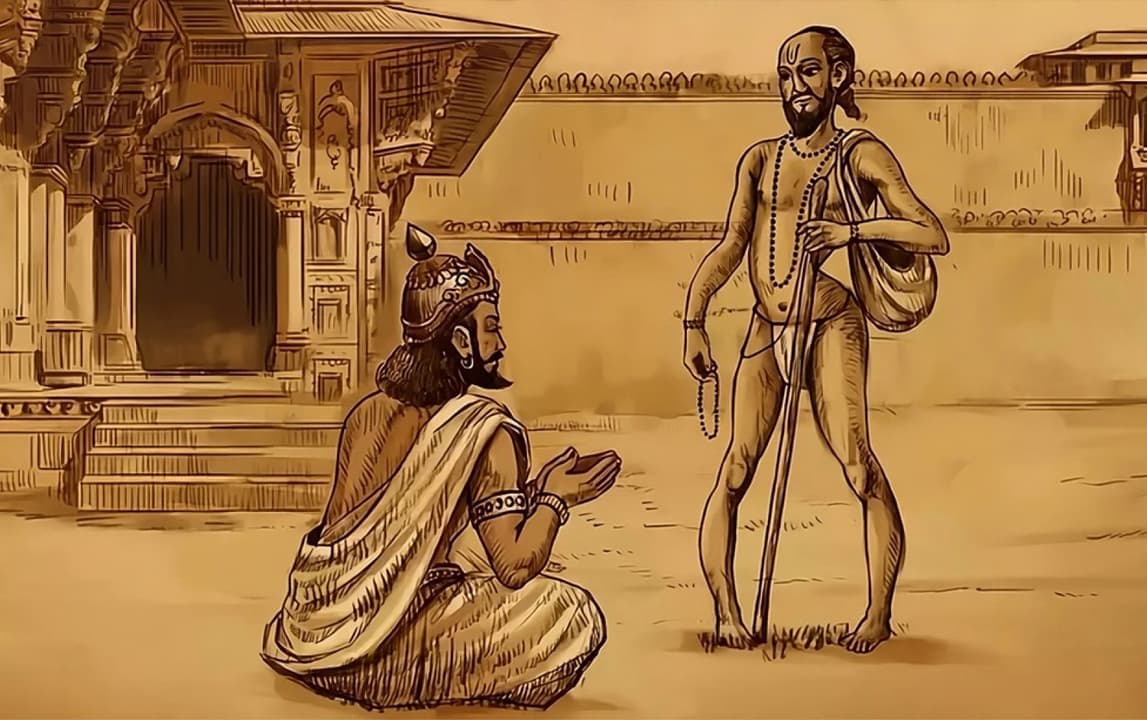
“One day a Marwari gentleman went to Sri Ramakrishna and asked him for permission to present him with some thousands of rupees. But the master had nothing but a stern refusal for this well-meant offer. He said,…
Climate change is more than an environmental crisis—it is a crisis of human choices. Our patterns of consumption, consumerism and endless pursuit of more are putting increasing pressure on the planet. But meaningful change does not necessarily begin with new technology or stricter policies. It begins with a deeper question: what are we willing to change within ourselves?
Parental expectations, peer comparison, and academic pressure can overwhelm you only when you allow others’ desires to dictate your life. As an adult, you are responsible for discovering your own potential and making choices through your own understanding. Love is not about fulfilling each other’s expectations or keeping someone happy. True love requires freedom—giving others the space to live and grow, while living according to your own inner clarity.
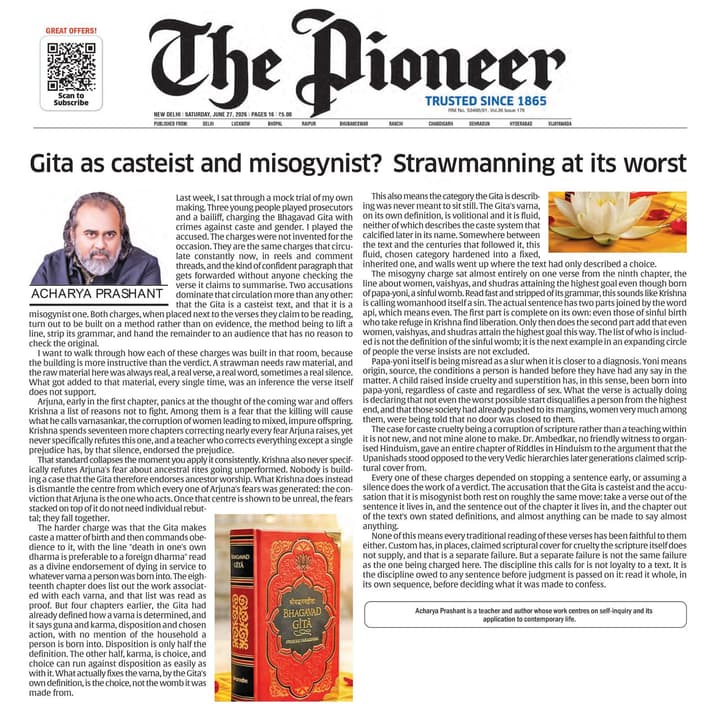
The Bhagavad Gita is often accused of supporting caste and misogyny through selective quotations that ignore context, grammar, and the text's central teachings. A closer reading shows that its emphasis is on inner qualities, conscious action, and spiritual equality rather than birth-based hierarchy or gender discrimination. Misinterpretations arise when isolated verses are detached from their broader meaning, while the Gita consistently points toward self-knowledge, freedom from ego, and the universal possibility of liberation for every human being.
Science and philosophy arise from different kinds of inquiry. Matter seeks continuity of state, while the ego seeks continuity of existence and constantly changes identities to preserve itself. Fear, danger, and suffering are rooted in the ego’s sense of “I,” not in material reality itself. Questions are valuable because they expose hidden beliefs, and genuine learning requires challenging assumptions through inquiry, dialogue, and self-examination.
The climate crisis is not merely an external environmental problem but a reflection of inner human greed, desire, and psychological disorder. Drawing from the Gita’s idea of yagya as desireless action, it says real ecological healing requires inner transformation. Outer pollution, exploitation, and destruction mirror the ego’s inner confusion, making personal consciousness and planetary health deeply inseparable.
Our mood is always dependent on others and situations. Results have not been up to your expectations. So now you require a morale booster, some motivating speaker. The moment that fellow is gone, your energy also goes away. But there is another way of living. Deep within myself, I find a point that no external situation can touch. Whatever happens, happens on the surface. That will remain stable, uninvolved, a non-participant. Then you are really free.
The only principle that truly runs this world, created by all of us, is the principle of greed and power. What do you think that fellow has earned his billions for? He didn't become a politician to be noble. The only thing that separates us from animals is the intellect, not the center the intellect is operated from. Don't locate the problem and the responsibility somewhere out there. We change ourselves; the world changes.

If you do not understand spirituality, you will fail even in economics. Look at how common people live their daily lives. Do we inquire into what we are doing? We do things because others are doing the same things. Out of ignorance, you act; and out of greed, you keep acting. Economics does not address the problem of ignorance. Economics also does not address the problem of greed. It is the Upanishads and the Gita that address these problems.

Superficiality offers pleasures. Superficiality offers cheap salvation. Therefore, it is easy to be attracted to superficiality. On the other hand, true spirituality challenges you to pay a heavy price. So, you see, all this knowledge has existed since antiquity. Yet there are people who do not want to read the Gita.

Ignorance is not about not having some particular knowledge. Ignorance is not an absence; ignorance is having knowledge. That which your mind is full of is ignorance. Ignorance is your basic sustenance. In such a situation, this utterance, “In reality, you are the One,” I repeat, must not be taken as the Truth in the sense of an affirmation. It is a method to help you drop that which fills you up. All it is telling you is this: “You are an entire universe sitting in your mind; you are not that.”

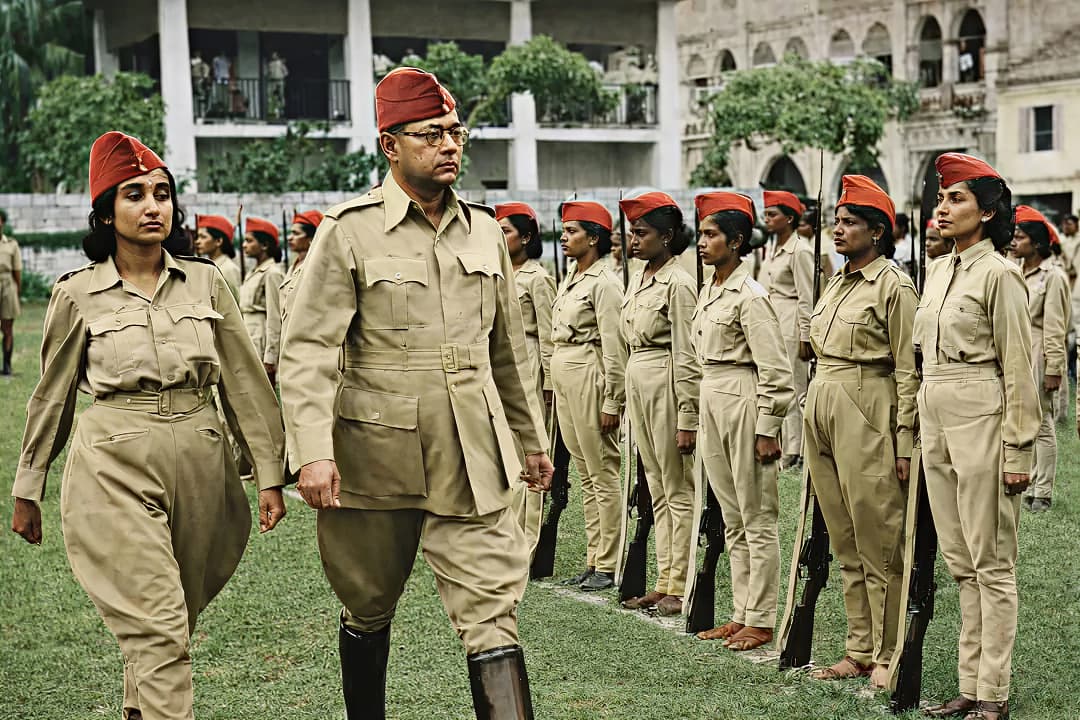
There is no revolution possible without the Gita. That’s the reason why even those who are not remembered particularly for their spiritual inclination, people like Subhash Chandra Bose, even they founded their core on Gita. What kind of revolution can you do if it’s the body that’s always at the top of your mind? You require a Gita to tell you that this body is perishable and would anyway go. Gita only teaches you, "Endure and fight."

There can be no self-respect without self-knowledge. And we have been repeatedly saying that the ego survives only in lack of self-knowledge. The less you know yourself, the denser and more crystallized your ego is. Self-respect is nothing but self-awareness. The more you know yourself, the more you realize who you are not, and that brings you to who you are. That is real self-respect, knowing oneself.

Shri Krishna is saying: the mind is conditioned to move towards objects and perceive only their surface, periphery, or form. Develop the practice of penetrating further. Let Truth be your practice. The moment you would look at something, and you are in no position not to look at things being embodied, you would look at things. Nobody said that you have to practice lust. Lust just comes. You might be a total fool, an utter retard, and still you will find yourself getting sexually excited once you reach a particular age. Did you need some practice? No, you didn’t. It just happened. But if you are to understand lust, if you are to cross over, if you are to be a master of your body, then it will require a lot of practice, and that will necessarily and obviously tell you about your predicament.

That’s what the entire spiritual process is about, collecting the airfare. So that you can rise up, otherwise, you stay crawling on the highway. Life is not so that you just remain a crawler, a creeper. Life is so that you can take off.

Every living being, from humans to the smallest species, is trying to change the world to suit its own needs. But this is not intended to do any good to the world, it is just coming from the little ego. And the ego will not say, “I'm not all right;” it will try to change the world. So, if your idea of ‘good’ is only relative to your personal self, is it right to impose it on others? You must be clear about why you aspire to change the world, and whether you have brought about any change in yourself first.

The money you pay for something must be commensurate with its practical utility, but how do you know something is worth its price? For example, does jewellery really have any utility that you pay so much for just a piece of metal? The average Indian household spends much more on the girl’s dowry than on her education. And poor farmers in India are often pushed to suicide because they spend a lot on weddings and funerals by borrowing at exorbitant rates. This is what happens when you are not deeply spiritual: you can be easily conditioned to earn from the wrong source and spend at the wrong place.

Drop the center of confusion, come to the center of clarity. Drop what the masses practice, come to the direct route of self-realization. That’s what it means.

Confidence is your enemy. Catch the inner thief red-handed. Look at its functioning. See how it manipulates and distorts. See how it has preset conclusions and then fabricates arguments in favor of the conclusions.

Joy is not a problem. Suffering is a problem. I am the sufferer. And if this ‘I’ is the problem, the sufferer, then firstly the ‘I’ itself has to be approached. And when I find that my efforts are getting saturated, I will have to go to a book that talks exclusively of the ‘I.’ The Upanishads are such books, because their subject matter is nothing but the ‘I.’ So, if you come across something that is dealing in stories, beliefs, and deviating from the self, you must know that it is not Vedanta at all.

The theoretical reply would be that if condemnation hurts you, then somewhere you are looking for praise. Even if it’s implicit praise or subtle praise, there is some hunger for praise. Or the inner condition that the ego has set is, don’t give me praise, but don’t condemn me either. So there is some condition that the ego is setting on the world. The fact is, the world has a movement, a flow of its own. You cannot set any condition on it. If you are getting hurt, it means there is an expectation, a condition.

It is one kind of misfortune to not have money at all. The next kind of misfortune is to have a lot of money rotting in your bank account. Why must it be there in your bank account? You are so impoverished, you couldn't find a right place where you can spend your money. Money is meant to be spent. Spend it at the right places. Go enroll in a hobby class. Get a tennis coach. All that is expensive. Spend your money. If you won't, then you will end up just buying whatever your friends buy.

Some battles need to be fought just because they deserve to be fought, not for the sake of victory but for the sake of the fight itself. And victory is indeed possible. We are not fundamentally evil. We are all hypnotized since birth. That’s what is called Maya. Just as somebody can hypnotize us, somebody can also break the hypnosis. It is possible! Never, never lose Faith.
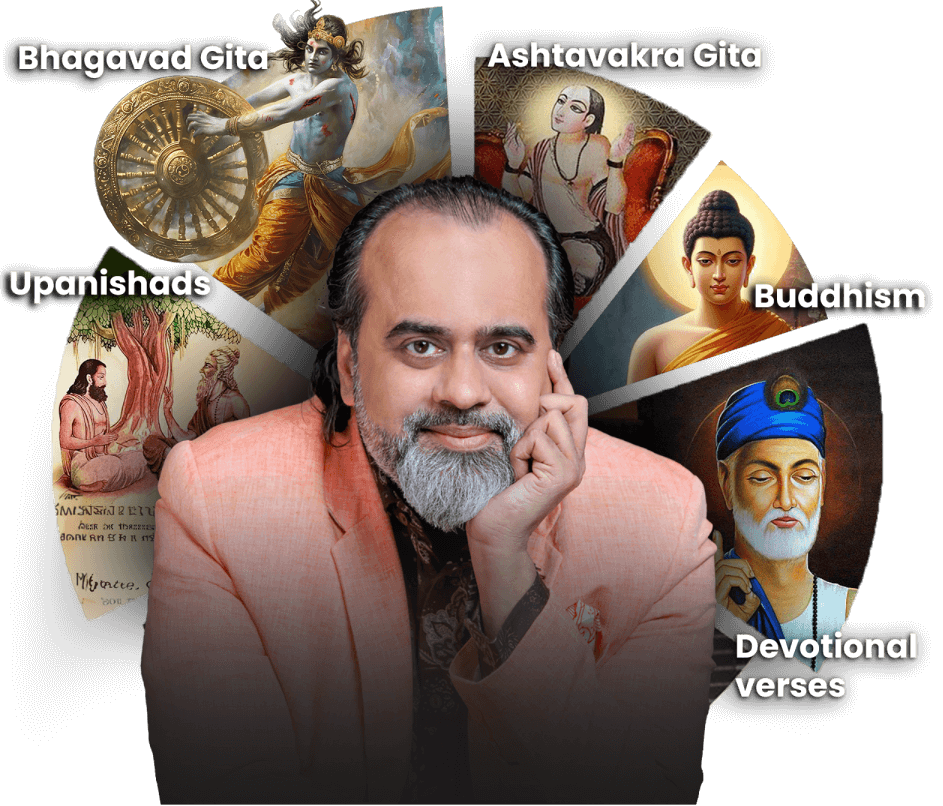
At the level of the body, this world will have an influence on you, and there is no need to even contest that. Let it happen, because it is going to happen anyway. But inwardly, let there be a place so sacred that nobody is allowed to enter — not even you. And when that is there, you can freely participate in the world because you'll no longer be afraid. You'll say, “Come what may, I'm secure within.” Then you will live in deep security, and we all know how pleasing security is.

The self is a hollow, incomplete thing by its own admission. It has no free existence of its own; it is nothing but associations with the objects around it, absorbing its worth from the environment. To hide this absence of self-worth, you keep running after all kinds of things, yet the promise of fulfillment is never kept, and you are deceived. Therefore, to have any self-worth, you must have clarity about the self. All wisdom literature is about clearing away your false notions of the self.

Question: If love is death of ego, then how will we live? Man is made of only these things. So, the only thing left will be ‘soul’. So we can say that we have moksha (liberation).
Speaker: The question is: If love is death of ego, then a loving man…

Questioner: If love is death of ego, then loving man will be just soul. So, is love Moksha (Salvation)?
Acharya Prashant: Everything that you just said, is a concept in your mind. Ego lives on concepts; ego lives on thoughts—concepts are thoughts.
What is the definition of a concept? Where…

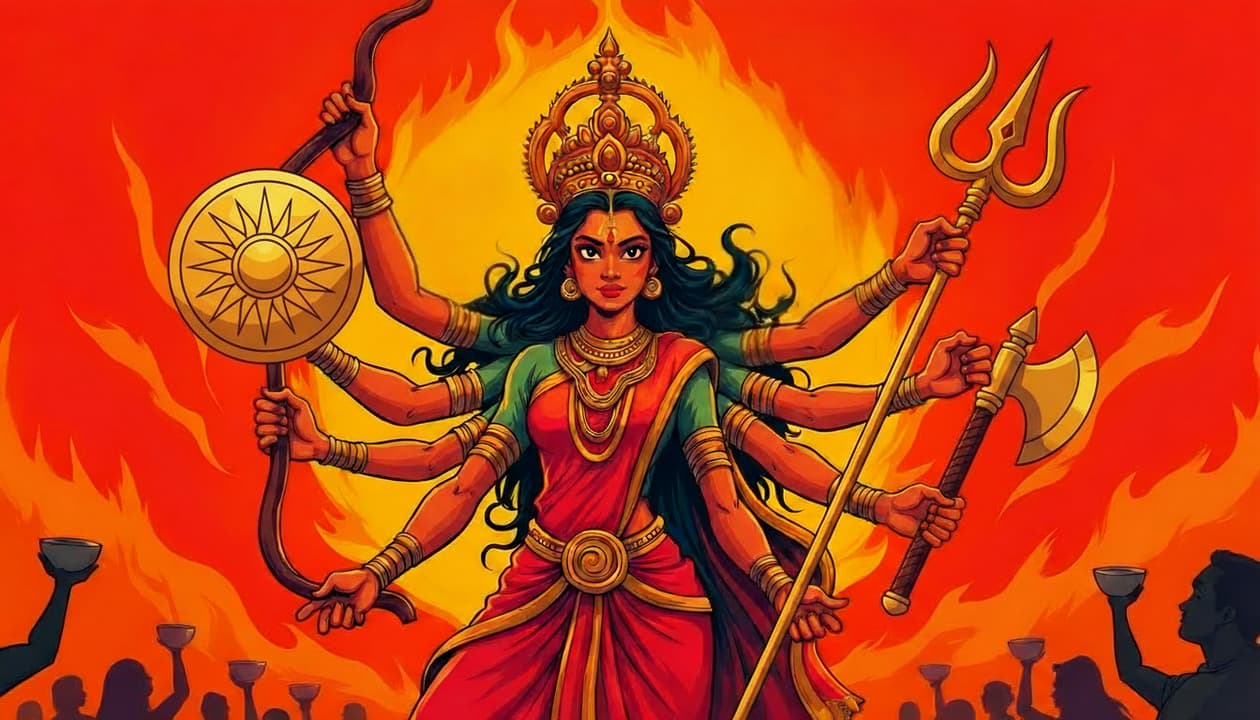
You are the subject, Puruṣa, and everything you can experience, perceive, speak, imagine, or think is Prakṛti. The only real spiritual question is to determine the right relationship between Puruṣa and Prakṛti. India came up with a beautiful answer: Worship Prakṛti with reverence, but do not try to possess or exploit her. The Shakti tradition with the Devi-puja is nothing but an answer to this question of right relationship. Durga, Ambika, and Kali — they all represent Prakṛti.

You are the quality of your present action. You are, right now, attention itself, if you are indeed listening to me. Unfortunately, this identity won't last. Soon you will be distracted. You'll become somebody else. The discipline lies in holding on to the highest identity possible, that which you know to be the highest, given your limited capacity. That's who you should be. That's the answer to — ‘Who am I?’

Do the right thing before you can be a non-doer. You are anyway used to doing, and you have been doing all the wrong things. Now that you have been doing the wrong things, wake up to your power to choose, your right to choose, and do a few things right. And then you will slowly discover that you don’t even need to do. That is called ‘non-doership.’ For choicelessness to descend upon you, at least first make good choices.

In the universe, there is no good, no evil. Ask instead, ‘To whom is good, and to whom is evil?’ The self, the ‘I,’ the ‘me,’ the one who wants to define good, the one who wants to define evil — he is evil, because he does not exist. Spirituality is giving the evil something right to do. If you do not give the evil the right thing to do, it will pick something else, making itself feel relevant, whereas the fact is that it has zero relevance. Work to remove yourself. That's your task.

Because you underestimate Maya. Because maybe you are in the illusion that you have conquered, that you have left her way behind. Because probably you do not perceive that you too are still threatened. You feel, 'Oh, the thing is so easy, I overpowered it. Why is my dad not able to accomplish this simple feat?' Maybe it's actually so difficult that not only your dad is failing—even you have not fully succeeded.

Acharya Prashant: That's why the rājasika mind is better than the tāmsika mind. The rājasika says, “I’m not alright. I need to do something to become better. I feel inferior. I feel incomplete. I need to rise. I need to achieve.” That’s the rājasika mind. The rājasika mind at least…

Overview
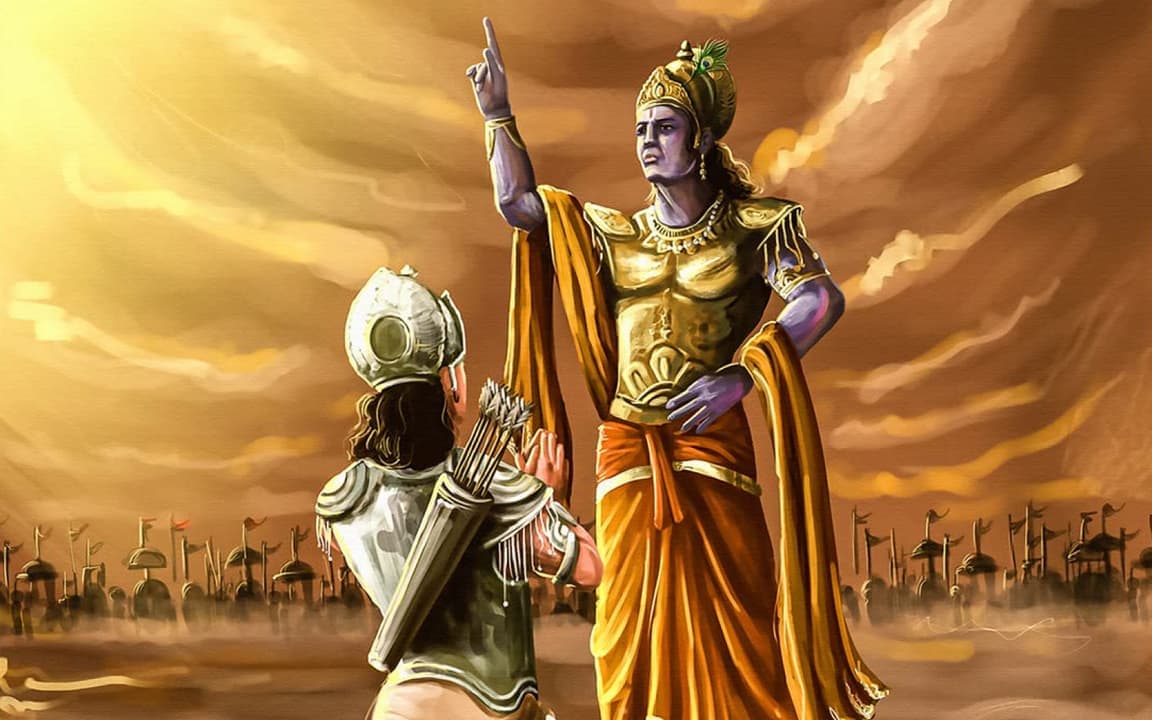
Fighting Duryodhana is Dharma. Fight Duryodhana in the way you can, that is swadharma. Dharma is the same for everybody, but swadharma varies according to your physical, social, temporal conditions.
But remember that swadharma can never be in contradiction of Dharma; swadharma will always be something…

Doing or not doing — both are functions of the doer. The doer is the instrument. Is the instrument, first of all, reliable? Know who you are. Know what it is that you lack. Know what it is that you need to shed. And then the deed is right. Then you know the one right direction for you — choicelessly. It's not just about doing something. It's about knowing the doer.

For change to happen, somebody has to be a change agent. But if that agent starts thinking, “I’m not exploited; I benefit from this discriminatory system too,” then who will demand change? My employer earns 11X from my intellectual labor, pays me X, and saves 10X. But that X enables me to run my household and fulfill my dreams. So, will I ever rise and rebel? The system bribes you into submission. The exploiter incentivizes the exploited to stay exploited.

If you have not been benefitting from the Guru, either you are too full of yourself or you are not really devoted and putting in the right efforts. Ashtavakra puts it very simply: Even if Brahma, Vishnu, or Shiva are your teachers, yet if you cannot get rid of yourself, you will not benefit. Only somebody who has seen the total failure of his ways is so determined to get rid of suffering that he can sacrifice anything, anybody — only such a person, such a mind, can be helped by the Guru.

When you look at the body, you see that the body was founded by something outside of itself: one cell from the father, one cell from the mother. And whatever the body feeds on — food, water, air, sunlight — all of that comes from outside the body. You, who are conscious, have hardly anything in common with the body. Also, the wise man says, “The body is not mine,” because he doesn't control the body. The body will die one day whether one wants it or not.

A common misconception that many of us have is that ‘ego is pride’, but it is far more pervasive than pride. It is the sum total of everything that we have taken from the outside and accepted as our beliefs and identities without applying intelligence. But we are not a sum total of external influences. Even if everything external is taken away, the pure existence still remains — we have an existence of our own. Ego is this forgetfulness of our pure existence.

Acharya Prashant: You will see that I'm repeatedly stressing on Shri Krishna as the demolisher, on Shri Krishna as someone who not only does not accept our prevalent definitions of right-wrong, true and false, humility, authority, right action, non-violence but, in fact, unabashedly and actively demolishes them. It is one…

You look in the mirror, and if there is a speck or blemish on your face, you want to change something. If you look at the Gita and that doesn't result in changes in your life, then you are misusing it. Anybody who holds the Gita must be ready to look within and discard all that which is unnecessary, borrowed, antithetical to life. If that is not happening, then that's disrespect to the Gita.

Good spirituality is good economics. We do not know what to purchase. We do not know what really is valuable, even in the material domain. The punishment of not being spiritual is that you lead a very bad, a very ruined worldly life and that includes an economic life, a ruined economic life. It is not merely the person, even nations, actually the entire world suffers when the one making the economic decision is spiritually bankrupt.

We often feel that the Mahabharata war was about avenging the atrocities that Duryodhana had been committing. But in fact, the war was to stop Duryodhana from wreaking havoc on the entire country in the future. If the state policies themselves promote Adharma, then the effect on the population would certainly be derogatory. Therefore, despite the likely great loss of lives, it was still important to fight the war.

The question of confidence arises only when you are afraid. You do not need confidence when you are with the loved one, but in the interview room, everybody says, “I need confidence.” Look at all your images of confidence, and you will see a fine aggression there, because fear and violence go together. Don’t ask for confidence, ask for fearlessness.

It’s not capitalism versus socialism; if the center I am operating from is itself animalistic, then I will want to earn profits for myself, whatever be the social cost. The change that we need is inward- ‘self-knowledge’. We need an education system in which the child is very openly helped to face his/her animalistic nature, then we will develop a certain humility to look for solutions beyond our tendencies.

Questioner (Q): I watched your recent video - “Loving your fake lifestyle.” In that video you talked about two things. One is abuse of consciousness and another was that corporates are dehumanizing the employees.
In that context I wanted to ask you, this dehumanization actually is not only happening in…