The ego is terrified of groundlessness, so it grabs a chair. It clings to labels because labels give it continuity. When someone says, ‘I am a Leftist’ or ‘I am a Rightist,’ this is not identity but insecurity. The chair is a crutch. The row is a refuge. The ego loves ideology because ideology is a respectable form of bondage. The real question is not Left versus Right. You were not born to sit on the Left or the Right. You were born to stand free.
A language is not merely a tool of communication; it carries within a worldview, a way of life, and an entire cultural and spiritual lineage. Its sounds are the history of a people and the thread that ties them to their roots. In India we speak hundreds of languages, and each one tells a unique story with a deep sense of belonging.
The mind has been living for long in patterns. It knows no other way of being. The movement of patterns is gross. The movement of egoless action is very subtle, and the habituated mind will initially fail to notice it. You will have to wait like one waits for a lover. Do not expect that the new action, the new voice, the new guide will be of the same type, the same nature as the old one. This will be new, really new. Be ready to be surprised.
That’s what the entire spiritual process is about, collecting the airfare. So that you can rise up, otherwise, you stay crawling on the highway. Life is not so that you just remain a crawler, a creeper. Life is so that you can take off.
It is said that when you are in the waking state (jāgrat), you are identified with the world; in the dream state (svapna), you are identified with the dream; and in deep sleep (suṣupti) you are still identified with some kind of primitive darkness. But, it is not as if that you have gone beyond identification. Turīya is the state that is present behind the drama of waking, sleeping and dreaming. Turīya, the witness state, is not ‘yours;’ it witnesses you, it is outside of you. So, your birth and death do not touch it.
The distinction between spiritual life and worldly life is a false distinction. Spirituality is not morality or a set of commandments. It is never instructive. You do not need great formulations or special practices. Spirituality is basic honesty. Just see and acknowledge what is going on, and then the right action follows. Nothing else is needed.
Death scares the ego because there was something that the ego wanted from its existence that has not yet been achieved. The technical problem there is that what the ego wants from its existence can only be attained from its non-existence. Therefore, the only way to avoid death is by dying before death.
The ego does not need an entire purpose of life. It's so much in pain and so full of immediate distress that it's enough for it to pay attention to its immediate surroundings. And the most immediate to the ego is itself. So words like ultimate mean nothing to the ego. The ego is like a patient on a ventilator. That fellow is looking forward to the next hour. Will I see the next day? Will I survive the next hour? That's the ego so much in distress that even the next one hour is difficult to to predict or see through or navigate.
Thought is a servant; thought is a shadow. The shadow cannot betray its owner, its master. So, what changes is the nature of the ego itself, not the nature of thought. So when we say, for example, selfless thought, that primarily implies that the ego has improved, loosely put. Since I have become better, so have my thoughts. Now, I cannot remain the same and say my thoughts have become selfless, and if I do that, then I'm being pretentious and just fooling myself.
Originally published in the The Sunday Guardian on 30 nov '24.
Right since our birth, we are trained to conduct ourselves according to others’ expectations. Everything about us seems to come from outside; every single identity is social. We write in prescribed ways, speak in acceptable tones, worship in traditional…
Originally published in the The Sunday Guardian on 11 jan '25.
According to the recent Global State of Connections report, a quarter of the world’s population, around 1.92 billion, felt ‘lonely’ or ‘very lonely’. Research indicates that loneliness is closely linked to depression, anxiety, substance abuse , heart disease, and…
23
We must ask why most marriages are based on superficial factors like appearance, caste, or family approval rather than deeper considerations. When marriage is based on a pursuit of security rather than wisdom and awareness, it can lead to dependency and exploitation. While legal reforms are necessary, the ultimate solution lies in societal transformation. And societal transformation means reforming the individual to have mental depth — self-knowledge is the only path.
Delimitation is the process of redrawing the boundaries of territorial constituencies in a state for the Lok Sabha and Legislative Assemblies to ensure fair representation. Since populations grow and shift over time, this process helps maintain balanced representation so
…
Excerpts from Articles
कद नहीं, अपनी कहानी बदलो
कई तरह के डर—अकेले पड़ने, छवि खोने या छोटा समझे जाने—की जड़ अक्सर अतीत में बनी पहचान और कहानियों में होती है। शरीर की हाइट जैसी चीज़ों को समस्या मानकर उनसे जूझने के बजाय उनकी अप्रासंगिकता को समझकर आगे बढ़ना चाहिए। अतीत को दबाने से मुक्ति नहीं मिलती; उसके करीब जाकर अपनी स्मृतियों, धारणाओं और पुराने पैटर्न को निष्पक्षता से देखना ज़रूरी है।
You Don't Understand the Bhagvad Gita, But You Still Claim That You Love Krishna?
The Bhagavad Gita deserves reverence not because of inherited beliefs about its author, but because of its power to dissolve falsehood and reveal Truth. Real devotion is not ritual or blind faith—it is understanding, inquiry, and living the wisdom of the Gita. Through sincere study, one discovers the true meaning of Krishna, making the Gita the most authentic path to knowing and worshipping Him.
Justice Without Boundaries: Why Compassion Cannot Stop at Species
Oppression should not see caste, gender, creed or colour, and it should not see species either. The moral threshold is sentience, not intelligence. An animal feels pain as fully as a human does, whether or not it can explain its suffering.
Struggling to choose between a secure job and the path you actually feel drawn to? This isn't really a question about careers. It's about why other people's opinions have so much power over you in the first place. Real clarity doesn't come from finding the 'right' choice. It comes from honestly looking at your own fear, again and again, until it stops running the decision for you.
Animal cruelty: Who deserves mercy, and who doesn’t?
Violence begins long before the knife or the slaughterhouse—it begins with the ego, the one that draws boundaries, seeks justification, and decides who deserves compassion. Laws and reforms may reduce suffering, but they cannot end violence while the ego remains intact. When the ego dissolves, exploitation ends naturally, and compassion no longer depends on regulation or moral boundaries.
ज्योतिष कितना सच है? कुंडली, ग्रह-नक्षत्र: इनका क्या अर्थ है?
वेदांत को केवल इसलिए सही या श्रेष्ठ नहीं माना जा सकता कि वह किसी विशेष परंपरा से आता है। विज्ञान जहाँ भौतिक जगत की वस्तुनिष्ठ जाँच करता है, वहीं अद्वैत वेदांत सीधे मनुष्य के ‘मैं’, उसके दुख, बंधन और मुक्ति की पड़ताल करता है। इसकी कसौटी वैज्ञानिक प्रमाण नहीं, बल्कि अपने जीवन में इसकी सच्चाई को देख पाना है। किसी दर्शन को मान लेना नहीं, बल्कि उससे स्वयं को मुक्त करना ही उसका वास्तविक उद्देश्य है।
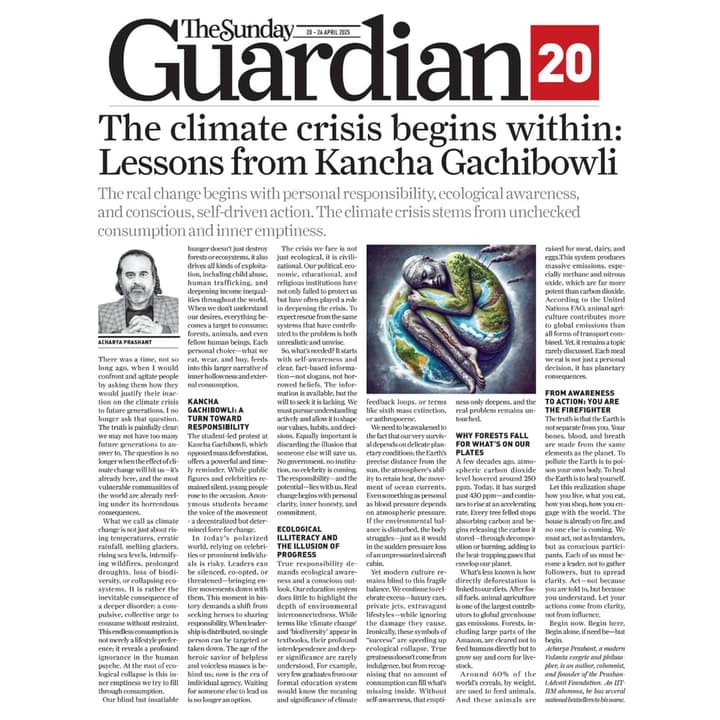
Climate change is more than an environmental crisis—it is a crisis of human choices. Our patterns of consumption, consumerism and endless pursuit of more are putting increasing pressure on the planet. But meaningful change does not necessarily begin with new technology or stricter policies. It begins with a deeper question: what are we willing to change within ourselves?
We are seeing catastrophic long-term shifts in temperature and weather patterns, driven by human activities such as burning fossil fuels, deforestation, and industrialization. Longer droughts, more intense heatwaves, and unpredictable rainfall patterns have become the new normal. The climate change of our planet reflects the fragmentation within. The way forward demands more than policy or technology; it demands a profound shift in how we live, think, and are connected to the planet.
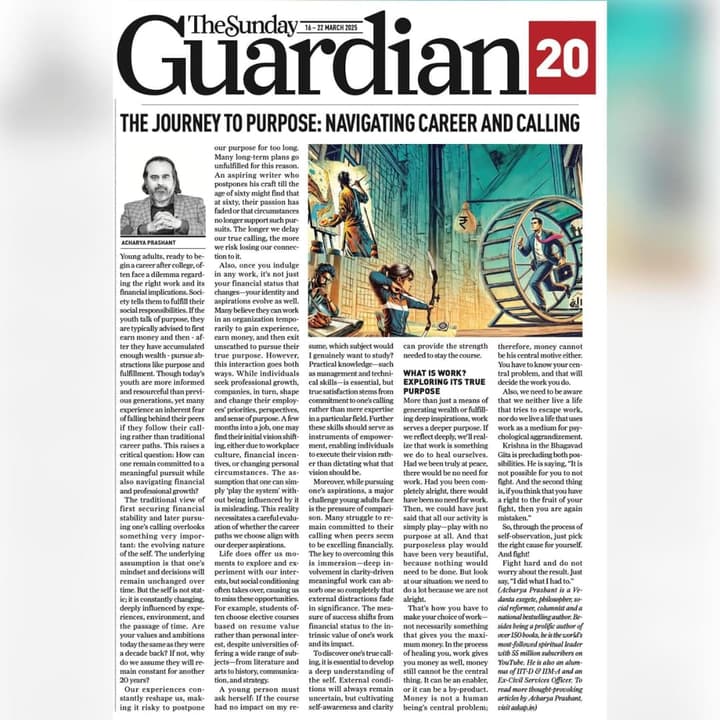
The traditional view of securing financial stability before pursuing one’s calling overlooks something very important: the evolving nature of the self. Therefore, it is risky to postpone our calling for too long. Many long-term plans go unfulfilled for this reason. The longer we delay our true calling, the more we risk losing our connection to it because the passion may have faded or circumstances may no longer support such pursuits.
The real change begins with personal responsibility, ecological awareness, and conscious, self-driven action. The climate crisis stems from unchecked consumption and inner emptiness.
There was a time, not so long ago, when I would confront and agitate people by…
The way we adhere to cleanliness standards, or fail to, is often a reflection of what we perceive as socially acceptable, not what we understand to be necessary.
Cleanliness has traditionally been tied to order and discipline, usually showing…
5
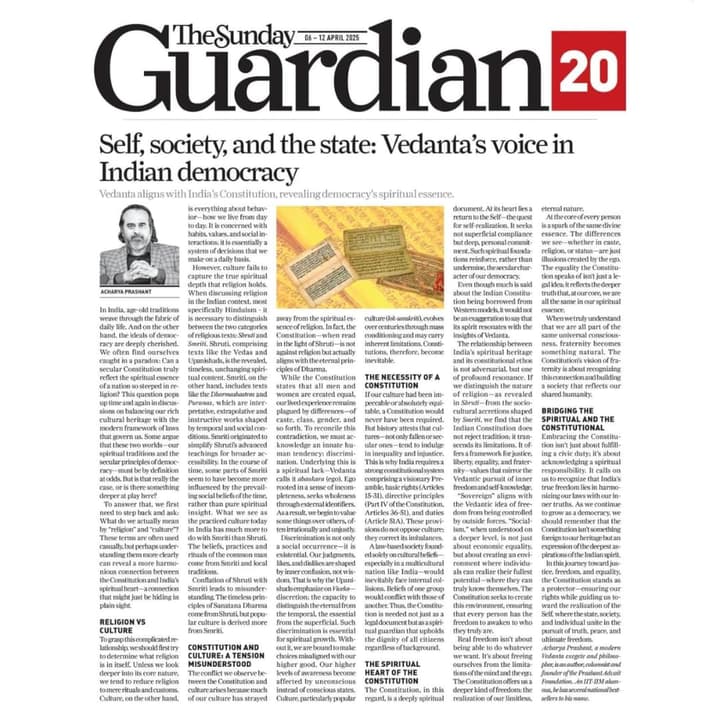
Embracing the Constitution isn’t just about fulfilling a civic duty; it’s about acknowledging a spiritual responsibility. It calls on us to recognize that India’s true freedom lies in harmonizing our laws with our inner Truth. As we continue to grow as a democracy, we should remember that the Constitution isn’t something foreign to our heritage but an expression of the deepest aspirations of the Indian spirit.
Cultures place too much value on conforming to relationship stereotypes. These dogmas and rigid opinions do not easily accept reality. And so, to please them, you become a habitual liar. But good relationships are founded on freedom; they are not based on obligations, and they are not afraid of reality. In good company, the other might frown, but less on what you did, and more on what you hid.
The challenges we face today are unprecedented — climate change, religious conflict, inequality and injustice, overexposure to social media. The tsunami of cheap fulfillment of shallow desire will continue to rise. Without looking at our own internal traps and darknesses, we keep talking of external solutions to these problems. That is just wishful thinking. There is no way forward but the one inward.
Originally published in the The Sunday Guardian on 19 jun '25
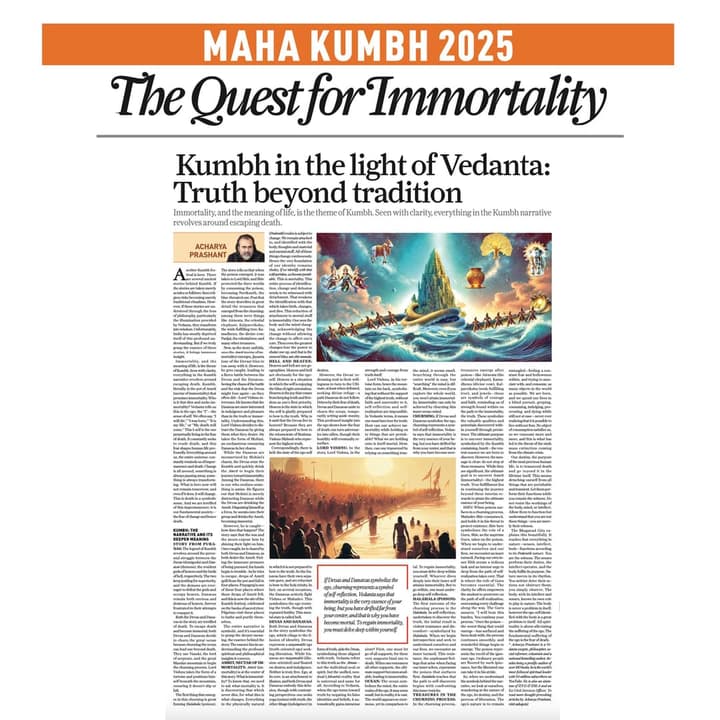
Immortality, and the meaning of life, is the theme of Kumbh. Seen with clarity, everything in the Kumbh narrative revolves around escaping death.
Another Kumbh festival is here. There are several ancient stories behind Kumbh. If the stories are…
4
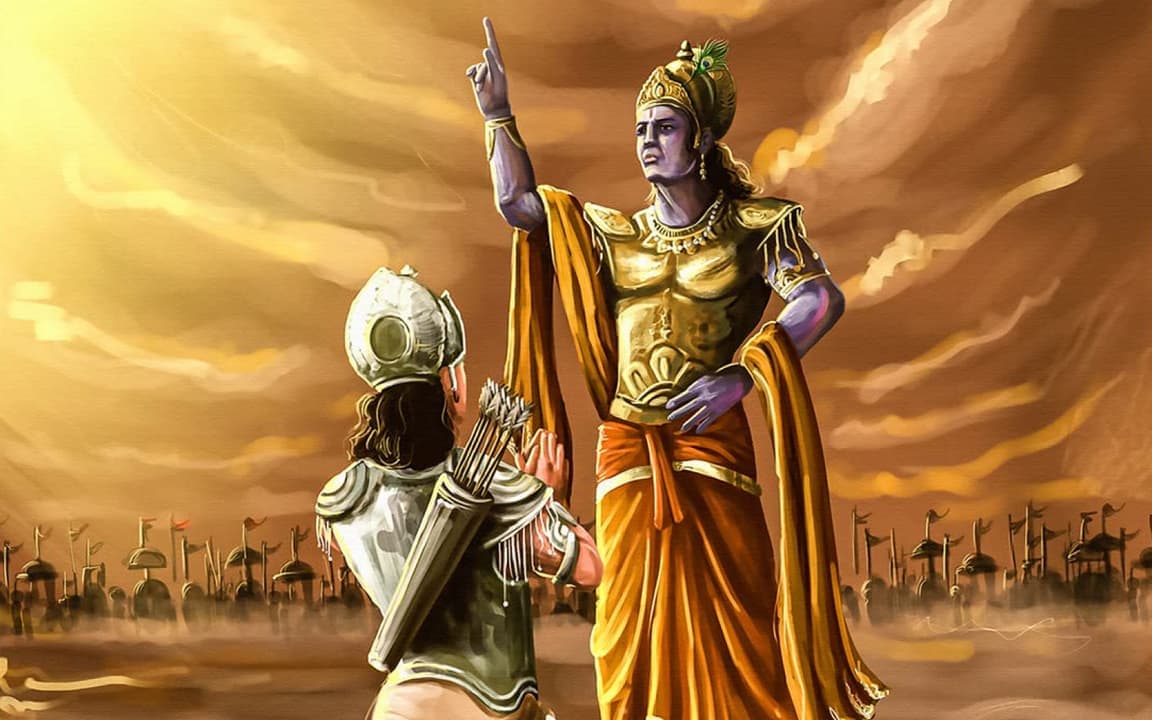
The Bhagavad Gita tells us how to respond when challenged with wars. Arjun was not merely instructed by Shri Krishna to fight, but to fight with clarity — free from fear or resentment. The Gita’s core teaching is: the right action must be based in wisdom — to understand the situation with clarity, rather than respond impulsively.
1
"Cult means personality worship. Where the entire teaching is that personality is false and the Self is truth, where will personality worship come from? And there is nothing in my personality worthy of personality worship. If one wants to worship like that, there are many standing in line whose entire job is to polish their personality.”
Ignorance is not about not having some particular knowledge. Ignorance is not an absence; ignorance is having knowledge. That which your mind is full of is ignorance. Ignorance is your basic sustenance. In such a situation, this utterance, “In reality, you are the One,” I repeat, must not be taken as the Truth in the sense of an affirmation. It is a method to help you drop that which fills you up. All it is telling you is this: “You are an entire universe sitting in your mind; you are not that.”
Our definitions of beauty and greatness are all egoistic. Something is beautiful if it corresponds with our likes and with our taste — then we call it beautiful. Whereas the real definition of beauty is that which silences you, that which does not leave you even in a position to utter a "Wow!" That's beauty. That which takes you beyond yourself — that's beauty.
The wish remains unfulfilled because that which we want by extending our dead life cannot be had through extension. It can be had only through termination of the dead life. So our ways are stupid. That which must be terminated is rather extended by us. We need to give death to death. This dead life needs to be brought to death, and then you will give death to a dead life, death to death, which is good. Instead we keep trying to prolong the dead life. And if you are prolonging a dead life, you are only prolonging the death that you are living.
We never know the total. The mind, the senses, the grasping power are all limited. The total is available to you, but not through the root of intellectualization, not through the root of causation. The total is available in silence, in noise, in movement, in appearance, in grasping, in holding, in intellect. When you are still, then that which is to be known is known just by itself — without reason, without cause, without preparation, without desire.
1
Truth enlightens, so it is attractive. Maya enthrals, so it is sometimes even more attractive. Where to go — that is the battle.
Overview
Fighting Duryodhana is Dharma. Fight Duryodhana in the way you can, that is swadharma. Dharma is the same for everybody, but swadharma varies according to your physical, social, temporal conditions.
But remember that swadharma can never be in contradiction of Dharma; swadharma will always be something…
Acharya Prashant: You will see that I'm repeatedly stressing on Shri Krishna as the demolisher, on Shri Krishna as someone who not only does not accept our prevalent definitions of right-wrong, true and false, humility, authority, right action, non-violence but, in fact, unabashedly and actively demolishes them. It is one…
1
Liquor consumption or flesh consumption or other kinds of unwise gratifications of the body, merely increase the obstacles that one faces. So, therefore, those kinds of things must not be practiced — even if it is observed that a realized man is practicing them.
Questioner: “Acharya Ji, my whole life, I treated sex as fun due to my early age experience. I would treat it as fun-just to relax my body. But now, at my mature age, I feel that it’s a responsibility to have a son or a daughter for humanity, to strengthen…
There is enough scientific evidence that says if the average global temperature exceeds 1.5 degrees centigrade above pre-industrial levels, it could trigger massive feedback loops — self-sustaining and irreversible climatic phenomena. There is evidence that the average global temperature rise has already reached 1.7 degrees centigrade. This operation is a voice against an impending catastrophe — a catastrophe that the younger generations are going to face the brunt of.
1
Acharya Prashant (AP): Great things are happening on the screen, don't get so excited, it's just the screen. Irrespective of what happens on the screen, it's not real. That's how you have to look at things. Great silence on the screen. Is it silence? No, it is the silence of…
Jesus is not a hater of persons. He is saying hate the way you have become. The Bible is not a document of hate, the central message is of Love. But when we love, we chain each other. When God loves us, He sets us free. So Jesus is saying to hate the way we relate to each other — because our love is not Godly. Love each other just as God the Father has loved you.
Your role models are unworthy people. They're your role models only because you aspire to consume as much as them. Notice how they either display their ability to consume or they present themselves as stuff to be consumed. So, when consumption is the ideal that we have been taught, the result is catastrophic like climate change. So, don’t just be driven to anything that appears attractive; choose your role models very carefully.
The United States has contributed approximately 25% of cumulative global greenhouse gas emissions since 1850, despite comprising only about 4% of the world's population. This exemplifies climate injustice, where wealthier nations emit the majority of carbon emissions, while poorer countries endure the most severe impacts.
They don't contradict each other. Existentialists like Sartre argue that humans cannot suppress consciousness and are 'condemned to be free.' We are born without a predetermined purpose—existence precedes essence. You exist first and must then discover your essence. In the spirit of 'Neti Neti' (neither this nor that), no external force can define your essence; it is your freedom to consciously determine what life is for.
That's the wrong relationship that the world is choosing to have with an unwise man. If you are to respect, you have to respect someone who is wise and who can bring his wisdom to your use. Instead, if you choose to have a relationship of respect with someone who is himself unwise, obviously, he can be of no use to you. So again, it's a failure of relationship—something is misplaced. Respect is something that has to be placed at the right point.
1
The question should be which one is relevant to you? What will you do by enquiring about Shri Krishna’s grace? That’s Shri Krishna’s prerogative, right? Shri Krishna will take care of his grace if he has to offer grace. Whatever he has to do, we do not know what grace is. We do not know who Shri Krishna is. How does it concern us to go into matters of his grace? What is it that’s in your control? Your own preparation, your own willingness. So, you take care of that.
So 'know', don’t try to know about Shiva. Shiva is not furniture. Shiva is not a tree. Shiva is not a cloud, not even the sky. How will you know Shiva? Do you know of anything that has no shape, no form, and is eternal? How will you know Shiva? But know, do know. What can you know? This world and yourself. Know that. That knowing is Shiva-ness. Shivatva.
The Gita is useful because its setting is extremely relatable. Just like us, Arjuna does not know himself—he's a victim of multiple identities and all kinds of conditioning. Therefore, the Gita is about letting Arjuna know who he is, and this illumination enables him to do what he must. So, first of all, see that you are Arjuna. Then, step by step, verse by verse, there will be some resolution.
And you can extend this observation to all the things in the world in the sense of our relationship with them. If we are highlighting something in this world, chances are we are going to destroy and distort it. We do not highlight things because they are virtuous or truthful. The ego does not want virtue. The ego has nothing for the truth. For the ego, its own security and preservation come first.
Some say 'God', others say 'Allah', and some say 'Ram'; all three refer to the same entity. If a name or sound reminds you of the nameless one, it's wonderful. The problem arises with self-appointed meanings. The purpose of religion is to convey the truth, not obstruct it. You have a variety of flutes, but there is one music. Religion is that music.
देवान्भावयतानेन ते देवा भावयन्तु वः।
परस्परं भावयन्तः श्रेयः परमवाप्स्यथ।।
~ श्रीमद्भगवद्गीता, अध्याय 3, श्लोक 11
अर्थ:
यज्ञ से देवताओं को आगे बढ़ाओ, तो वो दैवत्य तुम्हारी उन्नति करेंगे। इस तरह परस्पर (आपस में) उन्नति करते हुए तुम परम श्रेय प्राप्त करते हो।
काव्यात्मक अर्थ:
*यज्ञ से देवत्व बढ़े
देवत्व से…
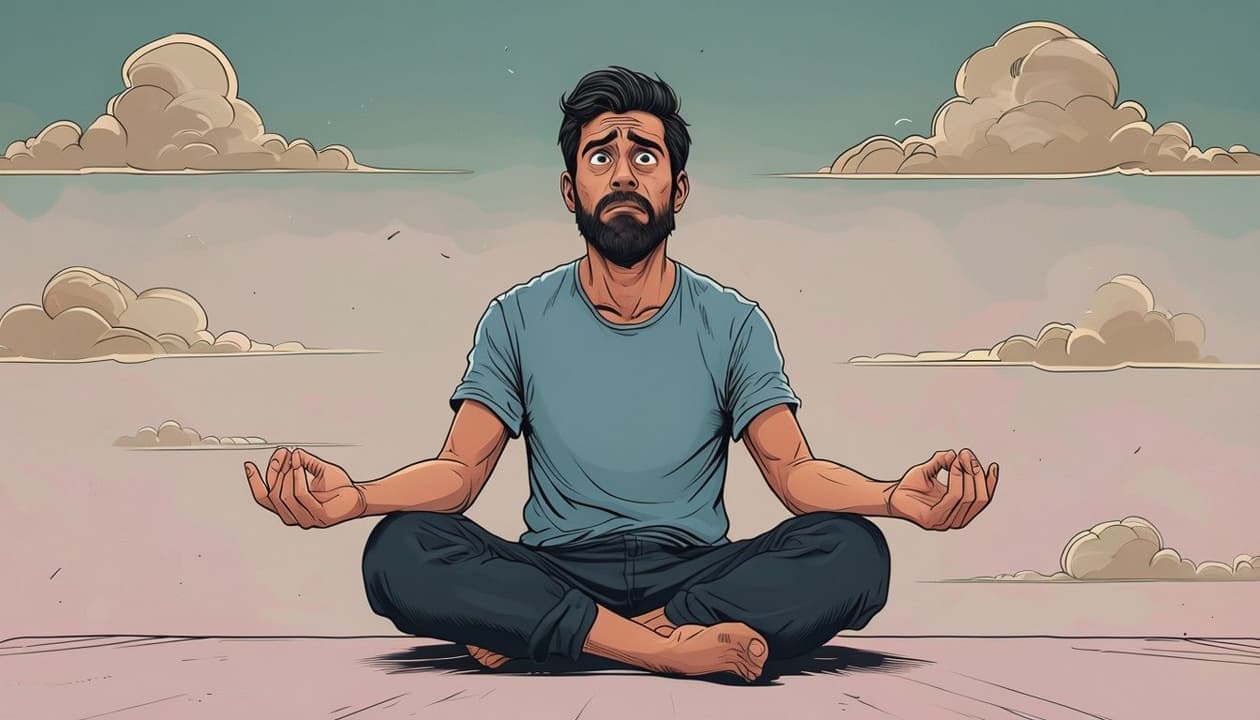
Meditation is the submergence of the ego in its essential nature. It is at the root of all self-knowledge and wisdom. However, most often, what we call meditation is just escapism—using some ‘method of meditation’ to superficially soothe our restlessness or gain temporary and deceptive relief from stress.
True meditation…
2
If all that the Ego wants is liberation from itself, which means coming to see its own non-existence, then the only way to see its non-existence is by paying attention to itself. The more the Ego pays attention to itself, it sees that it does not exist. The more the Ego remains attached to this and that, all the sensory inputs, the Ego feels that is real and this is real.
3
The word for a Guru does not really exist in the English language. So, they have borrowed Guru itself, Guru. But they have borrowed the word Guru and rather misunderstood it and misapplied it. So, anybody who seems to be an expert at anything, can be justifiably called a Guru in the English language. Now that's not the proper usage in spirituality or in Sanskrit.
In modern times, reading and respecting the Shastras is often seen in a derogatory light. An Asura disregards the scriptures, saying, “What I know is right. My own experience determines the Truth,” rejecting them because they will not allow him to do what he wants. We have come to a point where we are not merely ignoring but actually insulting the scriptures. If you're sincere about knowing life, why avoid a document with deep insights into it?
7
'The observer is the observed; an honest observation dissolves them both.' Or, 'The observer is the observed, and both are false.' We lay a lot of emphasis on the world, assuming it to be the Truth. If the world is an entity independent of everything, then it has to be the Truth, right? Truth is that which is independent of everything.