Originally published in the The Sunday Guardian on 15 mar '25.
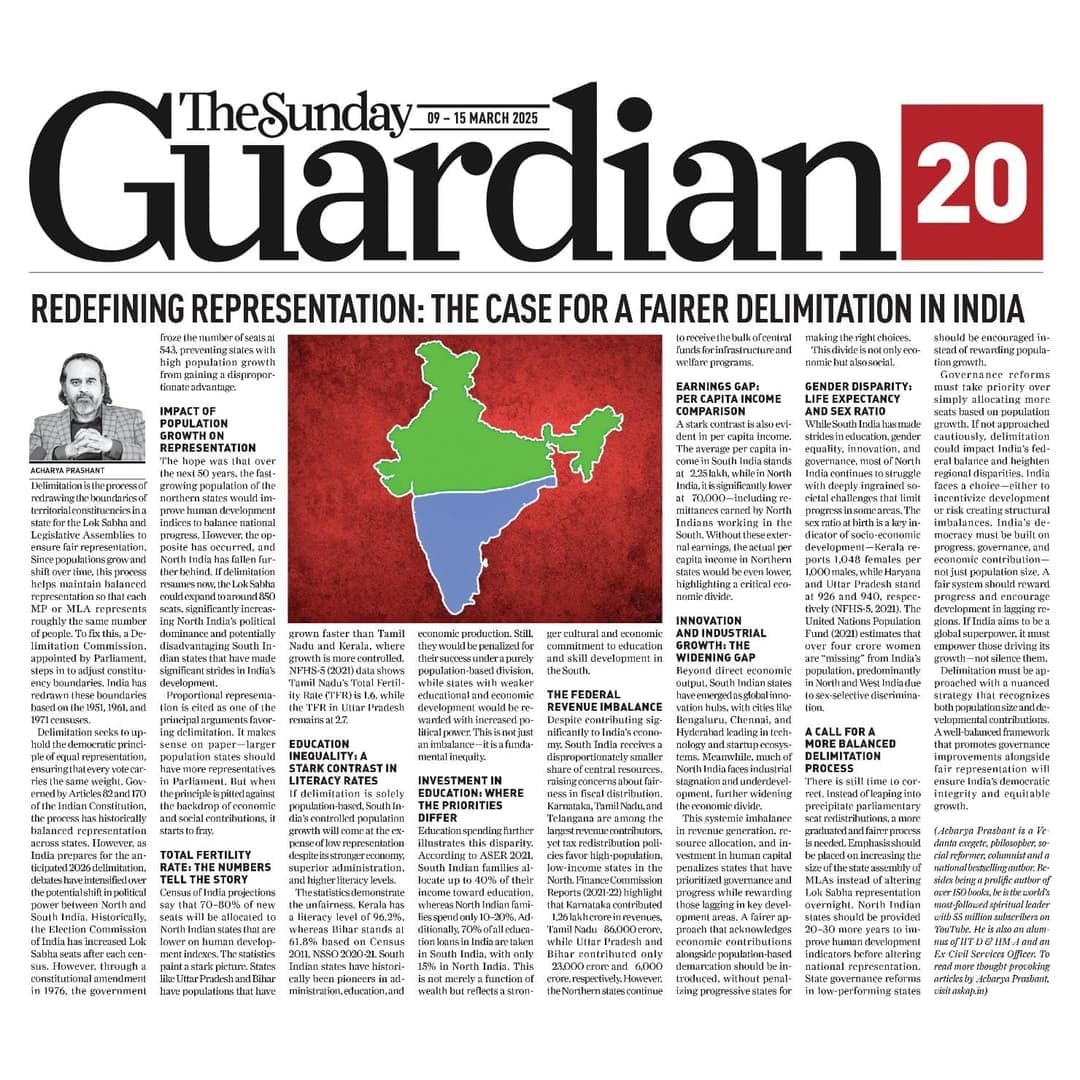
Delimitation is the process of redrawing the boundaries of territorial constituencies in a state for the Lok Sabha and Legislative Assemblies to ensure fair representation. Since populations grow and shift over time, this process helps maintain balanced representation so that each MP or MLA represents roughly the same number of people. To fix this, a Delimitation Commission, appointed by Parliament, steps in to adjust constituency boundaries. India has redrawn these boundaries based on the 1951, 1961, and 1971 censuses.
Delimitation seeks to uphold the democratic principle of equal representation, ensuring that every vote carries the same weight. Governed by Articles 82 and 170 of the Indian Constitution, the process has historically balanced representation across states. However, as India prepares for the anticipated 2026 delimitation, debates have intensified over the potential shift in political power between North and South India. Historically, the Election Commission of India has increased Lok Sabha seats after each census. However, through a constitutional amendment in 1976, the government froze the number of seats at 543, preventing states with high population growth from gaining a disproportionate advantage.
Impact of population growth on representation
The hope was that over the next 50 years, the fast-growing population of the northern states would improve human development indices to balance national progress. However, the opposite has occurred, and North India has fallen further behind. If delimitation resumes now, the Lok Sabha could expand to around 850 seats, significantly increasing North India’s political dominance and potentially disadvantaging South Indian states that have made significant strides in India’s development.