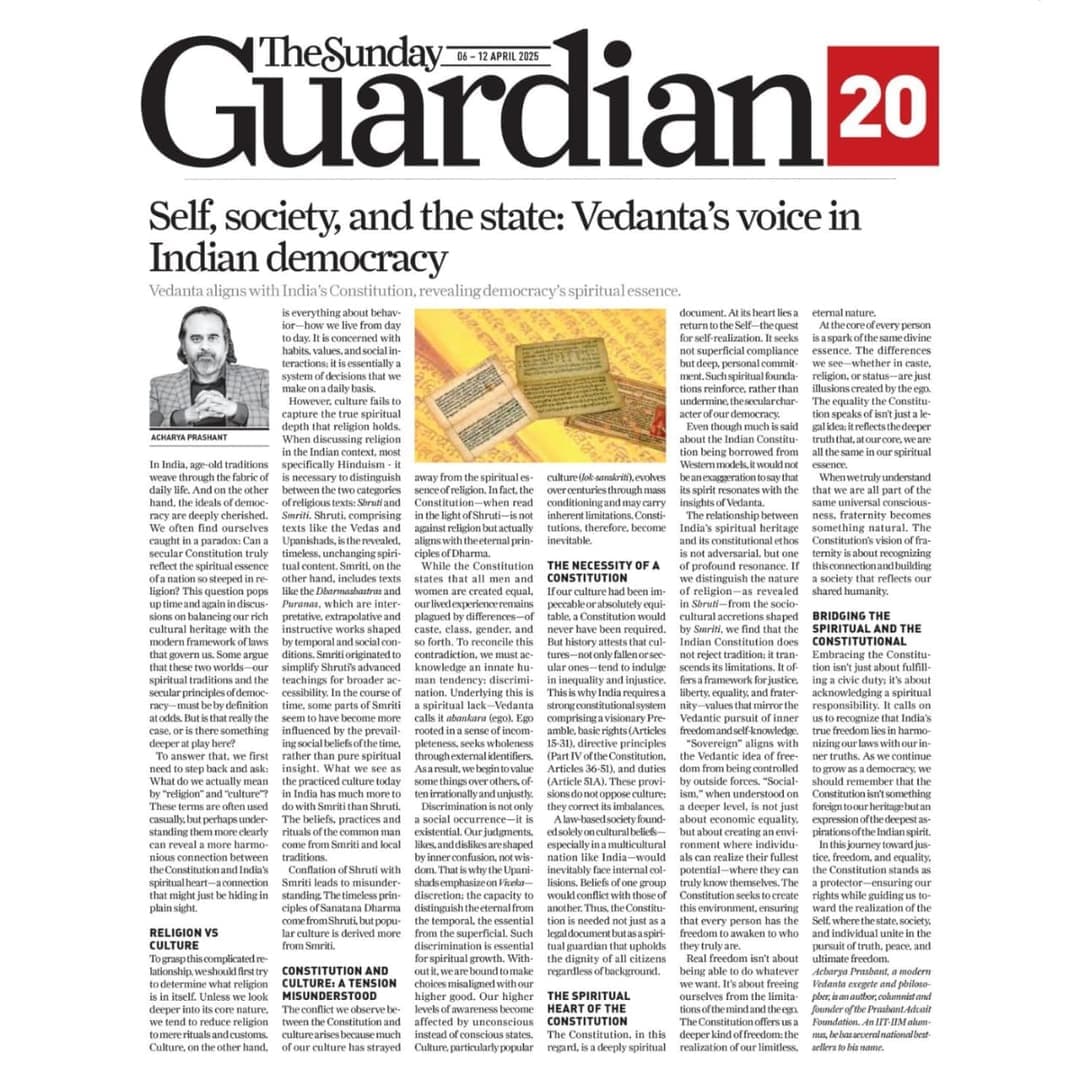
Embracing the Constitution isn’t just about fulfilling a civic duty; it’s about acknowledging a spiritual responsibility. It calls on us to recognize that India’s true freedom lies in harmonizing our laws with our inner Truth. As we continue to grow as a democracy, we should remember that the Constitution isn’t something foreign to our heritage but an expression of the deepest aspirations of the Indian spirit.
This summary is AI-generated. Please read the full article for complete understanding.
Originally published in the The Sunday Guardian on 12 apr '25.
In India, age-old traditions weave through the fabric of daily life. And on the other hand, the ideals of democracy are deeply cherished. We often find ourselves caught in a paradox: Can a secular Constitution truly reflect the spiritual essence of a nation so steeped in religion? This question pops up time and again in discussions on balancing our rich cultural heritage with the modern framework of laws that govern us. Some argue that these two worlds—our spiritual traditions and the secular principles of democracy—must be by definition at odds. But is that really the case, or is there something deeper at play here?
To answer that, we first need to step back and ask: What do we actually mean by “religion” and “culture?” These terms are often used casually, but perhaps understanding them more clearly can reveal a more harmonious connection between the Constitution and India’s spiritual heart—a connection that might just be hiding in plain sight.