Acharya Prashant: When the body dies, the body dies. The enlightened one has died far before the body dies. So there is nobody remaining to die along with the body, or to fear the death of the body. The enlightened one is gone in his lifetime. The psychological self, the ego-self, is no more. And that is what you symbolically call enlightenment. So enlightenment is an inner death before the outer physical death.
Listener: What is in between? When enlightenment happens and then the body dies, in that time.
Acharya Prashant: There is no “you.” There is just the body. There is just the body, the limbs, the brain taking care of the physical survival, because the physicality is all that has remained in the name of the person. And because physicality is now not being driven by a petty ego-self, hence it is integrated with something far larger.
So between the so-called enlightenment — the inner death, and the physical death is a period of no-oneness. One is no one. The activities continue, but they do not continue anymore for the protection, nourishment, or continuation of the little being we otherwise so feverishly protect.
What kind of activities continue? That is totally unpredictable. As long as there is someone concrete, definite, still alive, still remaining, still eager, anxious, you can predict him. His goals are so very old, clichéd, pattern-based, deterministic. You know what he is going to do. If the ego is alive, you very well know what the person is going to do. He is going to strive for the protection of the ego. He will say — this is me, this is my family, this is my community, this is my nation, this is my ideology, this is my personal wealth, this is my house, this is my religion, and I need to protect all of them and further them. So it is very, very predictable.
Before the inner death occurs. The life of the person is very predictable.
You may not be able to forecast in advance the exact details, but the broad contours you can be very definite about them. They are inviolable. If the person is there, he will get angry. If the person is there, he will get anxious. The person will be afraid. The person will have likes and dislikes. It is all so predictable. The person would have a past to get his identity from and a future to build.
You can look at anybody randomly and with great sureness say, “This fellow gets angry.” That is how predictable the ego is, because you know there is nobody who does not get angry. You can look at anybody just randomly and say, “I know something about him.” And what is it that you know? He is insecure. Because you cannot be ego-self and not be insecure.
So life before the inner death is predictable. After the inner death nothing can be said, because all that which could be said was necessarily about the ego, and now the ego is gone. Even if you want to talk, whom would you talk about? So there is nobody to talk about. A great void remains, a great void of which there can be no description, no mention, no contours, no beginning, no end, no boundaries, no color, no here, no there. Therefore you just do not know what life post the inner death is. And that exactly was your curiosity: you wanted to know what happens between enlightenment and physical death. You wanted to know what happens between the inner death and the physical death. Nothing can be said. Yes, a lot can be said about what happens prior to the inner death. A lot can be said.
Man chases woman. Woman chases man. A fellow gets jealous. A fellow gets hungry. A fellow is ambitious. A fellow is hopeful. A fellow is disappointed. All that can be said. The life of any individual can be summed up within these few words: hope and despair, happiness and sadness, achievement and failure, likes and dislikes, friends and enemies, this and that, here and there, within and without. So it’s all very predictable and therefore boring, and therefore deathlike.
So before the great inner death, life is actually quite dead because it is predictable; and that which is predictable is boring, and that which is boring is not lively, and if it is not lively, then it is dead. So before death you are dead. Oh! That's too bad. So if you want to avoid a dead life you will have to die. Which death are we talking of? The inner death.
So it’s a quandary. When you think that you are alive, you are actually dead. And when the inner death happens, then life begins. But when life begins, there is nobody who is living the life — there is just life. As long as there is somebody who is living, as long as there is somebody who is alive, then life is very, very deathlike. As long as there is somebody who is alive, life is just deathlike. And when there is nobody who is alive, life begins. Now there is life, beautiful life, blossoming life, full life, complete, lovely. Just that there is nobody to claim, “I am alive.” Now life is there; the living one is not there. So there is quite a procure, you can’t have both.
Now, which one do you want? The alive one, who is alive but as good as dead, or a lively life, which is complete in all aspects but lacks just one thing — the living one.
There are most people who make the wrong choice. They say we may not have life, and that is acceptable, but we want to maintain the living one. And who is this living one? The ego — the little petty dead thing. They say, “We may not have life, but we want to be able to keep claiming that the living one is there, that the ‘I’ is alive.” So they keep the ‘I’ alive and in the process, lose life itself. There is a definite trade-off. You need to choose: what do you want? Do you want life, or do you want to keep the ‘I’ alive?
That right choice made again and again; that right choice irreversibly committed to — is called enlightenment. When you are so very committed to life that you no longer bother for the ‘I,’ that’s when you can say the fellow is well enlightened.
Enlightenment is death and therefore we are very, very scared of it. But after death, life begins.
The dead ones are afraid of life. And what do they say? “Oh, we are living and we are afraid of death.” See such self-deception: actually they are dead, and they are afraid of life, but see what they claim; what do they say? “We are alive and, you know, death scares us.” Are you alive in the first place? And Prasanna (Listener’s name) claims it’s his birthday today. Prasanna, how many years of life so far? Good. That should be the approach. What did he say? Zero.
If you are not yet dead, what is the point in counting the number of years of life? That count then is not of the number of years lived. That count then represents the number of years wasted. That count then represents the number of years you have needlessly wasted in the graveyard or in the womb because you are not yet born. You could either say you are dead or you could say not yet born. But one thing is certain. You cannot say I’ve lived for so many years; it’s a false statement intended just to entertain the ego.
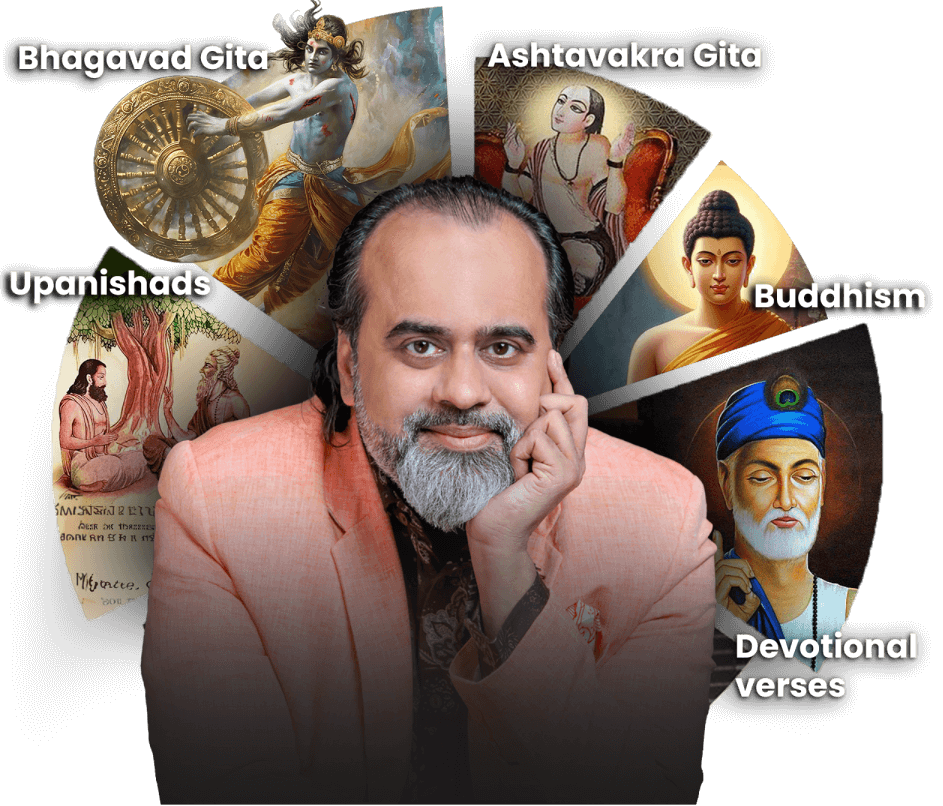
And that’s why the saints have celebrated the great death so much. On one hand they sing of Mukti, and on the other hand they sing of Mrityu. In fact, they have sung as much of Mrityu as they have sung of Mukti. And that’s the task for you for tonight: figure out at least ten verses from Kabir Sahib and other saints that sing of Mrityu and see how they rejoice in the great death. And now you also know why enlightenment is not for everyone — because death is not for cowards. That great death is only for those who not only do not resist it but actually work hard to attain it. The common man runs away from death. The seeker of freedom runs after death. That’s the difference. He not only welcomes death, he not only is non-resistant to death, he actually chases death. That kind of courage, sheer craziness.
Listener: Why do people want kids?
Acharya Prashant: You extend this discussion into that and you will see. The dead one wants life in a second-handed way. You could say a vicarious life, a second-hand life.
Mukti is when you stop looking at the future for fulfillment. Mukti is when you stop looking at others for fulfillment, when you stop looking at the body or the world for fulfillment. And so it is obvious that if you do not have Mukti you will look at time for fulfillment. You’ll say, “Fulfillment will come to me in the future.” You’ll say, “Fulfillment will come to me through the body or through the world.” You are not alive. You are living a predictable, boring, and dead life, and you don’t have the guts to embrace life through the great inner death. So you try a backdoor entry into the great palace of death. You say, “Maybe I can get that great joy that comes through enlightenment or Mukti by having kids, by extending myself into the future.”
Remember that if you are not yet fully born, if you are not yet Mukt, If you are not yet liberated, then death is a great scare. And when you look at your body, you very clearly see that the body is going to perish. And so what do you do? You then depend on the bodily mechanism, the reproductive tendency, the Prakritik urges to somehow try to beat death. And how do you want to beat death? By having kids.
When you do not have the real joy of life, then you try all these stupid means to feel a little fulfilled, to get some flavor of what immortality, timelessness, and liberation really are. And you do get a flavor. It is not as if your attempts go totally unanswered. All material, the entire world, all the bodily and the worldly things and processes are capable of giving you a glimpse of liberation. But then that is all that you get, a glimpse. You get a great lover and in a moment of physical intimacy you may get some glimpse, but that glimpse is an invitation to something far bigger. That glimpse is there so that you go beyond the glimpse and enter the real thing.
Otherwise that glimpse is just a teaser. It teases. It will irritate you. It will frustrate you because you have had the taste, because your nostrils have smelled the dish, and yet you cannot have the real thing, the dish in its fullness. All you have is some aroma, and the aroma frustrates you all the more, does it not?
So when you use your body, your intellect, your knowledge, the world, all that which material existence offers you to get happiness or pleasure, you do not fully fail. You succeed a little. Don’t you find people happy? They are often happy. Not only are they happy, sometimes they are ecstatic.
Somebody has been trying to achieve some success in academics or business for a long time, and he indeed does achieve. It happens, and he is euphoric. But that euphoria is a teaser. As we said, it does not last. It came to you so that you would say that if the teaser is so tempting, how wonderful the real thing, the total thing would be. If the teaser does not take you to the real thing, then the teaser, we said, is a big frustration. And that is how the life of most people is: happiness and success followed by lots of frustration.
You need to see that behind all these activities that are apparently desperate and not connected to each other, there is just one human wish, the wish to gain a joy that is unbounded, unending, undefined, unlimited. Whether you want academic success or success in politics or sports or business, whether you want a new house, a new person, a new book, or whether you want to travel to a new planet, or whether you want a new baby in your arms, the wish is the same. And what is the wish? Liberation, fulfillment, Mukti.
The wish remains unfulfilled because that which we want by extending our dead life cannot be had through extension. It can be had only through termination of the dead life. So our ways are stupid. That which must be terminated is rather extended by us. We need to give death to death. This dead life needs to be brought to death, and then you will give death to a dead life, death to death, which is good. Instead we keep trying to prolong the dead life. And if you are prolonging a dead life, you are only prolonging the death that you are living.
Neither gold nor knowledge, no reputation, no relationships, and not even parenting are going to give you that which can come through only the direct and honest route. If life is boring and you think that you can bring some liveliness, some spice to it by having a kid, you are being utterly dishonest. What is more, you are being very exploitative towards the kid.