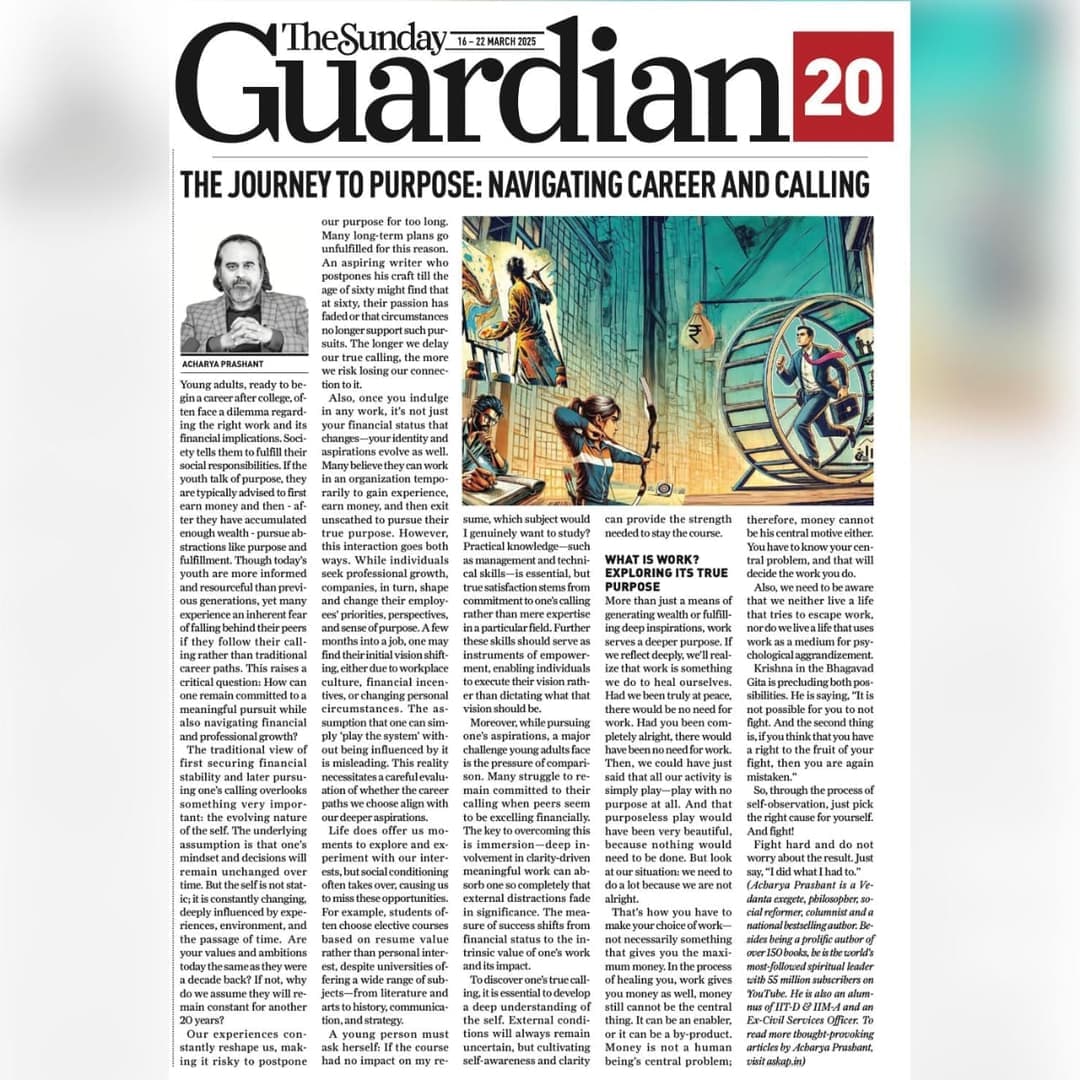
The traditional view of securing financial stability before pursuing one’s calling overlooks something very important: the evolving nature of the self. Therefore, it is risky to postpone our calling for too long. Many long-term plans go unfulfilled for this reason. The longer we delay our true calling, the more we risk losing our connection to it because the passion may have faded or circumstances may no longer support such pursuits.
This summary is AI-generated. Please read the full article for complete understanding.
Originally published in the The Sunday Guardian on 22 mar '25.
Young adults, ready to begin a career after college, often face a dilemma regarding the right work and its financial implications. Society tells them to fulfill their social responsibilities. If the youth talk of purpose, they are typically advised to first earn money and then – after they have accumulated enough wealth – pursue abstractions like purpose and fulfillment. Though today’s youth are more informed and resourceful than previous generations, yet many experience an inherent fear of falling behind their peers if they follow their calling rather than traditional career paths. This raises a critical question: How can one remain committed to a meaningful pursuit while also navigating financial and professional growth?
The traditional view of first securing financial stability and later pursuing one’s calling overlooks something very important: the evolving nature of the self. The underlying assumption is that one’s mindset and decisions will remain unchanged over time. But the self is not static; it is constantly changing, deeply influenced by experiences, environment, and the passage of time. Are your values and ambitions today the same as they were a decade back? If not, why do we assume they will remain constant for another 20 years?