A young athlete says she knows she should not be attached to winning, yet she is, because her coach, family and country are invested in it. Wanting to win on the court is fine; that is what a contest is for. But we never know who the next opponent will be, and the one opponent always present is ourselves. She also fears that starting at 14 was too late. The past is fixed, so what is left is to play the cards we are dealt. Where does our real contest lie?

Many Indian parents keep their children, and especially their daughters, away from sport, even where coaches and facilities exist. The barrier is often not outside but in the parent’s own ideas: poor returns, uncertainty, and fixed notions of what a girl’s life must be. Blaming our own parents does not help either; our life is now our responsibility. Parenting is a decision of the greatest responsibility, and it begins with self-love. Can we love a child if we cannot love ourselves?

Many of us promise our parents high marks, and when the result falls short, the guilt can feel heavier than the exam itself. But no one controls results; they depend on far too many things outside us. What is in our hands is our intent, our effort and our honesty with what we study. The Bhagavad Gita says the same: our right is to action alone, never to its fruit. What if the only promise we made was to study honestly and with love?


We often defend a bad choice by pointing to a worse one: stay dishonest or starve, keep the wrong grip or stop playing. But the real trouble is not the option we picked. It is the option we never let ourselves see. Action does not need greed or attachment to find its energy. The third way begins by rejecting both false choices, without knowing what comes next. Which of our everyday choices are really false dilemmas?

True freedom begins when we question the beliefs that make us feel trapped. Most of our suffering comes not from circumstances but from unquestioned assumptions, attachments, and imagined obligations. By suspending our beliefs, even briefly, we allow truth to enter, revealing that life always offers choice. Transformation is born from love for truth, the courage to let go, and the willingness to step beyond the boundaries created by the ego.

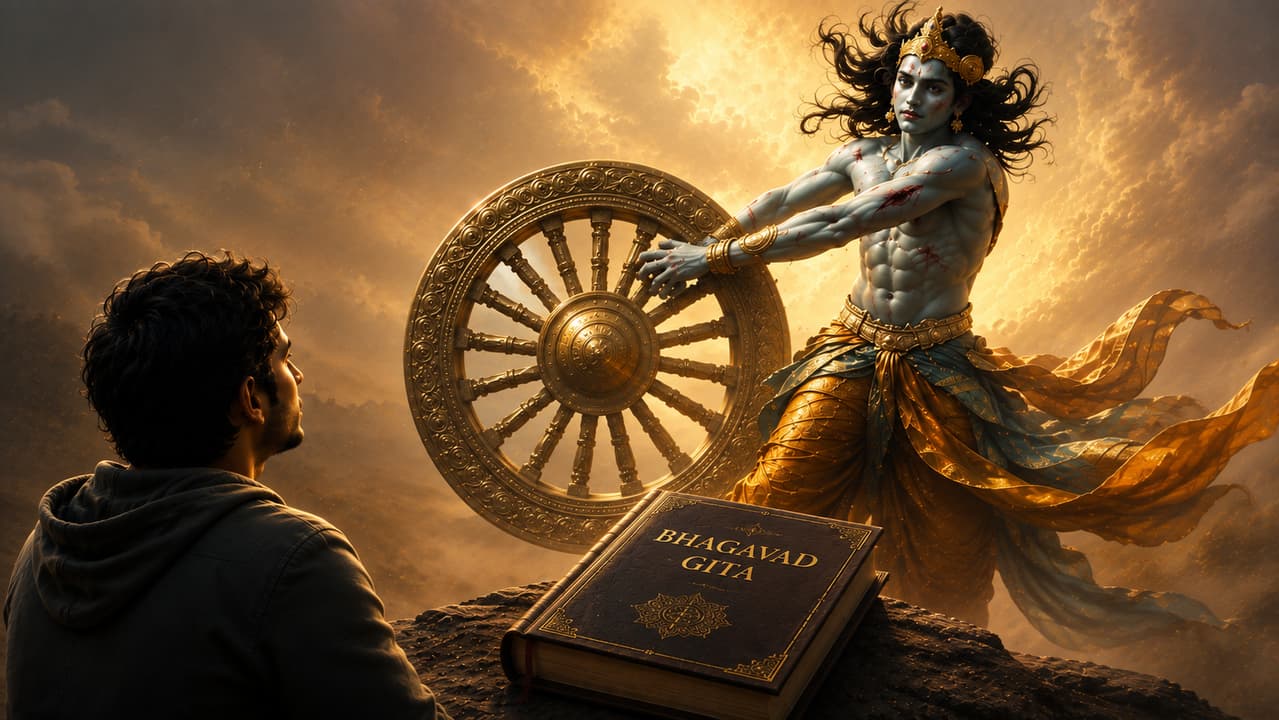
The Bhagavad Gita deserves reverence not because of inherited beliefs about its author, but because of its power to dissolve falsehood and reveal Truth. Real devotion is not ritual or blind faith—it is understanding, inquiry, and living the wisdom of the Gita. Through sincere study, one discovers the true meaning of Krishna, making the Gita the most authentic path to knowing and worshipping Him.

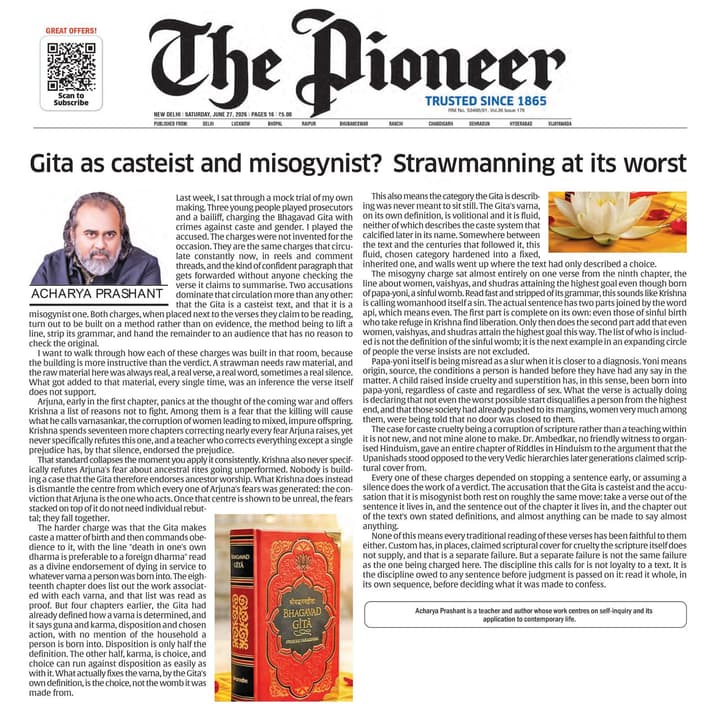
The Bhagavad Gita is often accused of supporting caste and misogyny through selective quotations that ignore context, grammar, and the text's central teachings. A closer reading shows that its emphasis is on inner qualities, conscious action, and spiritual equality rather than birth-based hierarchy or gender discrimination. Misinterpretations arise when isolated verses are detached from their broader meaning, while the Gita consistently points toward self-knowledge, freedom from ego, and the universal possibility of liberation for every human being.

Real change begins not by changing the world alone but by understanding the one trying to change it. Laws, technology, policies, and scientific progress have value, yet they cannot solve problems rooted in human consciousness and endless desire. Truth remains the same across cultures and disciplines, requiring only a change in language, not in essence. Lasting solutions emerge through honesty, self-inquiry, and inner transformation, because no external system can replace a change in the human mind.

The mind is not an independent entity but a structure built and maintained by the ego through thoughts, memories, beliefs, and experiences. Most spiritual practices fail when they become distractions from examining the ego itself. Experiences, emotions, and preferences are often conditioned and unreliable. Real inquiry begins with observing the experiencer, admitting facts without distortion, and applying the same rigor to inner life that science applies to the external world.

Operating from the highest inner point means living with honesty rather than self-created illusions. The ego becomes “higher” not through mystical growth but by dropping false self-images and testing its claims against reality. When honesty weakens, lower motives take control, creating inner conflict and disorder. Real growth lies in continuously questioning oneself, facing uncomfortable truths, and preventing the ego from being driven by comforting but deceptive beliefs.

The climate crisis is not merely an external environmental problem but a reflection of inner human greed, desire, and psychological disorder. Drawing from the Gita’s idea of yagya as desireless action, it says real ecological healing requires inner transformation. Outer pollution, exploitation, and destruction mirror the ego’s inner confusion, making personal consciousness and planetary health deeply inseparable.

Question: A gentleman was saying that a person, who is drinking or is drunk, he still has got some kind of stability on mind, and he too, can judge. That is what I felt to be perhaps wrong. A person who is drunk probably loses his judgement and whatever we…

Superficiality offers pleasures. Superficiality offers cheap salvation. Therefore, it is easy to be attracted to superficiality. On the other hand, true spirituality challenges you to pay a heavy price. So, you see, all this knowledge has existed since antiquity. Yet there are people who do not want to read the Gita.

There is no revolution possible without the Gita. That’s the reason why even those who are not remembered particularly for their spiritual inclination, people like Subhash Chandra Bose, even they founded their core on Gita. What kind of revolution can you do if it’s the body that’s always at the top of your mind? You require a Gita to tell you that this body is perishable and would anyway go. Gita only teaches you, "Endure and fight."

Shri Krishna is saying: the mind is conditioned to move towards objects and perceive only their surface, periphery, or form. Develop the practice of penetrating further. Let Truth be your practice. The moment you would look at something, and you are in no position not to look at things being embodied, you would look at things. Nobody said that you have to practice lust. Lust just comes. You might be a total fool, an utter retard, and still you will find yourself getting sexually excited once you reach a particular age. Did you need some practice? No, you didn’t. It just happened. But if you are to understand lust, if you are to cross over, if you are to be a master of your body, then it will require a lot of practice, and that will necessarily and obviously tell you about your predicament.

“Immersing myself in deep meditation.” What do you mean by meditation? And who is being immersed? Please tell me, beyond a trick of words, what is this? But you’ll never ask these questions, because some Baba-ji totally dominated your faculty to question with his get-up and demeanour. Real spirituality is not about something that sounds elevated or respectable. Whenever you are bombarded with high-sounding fluff, learn to ask this question; what exactly does that mean?

That’s what the entire spiritual process is about, collecting the airfare. So that you can rise up, otherwise, you stay crawling on the highway. Life is not so that you just remain a crawler, a creeper. Life is so that you can take off.

This breath-in, breath-out, stomach-in, tummy-out; this is not meditation. Even animals do not need training in breathing, and we are being taught how to breathe. What’s going on? You know, you should breathe mindfully. Why? Is there anything wrong with your breath? Meditation is nothing but an observation of the naked inner fact. That is meditation. To stand naked and honest in front of what is, that is meditation.

We teach our kids to write applications: “Humbly I beg to submit that today I have an ache in my tooth.” “Humbly I beg to submit!” If you are stating a fact, if the toothache is real, why the hell are you groveling? If that is the Truth, why are you begging? Drool, drool, drool. That’s become our culture. If your philosophy tells you to submit and surrender to several masters, you will never be a truthful person, because in Truth there is no authority but the Truth.

The other must exist in your life, and vice versa, only for the sake of internal elevation, to make you into a better person. Don't you see the impact the other one is having on your life? Seeing is the key. What does seeing mean? Seeing implies understanding. See and ask yourself: What is the impact upon me? And if you see that, you'll just push it aside. It will be spontaneous. You won't even require to think, because now you have seen.

Duality is Truth wanting to know itself. If there is no duality, what will the Truth do? Alone, absolutely alone. He too needs a partner. So, it divides itself into two. All our sufferings, all imperfections are important. There is no reason to feel small about it. Without you, how will the Source know what it is to fail, what it is to suffer? Indulge yourself fully, but remember what all this really is. Don’t forget that.

This in itself is a philosophical question. This is why you should study philosophy, because you already have this question. Philosophy is your affection for the Truth, your leaning towards the Truth. Don’t you want to know the Truth? How many of you are happy with lies? Nobody. So, it is this love for Truth that we all innately have; that’s called philosophy.

If you are in charge of a kid, then you have to be very sensitive, very careful, and loving. Just being with the kid in a loving way, not even having planned what to teach him, is sufficient. Instead of teaching kids, I have been learning from them, and they have given my ego great lessons by exposing me. No kid needs any training; we need de-training.

Drop the center of confusion, come to the center of clarity. Drop what the masses practice, come to the direct route of self-realization. That’s what it means.

In the rule books of the courts, there are offenses of a thousand kinds, but when it comes to life, there is just one offense, ‘Did you live by the Truth or did you betray it?’ Remember that chap called Bhagat Singh and his associates. The courts declared they were guilty, and they were still joyful because they were absolutely not guilty in front of life. Live rightly, and then don’t apologize. That’s it.

Some battles need to be fought just because they deserve to be fought, not for the sake of victory but for the sake of the fight itself. And victory is indeed possible. We are not fundamentally evil. We are all hypnotized since birth. That’s what is called Maya. Just as somebody can hypnotize us, somebody can also break the hypnosis. It is possible! Never, never lose Faith.

Our definitions of beauty and greatness are all egoistic. Something is beautiful if it corresponds with our likes and with our taste — then we call it beautiful. Whereas the real definition of beauty is that which silences you, that which does not leave you even in a position to utter a "Wow!" That's beauty. That which takes you beyond yourself — that's beauty.

The Bhagavad Gita, in essence, is a struggle of mukti (liberation) against sanskriti (culture). Shri Krishna urges Arjun to discard misogyny and cultural superstitions; the only thing that matters is mukti — liberation. Culture and traditions are time-bound; they hold meaning only when they point towards Truth — timeless, Sanatan. Have great traditions, and always be careful that your traditions are pointing towards the Truth. Only then do the traditions have life.

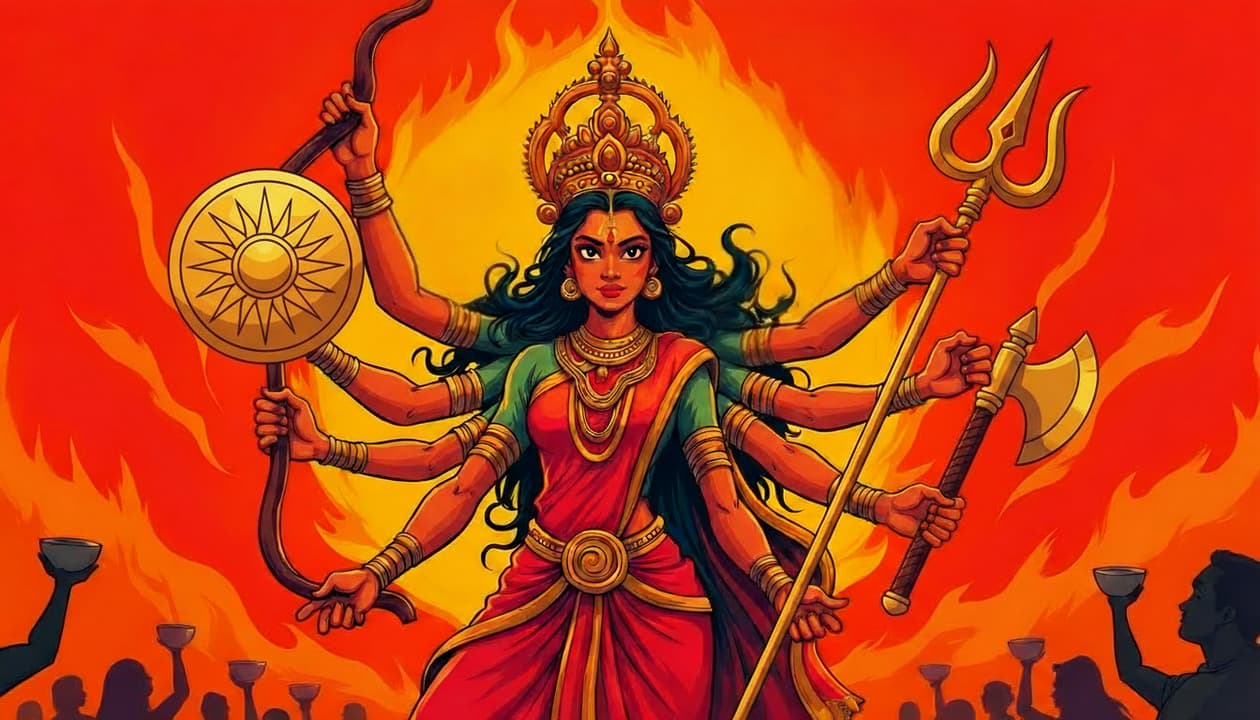
You are the subject, Puruṣa, and everything you can experience, perceive, speak, imagine, or think is Prakṛti. The only real spiritual question is to determine the right relationship between Puruṣa and Prakṛti. India came up with a beautiful answer: Worship Prakṛti with reverence, but do not try to possess or exploit her. The Shakti tradition with the Devi-puja is nothing but an answer to this question of right relationship. Durga, Ambika, and Kali — they all represent Prakṛti.
![Truth Without Apology [Book Launch]](https://cimg.acharyaprashant.org/images/img-db3ddbf9-ebdf-4baa-8b47-9373d316d478/30/image.jpg)
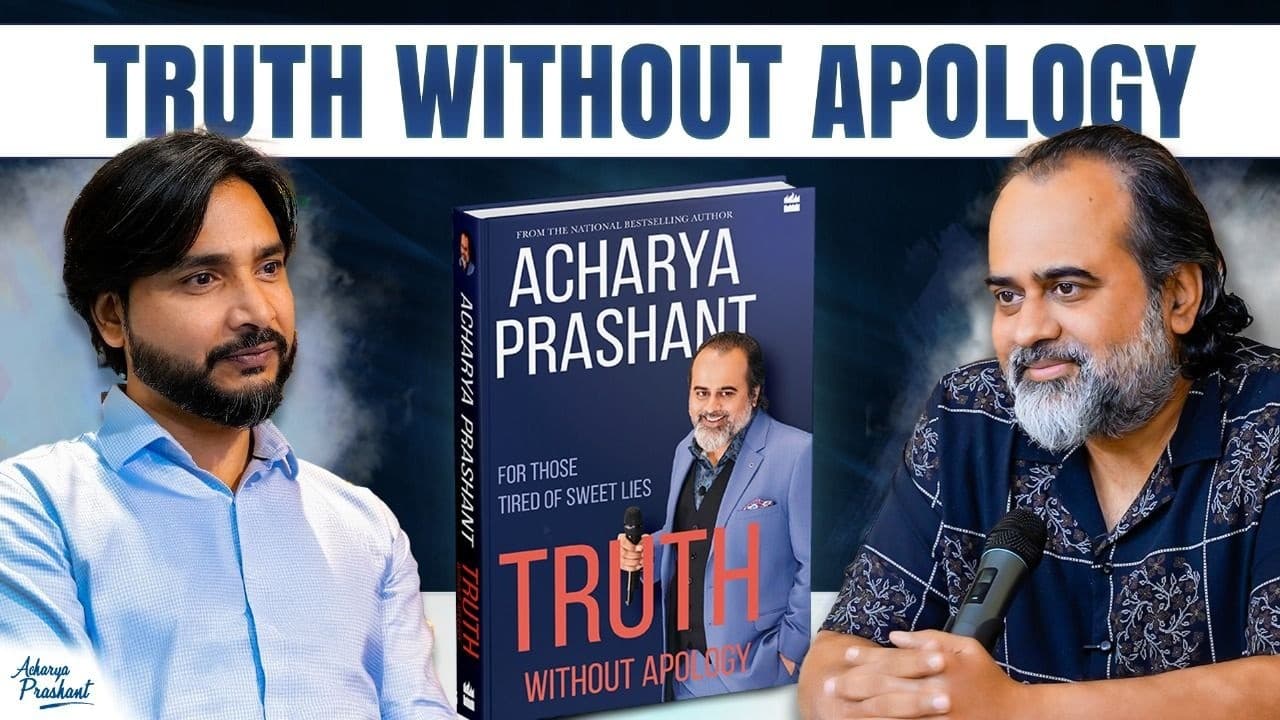
This evening in Delhi, a new book steps into the world—Truth Without Apology by Acharya Prashant. The launch takes place amidst seekers, readers, and companions of his work. In times when words are often polished to please and truths are dressed in comforting disguises, Truth Without Apology arrives like an uninvited storm—direct, raw, and uncompromising.

Life comes to us in an unending number of ways and you never know what's going to happen next. We are starved of something that really penetrates the surface. So, it is the intensity that this book brings — arrow-like depth, striking like lightning, immediately, so you don't have a chance to escape away from it. Like a Zen koan: very brief, very effective, and does its work in a snap. You could open just any chapter from anywhere and find it as if it was written just for you.

Because you underestimate Maya. Because maybe you are in the illusion that you have conquered, that you have left her way behind. Because probably you do not perceive that you too are still threatened. You feel, 'Oh, the thing is so easy, I overpowered it. Why is my dad not able to accomplish this simple feat?' Maybe it's actually so difficult that not only your dad is failing—even you have not fully succeeded.

The Truth is not a complicated puzzle. Everything is laid open, right in front of you. So, if it is not happening even now, then it is just because of your own mischief. We give preference to the trivial and miss out on the important. We drift from one thing to another, with no thing meaning anything to us. You are not missing the secret; you are missing the obvious.

When words arise from an honest observation of life, then those words are called "divine."

The distinction between spiritual life and worldly life is a false distinction. Spirituality is not morality or a set of commandments. It is never instructive. You do not need great formulations or special practices. Spirituality is basic honesty. Just see and acknowledge what is going on, and then the right action follows. Nothing else is needed.

Overview
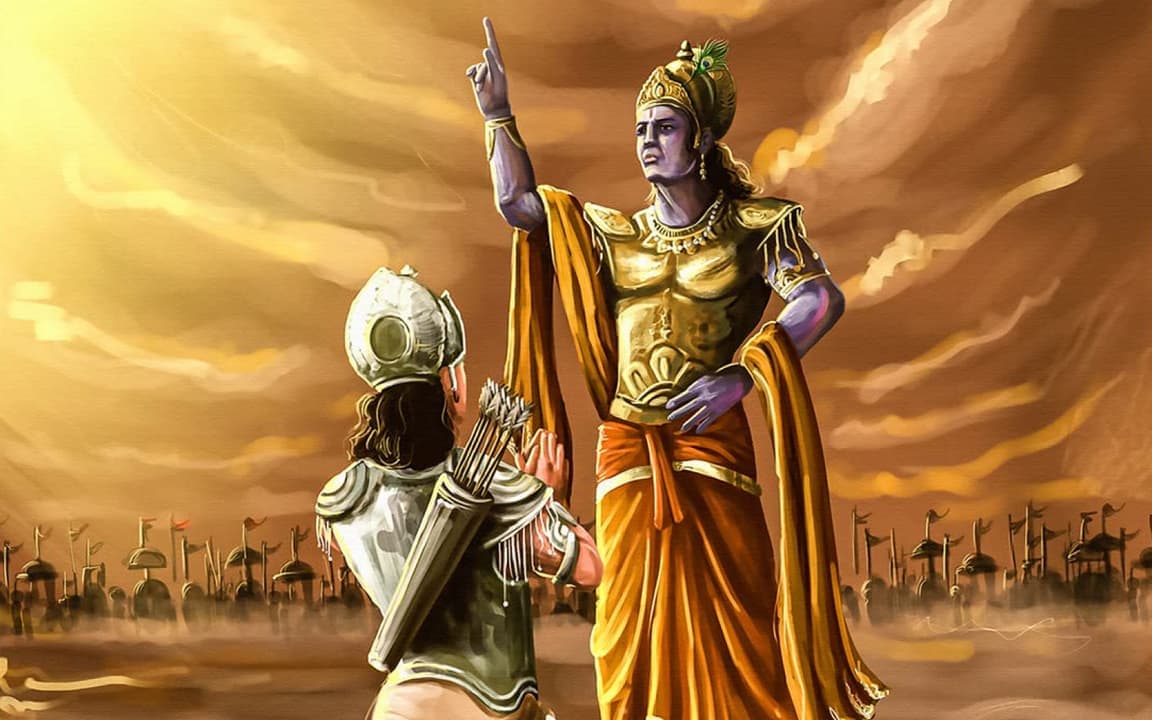
Fighting Duryodhana is Dharma. Fight Duryodhana in the way you can, that is swadharma. Dharma is the same for everybody, but swadharma varies according to your physical, social, temporal conditions.
But remember that swadharma can never be in contradiction of Dharma; swadharma will always be something…

Do not consume that which will poison you, even if it appears attractive. Now that is spirituality.

We are all distinctly different people — our genders, ages, religions, and houses are all different. Despite this, there is something that we all commonly value. If that is revealed, then the fault lines disappear. But without it, all you have are divisions, conflicts, and wastage of energy. This common meeting point is the subject matter of all philosophy — particularly Vedanta. If you really want to unite two people coming from different backgrounds, both of them have to be devoted to one common thing. Vedanta calls it ‘Atman’ — the True Self.

DANCE NAKED
Dance, Lalla, with nothing on
But air: Sing, Lalla,
wearing the sky.
Look at this glowing day! What clothes
Could be so beautiful or
more sacred?
~Lal Ded
Acharya Prashant- what does it mean to dance with nothing on?
L1- No causes.
AP- What does it mean to…

Explore Books on Lord Shiv by Acharya Prashant, revealing deep Vedantic insights into Shiv’s true essence, symbols, and spiritual wisdom beyond misconceptions.

All forms of gods and goddesses have emerged from man's mind — they are our own projections. Even if you show a god in the form of an animal, the animal will still be anthropomorphic, very closely related to human beings. So, this proves that we are worshipping our own form. Therefore, if any form does not remind you of a Truth beyond the form, then the form has not succeeded on you. This is why the highest spiritual philosophies have always said that the Truth is formless.

Figuratively, we say that Om, comprising ‘A, U, M’ (Akār–Ukār–Makār), representing the three states of consciousness, dissolves into silence, and silence is the target. Similarly, the mind, leaving behind all its three states, disappears into the target. Pass through all that you can experience — all that is possible in waking, dreaming, sleeping — and then transcend into 'non-being'. Within the three states, you are you, but when you leave the three states behind, you have left yourself behind. And when there is no you, then there is no mind, no ego. That is. That is.

One attractive and glitzy role model can influence your daughter toward the wrong attitudes, lifestyle, and ultimately, wrong life decisions. Just give your daughter the right role models. Give her great books; take her to the right documentaries, the right movies. Introduce her to glorious women in history. Once she’s spent a week reading the life story of Marie Curie, how will she respect Pari, who is admired because of her style and dressing? Education is the real thing.

Shakti represents everything in motion, everything that can be experienced, everything in space-time. We move in search of a final destination. That point is symbolically represented by Shiva. Those who are inclined towards having the right kind of movement worship Shakti. Those who have fallen in love with the destination itself, worship Shiva. The fact is that the two are inseparable.

To the one who believes in ghosts (Bhūta-Piśāca) — for him, they exist. When you are asleep and are engaged in some nightmare, you feel it actually exists. Bhūta-Piśāca Nikata Nahiṁ Āve, Mahāvīra Jab Nāma Sunāve: Mahavira Hanuman, devoted to Shri Ram, is to be taken as the representative of Truth. If you can be close to the representative of the Truth, you will get rid of all nonsensical and horrifying imaginations.

Practice means incremental improvement, daily improvement, moment-to-moment improvement. That's what we started this session with. Step by step you have to move — even towards the absolute. No one step can take you to the absolute. Not even a million steps can take you to the absolute. But still, there is no way except the million steps.

We want to do good to the ones we are related to and we have long stretches of memories with all kinds of identifications. I fully appreciate that. But I also know that it doesn't always work this way. Sometimes what works better is shifting of focus to more appropriate areas. Remember, nobody can be helped beyond their consent. That's the nature of life.

What you call as God is a concept; Truth is not a concept. Therefore, you can have stories about God, various religions, and their miscellaneous beliefs. But you can have no story at all about Truth because it is that which is invariable. Time cannot change it, and it doesn't vary from person to person. Irrespective of your subjective state, it remains as it is. Truth just turns you silent.

Our culture has turned attachment into value, very proximate to love. However, attachment is poison and has nothing to do with love. We don’t feel ashamed admitting that we are attached, as if something beautiful is happening. If you are with the wrong one, and not even prepared to see that you are with the wrong one — that’s attachment. And you can never be attached to the Right One; there is only dissolution.

The Truth cannot be objectified as a thing, place, person, or book. So, don't be too quick to accept your own assessments, judgments, likes, dislikes, and experiences. Whatever you're seeing is seen by "you" — the Ego — and you are no absolute. Everything must be available to enquiry, investigation, and questioning — and questioning cannot happen if you declare that you’ve already come to the Truth. Never believe that the journey has ended or that the ego itself is the Truth.