Vedanta: The Unity Behind Diversity

Acharya Prashant

9 min
600 reads
Vedanta: The Unity Behind Diversity
We are all distinctly different people — our genders, ages, religions, and houses are all different. Despite this, there is something that we all commonly value. If that is revealed, then the fault lines disappear. But without it, all you have are divisions, conflicts, and wastage of energy. This common meeting point is the subject matter of all philosophy — particularly Vedanta. If you really want to unite two people coming from different backgrounds, both of them have to be devoted to one common thing. Vedanta calls it ‘Atman’ — the True Self. This summary is AI-generated. Please read the full article for complete understanding.

Questioner: Hello, Acharya Ji. My name is Arvind Rajot. I'm a professor here in Manit. First of all, welcome and thankyou for coming here.

So this could be about the majority. There is an individual goal in it, like individual goals of an institute. If I talk about the educational system, there is a student. The student has their own goals. They want to go for placement. There is a faculty. They have their own goals. Some are related to careers and are being defined as per the institute's policy, like how many projects to take, how many papers to do.

And then that goal is based on national policy, in which we can see differences of this kind, like between Harvard and where there can be disputes. There can be differences at this level where there is talk of stopping Harvard's funding. So obviously the national policies affect them.

Then there is the market. So at so many levels, the different fragmentations that are seen, it appears as an educational system. How many parts is this divided into? And is there any solution to it? Can I operate by looking at it as a whole, integrally? And on the other hand, it seems that if this is everything, then it keeps us busy with arrangements. But what arrangements are they making?
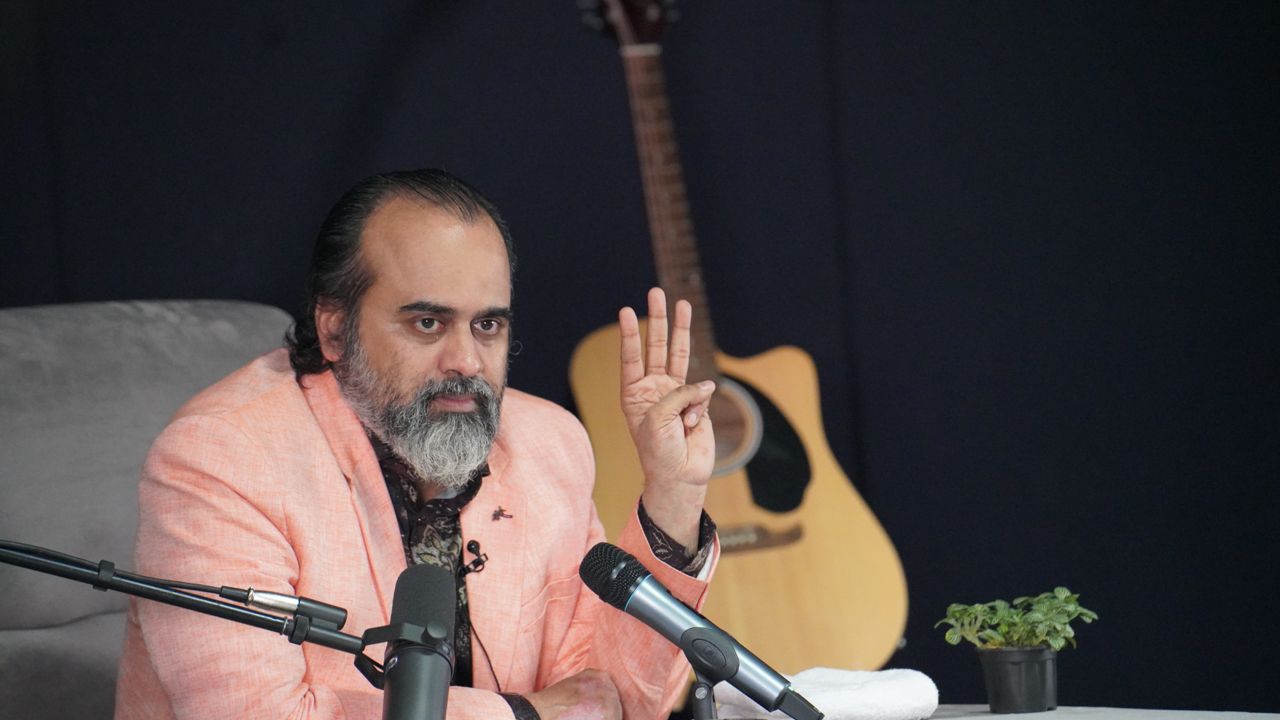
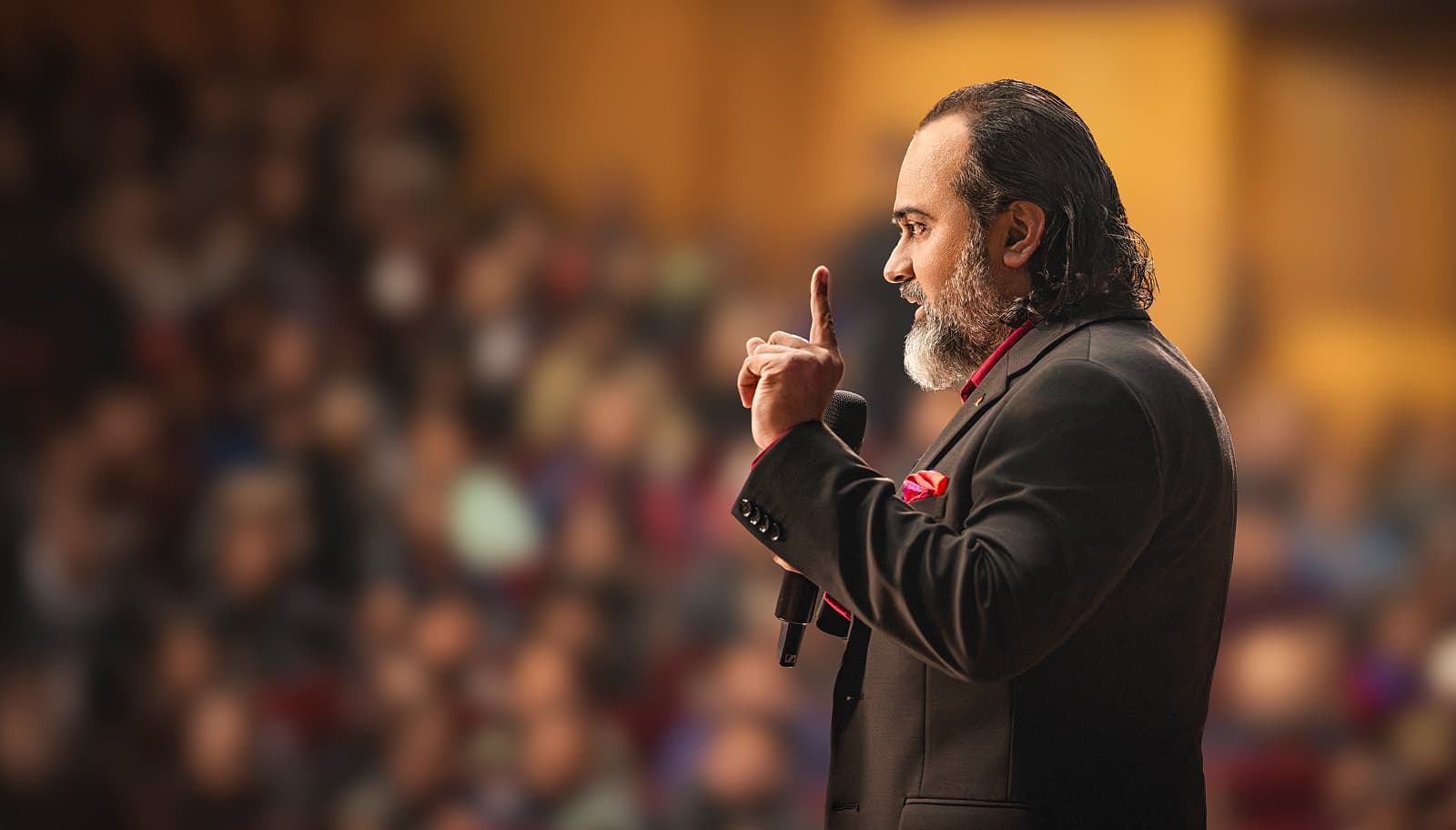
Acharya Prashant: The question is: in the education system there are multiple stakeholders and each one has a separate set of priorities, right? The central government issues a set of guidelines, and they have a certain policy that they want to get implemented. The NEP is there, for example, and various kinds of forces, including religious and cultural forces, have stakes in the NEP.

Then it comes to the students, who have their own priorities that relate to placements and higher education after graduation. Then there are parents who have their own priorities. Then there is the market that says, you should teach that which is currently being practised by us so that your students are employable with us.

He's saying there are so many stakeholders and not all of them have aligning priorities. What do we do?

We have so many of us here, right? So many of us here, and we all are separate individuals, distinct personalities coming from different backgrounds.

Before the stage was occupied, what were we doing? Let's say, we have 500 or 700 of us here. What were these 500 people doing before the stage was occupied? Looking hither and thither, this way and that way. Talking to each other. Getting up. Looking for a better chair to sit on. Trying to locate where one's friend is sitting. Ah, there's a pretty face there. This one, where's that one come from? All those things, right?

All that was happening. And that's personal priorities, that would happen. And someone would say, the speaker is not yet there so let me, till that time, scroll a little. So many of you would be busy with Instagram. And all of that was happening in this hall itself, because we have 500 different universes here. We have 500 different sets of priorities here, right? All that was happening.

In fact, if there would have been 20% people looking in this direction (pointing to the right side) because someone loves videography or cameras, 'Hey, what make is this one? Which particular model is this one and that one?' Wow, fascinating! And someone likes something else. And someone is looking at the exit door. And someone is saying, okay fine, I have to complete an assignment, and carrying a notebook and doing something. All those things are happening. There's so much divergence. No? There is so much divergence.

One does not see any kind of alignment. But what happened the moment the stage got occupied? What happened the moment the stage got occupied? Now all of you are still very, very different personalities. How come all of you are looking in one common direction now? How is it possible?

Because something more important has appeared in front of us. And then your personal priorities become secondary or subservient. You say all that can be kept aside. Something important, and something so important that it is important to everybody equally, is now seen. And then you can leave other things aside. Some of us might still be busy with Instagram. Are you getting it?

In spite of all our differences, there is something certainly that we all commonly value. If that is revealed, then these contradictions are taken care of. Then the fault lines disappear. Otherwise, there are only contradictions and contradictions. And that one will say, I have that thing that I value more. And this one will say, I have that thing that I value more. And there will never be a common meeting point.

The common meeting point is greatness itself. Vedanta calls that as 'Atman', the True Self.

Only that is what is common between all individuals. Only that. And if you cannot have that in life, then all you will have is divisions, conflicts, contradictions, disagreements, and dissipation of energy — because one half is trying to go this way (pointing to the left side), the other half is trying to go this way (pointing to the right side), and there's a lot of wastage. Are you getting it?

There has to be an overarching vision. The education system has to include something that everyone can be ready to lay down his or her life for. And I'm not talking of indoctrination. I'm talking about revelation. I'm talking of really knowing what life is worth living for. And that is the only point of unity, commonness, cohesiveness.

Otherwise, we all are distinctly different people. Our houses are different. Our religions might be different. The level of caste etc. We are different. Our backgrounds are different. Genders, age-wise, economics — everything is different. And when there is so much difference and diversity, even disparity, how will you come to a commonness?

That commonness is what is the subject matter of all philosophy, particularly Vedanta.

If you want to unite two people coming from different religions, different countries, of different age, different gender, whatever, if you want to really unite them then both of them have to be devoted to one common thing. And that one common thing is the only thing worth living for.

Otherwise, A and B can never be united. They'll just keep fighting with each other. If you want to unite A and B, show both of them that the purpose of their life is C. And then they both will rise towards a common point. So you'll get both a rise and commonness.

Here is A, and A is very different from B, and A and B can never meet. But show A that you are born to reach C, and show B that you too are born to reach C, and then these two lines will keep converging. That's the only way to achieve unity, and that's the only level at which unity is possible. All other kinds of unities are superficial and very fragile.

If the government is thinking of securing the next term, if the market is thinking of salvaging the next quarter, if the institution is thinking of doing better in the rankings next year or getting a better crop of students the next year, if the placement department is saying, how do I raise the average CTC — there is no way they can come together. Yes, the system will somehow function, but with a lot of wastage. But when there is this C present, then all these stakeholders work commonly towards C in their respective ways.

The ways are different, but all of them then try to rise towards that same point. What that same point is, that cannot be easily defined. That point in the sky, is what we are born for. That point in the sky, if loved, is that which gives you unlimited energy to carry on in spite of obstacles. Are you getting it? This happens in the interactions between various departments of an institution. It happens in the interactions between various ministries of a government. It happens in the interactions between various members of a family.

You see, we think in a family situation, let's say, we think we like each other, we love each other. See, loving each other directly is not possible because A and B, they are different at the level of personality. And therefore, they'll always have different priorities. And that's why even in relationships, love is so difficult.

A and B can truly love each other only via C. A loves C and B loves C, and hence A and B keep coming closer and closer. That's the only way to have agreement and unity in any kind of relationship, formal or informal.

When A and B directly try to approach each other, then that's like two protons trying to come close. Won't happen. In fact, the closer they come, the more energy it will require to bring them yet closer. But both these protons are silently in love with the electron there. See, if both of them can move towards that, then the distance between them will reduce.

The only problem is that we are great lovers, but the love is silent. We do not even know that we love. And therefore, the hidden love, the unexpressed love, keeps eating us from within and destroys life.

This article has been created by volunteers of the PrashantAdvait Foundation from transcriptions of sessions by Acharya Prashant
Comments
LIVE Sessions
Experience Transformation Everyday from the Convenience of your Home
Live Bhagavad Gita Sessions with Acharya Prashant
Categories