Entrepreneurship is often driven by the same urge for accumulation that shapes human life from childhood-chasing bigger numbers, status, and validation without self-understanding. This leads to hollow pursuits where profit replaces purpose. True fulfillment arises not from external success, but from inner clarity. When one understands oneself, work becomes meaningful, and money shifts from being the goal to merely a tool.
Questioner: Talking about the theme that we have today – The Profit beyond profits. In management, we learn about how to maximize profit. And, you talk about going beyond profits. So what does going beyond profits mean?
Questioner: So, you yourself are an entrepreneur. So, how would you define Entrepreneurship? And what would you define as value creation by an entrepreneur? And subsequently what advice would you give to budding entrepreneurs out here?
Detachment and ambition are not opposites. Both arise from clear insight into what is truly valuable. Detachment means naturally dropping what is seen as false, futile, or harmful, while ambition means pursuing the highest and most meaningful truth with complete intensity. Spiritual surrender is continuous: as understanding deepens, false attachments are repeatedly abandoned, until renunciation becomes natural and almost choiceless.
Success and failure matter less when your work is driven by love rather than outcomes. Setbacks are opportunities to reflect, not reasons to quit, and true failure comes only when you stop trying. Regret and guilt become meaningful only if they transform you into a different person instead of becoming excuses for self-pity. Real growth begins by questioning your assumptions, facing reality honestly, and living with awareness rather than mechanical habit.
Entrepreneurship is a good thing, but a small thing. The real thing is having the right relationship with work because ‘work is life.’ If the right work happens as an employee — wonderful. As a partner — wonderful. And for the right work, if you have to start a concern, become an entrepreneur. But the objective must not be entrepreneurship; it must be right work.
Can a man who is bored during the weekdays suddenly become lively over the weekend? Why is there a separation? There is work, and then there is something else. It means you do not know what you are doing. When you have no real relationship with your work, you do not have any relationship with yourself, and as a result, all your life is spent just seeking holidays.
One knows what one is getting into is definitely worth doing. It is something one can give herself to, irrespective of what comes out of it, that kind of certainty and then comes the rational planning and decision making part. To get into what is right without worrying too much about the outcome. To be sure that the effort and the process itself is worth it even if nothing or very little tangible comes out of it. That is faith.
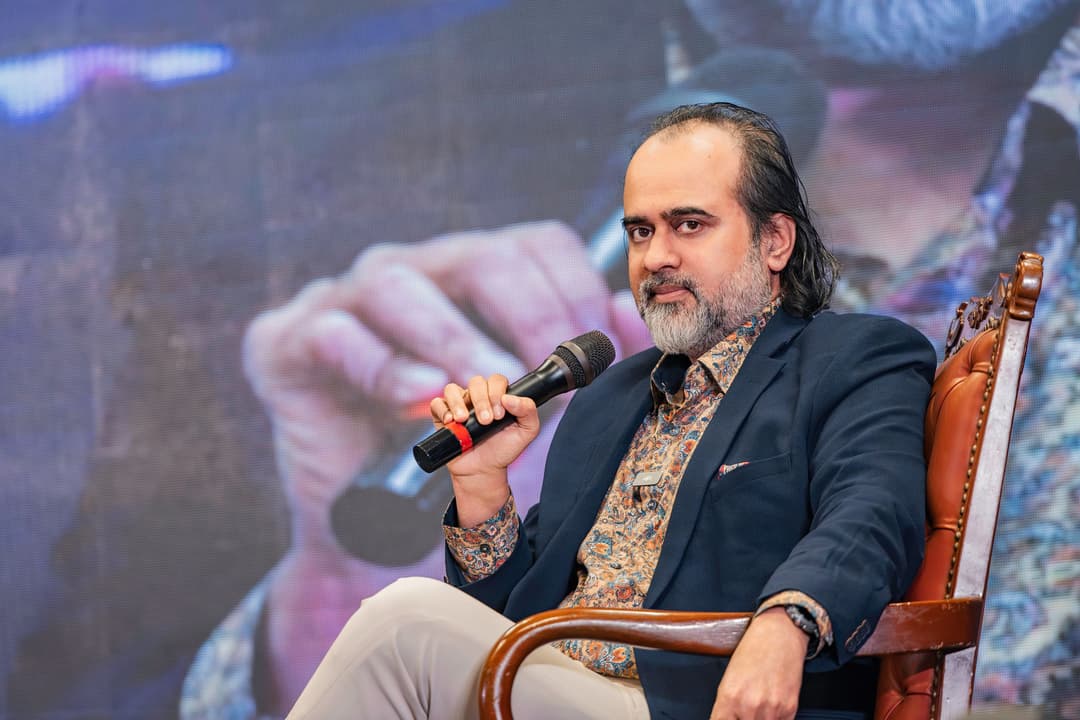
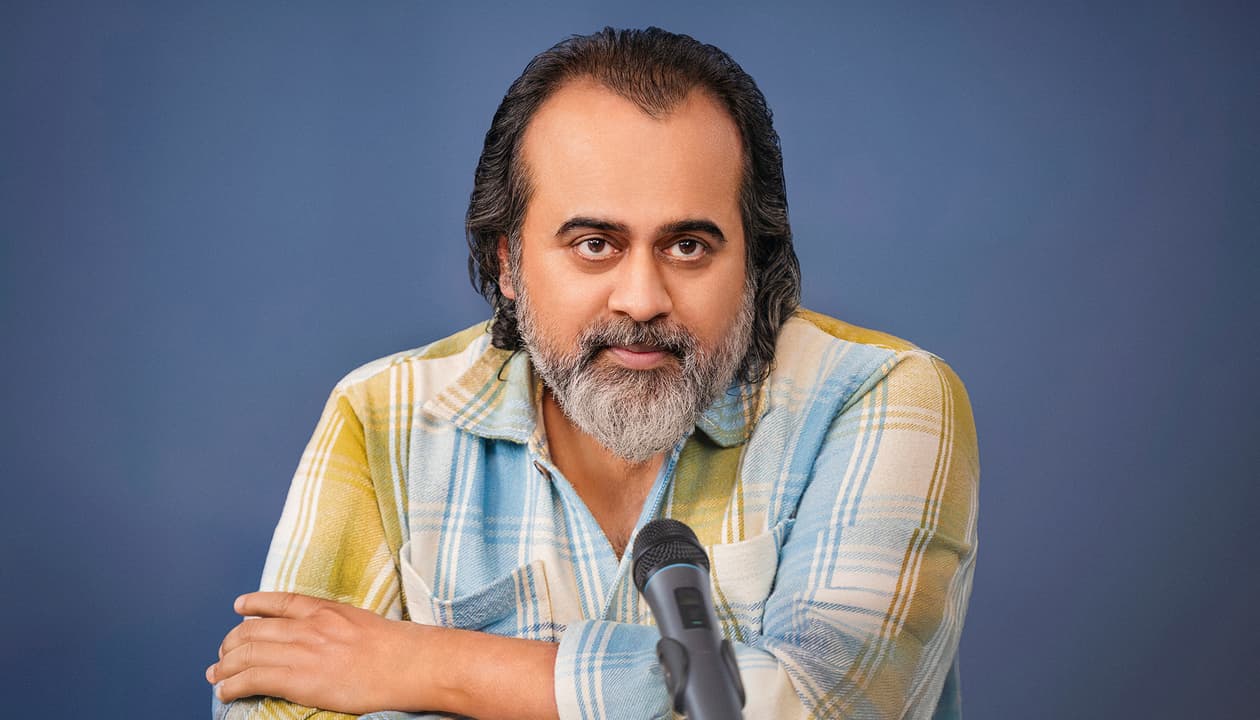
Questioner: Good evening everyone, my name is Saurabh Sardana and you are watching the first episode of season 2, ‘Recast.’ I’m so glad to have you with me today, Acharya Prashant Ji. I’m pretty sure, that most of you that most of you sort of follow him on one of…
Excerpts from Articles
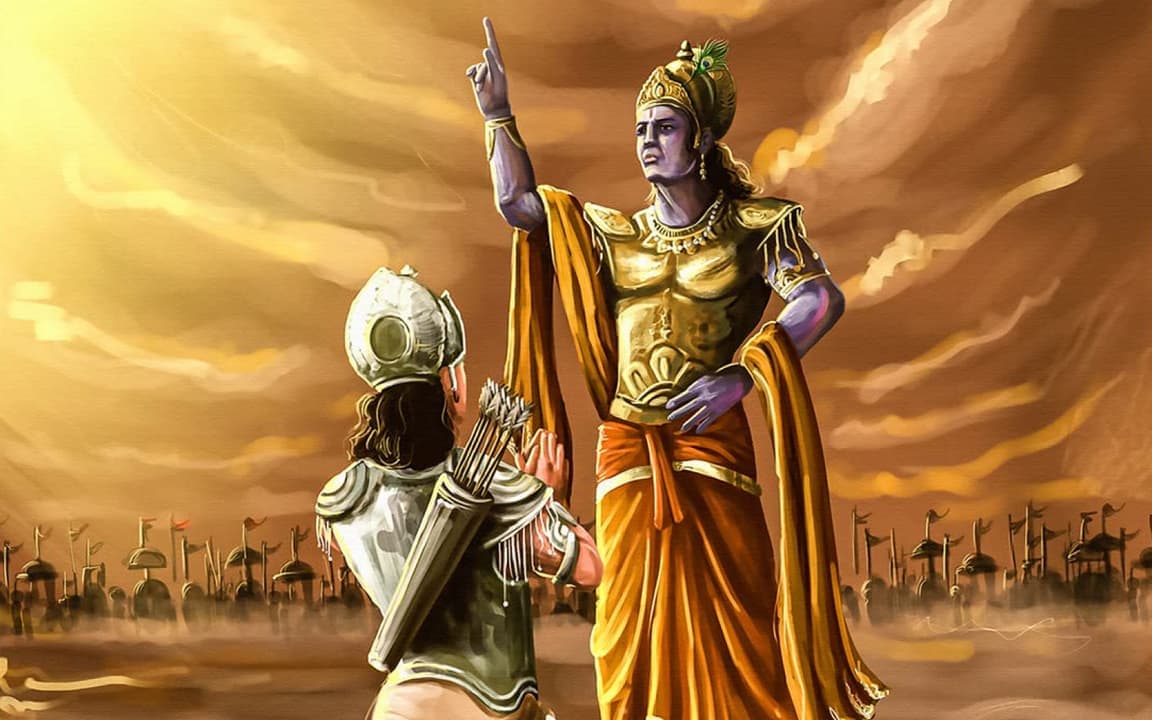
You Don't Understand the Bhagvad Gita, But You Still Claim That You Love Krishna?
The Bhagavad Gita deserves reverence not because of inherited beliefs about its author, but because of its power to dissolve falsehood and reveal Truth. Real devotion is not ritual or blind faith—it is understanding, inquiry, and living the wisdom of the Gita. Through sincere study, one discovers the true meaning of Krishna, making the Gita the most authentic path to knowing and worshipping Him.
ज्योतिष कितना सच है? कुंडली, ग्रह-नक्षत्र: इनका क्या अर्थ है?
वेदांत को केवल इसलिए सही या श्रेष्ठ नहीं माना जा सकता कि वह किसी विशेष परंपरा से आता है। विज्ञान जहाँ भौतिक जगत की वस्तुनिष्ठ जाँच करता है, वहीं अद्वैत वेदांत सीधे मनुष्य के ‘मैं’, उसके दुख, बंधन और मुक्ति की पड़ताल करता है। इसकी कसौटी वैज्ञानिक प्रमाण नहीं, बल्कि अपने जीवन में इसकी सच्चाई को देख पाना है। किसी दर्शन को मान लेना नहीं, बल्कि उससे स्वयं को मुक्त करना ही उसका वास्तविक उद्देश्य है।
Climate change is more than an environmental crisis—it is a crisis of human choices. Our patterns of consumption, consumerism and endless pursuit of more are putting increasing pressure on the planet. But meaningful change does not necessarily begin with new technology or stricter policies. It begins with a deeper question: what are we willing to change within ourselves?
Animal cruelty: Who deserves mercy, and who doesn’t?
Violence begins long before the knife or the slaughterhouse—it begins with the ego, the one that draws boundaries, seeks justification, and decides who deserves compassion. Laws and reforms may reduce suffering, but they cannot end violence while the ego remains intact. When the ego dissolves, exploitation ends naturally, and compassion no longer depends on regulation or moral boundaries.
कई तरह के डर—अकेले पड़ने, छवि खोने या छोटा समझे जाने—की जड़ अक्सर अतीत में बनी पहचान और कहानियों में होती है। शरीर की हाइट जैसी चीज़ों को समस्या मानकर उनसे जूझने के बजाय उनकी अप्रासंगिकता को समझकर आगे बढ़ना चाहिए। अतीत को दबाने से मुक्ति नहीं मिलती; उसके करीब जाकर अपनी स्मृतियों, धारणाओं और पुराने पैटर्न को निष्पक्षता से देखना ज़रूरी है।
Struggling to choose between a secure job and the path you actually feel drawn to? This isn't really a question about careers. It's about why other people's opinions have so much power over you in the first place. Real clarity doesn't come from finding the 'right' choice. It comes from honestly looking at your own fear, again and again, until it stops running the decision for you.
Victory is not decided by the trophy you hold but by the battle you choose to fight. Real strength lies in making the right decisions, staying true to your deepest values, and refusing to be ruled by fear or circumstances. When your actions arise from clarity rather than ambition, the outcome loses its power over you. The moment you choose the right path, you have already won.
See, when we talk of material profits, profits in the commercial,
…
Entrepreneurship is about initiating something, right? Doing something, beginning something. Before you become a good entrepreneur, must you not ask what is worth doing? Or is entrepreneurship merely about collecting profits rather than salaries? To many people,
…
Questioner (Q): Acharya Ji, pranam. Gail decided what he would like to do when he was just 16 and followed it throughout his life. I have always been risk-averse and I have followed a conventional career path.
I have planned to go for MBA next, though I decided this long…
3
Questioner: Sir, you always emphasize on total involvement in any task one takes up. But in our lives, we experience a constant state of flux. So, my question is, how to remain centered amidst all ups and downs, and remain involved in my task?
Acharya Prashant: The task has to…
Acharya Prashant: See, there is entrepreneurship that is just an extension of what you…
Struggling to choose between a secure job and the path you actually feel drawn to? This isn't really a question about careers. It's about why other people's opinions have so much power over you in the first place. Real clarity doesn't come from finding the 'right' choice. It comes from honestly looking at your own fear, again and again, until it stops running the decision for you.
2
Wrong career choices, unhealthy relationships, and endless entertainment are often symptoms of escaping oneself rather than seeking happiness. Self-deception, ego, and inner dissatisfaction drive people toward temporary relief through social media, gaming, movies, and distractions. Real transformation begins with self-inquiry, honest awareness, and the courage to face reality instead of running from it, leading to clarity, freedom, and meaningful living.
Success achieved under pressure or conditioning is not true success because the goal was never truly one's own. Before chasing any achievement, one must ask whether the desire is authentic or borrowed from society. Real change comes not from becoming stronger but from gaining clarity and honesty about oneself. Young people are already capable; what keeps them trapped is the comfort of obeying external expectations. Life is too short to spend serving invisible masters instead of pursuing what one genuinely loves and understands.
2
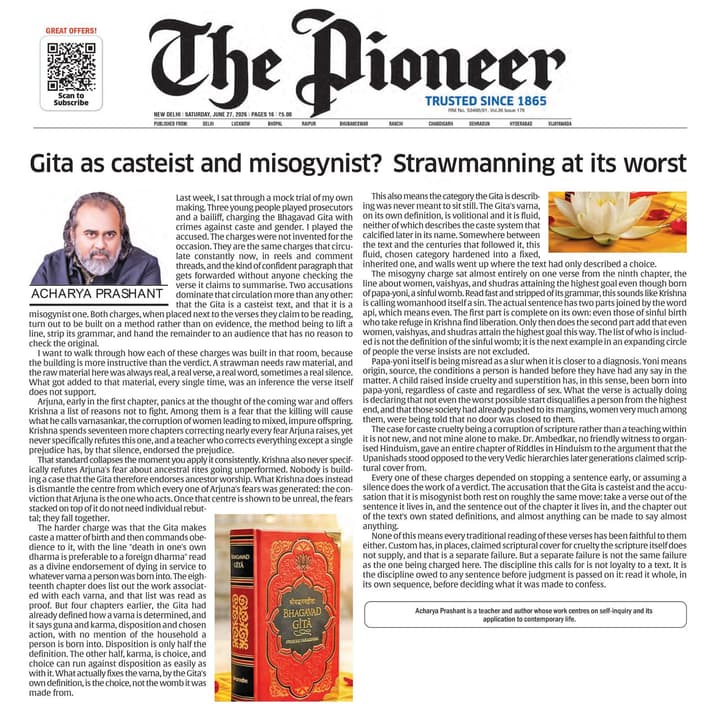
The Bhagavad Gita is often accused of supporting caste and misogyny through selective quotations that ignore context, grammar, and the text's central teachings. A closer reading shows that its emphasis is on inner qualities, conscious action, and spiritual equality rather than birth-based hierarchy or gender discrimination. Misinterpretations arise when isolated verses are detached from their broader meaning, while the Gita consistently points toward self-knowledge, freedom from ego, and the universal possibility of liberation for every human being.
Freedom is often assumed to be the ability to choose, yet most decisions arise from conditioning, biology, social influences, and habit. Real freedom begins by seeing how mechanical and unconscious life usually is. As awareness deepens, confusion and endless options gradually diminish, making life simpler and more direct. Liberation lies not in imagining freedom, but in recognising and understanding the forces that keep one bound.
True dedication does not feel like painful sacrifice. When a goal becomes love, unnecessary distractions quietly lose importance instead of being forcefully abandoned. Personal growth and contribution to society are not separate; meaningful work naturally benefits both oneself and others. Real freedom is not outward performance but inner clarity. Life should be measured by inner elevation, not by comparison with others’ achievements.
The climate crisis is not merely an external environmental problem but a reflection of inner human greed, desire, and psychological disorder. Drawing from the Gita’s idea of yagya as desireless action, it says real ecological healing requires inner transformation. Outer pollution, exploitation, and destruction mirror the ego’s inner confusion, making personal consciousness and planetary health deeply inseparable.
The debate around nudity and movements like “Free the Nipple” miss a deeper issue: true freedom is not about clothing, but freedom from psychological conditioning and body-based identity. Clothes themselves neither oppress nor liberate. A truly free society is one where the body becomes ordinary and irrelevant, not a source of obsession, shame, validation, or social control.
You look at Iran, at revolutions, and ask: can systems really bring freedom? Revolutions keep replacing one system with another, yet the chaos remains. The real question is rarely asked: what within us creates these systems? Real freedom is not political or social; it is inward. Without inner change, every revolution only rotates power, never resolves suffering.
Saurabh Netravalakar, a software engineer and cricketer, discusses balancing multiple pursuits with Acharya Prashant. They explore how hidden wastage of time and energy prevents genuine progress. The conversation extends to team sports teaching ego-dissolution, broadening identity beyond self-interest, and addressing planetary crises through inner transformation. They examine how religion's core purpose—freedom from suffering—unites humanity despite different practices, and discuss practical solutions to environmental exploitation through proper pricing and intent.
Acharya Prashant (AP): That which you call “Vipassana” today, is a very recent phenomenon. They claim that it comes from the Buddha, actually, it is not. The stream flowing from Buddha got extinct around the 8th or 10th century AD. This modern Vipassana came up in Burma, just around a…
If you do not understand spirituality, you will fail even in economics. Look at how common people live their daily lives. Do we inquire into what we are doing? We do things because others are doing the same things. Out of ignorance, you act; and out of greed, you keep acting. Economics does not address the problem of ignorance. Economics also does not address the problem of greed. It is the Upanishads and the Gita that address these problems.
Superficiality offers pleasures. Superficiality offers cheap salvation. Therefore, it is easy to be attracted to superficiality. On the other hand, true spirituality challenges you to pay a heavy price. So, you see, all this knowledge has existed since antiquity. Yet there are people who do not want to read the Gita.
Often, in the name of financial pressure, what we are really kneeling down to is something else. But because that something else is not nice enough to be named, what we quote is financial pressure. Nothing is ever forced in a tangible way. The way is kept gentle in appearance. But there is something else at work inwardly. What is that thing? That is what you have to uncover. You have to be honest towards yourself, very honest.
All of us want a new future. But the brain cannot want anything new. How many of you would want to taste a dish like Kakatua? Forget about tasting it, you haven’t even heard the name before. So, there is a golden rule: all desire is nothing but a stale repetition of memories. Ambition is nothing but a repetition of the past. What you didn’t know in the past, you can’t want in the future. New is new only when it is totally unrelated to the past. The truly new comes as a surprise.
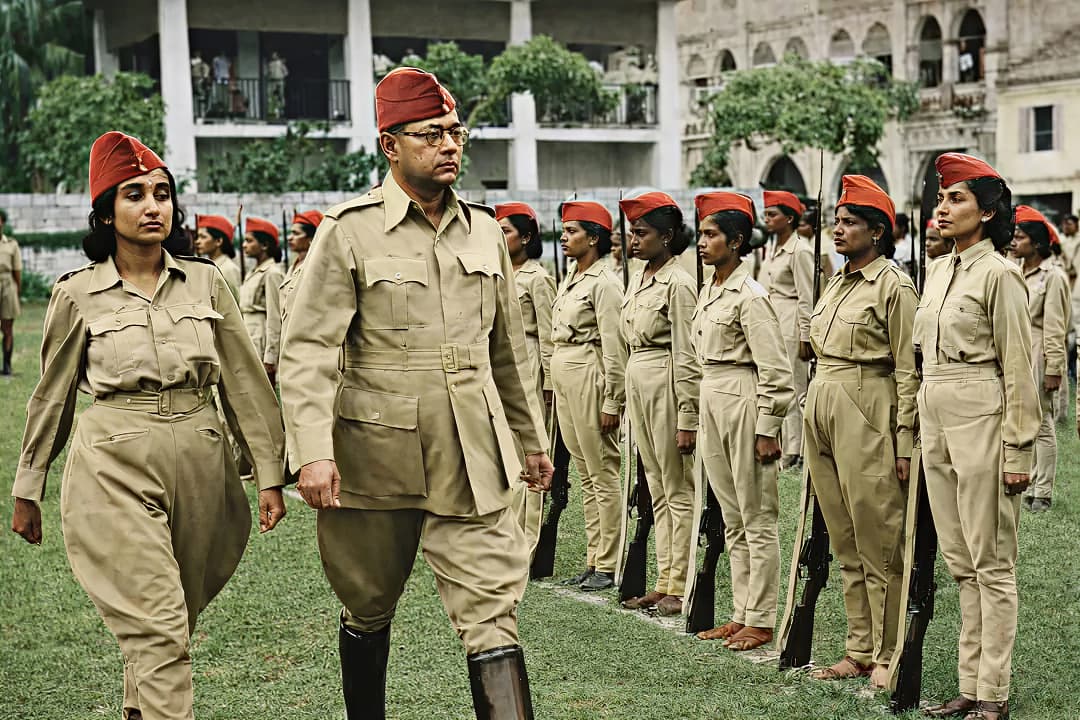
There is no revolution possible without the Gita. That’s the reason why even those who are not remembered particularly for their spiritual inclination, people like Subhash Chandra Bose, even they founded their core on Gita. What kind of revolution can you do if it’s the body that’s always at the top of your mind? You require a Gita to tell you that this body is perishable and would anyway go. Gita only teaches you, "Endure and fight."
Shri Krishna is saying: the mind is conditioned to move towards objects and perceive only their surface, periphery, or form. Develop the practice of penetrating further. Let Truth be your practice. The moment you would look at something, and you are in no position not to look at things being embodied, you would look at things. Nobody said that you have to practice lust. Lust just comes. You might be a total fool, an utter retard, and still you will find yourself getting sexually excited once you reach a particular age. Did you need some practice? No, you didn’t. It just happened. But if you are to understand lust, if you are to cross over, if you are to be a master of your body, then it will require a lot of practice, and that will necessarily and obviously tell you about your predicament.
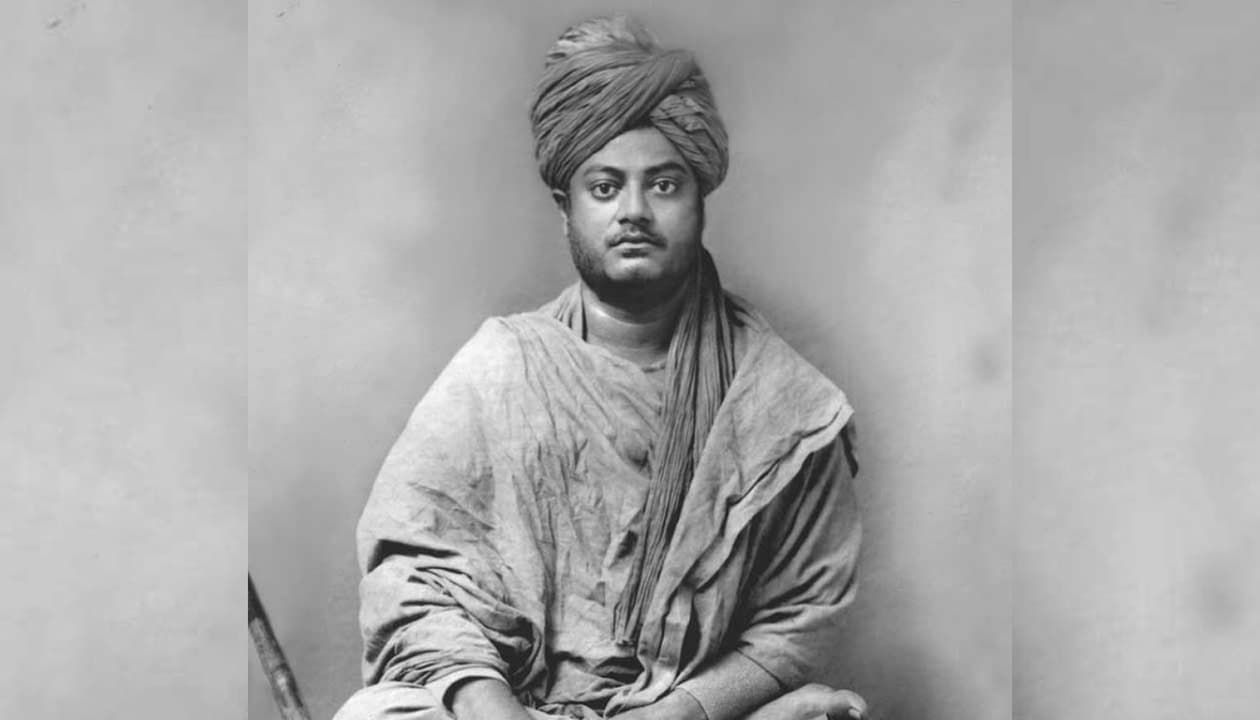
We love to talk of Swami Vivekananda as a youth icon. And I am asserting that were he to be here today, it is the youth that would resist him the most. When he returned from the United States, a huge procession greeted him, right at the port. But when he asked for just a hundred people who could be his soldiers, he was denied. Nobody wants to accept a Swami Vivekananda. He was resisted then, he would be resisted even today.
Be in love with your work and give it just everything that you have. The quality of the relationship must be so high that you are left choiceless in attending to it. Once you have given it all that you have, you will be left with very little time, space, or energy to bother about the result. “I gave everything that I had; now it is difficult to differentiate between defeat and victory.” Live so intensely that, in the end, you are left with no energy to be concerned with the result.
The money you pay for something must be commensurate with its practical utility, but how do you know something is worth its price? For example, does jewellery really have any utility that you pay so much for just a piece of metal? The average Indian household spends much more on the girl’s dowry than on her education. And poor farmers in India are often pushed to suicide because they spend a lot on weddings and funerals by borrowing at exorbitant rates. This is what happens when you are not deeply spiritual: you can be easily conditioned to earn from the wrong source and spend at the wrong place.
Drop the center of confusion, come to the center of clarity. Drop what the masses practice, come to the direct route of self-realization. That’s what it means.
It is one kind of misfortune to not have money at all. The next kind of misfortune is to have a lot of money rotting in your bank account. Why must it be there in your bank account? You are so impoverished, you couldn't find a right place where you can spend your money. Money is meant to be spent. Spend it at the right places. Go enroll in a hobby class. Get a tennis coach. All that is expensive. Spend your money. If you won't, then you will end up just buying whatever your friends buy.
Acharya Prashant: That's why the rājasika mind is better than the tāmsika mind. The rājasika says, “I’m not alright. I need to do something to become better. I feel inferior. I feel incomplete. I need to rise. I need to achieve.” That’s the rājasika mind. The rājasika mind at least…
Fighting Duryodhana is Dharma. Fight Duryodhana in the way you can, that is swadharma. Dharma is the same for everybody, but swadharma varies according to your physical, social, temporal conditions.
But remember that swadharma can never be in contradiction of Dharma; swadharma will always be something…
We all have been trained to buy respect and barter it for life itself — through riches, status, etc. This means that you're a big man only as long as the small ones approve of you. But what is the point of being big, rich, and powerful, if it is still the small ones that call the shots for you? And this is not exclusive to the successful ones. Every single person who does not know the foundations of living will live in a secondhanded way — secondhanded love, success, and respect. And this will not allow you any kind of peace.
Neuroscience says there is no free will. Vedanta also comes to the absence of free will, but through the route of choiceless understanding. It says that the right action will never be a product of your choice because there's no such thing. The right action happens when you just don't see options — not because you're an idiot, but because you're in love with the right one. So, you don't require choice. You require observation. And then, you don’t have to choose. It’s an effortless flow.
Your entire identity comes from the world — society, religion, family, tradition. Had your identity been independent of the world, then you wouldn't have needed to get ahead or prove anything to the world. And when there is more internal hollowness and insecurity, there is more need to ostentate. The deeper the lovelessness, the more lavish the wedding is. So, the fundamental problem is the framework in which you cannot be successful without being ahead of the world. Real success is when you drop this framework.
Love, for the one who is at a low level of consciousness, is to aspire for a higher level. And love, for one sitting on the Himalayan peaks of consciousness, is to be compassionate towards those at lower levels — and, for their sake, if needed, lay down your life.
It was Guru Nanak who said, "You may try as hard as you can, but you will never get to know the mind of the liberated one." That's from the Adi Granth. You keep trying. You keep speculating. And the ego has a serious urge to know what is going on in the mind of the Buddha. But you'll never know what's there in the mind of the Buddha. Being who you are, how will you know the mind of the Buddha?
Don’t think of heaven and hell as the afterlife; both are here, right now. As the Niralamba Upanishad says: Right company is heaven; wrong company is hell. If you are someone who loves to be with people who will take you towards truth, joy, and simplicity, you are already in heaven. And if you surround yourself with people who pull down your consciousness, then verily, you are—right now—in hell.
Acharya Prashant: You will see that I'm repeatedly stressing on Shri Krishna as the demolisher, on Shri Krishna as someone who not only does not accept our prevalent definitions of right-wrong, true and false, humility, authority, right action, non-violence but, in fact, unabashedly and actively demolishes them. It is one…
The Gita has nothing to do with sāttvikatā. Even sāttvikatā is to be rejected as destiny, while even rājasikatā is to be embraced if it serves as a means to freedom. Everything and anything is fine if it is usable in the context of liberation. Even sattva can become an object of consumption — don’t we see learned people whose knowledge becomes their identity? The Gita is about getting rid of all traps — be it sattva, rajas, tamas, or anything.
Questioner (Q): The theme of today’s interaction is inner growth. Usually when we talk of growth, we talk of external growth. For example, for an individual growth usually means job promotions, better income, or more comforts, etc. For a company, growth may mean growing in profits. For an institution, it…
You look in the mirror, and if there is a speck or blemish on your face, you want to change something. If you look at the Gita and that doesn't result in changes in your life, then you are misusing it. Anybody who holds the Gita must be ready to look within and discard all that which is unnecessary, borrowed, antithetical to life. If that is not happening, then that's disrespect to the Gita.
Good spirituality is good economics. We do not know what to purchase. We do not know what really is valuable, even in the material domain. The punishment of not being spiritual is that you lead a very bad, a very ruined worldly life and that includes an economic life, a ruined economic life. It is not merely the person, even nations, actually the entire world suffers when the one making the economic decision is spiritually bankrupt.
Acharya Prashant (AP): Great things are happening on the screen, don't get so excited, it's just the screen. Irrespective of what happens on the screen, it's not real. That's how you have to look at things. Great silence on the screen. Is it silence? No, it is the silence of…
You look at a Swami Vivekanand and then you want the others to be like that. But a Swami Vivekanand is not normal. He's an aberration. He's a great exception. Just by looking at him, if you start assuming that all young human beings by default should be like him, then you are missing the fact of what it means to be a human being.