When you don’t want to do something, you feel lazy. All your wants emanate from your conditioning. Have a sharp look at what you call your ‘wants’. Our ‘wants’ are just an expression of how we have been programmed; they are not our ‘wants’ at all. Wanting and realizing are very, very different dimensions. Act on the basis of your intelligence, on the basis of your realization. Laziness is just a symptom of the effects of conditioning.
Treat the body as a companion, and see how this companion behaves when you fulfill its demands, and how it behaves when you do something that is for your own welfare. This companion is very, very selfish, very greedy. It cares only about itself; it has no respect for what
We are told that cleaner technology will solve the climate crisis. But emissions begin before any fuel is burnt, in a life that has no joy and so keeps reaching for the next lower pleasure: the party, the trip, the purchase. The demand for pleasure is not wrong. What matters is which pleasure we seek. Music, books, sport and real company cost the planet almost nothing. Can we look honestly at what our own consumption is trying to fill?
Many of us interrupt, rush to make our point, or change the topic when a conversation comes too close. We call it a lack of patience or discipline. But impatience in a conversation is often fear: when what we hold within is borrowed belief, every question could shatter it. The same confusion makes us take our instincts and feelings as ourselves, though they are only the body’s chemistry. If we looked honestly at what we hold, would a question still feel like an attack?
Many Indian parents keep their children, and especially their daughters, away from sport, even where coaches and facilities exist. The barrier is often not outside but in the parent’s own ideas: poor returns, uncertainty, and fixed notions of what a girl’s life must be. Blaming our own parents does not help either; our life is now our responsibility. Parenting is a decision of the greatest responsibility, and it begins with self-love. Can we love a child if we cannot love ourselves?
Detachment and ambition are not opposites. Both arise from clear insight into what is truly valuable. Detachment means naturally dropping what is seen as false, futile, or harmful, while ambition means pursuing the highest and most meaningful truth with complete intensity. Spiritual surrender is continuous: as understanding deepens, false attachments are repeatedly abandoned, until renunciation becomes natural and almost choiceless.
True love is not a biological instinct, emotional attachment, or social conditioning. Biology and science explain the body's drives, but they cannot explain the self that seeks freedom. Love is the inner restlessness to move from ignorance and bondage toward truth and liberation. Religion is not rituals or inherited beliefs but this personal journey of understanding. Freedom—not possession or conformity—is the essence of both love and religion.
Truth cannot be forced upon anyone, but neither should falsehood be entertained. Genuine love is not about preserving relationships at any cost; it is about helping oneself and others break free from illusion, even if that means risking the relationship itself. Spiritual growth begins by questioning conditioning, examining falsehood without bias, and choosing authenticity over comfort. Real relationships are built on the courage to seek freedom, not convenience.
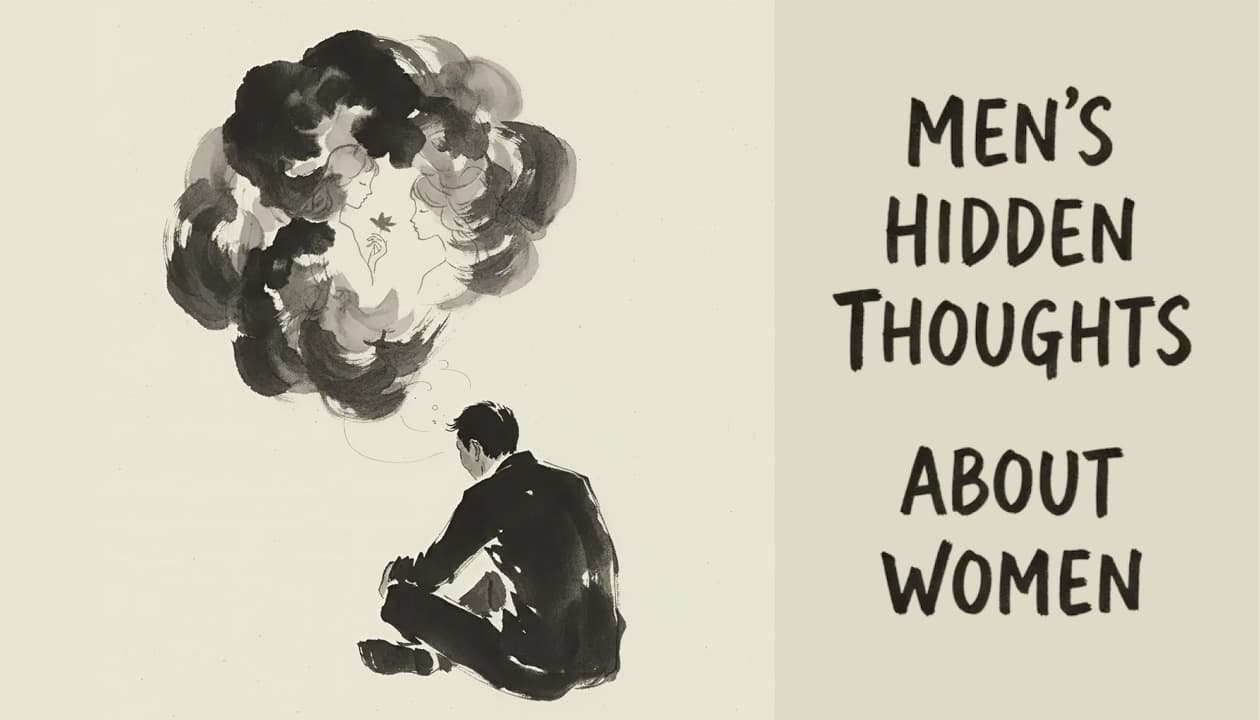
That’s the purpose of life, no? To know your real destiny beyond your physical limitations and social conditioning. Most people do not know that such a dangerous thing is surreptitiously happening to them. I have found that we are quite big on media and social media now, so comments flow in their hundreds. And women actually have a self-righteous position when they say that we are not supposed to work and you better not expect that from us. Equally, men are conditioned about the roles they are supposed to play in life at home, in society, and how they are supposed to feel about themselves.
Search
Those who are lazy, lack not in energy but in understanding. In physical nature, there is a tendency toward work minimization. If something gives you more output with less work, you will do it. You do not know that the right work brings benefits, dividends, and joy. Had you known it, you would have chosen the right action over laziness every moment.
'Laziness' is an unnecessary pejorative. You’re imposing morality on Prakriti (physical nature) and calling it laziness. There’s nothing called laziness. In nature, there’s a tendency towards work minimization, which is logical—get maximum output with minimum effort. You view it through a moral lens and call it laziness. If something gives more output with less work, you’ll choose it. You call it laziness, but it’s simply efficiency. You calculate the pleasure-to-effort ratio, and if lying in bed offers more pleasure than working out, you’ll naturally choose the bed.
1
Question: How to differentiate between and recognize, whether one trusts in the universe to unfold one’s destiny and goes with the flow, and allows the life to unfold, and be the one who is a loser, who is lazy and does nothing?
Acharya Prashant (AP):
The lazy one does a…
3
Question: What is Life?
How do you call somebody alive?
AP: A dewdrop vanishes in no time, does it have a life?
Talk about yourself. What do you call as ‘your life’, your aliveness? We have this instrument here. Anybody can push the buttons and get it to operate in…
Excerpts from Articles
Climate Change: The Solution Is a Choice
Climate change is more than an environmental crisis—it is a crisis of human choices. Our patterns of consumption, consumerism and endless pursuit of more are putting increasing pressure on the planet. But meaningful change does not necessarily begin with new technology or stricter policies. It begins with a deeper question: what are we willing to change within ourselves?
कई तरह के डर—अकेले पड़ने, छवि खोने या छोटा समझे जाने—की जड़ अक्सर अतीत में बनी पहचान और कहानियों में होती है। शरीर की हाइट जैसी चीज़ों को समस्या मानकर उनसे जूझने के बजाय उनकी अप्रासंगिकता को समझकर आगे बढ़ना चाहिए। अतीत को दबाने से मुक्ति नहीं मिलती; उसके करीब जाकर अपनी स्मृतियों, धारणाओं और पुराने पैटर्न को निष्पक्षता से देखना ज़रूरी है।
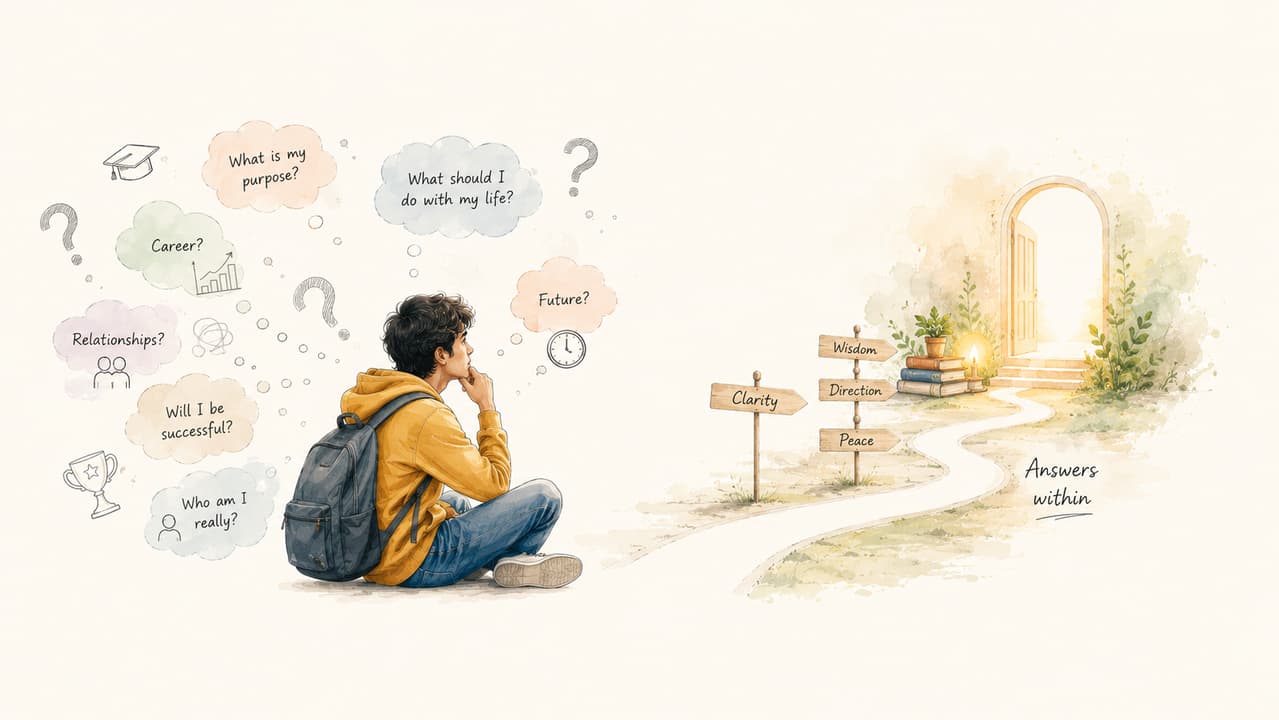
Struggling to choose between a secure job and the path you actually feel drawn to? This isn't really a question about careers. It's about why other people's opinions have so much power over you in the first place. Real clarity doesn't come from finding the 'right' choice. It comes from honestly looking at your own fear, again and again, until it stops running the decision for you.
ज्योतिष कितना सच है? कुंडली, ग्रह-नक्षत्र: इनका क्या अर्थ है?
वेदांत को केवल इसलिए सही या श्रेष्ठ नहीं माना जा सकता कि वह किसी विशेष परंपरा से आता है। विज्ञान जहाँ भौतिक जगत की वस्तुनिष्ठ जाँच करता है, वहीं अद्वैत वेदांत सीधे मनुष्य के ‘मैं’, उसके दुख, बंधन और मुक्ति की पड़ताल करता है। इसकी कसौटी वैज्ञानिक प्रमाण नहीं, बल्कि अपने जीवन में इसकी सच्चाई को देख पाना है। किसी दर्शन को मान लेना नहीं, बल्कि उससे स्वयं को मुक्त करना ही उसका वास्तविक उद्देश्य है।
Justice Without Boundaries: Why Compassion Cannot Stop at Species
Oppression should not see caste, gender, creed or colour, and it should not see species either. The moral threshold is sentience, not intelligence. An animal feels pain as fully as a human does, whether or not it can explain its suffering.
Acharya Prashant: What is this thing about sending something, delegating something to the future. What is this thing about procrastination? Would you ever postpone something to the future if you are really in love with it? Would you…
Those who are lazy lack not in energy but in understanding. You do not know that you need to work and that work will get you benefits, dividends, joys. Therefore, you are preferring inaction over action. Had you really known the sweetness, the ambrosia of right action, you would have…
1
We often defend a bad choice by pointing to a worse one: stay dishonest or starve, keep the wrong grip or stop playing. But the real trouble is not the option we picked. It is the option we never let ourselves see. Action does not need greed or attachment to find its energy. The third way begins by rejecting both false choices, without knowing what comes next. Which of our everyday choices are really false dilemmas?
5
Struggling to choose between a secure job and the path you actually feel drawn to? This isn't really a question about careers. It's about why other people's opinions have so much power over you in the first place. Real clarity doesn't come from finding the 'right' choice. It comes from honestly looking at your own fear, again and again, until it stops running the decision for you.
2
We often call something “help” or “love” while secretly expecting something in return. When that return does not come, we feel hurt, revealing that the relationship was a trade, not genuine help. The ego, being unfulfilled, cannot truly love or share. Likewise, desperation to be loved makes us controllable. Real love emerges when we stop seeking validation, work on ourselves, and become so inwardly fulfilled that we no longer need to be loved.
4
Reaction is an instinctive, unconscious response rooted in ancient survival mechanisms, while response arises from consciousness and understanding. Our biological instincts evolved for survival, but modern life demands that we move beyond them. Emotional reactivity makes us predictable and controllable, allowing others to manipulate our emotional triggers. True freedom lies in pausing before reacting, examining emotions, thinking deeply, and responding consciously rather than living as slaves to instinct.
1
The Bhagavad Gita is not a separate spiritual path or an escape from everyday life - it is a mirror that reveals the truth of your present life. Real spirituality begins with self-observation, not rituals or temporary practices. Lasting transformation comes when work, relationships, career, and personal growth become one integrated life driven by awareness, love, and freedom rather than ego, fear, money, or social pressure.
5
Bullying hurts deeply only when it is allowed to define one's inner identity. External abuse may wound the body, but lasting psychological wounds require inner participation. While OCD, anxiety, depression, schizophrenia, and other mental health conditions deserve proper treatment through psychiatry, lasting freedom demands self-knowledge.
2
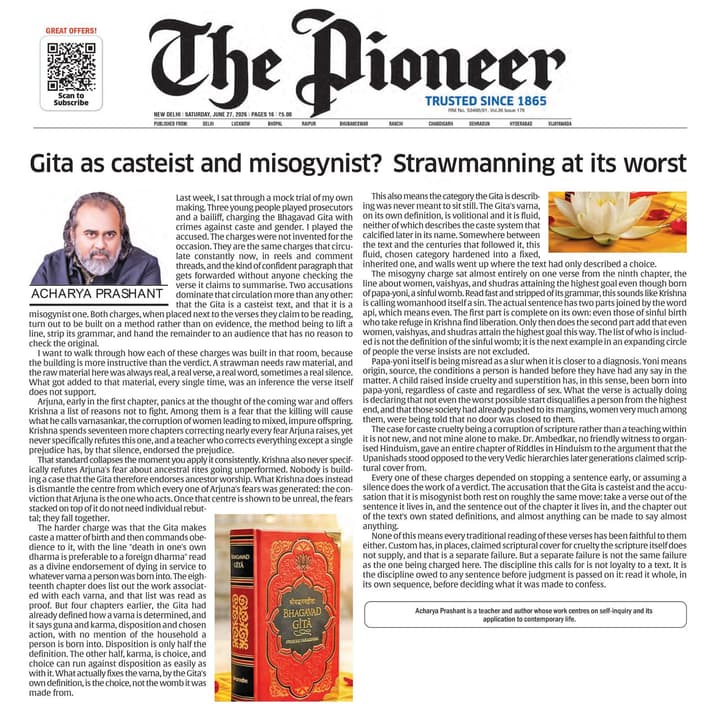
The Bhagavad Gita is often accused of supporting caste and misogyny through selective quotations that ignore context, grammar, and the text's central teachings. A closer reading shows that its emphasis is on inner qualities, conscious action, and spiritual equality rather than birth-based hierarchy or gender discrimination. Misinterpretations arise when isolated verses are detached from their broader meaning, while the Gita consistently points toward self-knowledge, freedom from ego, and the universal possibility of liberation for every human being.
Love is not a special emotion reserved for selected people or relationships but a way of relating free from self-interest, possession, and psychological dependence. Most relationships become transactions driven by insecurity, where the ego seeks completion through ownership and exchange. Genuine companionship arises without the urge to control or claim another, allowing affection to exist naturally, freely, and without conditions or expectations.
2
Modern relationships often create more insecurity, not less, because people are conditioned to seek completion, validation, and identity through another person. Social institutions, media, culture, and tradition continuously reinforce the idea that fulfillment lies in romantic attachment. As a result, relationships become driven by dependence rather than love. Real companionship becomes possible only when one is inwardly at peace and not using another person to fill an inner void.
1
Love is not attraction, possession, dependency, or a transaction driven by personal gain. As long as relationships arise from insecurity, ownership, or the desire for psychological completion, they remain centered on the ego. Love is simple, natural, and free of self-interest, flowing without preference or exclusion. The ego seeks security, continuity, and suffering because they preserve its identity, while freedom and joy threaten its existence. A meaningful life begins when one stops repeating old patterns, accepts uncertainty, and chooses freedom over the comfort of familiar cages.
True dedication does not feel like painful sacrifice. When a goal becomes love, unnecessary distractions quietly lose importance instead of being forcefully abandoned. Personal growth and contribution to society are not separate; meaningful work naturally benefits both oneself and others. Real freedom is not outward performance but inner clarity. Life should be measured by inner elevation, not by comparison with others’ achievements.
1
Climate change, population policies, and social conflicts often arise from a common source: narrow love. People, communities, and nations justify actions that benefit their own group while overlooking broader consequences for humanity and the planet. True care is not exclusive or identity-based; it is expansive and inclusive. Even motherhood, patriotism, and family concern can become limiting when reduced to narrow self-interest rather than guided by wisdom, freedom, and universal responsibility.
The climate crisis is not merely an external environmental problem but a reflection of inner human greed, desire, and psychological disorder. Drawing from the Gita’s idea of yagya as desireless action, it says real ecological healing requires inner transformation. Outer pollution, exploitation, and destruction mirror the ego’s inner confusion, making personal consciousness and planetary health deeply inseparable.
If you are honest, you will find that significant chunks of your time are being taken up by activities you do not even want to admit to yourself. The thing is, we ought to be objective; we ought to know where it is really going. And you might discover that nobody is actually all that short of time. Time is there; it’s just that when it is spent on activities that please us, we try to hide that time because it’s our little joyful secret.
Love has to be seen as the need of the mind, the attraction of the mind towards Peace, towards rest. All attraction is there only with a desire; the hope is of fulfilment. So when the mind says ‘love’, along with love it has a picture of love. How do you know that somebody loves you? Only if he behaves according to set patterns. When real love comes to us, we close our gates to it. Love is not with a particular man or woman; Love is the natural state of the mind.
10
The kinds of meanings that we associate with love are actually quite demeaning. It’s not your own self-interest that you think of in love. Love is not an emotion; love primarily is a spiritual understanding. Saint Valentine would not be quite pleased with the meanings we have associated with his name and his day. The saints laid down their lives so that our faulty definition of love could be corrected, and that is probably the best use this day can be put to: correcting the definition of Love.
Superficiality offers pleasures. Superficiality offers cheap salvation. Therefore, it is easy to be attracted to superficiality. On the other hand, true spirituality challenges you to pay a heavy price. So, you see, all this knowledge has existed since antiquity. Yet there are people who do not want to read the Gita.
Real Love is a very pure thing. It is pure and it purifies. If you really love her, forget about the families, you won’t even bother whether she loves you, because Love does not demand anything in return. Forget about marriage or anything else. You love, you know love, and that is all, sufficient. Love unconditionally, and then a way will emerge. Unconditional Love is very, very intelligent, and knows no fear. It knows where the solution is, it will find a solution.
All of us want a new future. But the brain cannot want anything new. How many of you would want to taste a dish like Kakatua? Forget about tasting it, you haven’t even heard the name before. So, there is a golden rule: all desire is nothing but a stale repetition of memories. Ambition is nothing but a repetition of the past. What you didn’t know in the past, you can’t want in the future. New is new only when it is totally unrelated to the past. The truly new comes as a surprise.
37
There is no revolution possible without the Gita. That’s the reason why even those who are not remembered particularly for their spiritual inclination, people like Subhash Chandra Bose, even they founded their core on Gita. What kind of revolution can you do if it’s the body that’s always at the top of your mind? You require a Gita to tell you that this body is perishable and would anyway go. Gita only teaches you, "Endure and fight."
5
Shri Krishna is saying: the mind is conditioned to move towards objects and perceive only their surface, periphery, or form. Develop the practice of penetrating further. Let Truth be your practice. The moment you would look at something, and you are in no position not to look at things being embodied, you would look at things. Nobody said that you have to practice lust. Lust just comes. You might be a total fool, an utter retard, and still you will find yourself getting sexually excited once you reach a particular age. Did you need some practice? No, you didn’t. It just happened. But if you are to understand lust, if you are to cross over, if you are to be a master of your body, then it will require a lot of practice, and that will necessarily and obviously tell you about your predicament.
I have desires and you are the means to fulfill those desires. That’s why I come to you and I say I’m a loving person. This is not love. Most of that which we call love is actually just self-interest. A lot of our comforts, conveniences and identities depend on the other; therefore, we want to hold the other. Real love is possible only when you know that the other cannot bring anything to you. You relate to the other to share, not to gain.
Be in love with your work and give it just everything that you have. The quality of the relationship must be so high that you are left choiceless in attending to it. Once you have given it all that you have, you will be left with very little time, space, or energy to bother about the result. “I gave everything that I had; now it is difficult to differentiate between defeat and victory.” Live so intensely that, in the end, you are left with no energy to be concerned with the result.
The tiger chases the buffalo calf and brings it down. Does that disappoint you? No, because that was expected. Similarly, expect animal behavior all the time from everyone around you, including yourself. Everything we do comes from the jungle, so don’t be disappointed. Disappointment always arises from expectations. You really have to strive to be someone who is not an animal. And the first step in that striving is to address your own inner animal.
Manifestation is simply an expression of your desire. You desire something, and then you imagine your desire has been fulfilled. What does the common man desire? ‘Give me more money.’ What will the politician desire? ‘Finish off democracy and give me power for life.’ We have very stinking desires. Do we ever desire anything that is really good for everybody? The question remains: Was that thing worth it? You gave it so much time, so much respect, did it deserve that?
“I love my job as long as I'm paid for it.” Can you work without being paid? If yes, then probably there is some beginning of love. There are ten things we all like, and all liking or disliking is conditional, and the mark of love is that it survives all conditions. If you come to something that is dearer to you than life itself, then you know what love is. Love is dangerous, because it would mean you have come to something that's more precious to you than life itself.
Drop the center of confusion, come to the center of clarity. Drop what the masses practice, come to the direct route of self-realization. That’s what it means.
When you do not like human beings, you must also remember that they do carry the potential to be lovable. Not just the potential to be loved, but the potential to be lovable. Beyond likable, lovable. So, along with not liking humanity, also comes the responsibility to maybe help them become lovable, to whatever extent one can.
The object of love is so big, so total, so filling, so occupying that it leaves no space for the subject to hide and survive. The task is so damn big that it can’t be done if you protect yourself. If you protect yourself, it won’t happen. Love involves a lot of bloodshed and demolition. And there are fireworks. Great structures collapse. Formidable enemies have to be defeated. All that is love.
Acharya Prashant (AP): Jayant has initiated, and he is saying that he used to lead a mechanical life that starts the story, and then he got into spirituality, now he wants to be in love always but that does not always seem possible. Right?
An ignorant person is a dangerous thing, made even more dangerous by a relationship. An ignorant person, even if he is walking alone on a road, is a dangerous thing. What if you bring that person to your bedroom? How does it matter? You start calling him your husband or wife. He has remained equally ignorant. Or, does wedding change things so much? It doesn't. Very stupidly you can go round and round the fire, how will that change anything within?
“The food is not good. You smell bad. You do not flush properly. You are overspending on this thing. No, I would not watch that movie." That is the stuff of your usual domestic. What else do you fight over? Whether or not Trump should interfere in Ukraine? Is that what husbands and wives fight over? No. Only these things. "Why were you ogling at the neighbor?" Focus on what is important and forget the rest.
Fighting Duryodhana is Dharma. Fight Duryodhana in the way you can, that is swadharma. Dharma is the same for everybody, but swadharma varies according to your physical, social, temporal conditions.
But remember that swadharma can never be in contradiction of Dharma; swadharma will always be something…
The real issue is not about time at all. You are spending time exactly according to your values. Don’t ask how to utilize time. Ask yourself, "Do I know what is truly valuable?" When you are clear about what is truly valuable in life, all your time will be devoted to that. Become clear. Know what is truly valuable.
Try it out, go get an experience. But you must have the intent to really test it for what it really is. Experience is one thing and realization is a totally different thing. You can live your entire life without knowing even a moment of love. Real love is a purely spiritual thing. You cannot have real love without having paid the price to earn spiritual education.