We are told that cleaner technology will solve the climate crisis. But emissions begin before any fuel is burnt, in a life that has no joy and so keeps reaching for the next lower pleasure: the party, the trip, the purchase. The demand for pleasure is not wrong. What matters is which pleasure we seek. Music, books, sport and real company cost the planet almost nothing. Can we look honestly at what our own consumption is trying to fill?
This summary is AI-generated. Please read the full article for complete understanding.
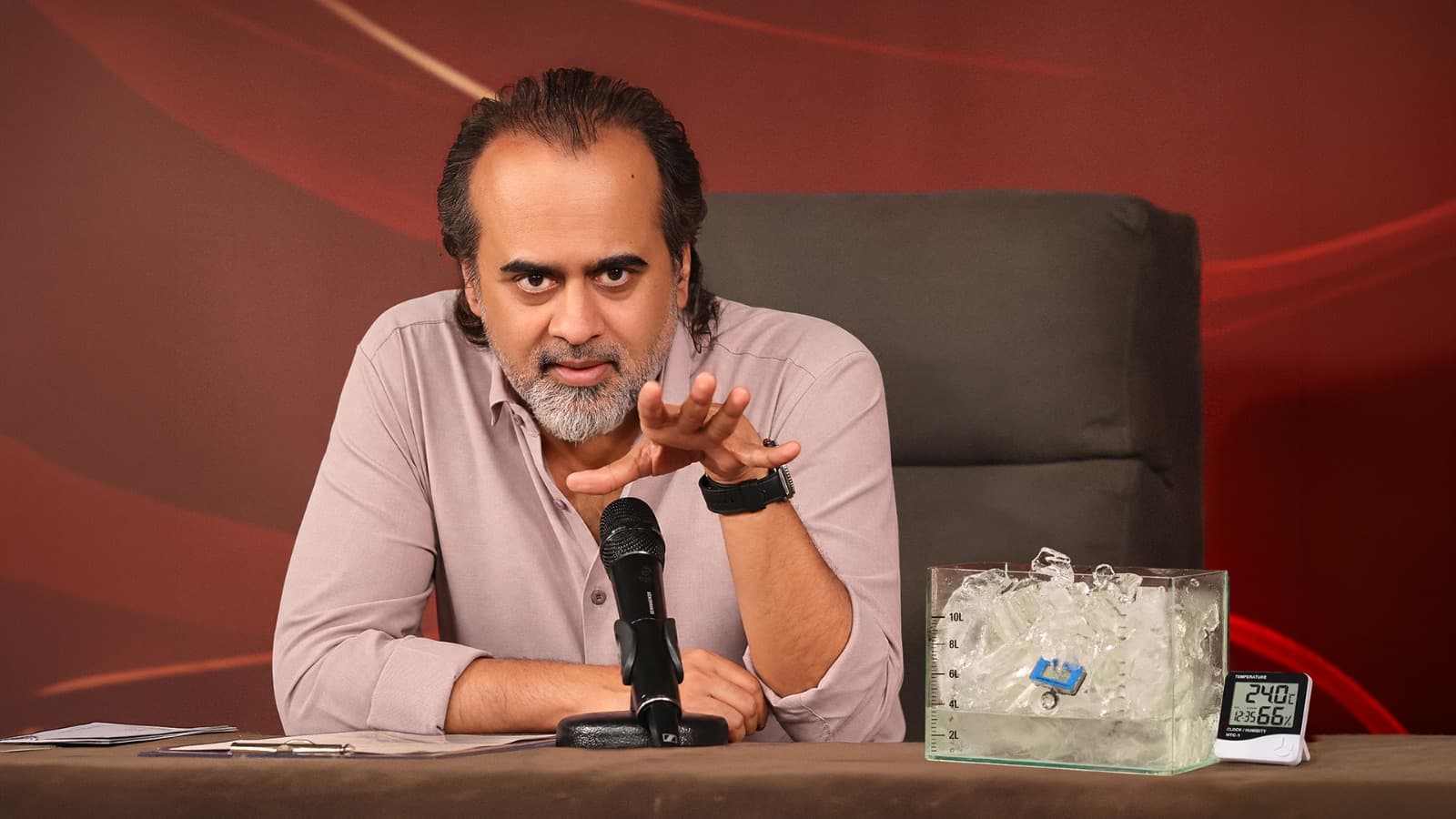
[From a session on climate denialism, held beside a live demonstration: a block of ice standing for the Himalayan glaciers, slowly melting into a tank of water.]
Questioner: On the point that you were talking about, models are unreliable, found some interesting things. So out of 17 model projections published 1970 to 2007, 14 matched the warming that actually happened. Once actual emissions were accounted for, Exxon’s own 1977 to 2003 projections were also accurate.
Acharya Prashant: Exactly right. Yes. Yes. The models have known it, modeled it fairly accurately. The knowledge is present and not disputable. Now it remains to the ego. The only solution is you have to ask yourself, must you find pleasure in the usual consumptive and emissive kind of desire? Or are there other ways of higher pleasure? Because pleasure you will need. The ego is a thing that is born suffering. Therefore, pleasure, the demand for pleasure is not unreasonable. It’s just that there is a lower pleasure and there is a higher pleasure that you can call as joy. Can there be joy in life? Because if there is joy in life, I’ll not need to burn fuel just to have some fleeting, momentary lower pleasure. Is higher pleasure possible? What if running gives you pleasure? What if? Please tell me. What if you are somebody who finds pleasure in running, singing, reading? We need to have a humanity that knows the tastes of higher pleasures.
Remember, the field of self-inquiry is not about denial of pleasure. It is about sublimation of pleasure.
It is about having higher pleasures, so high that you cannot even relate them to happiness. So you come up with a new word for that, Anand. Anand. That kind. And when that is there, then you do not need to burn coal or oil or kill animals just to please yourself for a while. If you do not have that higher pleasure in life, you will have no option because you are anyway suffering. The suffering one will go and fall at some lower place of pleasure.
Give yourself higher pleasure. In some sense, this discussion that has been happening since the last few hours is one such pleasure. How much have we emitted in the last three hours? Very little. There is electricity consumption here, but take it on a per capita basis and it’s negligible, right? Had you not been here, would your emissions have been higher or lower?
Questioner: Higher.
Acharya Prashant: That’s what. Give yourself higher pleasure, and higher pleasure usually does not require emissions. Beautiful music. Beautiful music for three hours. Or you are dancing for an hour. There is no emission, yet there is such great pleasure. Or just sitting with somebody who is worth it. Two persons chatting silently in a corner. Is there any emission there? Maybe, you know, there is some beverage in front of them. They are sitting in a cafe. There’s not much emission happening there. Yes, the cafe is air-conditioned, so yes, some emission again there, but not much. Not much. Yet three, four hours of deep pleasure. Deep pleasure. So go and find venues of higher pleasure. And mind you, higher pleasure is often carbon neutral. If not carbon less, then it involves insignificant amounts of carbon. Yes, you will burn some fuel to arrive at the cafe. That much is there, fine. But that is not too much. Are you getting it? And mind you, if you do not fill up your life with the higher pleasure, you will be forced into...
Questioner: Lower.
Acharya Prashant: ... the lower pleasures. The ego will not tolerate a vacuum of pleasure. Do not give it the higher one, and it will rush towards the lower one. It’s not improper to be happy. You must be very, very happy. But you must have higher happiness. Call it higher happiness, higher pleasure, whatever. You get the idea, right? What I’m trying to say.
Vedanta talks of the state of the ego, Satchitananda. And not just Satchitananda, Satchitananda Ghana. Higher and dense pleasure. Dense not in the usual sense of the word. Concentrated. Allow yourself to have that in life. Do not be afraid of real pleasure. If you’ll be afraid of real and higher pleasure, then I repeat, you will fall into the lower places. And higher pleasure is expensive. Please pay the price. Please pay the price. The price is not so much financial. It is more psychological. Please pay the price for higher pleasure. There is just so much pleasure that life itself can give you without any financial payment. Please.
Have you ever known your body is such a great source of pleasure? Have you ever seen that? Not the usual kind of weak and falling body. Ask someone who cannot get up properly from the bed in the morning. How many of us does it happen with? In the morning, you’re getting down and the knees are, “Oh.” [audience laughs] It is a pleasure just getting up from the bed with a spring in your feet. Just getting up from the bed is pleasure. Being with the right person is a pleasure, even physically, because I’m talking to young people. But there is an important distinction or qualification there, the right person. Otherwise, that too becomes the worst kind of pleasure. Do not deny yourself pleasure. It’s not about shrinking and becoming lifeless. Anand. You are happy, I’m joyful. [audience laughs]
Spirituality talks of bliss, nothing short of bliss. It does not say you have to become a log of deadwood or something. “No, no, no, no, no, happiness is a crime. Happiness is a crime. You know, I am a sinner if I am found smiling or laughing.” Nothing. You are entitled to extraordinary happiness. The problem is the ordinary kind of happiness. Kee khee khee khee khee. What? Kee khee khee khee khee. [audience laughs] That’s where emissions come from. [audience laughs] Yeah. Kee khee khee khee khee, let’s go and have a party. And the party is a lot of emissions. Kee khee khee khee khee, let’s go and enjoy something. Maldives, Maldives. And that is emissions.
And you don’t have the body that can even survive a direct, fresh, rejuvenating spell of rain. No, that pleasure you have just disqualified yourself from. It is raining, “Eh, thandoo lag jayega.” [audience laughs] And then you want a five-star hotel with a swimming pool. What will you do with the swimming pool? The rains are there, but then, “Oh, no, I cannot go out in the rain.” Go out in the rain. You will emit lesser.
Books. I don’t know how many of you are readers, avid readers, but the kind of pleasure that is there in encountering the words of somebody sublime, wow. And so much more. Sports. Sports. Fight, fight, fight. Even if you’re losing, fight for every point. You disappear. You disappear in the fight. And what can be a bigger pleasure than that? Athletes are not found doing random things, at least in terms of food. If you’re a player, you’ll automatically find that your diet has changed. Start playing, and the body will start rejecting trash. The chola bhatura will no more be as exciting. [audience chuckles] Once in a while, it’s fine, but not that you’ll be drawn daily to it. Do you get this?
Don’t be afraid. Don’t be afraid. The sages didn’t want you to die unhappily. No. The sages said fly, and freedom is joy. Freedom is joy. And that’s the answer to this entire climate crisis. We need individuals who are joyful.
The more... What should I say? Tense? No, that’s not the word. Sorrowful, that’s too academic. There has to be a better word for that. Ha, that’s the word.
The more miserable your life is, the more will be the size of your emissions. The more miserable your life is, the bigger will be your carbon footprint.
You’re not supposed to live and die in misery. And vice versa, which means if there are people you know who have a huge carbon footprint, they might be trillionaires, but internally they are rotting.
Which doesn’t mean that your carbon footprint has to be reduced to zero. No, not zero. Mother Earth is saying, “Beta, three tons, four tons is fine. Don’t exceed that. That’s all. That’s all. That much if you emit, I will absorb. The responsibility is mine.” See?
Climate catastrophe, the answer is happiness. We are an unhappy planet. We are an unhappy, miserable planet. That’s the fundamental problem.
And we do not like those who are joyful. We grow envious. Huh? I’m living in all these bondages, surrendered, defeated, encaged. How is the other flying freely?
No, don’t envy freedom. Let the other’s freedom remind you of your own.
Questioner: Acharya Ji, actually that was very ironically the last argument that I had, where the denialists say that, “Don’t make me feel guilty. It’s my choice, and don’t deprive me.” And they basically say the Maslow’s hierarchy there that, “Don’t deprive us of the bottom layer also. We want to get to the topmost layer, which is the self-actualization layer.” [chuckles] So that is quoted a lot.
Acharya Prashant: It has never been seen that a lot of consumption has led to self-actualization. The level of mental disease and disorder in Western societies, which are affluent, is far greater than what we experience in less affluent societies. It is not as if a lot of consumption and a lot of money will lead to self-actualization or spiritual liberation. That has not been empirically seen anywhere. Okay? And these are not things we should take seriously here in India. We know of people, we know of Sant Kabir, we know of so many others who didn’t have to pass through a big consumption phase, huh, to be liberated. If a lot of consumption and emission is what you require for liberation, what happens to Kabir Sahib? He never had enough to consume. He was consuming something, but what? Less than a ton? That would have been the level of his emissions.
This is a popular argument. You get the argument? “Why are you listening to Acharya Ji? He has consumed all his life, and only now he has become an austere ascetic.” [audience chuckles] “First of all, you also go and do your IIT, IIM, and then you do your jobs, and you must earn a lot of money and fame. And after that, you can renounce.” This is an argument on similar lines. This is that Maslowian thing, that first of all, your fundamental needs should be satisfied. You know of that pyramid, right? That triangle that you see in your textbooks. So basic needs, and then your security needs, and then social needs, and finally... And I have discounted this model many a time. There would be videos. You just type Acharya Prashant Maslow, and you’ll get that. India has repeatedly demonstrated that all this can be bypassed. You don’t have to pass through everything to come to that because there is nothing to come to.
The real thing is not an achievement, but a negation, a reduction.
What is being said there is lot of prosperity is needed, and only then there can be self-actualization. That’s the argument. No, that’s a very bad argument. Very bad argument. With no empirical evidence.
Have you found that the rich become liberated because they are now rich? In fact, there is evidence to the contrary. The more you have, the more you want. The more you have, the more you want. The wants escalate in proportion to what you have, sometimes disproportionately. Have you seen that the rich stop earning more because they already have enough? Does it happen? In fact, they grow even more desirous. Money turns into mania. Happiness is the answer.
You need your own field. With yourself, your existential ego, your body, and this planet. You need to come alive in the arms of the earth. After long, very long, I’ve started to feel a little fitter in body, almost after two months. So tonight is my biking hour. I’ll probably return and pick up the bike after long. I don’t know, 50 kilometers, 100 kilometers. Not sure. Not suggesting something. Do you get this? And biking anyway produces emissions. So I’m not saying you have to do something with a vehicle necessarily. No. But you must have your own space, your own field, your own hour, your own body, your own life, your own music. And that doesn’t mean there can be no other person in that. I’ll be with the bike. You decide who you want to be with. Are you getting this?
This crisis should never have arisen in the first place. It is arising because we are very sick people. So sick, such losers, such lifeless losers, such unhappy losers that we can do nothing except burn something, destroy something, and emit carbon. That’s all these losers can do. We are not creative. We are not life-giving. But we want pleasure, so the only pleasure that is available to us is destruction. Destruction.
I saw this once. One of my night rides. Random guys, Noida side, arriving in a Thar and some Scorpio behind it. And around Sector 18, there are these little shacks or shanties, whatever you call them, selling their little food items. They are shouting, blaring music, this, that, and then they get down. And they randomly just demolish a khoka, which belonged to some, you know, poor tea seller or somebody, or maybe a toy seller, I’m not sure. And they’re very happy. Because they are so unhappy, they wanted to get it from somewhere. They got it for a while from that act of destruction. And nobody’s watching. So there are the four or five young guys, they emerge from that Thar, and what do they do? And maybe somebody comes to intervene, and they slap him, and he runs away, and they laugh even more. This is the carbon crisis. You do not know how to enjoy yourself, so you indulge in all the nonsense. Beat somebody up or something.
What’s your idea, I ask you, of having a good time? Please tell me. Please tell me what’s your idea of good time. And if you cannot answer this question rightly, what are you living for? Because life is time. If you do not know what it means to have a good time, what are you living for? Life is time. What is a good time to you?
Right now, this to me is the best of times. I don’t know for you, but... And for me, this kind of continues, and when it doesn’t continue, I get irritated. Again, I’m speaking for myself. Don’t know about you. One must have that in life. Joyful without consumption. Or you could consume. The consumption is not a sin. You know, every species on the planet is consuming something.
Consumption again is not a sin, but consumption that feeds not the stomach but the ego is a definite problem.
Wearing a T-shirt because you need it against the elements, against the weather, it’s all right. It’s all right. It’s a basic social need as well. You need to wear something, so you’re wearing something. That is fine. But wearing a piece of garment as a statement of the ego, that’s a big problem. That’s a big problem. Are you getting this? Don’t be afraid of joy. I could say all this that is happening here is in some sense springing from my joy and speaking to your joy. I might look like a khadoos, but when I’m on this chair, I’m very joyful. Go. Enjoy. That’s all, I suppose.
[The block of ice in the demonstration has now melted completely.]
Questioner: Yes. Yes, the ice melted.
Acharya Prashant: It’s gone. Finished. All you need is the Noah’s Ark now. Over. Khelo khatam. How many dead? Millions. Maybe billions. Everybody gone. Finished. That’s why the old books say that it all started with just water, and it will all end in just... water. Water. Where is Mumbai now? Chennai? And we behave as if it is somebody else’s problem.