You Call This Love?

Acharya Prashant

30 min
677 reads
You Call This Love?
I have desires and you are the means to fulfill those desires. That’s why I come to you and I say I’m a loving person. This is not love. Most of that which we call love is actually just self-interest. A lot of our comforts, conveniences and identities depend on the other; therefore, we want to hold the other. Real love is possible only when you know that the other cannot bring anything to you. You relate to the other to share, not to gain. This summary has been created by volunteers of the PrashantAdvait Foundation

Questioner: “The purpose of life lies in the process of living. Live with clarity, love freedom.” As you can see, I'm quoting from this fantastic book by Acharya Prashant, Truth Without Apology.

Welcome to this special feature on NDTV. I am Preeti Dahiya, and Acharya Prashant Ji is right now sitting with me for another wonderful round of conversation that we've been having around this book, and we want to expand further on several topics that we've not managed to cover before this.

Of course, Acharya Ji already has to his name more than 160 titles, and this comes as a fresh one from his long line of books and the topics that you've been writing on. So, Acharya Ji, this Truth Without Apology; how it's a mirror really to all of us for our day-to-day lives? I want you to tell the listener right now the topic on which you paid the maximum amount of effort and the words really flew without a lot of effort because it was so close to your heart, and very crucial observations have been poured into it.

Acharya Prashant: Love. That's a topic.

Questioner: Was it difficult to write, or did it just become a free flow of words?

Acharya Prashant: It's difficult because it is a free flow, and it's a free flow of the flooded mountain-river type. So the challenge is to contain it, channelize it, and make it useful rather than scary. It's the biggest force; it's the most powerful thing; it's the very essence of life. And one doesn't want to hold himself back on it. Equally, one wants the book to remain relevant to the general reader, useful and relatable. So something as important, as pure, as sacred as love had then to be somewhat circumscribed. So that's where the challenge was: it had to be contained, but not diluted; it had to be channelized, but not impeded.

Questioner: Well, I was keen on discussing the chapter related to society and the norms that you have touched upon, but now that the chapter that's closest to your heart is something that we know.

Acharya Prashant: They’re related, by the way. What society does, and what society does to love.

Questioner: So that's very interesting, because now we are going to have this discussion today on this topic of “Relationships; The Great Illusion,” and this comes around page 121. The chapters here start with the concept of loneliness being the first teacher. Is it important to first understand yourself as a lonely being and then seek love? Is that what you are trying to say? What is the concept here?

Acharya Prashant: Because that's the default state anyway. What else can you start from? We are always lonely, in the sense that we always want stuff. There is some object, some person, some place, some idea always beckoning, alluring, presenting itself as important. So we are lonely. We want to couple ourselves with something. We want to form a bond. We want to not just get attached; we want to be identified. So that is there, and one has to start from there because that's the default state of each human being.

What is this inner condition that asks for company? And where did this condition come from? How do I know that I must have this thing or that thing? From where did I get that idea or that feeling? I could just sweep it all away by calling it natural, I could say it is human nature; it is very natural to ask for company or to ask for objects or to ask for this and that. It is very natural. But that puts an end to all inquiry.

Is that really natural, or have we absorbed it from somewhere, that life is incomplete without this or that? And in fact, it is this idea that is causing the incompletion. Maybe incompletion is not a natural state but an idea that we have absorbed, and that idea is absorbed since the very beginning. So it becomes our default state; default, all-pervasive, very common, very usual, but still not natural. Not natural because it is something we have taken upon us. It is like the clothes we are wearing.

So one starts from there: Why do I think that if I get that house, that car, or that man or that woman, then I’ll be no more lonely? Isn't loneliness a concept then? The way I put it is: “Loneliness is a crowd within.”

Questioner: Yeah, that's the second chapter in this.

Acharya Prashant: Loneliness is a lot of noises within, a lot of voices within, that are constantly telling you, “You are lonely.” And none of those voices is your own. You're not there. It's a crowd there. And that's what loneliness is. And that's why any attempt to get rid of loneliness by coupling with this, that person, object, whatever, will not succeed.

Questioner: So can we say that the starting point of any relationship is the start of the fact that love being lonely? You have to accept that I'm okay with being just me, and then you start building your relationship.

Acharya Prashant: Are you asking about how it ought to be or how it usually is?

Questioner: No, no, how it should be, because how it usually is, is the mirror in this book. We've been reading this. So I'm just trying to put things in context: what is the starting point of a relationship? First I need to have a relationship with myself, then only I can have a healthy relationship with another being.

Acharya Prashant: Yes. There can be no clear blueprint or prototype for how a healthy relationship should begin. But there are very, very visible indicators pointing towards an unhealthy relationship. If I'm looking at the other as some kind of a crutch or some kind of stuff to plug my inner hollow, that is not a healthy sign. If I'm looking at the other as someone to lean upon, as someone to share my nonsense with in the name of emotions and feelings, then that is not a healthy sign.

Questioner: Why do you call them nonsense, emotions and feelings?

Acharya Prashant: Because they don't make sense even to ourselves.

Questioner: All emotions?

Acharya Prashant: Do your emotions make sense to you? Are your emotions really yours? Take away a few hormones, and none of them will remain. How are they yours?

Do your emotions arise with your permission? They don't. How are they really yours?

Since they don't make sense even to the emotional one, it's proper to call them nonsense.

Questioner: But that chemical loccha (imbalance) is happening in my body, right?

Acharya Prashant: Yes. But is your body really yours? Does it take your permission to do its stuff?

Questioner: I mean, I don't have control over them.

Acharya Prashant: Yes. But then I identify with it, I say my body. How is it even my body? I mean, it's a thing of physical nature. A rose-like wave will fall like a wave, and it remains to be questioned: to what extent can I afford to be identified with it?

Questioner: I have to say it's easier said than done. It's easier read than implemented for a person covering a journey.

Acharya Prashant: Nobody has to implement it. This book or any kind of wisdom never demands implementation. All it asks for is understanding. If you have understood, implementation happens in its own little ways, very subtle ways, without being forced, without being arranged, without being planned. It just happens. You don't have to rush yourself or push yourself into it. It'll happen. Don't worry about implementation. The question rather is: do we understand?

Questioner: Okay. So when we dive further into this chapter, we go through various emotions which are nonsensical to a philosopher's mind, but for a common person, we are suffering at the hands of those relations almost, and emotions on a daily basis. We talk about the sense of insecurity that one person feels when he or she is in a relationship with another person.

There are two ways of looking at insecurity. One is: so much affection that you feel protective about that person, and you want that person to be with you all your life, “until death do us part.” And the other is that he or she is so insecure that there is a lack of trust. So how do we compile these two? And insecurity again is a negative word; it's not seen positively, but it's part of every relationship, isn't it?

Acharya Prashant: Yeah, it's part of a relationship because we are who we are. As long as we remain ignorant, we will remain insecure about the other, and that is a lot of violence towards the other. Please understand. It's not that we love the other so much that the thought of losing the other makes us insecure. It's just that a lot of our comforts and conveniences and identities depend on the other. Therefore, we want to hold the other. We want to clutch the other like a useful thing. If something is useful to you, you don't want to let go of it, do you?

So that's what possessiveness is. That's what insecurity about that thing is. The more that thing is useful to you, the more that thing panders to your self-interest, the more closely you will want to guard it. Thicker will be the vault you put it in. And that is often touted as love. It is not. It is just your own selfish interests taking on a holy name, which is very misleading.

Most of that which we call love is actually just self-interest. Real love is possible only when you know that the other cannot bring anything to you. You relate to the other to share, not to gain.

Right? And then that can be rightfully called love.

Questioner: So that's where we compare the two things: Is it valuable or merely vulnerable? Is love making us vulnerable, or is it a valuable thing in our life that we want to live with?

Acharya Prashant: First of all, there has to be value within you, and then you can share it with the other, that you can call as love. On the other hand, all that you carry within is hurts and wounds born out of ignorance. Then there is just vulnerability. And even if you relate to the other, all you will be sharing is wounds.

See, just because you are gripping the other tightly, that does not mean there is love or affection. A jeweler holds on to his wares very tightly. Even the street vegetable vendor would not tolerate a stray animal coming and picking on his vegetables. That does not mean there is love, just that the vendor expected some gain out of selling those fruits or vegetables and now he seems to be losing what he desired. So he’s angry. That does not mean there is any love.

Love, first of all, is a very internal thing, a very individual thing. It is not a thing between two people. First of all, love is a thing between you and yourself. First of all, love is your attraction towards your own inner purity. And then that purity shines through in all your relationships. That is secondary love. But for that secondary love to be great, to be lovely, first of all, the primary thing must be set all right.

It would sound strange, I know, and I can gather from your expression, but love is first of all a thing within each person. I ought to have a taste for the inner sky, for purity, for not being little or confined or scared. I don't want to be all that, and that is love. I love myself so much that I cannot allow myself to lead a petty life. Do you get a sense of what I'm trying to say? That is love. You can also relate it to self-respect; you can relate it to fulfilling your potential.

Questioner: So that point really gets me to think that the nature of love is also to evolve. A person who's evolving can perhaps admit to the nature of evolving love, which is changing through different stages of life with the other person as well?

Acharya Prashant: Yes, of course. You see, inwardly one is on a journey. Right? Hopefully on an upward journey.

Questioner: Not to come down.

Acharya Prashant: Not to come down. Inwardly one is continuously becoming better, and that is the purpose of life. And if one is related to the other, that upwardness, that newly gained height, would obviously be shared. And the nature of a relationship must accommodate that, not just accommodate that, celebrate that: I have become better; I'm no more the person you once related to. Please celebrate that, instead of complaining, instead of saying, “Ah, you have changed. You are no longer the same person.” Yes, I'm no longer the same person. I'm a better one now. Cherish it. That must be there. And when that is there, then you know you have a nice relationship at hand.

On the other hand, if the other starts feeling insecure, “Why are you getting better? Why are you changing? Why are you expanding your horizons? Why are you traveling more? Why are you earning more? Why are you reading more? Why are you getting wiser and deeper? Why are you becoming less afraid? Why is your inner landscape becoming cleaner? No, no, no. I don't like all that. You remain the 18-year-old that I once proposed to. You must remain like that.”

Questioner: The College kid.

Acharya Prashant: “You must remain like the college kid, otherwise I'll accuse you of disloyalty and infidelity. You have changed.” Now, this is sickness.

Questioner: In fact, I was coming to this point because in our daily observations around us, especially in husband-wife relationships, two people must have fallen in love in their early 20s, they got married, and now they are in their mid-40s or whatever. And both keep on accusing each other of being a changed person, and that has affected their family life or whatever. Something as simple as a man starting to go to the gym, the woman becomes insecure: “Whom are you trying to impress? I'm the same person; why are you changing yourself?” But perhaps the guy is just trying to be more healthy and evolving.

So what advice would you give, Acharya Ji, to a couple in a situation like that, that fell in love when they were in college?

Acharya Prashant: Accompany him to the gym. That's the advice.

Questioner: Yeah, evolve together.

Acharya Prashant: Evolve together. And if the other one doesn't want you to go to the gym? You must still keep going to the gym.

Questioner: Find your own time.

Acharya Prashant: Find your own time. And ultimately, you see, you are born alone, you die alone.

Your first accountability is towards yourself. All your relationships exist because of you. Right? You are at the center of all your relationships. So take care of yourself.

Be good to yourself. Only when there is light within can it radiate outwards. If you extinguish the light within, there is no way you can be of any use to others.

This, by the way, was a new one even for me, “Why are you going to the gym? Who are you trying to impress?”

Questioner: No, but this is a very common complaint. Somebody just takes up a sport. These days pickleball has become very interesting; golf has become an interesting sport. And especially men, I think it's their way of unwinding, they take to a sport. And women, who don't have any other outlet, who were used to going out on dinner dates on weekends, suddenly find that the husband is busy playing golf. So this brings a lot of friction in relationships.

Acharya Prashant: The very purpose of love is to help the other rise. Instead, if love is of a type that gets scared on seeing the other rise, then it was never love in the first place.

Questioner: But that's also very much the fabric of society. I'm talking about the Indian context, where a lot of relationships are built on an arranged basis, where people try to fall in love, they show everyone that they are in love, they start a family together; but after, let's say, 5, 10, 15 years, that starts unwinding.

Acharya Prashant: Must be really difficult to bear. No? I just shudder at the very thought of it. Must be very difficult to bear. All the pretends start falling through.

Questioner: But I'm going to connect that to society. You know, we've been quoting numbers about the fact that India is one of the countries which has the lowest divorce rates. Is that something to be proud of or something to worry about?

Acharya Prashant: Neither. You see, If first of all, the foundation of the relationship, the association, was strong. If the relationship was built from the right place, the right center, the right ingredients, then it's a great thing if there is no divorce. It's a great thing.

On the other hand, if the relationship was faulty even to begin with, then it cannot be a great thing if there is no divorce. So divorce always comes later. The first thing is the quality of the relationship, the quality, the strength of the very foundation the relationship is built on. If the relationship is built on the right foundation, it is a thing of celebration that the relationship has been lasting and lasting, and there is no divorce, no acrimony, nothing. Wonderful.

On the other hand, if the two got together on greed, on ignorance, on lust, on fear, on loneliness, on social pressure, and they are still carrying on, I do not know whether this continuity is a problem bigger than divorce.

Questioner: But, Acharya Ji, in your observation around us, is it also true that love fades away? There was love once, and now there is none.

Acharya Prashant: Attraction fades away.

Questioner: So the identity of the connection was wrong?

Acharya Prashant: Obviously. There was no love in the first place. That's what the movies have told us, this is love. Boy meets girl, girl meets boy, and the rainbows and the scarves and the teddy bears and the chocolates, and that is love. So you feel this is love. This is not love at all.

Questioner: That's Valentine's Day.

Acharya Prashant: And it must fade away, and it must be admitted that it has faded away, and there was no love. Maybe that will open the gates to love. It's never too late.

And I'm not talking about the love of the man-woman kind necessarily. As I said, love is first of all a very individual thing. It is about you being committed to your own highest potential. That is love. Because unless I am all right, how will I relate to someone in the right way?

Questioner: There is a chapter on “When Closeness Becomes a Cage” in which we are talking about continuously checking on our relationships, if we have become dependent, have I turned exploitative, have I started holding self-centered expectations, and is the other person expecting too much? If we are constantly checking on our relationships, are we truly enjoying our relationships?

Acharya Prashant: No, checking is not an active thing, it is a thing of passive observation. I do not mean you have to check on somebody or inquire like a policeman.

Questioner: But reflect.

Acharya Prashant: Just see. Be open to what you see. Don't close your eyes. The fact is there, out in the open. Don't be blind to it. That's what I mean. It's almost like being sensitive to your own health. Right? You must know, something in the back hurts, something is here, what's happening to my eyesight? It's like that.

Questioner: So if you use Gen Z lingo, these can be the red flags.

Acharya Prashant: Yeah, the red flags. And there are red flags. Just that desire makes us blind to them. When you are so full of desire, then red flags turn green. You don't want to admit that there are obvious red flags in the relationship because you're looking forward to the next date or to the next sexual encounter. So you don't want to admit that, no, no, no, no, there is a deep problem here. Wait, wait. Let's check. Let's question. Let's be doubly sure, and then we'll proceed.

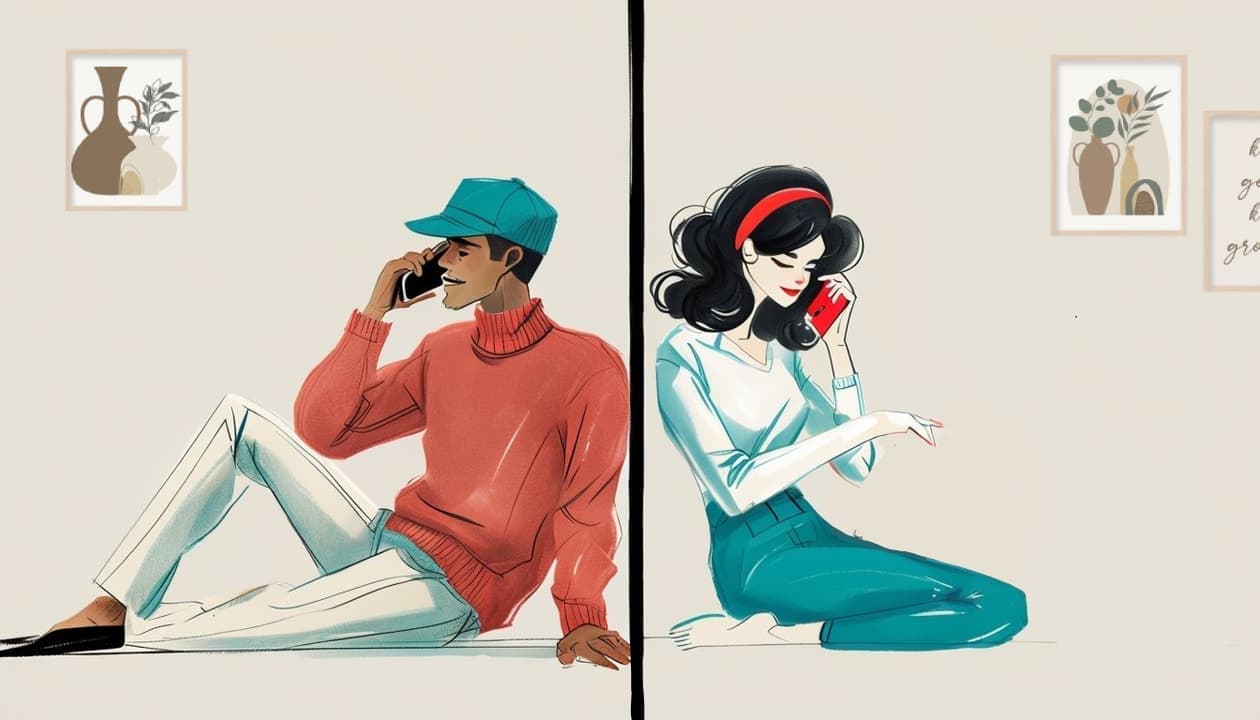
You are afraid of questioning. You are afraid of inquiring. You don't ask the right questions. People speak over the phone, or they sit in front of each other for hours at a stretch, yet they would never even touch some important points to discuss. Some questions are deliberately avoided. Some things they very well know, if they are discussed, would be, as they say, the spanner in the wheels. So they know the no-go zone. They don't go there. They don't go there because the relationship might be troubled. And why must the relationship be sustained? Because there is a desire to fulfill. The most important questions are the ones that are never asked.

Questioner: And someday they will be asked.

Acharya Prashant: Even if you don't ask them, they will be exposed. That's the nature of life. It's an important topic. By the very fact that it is important, life will bring it up in some way or the other. How much can you avoid?

But we avoid it for the sake of temporary fulfilment of desire. It's almost like you're a vegetarian, right? And there is an item there in the bakery. You don't take eggs, but it looks so tempting that you don't want to check with the seller whether it has eggs. You know the question is dangerous, so you would pretend, you would convince yourself there is no egg here, and you will buy it and eat it. You will not ask the very obvious question, does it have eggs? You'll not ask the question.

That's what in the relationship, when it's in its formative stage, the most important questions are never asked, and then avoidance becomes a rule in the relationship. You don't ask me this, I won't ask you that. Let us exist on a barter basis. Give and take becomes the nature of the relationship.

Questioner: Let's skip to the chapter (My Hormones Again) on the part that hormones play in defining our relationships or the way we will proceed with a certain person in our life. Now, when you say that this is something which is not in our control, and you know you will definitely fall prey to it, you will be doing things which perhaps you would have avoided at an early or later age, but at a certain age you will fall victim to it.

Acharya Prashant: The first part is right. The second, not necessarily. You said hormones are not in our control. That's right. That's well said. The second thing you said, we'll definitely fall prey to it. Not necessarily. You may not control the hormones, but you have it in you to observe the play of hormones, and what is observed becomes harmless. Now you know what is happening is hormonal, chemical. Therefore, you will not fall prey to it. You don't need to control it; you just need to know.

Questioner: But that sort of observation doesn't come to teenagers. I mean, they are too young to even observe themselves.

Acharya Prashant: It's not a matter of youth. It's a matter of conditioning. Teenager is a very old person. He has already been conditioned for 10 years or more. If the fellow is 16, maybe the process of conditioning started from the age of 6. So he's already been conditioned for 10 years.

In so many cases, actually, if you go and ask psychologists dealing with child psychology, they'll tell you the process of conditioning starts as early as 2 months, 3 months. That's the kind of age you start getting stamped on. They come and they leave their imprints. That's what we call conditioning. So by the time you are 18, it's actually 17 or 18 years of a very intensive process of indoctrinization. Right?

So that's what makes it tough for the teenager. It's not as if you require to be really old to understand a few things. It's not that self-observation is something that can begin only after you are 25. Self-observation is a very, very simple thing of direct honesty.

You know, you have a little daughter, and she can honestly admit, yes, I was jealous. It's a very obvious thing. Jealousy is a thing of hormones, is it not? Yes, I was jealous. Why did you hide the apple from your brother? I was greedy. This is self-observation. This does not demand a particular age.

But when you tell her in advance, you're a bad girl, if you are envious or jealous, if you're a bad girl, then she will not admit it.

Questioner: She'll start hiding her true emotions.

Acharya Prashant: She’ll start hiding her true emotions.

Questioner: And when we are forced to mask our true emotions and true self?

Acharya Prashant: You cannot then afford to observe.

Questioner: And there will be a sudden eruption.

Acharya Prashant: Yes, obviously. I'm very, very scared within, but the society I come from values bravado. Now will I ever afford to observe my cowardice? I cannot, because it’s been implanted in me that if I am scared, then I'm not valuable, and that the society can in fact ostracize me, and that I must fall in my own esteem.

So that impedes observation. How can I observe something if I'm already afraid of the consequences of the observation?

Questioner: You are ending a chapter by putting up this question, can there be love beyond this thing, chemistry, or some sort of chemical element to it? Does the self want to ingratiate itself or dissolve itself? I want to understand these lines. It's beyond my level of understanding.

Acharya Prashant: Can you read out a few lines?

Questioner: It's this para that I'm quoting. If you want to just have a look. The last line of the stage.

Acharya Prashant: I'll start with the previous one.

“That is a normal human love: as objects meet objects. Such unions exist only under certain conditions. When the conditions change, the dream is over.

Can there be love beyond chemistry? Does the self want to ingratiate itself or dissolve itself? Dissolution can come only when the self sees itself as needless. This seeing is at the core of all wisdom. It is self-awareness, the sine qua non for love.”

How can there be space for the real thing when the unreal keeps posing as the real? You see, the unreal cannot enter your life declaring that it is unreal. Right? Will you ever accept lies if lies present themselves as lies? Will you? You will not. You must have been lied to, some incident in life. How did the person or whatever succeed in lying to you? They said, this is the Truth, right? So lies present themselves as Truth.

Questioner: Someone’s Truth.

Acharya Prashant: Someone’s Truth as reality to be accepted. And you accept them.

So what we have as per ourselves is always the Truth, even if it is a lie, but the very fact that it has been accepted means that we took the lie as Truth. Means whatever sits within us is for us the Truth. And if it is already the Truth for us, how can the real thing now enter? Because we are assuming that the real thing is already here inside, within.

So what it says is, you have to then look at what you already have and ask to what extent is it real. And that is self-dissolution. Why? Because all that sits within us, this is what we call the self (pointing towards the mind).

Now real love is waiting outside there. But this self is not admitting real love. That's the real thing. But this self is not admitting the real thing. Why? Because it assumes that the real thing is already inside. Whereas what is inside is unreal. It was just masking as real.

So how can you then admit that within? By first seeing that this is unreal (pointing towards the mind).

Questioner: So, vacate the space first.

Acharya Prashant: You don't have to be determined to vacate, but you have to be determined to inquire. Because it (pointing towards the mind) is your sanctum sanctorum. This is your sacred place. This or this (mind or heart), whatever. You know this is the most precious place you can have. And before you admit something in here, you must first check for its veracity. Right?

Now we all have already maybe made a mistake, and something has seeped in. Still, check for its credentials. Inquire into its reality. And then maybe something very, very real out there waiting for us will find a space to be welcomed.

Questioner: So that's the beauty of this conversation and this book, that it's not only talking about us and our expectations from others and what they do to us, etc. etc. It's about self-reflection and completing a journey within before you start a journey outside.

So as a parting note for this round of our conversation, let's just put this page, chapter number 18 in context: “Be whole before you belong.” Unless you are a complete person within yourself, you will never become a worthy partner?

Acharya Prashant: You will, if I may say, be a clinger. And if I can be allowed to be harsh, you'll be a parasite. Because if I'm not whole, what am I coming to you for?

Questioner: To eat your food.

Acharya Prashant: To eat your food. My plate is not whole, so I'm targeting your plate and I'm calling it a relationship. You know, I have desires and you are the means to fulfill those desires. That's why I come to you and I say I'm a loving person. This is not love. And because you will not admit to my desires, so I offer a bargain. I say, “Fine, do you too have some desires? I can fulfill your desires and let the two of us then pair together.” Won't work for long because you change, your desires change, and the relationship founded on desires is bound to wither away. Right?

Questioner: Acharya Ji, once again, I'm going to leave a lot of thoughts between the two of us, revolve around in this room, and for the listener and the viewer to take it and understand it, because understanding is the true window to wisdom. Unless you observe yourself, no one can really open your eyes. I think that's the gist of our communication and, again, I can't emphasize it enough. It's a wonderful book. Please get your hands on it and try to read page by page and get a better understanding of who we are as humans. Thank you once again.

Acharya Prashant: And I hope this will be a nice companion for you on your flight back. Thank you so much.

Questioner: Thank you.

This article has been created by volunteers of the PrashantAdvait Foundation from transcriptions of sessions by Acharya Prashant
Comments
LIVE Sessions
Experience Transformation Everyday from the Convenience of your Home
Live Bhagavad Gita Sessions with Acharya Prashant
Categories