
Questioner: Hello sir, I’m Yash. I read one of your quotes, “If you want to test a relationship, if you want to test the quality of your company, start talking real stuff with them or just start blocking the nonsense.”
In most of my life, whenever I’ve had discussions or conversations with anyone, whenever there’s a surface-level discussion or something that is not diving deep, or something related to lies, then everyone wants to pitch in, to give their own opinions, own beliefs. But whenever I start to put facts on the table, try to put the truth on the table, or question them, the discussion stops. They don’t want to pursue it further.
A recent example of this is with my own parents. They are very workaholics. Whenever I try to tell them about their health issue, focus more on it, they try to avoid the discussion, “We’ll talk about this at a different date,” for example. And then that date never comes.
So in that case, there’s no discussion. I’m not able to have a proper, deep conversation with someone with whom I have or supposedly have a relationship, if I believe in. And if I try to sugarcoat something and have a discussion, they do listen to me, but it doesn’t feel as deep enough as a proper conversation, which we might have now. So how do I go about this problem?
Acharya Prashant: Don’t participate in random stuff. That’s it. If I can’t have a truthful discussion, I won’t have a false one either; simple. Obviously, you cannot force anyone, let alone parents, into a discussion that you cannot do, basic civility. But then you too can’t be forced to participate in gossip. That’s it. Let there be silence.
Questioner: But then, even I have some worries, maybe this is a biological response from years of them caring for me. Maybe it’s a response.
Acharya Prashant: Your silence will be your empathy. It will tell them how much you care. If you are a cancer patient and I’m discussing the stock markets with you, when you’ve been very reluctant to have even a proper diagnosis; then am I your friend? Am I your friend? No. The least I can do is not participate in frivolous discussion, and that will tell them something else is important.
Questioner: So, but again extending this, now, currently I’m in the campus and they are at home, and I have other family members as well. Since we’ve never had a proper, deep discussion, I cannot be sure that other family members will question them the same way I do. Maybe there’s an echo-chamber-like effect between them, and they never get out of this cycle; they don’t question themselves as much as maybe I would.
So, within the short time spans during vacations or whenever I call them and try to have discussions, is there some way I can maybe try to at least make them question themselves?
Acharya Prashant: There is a way, it’s a demanding way. You see, if a relationship can sustain on falseness, it will continue to sustain on falseness, right? And in such a relationship, it’ll be very difficult to bring the other to the truth. Getting it? Now, the way will be to put the relationship itself at stake. You see, if I am somebody who does not want to confront the fact of my own physical situation, how truthful would I be with respect to someone who is my physical, psychological, and economic product?
You want to address the other person in the relationship, and you want to address the one because of the relationship, right? He’s my friend, or he’s my father, or she’s my mother; so I want to help them.
What if the very foundation of the relationship prohibits any truth in the relationship because the relationship itself is founded on? Yeah, biology, physicality, many things. Now, if you want to bring the truth to the other, it might be needed that you challenge the relationship itself. Bringing the truth to the other means challenging the false, right? The relationship itself is false. Challenge the relationship, that might be the only way of helping the other.
As long as the relationship can survive with haze, it will continue to prefer the haze. Only when there is an ultimatum, that if we do not clear the haze, we will lose the relationship; then the other is forced to wake up, acknowledge, talk at least.
We are sitting here, and in that sense, you have a relationship right now, right? We are interacting, so there is a relationship. Now suppose you all start spewing gibberish at me. Ultimately, what resort do I have? I’ll have to get up and walk away, and I’ll say, see, so many of them are there, it’s a matter of our collective time, so many man-hours are being invested in this process, but you don’t want to listen. Right? How do I communicate to you? How do I communicate to you that this is important? Ultimately, how do I communicate? I’ll have to get up and at least pretend to walk out. No?
But that’s difficult, that’s demanding. See whether you are loving enough to do that. It demands a lot of love, ironical, no?
Threatening to disrupt a relationship actually demands a lot of love in the relationship.
Otherwise, you’ll have to say, I love you too much to let this kind of relationship continue.
Questioner: Sir, can you please explain what love is exactly?
Acharya Prashant: At the most fundamental level, it has to be tied again to the fundamental human condition itself. You’re not right, you want to be right. That’s love. You’re suffering, you don’t want to suffer. That’s love. You are in bondage, you want to fly in the sky. That’s love, at the inner level.
Between persons, the one who can help you fly in the sky is the one you ought to love. Instead, we often find ourselves loving those who propose to us with chains, “Come, hold my hand, I’ll give you a mansion to live all day in,” and you’ll think that’s great love. No, you are being confined to a mansion.
Questioner: So, another question: when you told him that sometimes we have to be daring to challenge our own relationship, that if it doesn’t happen, I’m walking out. Doesn’t it enforce, doesn’t it kill their own free will?
Acharya Prashant: There is no free will. If there is free will, then they are already free, then why do you need to disrupt the relationship? How can an unfree entity have free will? Your desires, your thoughts, hopes, ambitions, they are all conditioned, they are very unfree. Tradition, media influences, biology, movies, culture, they decide even your most intimate matters. Where is freedom really?
So, it’s not a question of free will because there is no free will.
Questioner: But sir, then who am I to force someone?
Acharya Prahant: That’s a good question to answer, yes. The kid is putting his finger into the electric socket, who are you to stop it? Let the kid exercise its free will, who are you?
And obviously, the question is not just rhetoric, because first of all, you have to be more mature than the kid, right? It is actually possible that the kid might be doing nothing wrong, and you are worse than the kid, and you pull the kid away or slap it or do something very stupid. So you have to decide whether you are really in a position to help.
Questioner: In this same concept, how do we stop moral arrogance? How do I understand if I think I know something that is right, is it my duty to tell you that, even if it wounds you a lot, even if it breaks the fabric of our relationship, is it still my duty?
Acharya Prashant: It all depends on the intensity of your love. You see, if you are speaking to an unwilling one and telling him things he is not yet ripe enough to appreciate, it will hurt him and he’ll retaliate. So, it depends on the intensity of your love whether you want to suffer the retaliation. Are you getting it?
There are those who are ready to listen, and it’s good to talk to them. But it takes a lot of heart to talk to those who do not want to listen. You don’t talk to them, first of all, you chase them, because they would never come to you on their own. So, first of all, it takes a lot of stamina to chase them, and always chase them, because they want to run away. Even if you somehow gather them, they want to run away. But there is always a bit of coercion involved. And then, if you have gathered them and you speak to them, it’ll hurt them, and there will be a reaction, a retaliation. What remains to be seen is how much you can suffer for their cause. That’s where your love is tested.
And that’s not an obligation, by the way. You can always say, “I’ll speak only to the willing ones. Why should I risk my own wellness, my own peace, sometimes even my own life for the sake of unwilling idiots?” You can always say that.
A point comes when you don’t want to say that. A point comes when you find yourself unable to say that. A point comes when you find you can’t help risking your own wellness because something is just so important, so urgent; it deserves a sacrifice, maybe.
Questioner: So, when you mentioned that to change someone else you have to be mature yourself, but what do we mean exactly by mature? In the case of a small child, for example, a toddler, they question a lot of things. Maybe the parents might have questioned when they were toddlers, but may have forgotten, and then they learn newer things from the toddler, from their questions.
Or, another example is if we keep pets, by observing what the pets do every day, we can learn about our own basic biology, which might be common between us: our needs and stuff like that. So, in this case, the toddler or the pet, generally, we do not consider them as more mature than the adult.
Acharya Prashant: Yeah. But you are more mature because you can learn by looking at the dog, and the dog cannot learn by looking at you. So, you are more mature than the dog.
Questioner: And in the case of the toddler?
Acharya Prashant: Same thing. A good indicator is, if you can look at the other and see your erstwhile self there, then there is a realistic chance that you have matured. When you look at the other and you see your former self there; the self that you have outgrown. Then there is a realistic chance that yes, you are in a good position to help. You see someone committing the same mistakes you made in the past, there is a chance you are qualified to help.
And there is risk involved. I just said “chance.” Chance is risk. Yeah?
Questioner: Sir, I wanted to delve deeper into the Truth problem, which is a problem, definitely not a conclusion. Number one: the question I had was, if I say, “If we all here pledge that we will pledge our allegiance to the Truth and nothing but the Truth from now on.” Number one the question that arises is: how do we know that this Truth that I’m talking about is not just an amplification of my own bias? And two: if I go to some other Truth, if I find out, “Okay, what I believed was wrong, and now what I believe is the Truth,” how do I know that that is also not wrong?
Acharya Prashant: There is no Truth. There is just a progressive rejection of falseness. There is nothing called Truth, no point, no image, no destination, no statement, nothing. There is nothing called the absolute Truth.
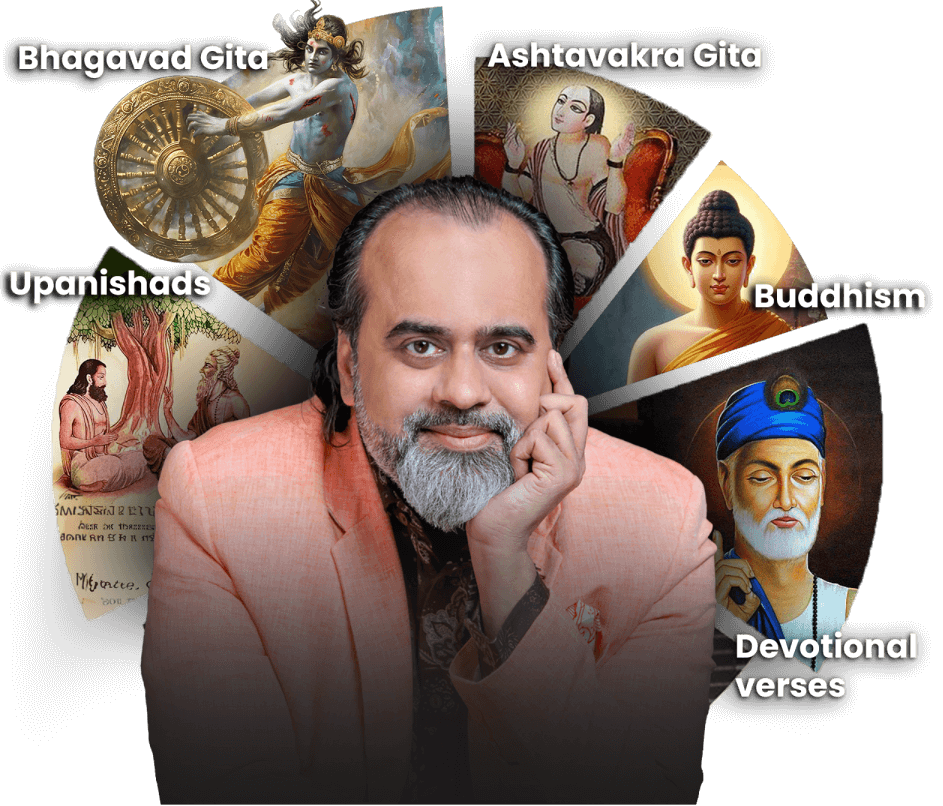
And that’s the reason why the real scriptures use some very peculiar words for the Truth. Let me come from the direction of Upanishads, they will say: “Akathya” (can’t be spoken); “Anirvachaniya” again (can’t be spoken); “Akalpaniya” (can’t be imagined); “Asang” (without company); “Asparshya” (not available to be touched); “Aniket” (never housed at any place or any geography).
Just so that you do not create an image around the truth. Hence, in several ways they warn you, they caution you; anything that you can think of, know of, imagine, sing of, is not the Truth. Never. Forget the Truth. Dare the false. And because you don’t want to look at the intimate falseness, so you imagine, speculate a faraway truth. No? Some distant blaze there, that’s the Truth, look there, so that you don’t have to look at yourself.
And that also brings us to the definition of a real scripture. It is not like a map to a destination, it is like a mirror to yourself.
Any book that acts like a map is to be discarded as a scripture, it is not a scripture. A scripture is a book that says, “Look at yourself,” and says that in a thousand ways.
A mirror. Can you look at your own face? That’s a scripture. A mirror does not tell you anything. It does not tell you what the Truth is, but it tells you how false you are, how tainted is the face. No? That’s what real scripture does. It never tells you the Truth. Any book that claims to contain the truth is to be immediately rejected. The truth is contained in no book.
But yes, there are great books that deserve to be called scriptures, that can inspire you to challenge falseness. That’s all that a book can do.
Questioner: Would it be fair to say we reach something we don’t understand by rejecting everything we do understand?
Acharya Prashant: You don’t have to reject everything that is there.
Questioner: Everything that we know is false?
Acharya Prashant: Yes. Examination is the word. Inquiry is the word. You can’t come to something with a premeditated mind, “I’m going to reject it.” That’s bias. That’s bias, not inquiry. It’s not a commandment, “Reject, reject, reject.” The way of living, the nature of consciousness, is knowing. Now, if that knowing results in rejection, fine.