
Questioner: Namaste. I'm very grateful to be here. Nice to see you today. As relationships and being in conflict within yourself of ‘what is right?’ And ‘what is wrong?’ So, usually when I talk these days, I feel there's nothing right or wrong. It's a perception of an individual, how he or she sees a given situation.
I have had a tough journey in my life, where I have done a lot of right in my perception, and received a lot of wrong in my perception. So today, when I look back, I really feel, "Jo hamaare mummy-papa hamein sikhate the, ya school mein padhaya jaata tha moral science lesson. Ya hamein sikhaya jaata tha ki aap achchha karoge, aapke saath achchha hoga.” I don't think it really works. I'm at a stage where I really doubt. This does not work. So, today I feel that everybody's purpose is different. There, I have heard the word, "journey," is different. Their pace is different.
So, in relationships there are two people. It can be mother–father, it can be brother–sister, it can be husband–wife, it can be any. There are two people walking at their own pace. One thinks differently, the other one thinks differently. How do you come to a common standpoint without saying right or wrong? Without looking at the other person in a manner that he or she is any less or more, and treating the other person equal, fulfilling each other, as we call as filling each other's bucket, and living a purposeful life, and getting along at a mediocre level? For example, we all cannot be you. We all can be behind you maybe, and that's why we are here and you're there. How do we live a life which is just fine? Which is just fine. That is my question to you. Thank you.
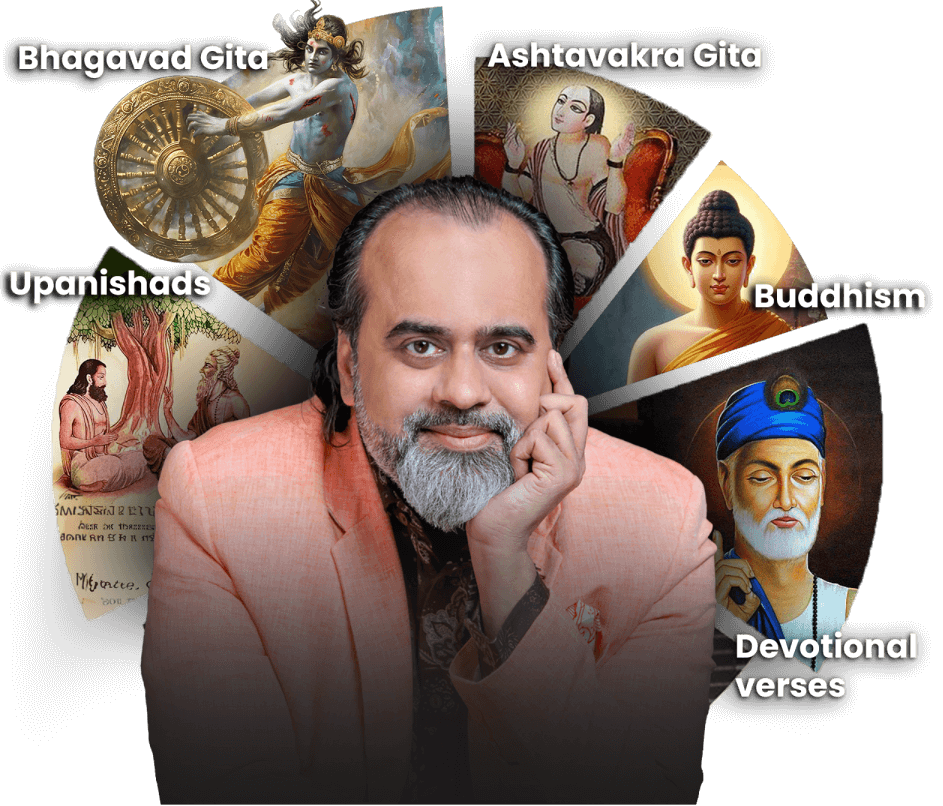
Acharya Prashant: Why be related to anybody at all?
Questioner: Because we are social people.
Acharya Prashant: No, no, that means nothing. What do you mean by we are social people? Get to the root of this. Why be related to anybody? Why?
Questioner: Because we are, in one way or the other. We live under the same roof.
Acharya Prashant: Why do you live under the same roof? That's the question.
Questioner: Because we are born together, maybe as siblings.
Acharya Prashant: Even if you are born together as siblings, I mean you do take your separate routes. I mean why should one be related at all?
Listener: coming from society.
Acharya Prashant: See, typically when we are in this domain, we are either talking of parent–child relationship or one's relationship with the spouse.
Why is one related at all?
Here (pointing towards oneself) is the human being, right? All questions are from human beings. All suffering belongs to the human being. All purpose, all direction, all journeys, they are relevant only to the human being, the individual. Why must the individual relate to the other?
Questioner: For companionship.
Acharya Prashant: What does he mean by that? Who is the individual and what does the individual relate to the other?
Listener: Are we talking about Ego?
Acharya Prashant: I'm talking about the individual. Here I am, right. Why must I, or why do I, relate to somebody?
Listener: Because I am looking for fulfillment.
Acharya Prashant: Because I'm looking for fulfillment. So, the question of relationship must start with the question of identity, right? "Who am I?" And that will tell me why I relate to others. Right?
For example, right now I'm relating to all of us here. I'm relating to you. I'm not relating so much to the walls and the electronic equipment and other things, the vehicles parked outside. I'm not even thinking of my friend standing here behind me. Right? I'm relating to you for a purpose. Correct?
When we relate to each other, what is the purpose? Because we are creatures of purpose. Why do we relate to each other? You're born alone, right? And there is a biological relationship one has with the mother. And that relationship is also severe after a while.
Why do I relate to somebody? What within me makes me relate to somebody?
Listener: For our growth in life.
Acharya Prashant: Yeah. But do I know that I need growth? Do I understand where I stand? Do I know where I stand? And therefore, do I know what the meaning of that growth is?
Questioner: I think this is need. The word is "need" here.
Acharya Prashant: So, we are born unfulfilled, aren't we? We are born unfulfilled. And that lack of fulfillment is an experience. We experience that we are unfulfilled. It's a very vague kind of thing. As vague as the responses we get when we ask, "Why do we relate?"
These are vague responses. You know, we relate, oh, there's something. There's no clarity there. But there's an experience there. There's a clear experience that one cannot invalidate. We do experience a certain hollowness. A lack of wholeness within. Something is amiss. Something is not right. That's the very definition of the human being. And I'm calling it definitive because that's something that we don't acquire. We are born with it. We might amplify it later, but that's not called acquisition. That's amplification. We are born with this experience that something is not all right with me.
We experience it. But do we understand it?
Because experiencing is not the same thing as understanding. You might experience palpitations, but do you understand what's happening? Do we understand? No.
So, there's restlessness within, emptiness within, loneliness within. But we don't understand what it is. But it's so very a thing of experience that we cannot deny it. And because we are experiencing it, it makes us do things—just as when you have a severe headache, you might not know where it's coming from, what its origin is, but it will make you do things. And it can make you do very, very insane things. Stuff that is experienced but not understood can make us do insane things. Right?
Just like, when you are hurt in your little toe. Have you seen what you do? You're walking and you get hurt and there's something here, the leg of a table and you just (get hurt), what do you do? You scream and you run for a while sometimes, and then you hop around holding this in your hand. That's what experience is making you do. And none of that amounts to any understanding of what is happening. Right?
Somebody comes and puts something on your shoulder from behind you, and you start running. Now, running will not help the situation. But you start running because you're experiencing it. And the experience is so overwhelming, so overpowering, that it makes you suspend your realization, your faculties even more. That's what loneliness, emptiness, that void within makes us do. We don't understand it. Relationships are our way of filling up that void. Something is amiss. "Can I get someone in my life to fill up that void?"
It's a Bṛhadāraṇyaka Upaniṣad, and Yājñavalkya is speaking to Maitreyī. "Oh Maitreyī, Know that the wife relates to the husband not for the sake of the husband but for the sake of the self."
All relationships, the wise ones have told us, are for our own sake. What's worse is that we do not know where our sake lies. We experience, but we do not understand.
So, we do not know where our real self-interests lie. So what do we do? We do anything at random. When you do not know what you must do, you sometimes start doing, you often start doing what everybody else is doing. That includes relating as well. And it's so prevalent that we don't even feel like asking, "Why the hell am I doing this?"
Sometimes the body becomes overpowering, the physical needs, and sometimes the society overwhelms you. And then you start relating and doing things like staying under one roof and sleeping on the same bed without ever asking yourself, "Why the hell am I doing this?" Not that we want to denounce that or condemn that. We just want to understand that.
And that behavior arising out of an experience of hollowness without any understanding of hollowness — that same behavior is reflected in a relationship with the entire universe. "Why do you need one more pair of shoes?" That too is a relationship. "Why do you watch that particular comedy show?" That too is a relationship. "Why do you espouse that particular ideology? Why do you vote for that party?" That too is a relationship.
We do not understand. But we operate on the basis of a vague feeling. I have a vague feeling, and that feeling is making me run. That's our nemesis. Are you getting it? "Why must I relate to the other?"
And then there are those like the gentleman Rishi I quoted, Yājñavalkya. They too relate. He was a married sage. They too relate. But they do not relate from the point of their inner void. They relate because they are already fulfilled. And because they're already fulfilled, so now they can operate in one of two ways.
One, they can play around. "I don't have anything to gain. I can just run around. Do you want to run with me? Let's have fun. We won't gain anything from this. I'm not here to own your body or your emotions or your loyalty. We, the two of us, are together just to have some fun." So that's one way in which nothing is expected from the other, because you are already complete in an inner way.
And the other way is that of sharing, giving. "I'm all right, and I relate with you to share something that I have because I see that you are much the same being as I am in terms of potential. There is no difference between you and me. So I relate to you to share. Share not so that you can give me something, but because it becomes your nature to share. You have it, so you're sharing it."
These are the only two healthy ways of relating to the other. Only two healthy ways. And in both of these ways there is the Nishkāmta that Bhagavad Gita talks of — a lack of self-interest. "We are together. Why? Well, we never thought of that." And that's beautiful. We never thought of that because there is no self-interest involved here. It's just good fun being with this person.
"We are not here to bind each other and cage each other. We are just with each other." That "justness" — that's one of the most beautiful things in a relationship, justness.
And the other thing is when you are there to radiate, to distribute, to share, to uplift, to help.
But the normal kind of relationship belongs to neither of these types. The normal relationship is transactional. "I am with you because I think there are certain things I can get from you, and there are certain things I can trade with you. So in my perception, I think that's a fair deal. I'm expecting certain things from you. You keep your side of the deal, and in return these are the things that I'll provide you. That's my side. And I think that puts us as equals."
No, no, that's not something that he might be expecting. The fact is, in a relationship what we expect from the other can never materialize, because somebody said, "We have a God-sized hole in our heart." The size of the hole in the heart is enormous. And the other one, irrespective of who the other one is as a human being, the other one is too small, too petty to fill up that vacancy. He'll never suffice. He will never succeed.
And when he'll not succeed, then you'll be angry and disillusioned and disappointed and violent. Because that's always the hidden expectation: "This fellow will enter my life and make it blossom." Nobody can make your life blossom. Only your own understanding can help you. The other fellow could not make his own life blossom. How will he help you?
I often say the operator in relationships is not plus but multiplication, not addition but multiplication. We experience incompleteness. The other one is incomplete as well. So we presume that half plus half will become one. We do not understand that the operator is multiplicative. So it actually becomes half multiplied by half equaling one-fourth. You are worse off after the relationship.
What you expect from the other can never, never materialize because you are expecting the impossible. What you want from the other is something only you can deliver to yourself. The other is in no position. But the other bears the brunt of our expectations, and often when we strike a relationship we do not even take the other's consent. Do we actually list down all that we expect from the other and get his signature? No.
The fact is, if you were to honestly list down what you are secretly desiring from the other, the relationship would be aborted right in the beginning. The fellow will see, "This is what you are planning, you evil one." Outwardly you are saying, "No, no, no, you know, the two of us, we will do great things to each other." But inwardly there is a subconscious plan being hatched. And when the plan is foiled, then there is anger. That's what happens.
And both the parties are victims. If you play the victim, you are not wrong. You are just telling half the story. The fact is, both of you are both victims and victimizers, because both of you are equally ignorant beings.
I'm asking you, please — how can anything that starts with lack of clarity be good or auspicious for you? It does not just start from a point of lack of clarity; all its duration, it runs its course in ignorance and vagueness. How can it bring goodness to anybody? Be it a father–son relationship, a mother–daughter relationship, or siblings, or just friends, or spouses.
I mean, the first thing that you need is clarity within yourself. Otherwise your very touch will be destructive. You might keep saying, "I love my kid." But if you are an ignorant parent, your love will be very harmful to your kid. Like you said, all these lovely and nice-sounding things that we were told, we found that life doesn't work like that. That's the point.
You become a parent at 25, 30, 35, and you are very ignorant at that age. And then you start preaching to your kids. Are you even entitled to teach anything to your kid? What do you know in life? Why are you teaching your kids? Why did you beget kids first of all when you don't know anything about life? Who entitled you to become a mother or a father? And on top of that now you are trying to become the guru and saying things like, "You know, Accha karo, accha hoga. Tumhare saath bura hua, tumne kabhi kuch accha nahi kiya tha?”
It's bad if it disappoints us. But the fundamental thing is knowing yourself. If you do not know yourself, there is no way your relationship with anybody, or anything, or a thought, or ideology, or history, or future will ever be healthy. It is not going to be possible.
An ignorant person is a dangerous thing, made even more dangerous by a relationship.
An ignorant person, even if he is walking alone on a road, is a dangerous thing. What if you bring that person to your bedroom? How does it matter? You start calling him your husband or wife. He has remained equally ignorant. Or, does wedding change things so much? It doesn't. Very stupidly you can go round and round the fire, how will that change anything within?
This person who does not know how to choose, for example, an educational stream. This person does not know how to choose a leader to look up to or follow. How will this person choose a partner to spend life with? I'm asking you, please tell me. He does not know how to make choices because he does not know the person who is making the choice. He does not know himself. Therefore, he does not know what is good for him or her. And this person makes a de facto irreversible choice and says, "No, no." And then he says, "You know, life is such a melancholy tale." And he writes poems in his tears and says, "Yeah, I'm a good man, but life has not been fair to me."
The only goodness is clarity.
Did you ever try to understand? No. You spend your life based on your experiences, feelings and emotions, never having the courage to look into their genesis, their entire process, where they come from, and how heavily they are influenced by your hormones and the social systems.
Then you said, "Just because I'm feeling something, it is the truth. Just because I feel like saying something, I agree, I disagree." No, no, no. Do you even understand what you are saying? Before speaking to the other, would you mind speaking to yourself first? Before proposing to the other, would you mind loving yourself first? Too much to ask? no?
"I love you all. I love chicken as well." That's the quality of our love. "I love you." It's such a dangerous statement. Just two minutes back, I heard him saying, "I love mutton." And now he's saying, "I love you.” Run, run, run, run. His love is another name for brutal desire. No? It was this song, "I love the shape of you." And when you're out of shape, then you come to Acharya Prashant talking of lovelessness in life.
You have allowed me to hurt you, you know. I do feel sorry for that. But please continue allowing me. The day I feel you no longer are game for it, I'll stop.