Does Your Partner Love You, Or Just Own You?

Acharya Prashant

11 min
157 reads
Does Your Partner Love You, Or Just Own You?
Love is not attraction, possession, dependency, or a transaction driven by personal gain. As long as relationships arise from insecurity, ownership, or the desire for psychological completion, they remain centered on the ego. Love is simple, natural, and free of self-interest, flowing without preference or exclusion. The ego seeks security, continuity, and suffering because they preserve its identity, while freedom and joy threaten its existence. A meaningful life begins when one stops repeating old patterns, accepts uncertainty, and chooses freedom over the comfort of familiar cages. This summary is AI-generated. Please read the full article for complete understanding.

Questioner: Good evening, sir. My question is: What is love? Is it the same for, say, a partner, my family, my friends? Is it binary, or is there anything such as love other than the self-love that we have?

Acharya Prashant: Start from where we stand. What is not love? What is not love, right? A man looking at a woman because she's pretty, obviously that's not love. A woman looking at a man because he's handsome. Both engaging with each other after looking at each other's bank account, no, obviously that's not love. Ensuring that the parents agree and the caste equation too agrees, obviously that's not love.

Or the mother and the kid. A mother saying, "This is my particular kid, so I'll take care of it." Or a dog lover saying, "Oh, dogs have to be taken care of, and I'll feed chicken to them." Obviously that's not love.
Have you seen people walking their dogs? Some of those exotic species, they keep a cane with them. One hand the leash, the other hand the cane. What's the cane for? To beat up the stray dogs. "This is my dog. This is my baby. I love it so much. I am the mama, the pet mother." That's the love between the mother and the kid. "My baby, I love it so much. And, if needed, I'll beat up the other ones." That's obviously not love.

What's love then? Nothing in particular. Nothing at all. Be free of this mischievous thing, and then you have natural relationships. If you prefer, call it love. It's nothing extraordinary, nothing special. Doesn't glow, doesn't shout, no gloss, no glitter. Something very simple. I like to say: like the wind blows, like the grass grows; love, simple, pure, ordinary. Not the scintillating kind, not the glamorous kind, not the special kind. "Ah, my somebody special, the prince of my dreams. The princess of my dreams, wet dreams." Nothing. Simple.

The ego stands surrendered. Now your relationship with everything can be called love. Everything.

Now it's not a special object you are loving towards. You are just loving. Just loving, irrespective of the object. Doesn't matter whether my baby or somebody else's baby. Doesn't matter whether a baby at all. It's a particular quality in a relationship, a quality free of self-interest, a quality free of ignorance and exploitation.

It is not peculiar. It is not specific. It is not unidirectional. It's a radiation, general, universal, like the light of the sun. It doesn't choose. Like a large cloud raining, doesn't choose. It won't say, "Ah, this special droplet is only for my wife because the wife will get angry and jealous and envious and beat me up if I offer it to the neighbor's wife." Do you get this?

You have romanticized love. You have turned it into something very sensational and, therefore, very vulgar. The wind kisses the leaf, that's love. Nobody says a special event just occurred because there is nothing special in it. Nobody wants to celebrate an anniversary because there is nothing special in it. The soil gave birth to a blade of grass, that's love. Nothing special in it. You don't throw a party. And in such love, there is no breakup. Because your hookups are special events, so are your breakups. And you remember both the anniversaries.

If you are listening without care for consequence, without trying to conclude, without projecting a future, how is that not love? Are you listening? If you are listening without caring for consequences, that is love.

Questioner: Sir, marriage or relationships that we have with people, friends, or family, those are just for partnership, and we love everyone in the same way? Is it that, or how do we form relationships with people?

Acharya Prashant: Must we justify nonsense? How is that a responsibility? Simply call trash as trash. Why do you need to glorify it? Don't you know what is meant by marriage? You aren't from some other universe, right? You know what it entails. You know how it happens. You know what it means. You know the entire process. Why even associate love with marriage?

Questioner: Thank you, sir.

Acharya Prashant: It's getting dangerous. I want to stop it.

Questioner: Like, if someone decides to say, “Marry someone,” I used to think maybe it is like, obviously, they should love them. So why not marry someone else? Why someone? Like, you're choosing someone, right?

Acharya Prashant: If nobody told you that between a man and a woman, or between a man and a man, or whatever combination, there can be something called marriage, would you still marry?

Questioner: Like we decide to live with someone.

Acharya Prashant: So that's fine. Right now you're asking me a question. In the evening, you were roaming around with someone. That's called companionship. That's fine. Why must you tie the other to a pole by your name? You understand companionship? I am free, and so are you. And we have chosen to walk together without any vision for the future because we love. And in love, one doesn't have the space to worry about the future.

I won't say, “Ah, but I need to get her under legal obligation, and religious obligation, under social obligation. The priests must be there. The entire world will see. Else she will run away.” Is that love?

Companionship is beautiful. But what is this urge to own and possess the other and say, “You are mine?” The other is not an object. How can you belong to somebody?

Questioner: But why do we decide to walk with someone? Is it like we don't decide…

Acharya Prashant: How did you decide to talk to me? Because it's worth it. Yeah?

Half the planet is women. A lot of them are worth it. There is this ego thing within, and for its own sake, it enters into all kinds of relationships, right? With the workplace, with the mic, with the shoes, with the house, with the politician, with the priest, with the shopkeeper, right? All these are relationships, right? And what are all these relationships for? To serve my interests, because I am the ego, and that's all that I can do.

The ego is an insecure trader. First of all, insecure. Secondly, holding the belief that by trading something, it can get completeness. So, it's all the time busy bartering. “I'll give you this, you give me that.” That's what the ego is continuously doing, right? And it has relationships with everything. Even the handkerchief in your pocket, there is a relationship that you have, right?

Similarly, you have relationships with people in your life. Same center, exactly the same center. Like you buy a bike for your own sake, you take care of the bike, don't you? You take care of your loved ones as well. One day you discard the bike. One day you discard those around you. The same thing. Not a moral lecture. The inevitable consequence of operating from the ego center. There is nothing else that it can do. It has to trade. It is so insecure. It suffers so much. It has nothing else to offer.

Are you getting it? So that's not love.

Questioner: Namaste, sir. My name is Manish Debnath. I am a Junior Research Fellow in IIT Bhubaneswar. So, my question is that, why the karta chooses bondage or pleasure over freedom, or maybe some important action?

Acharya Prashant: In joy, it dissolves, and it is a choice to prefer existence over joy. There is no reason. It's a choice. One may say, “I must survive. I need security. Even if survival means suffering, I must survive.” The other one says, “It's a choice, a sovereign choice.” The other one says, “I will dance. I will celebrate, even if that means my dissolution.” It's a choice. You're asking for a reason. You are the reason because it's your choice.

The ego can survive only in suffering. Therefore, the ego chooses to suffer. In joy, there is just joy. You are gone. It's some kind of death. Therefore, the ego rejects joy.

Wherever it finds joy, it runs away. Joy seems too expensive, too dangerous, and suffering offers security. That's the reason the entire world is suffering. It's a choice. There is a trade-off. Even if I am suffering, I am secure. Cages make you suffer, but don't they offer you security? Please tell me.

“Oh, my little girl, I love you so much. You must be home by 7:00 p.m. I love you so much.”

“Papa loves me so much.”

In cages, yes, there is suffering, but there is also security. You have to choose whether security is worth it. It's a decision to be made continuously. Yes, there is danger on the roads. Yes, but there is death in the cage. What would you prefer, danger or death?

If you are not prepared to embrace danger, you'll also not accept life. Because in security there is no danger, for the simple reason that for the dead there can be no danger. Cages make you dead, and once you are dead, there is no danger. A lot of people, therefore, prefer to be caged and dead. At least there is security.

“The job sucks, but it's a secure job, you see. Nobody can fire me.” How can you be fired? You're already dead. You don't need to be fired. You need to be cremated. But look at the craze for the secure kind of jobs. Any portfolio, any task, I don't bother. But just keep it secure.

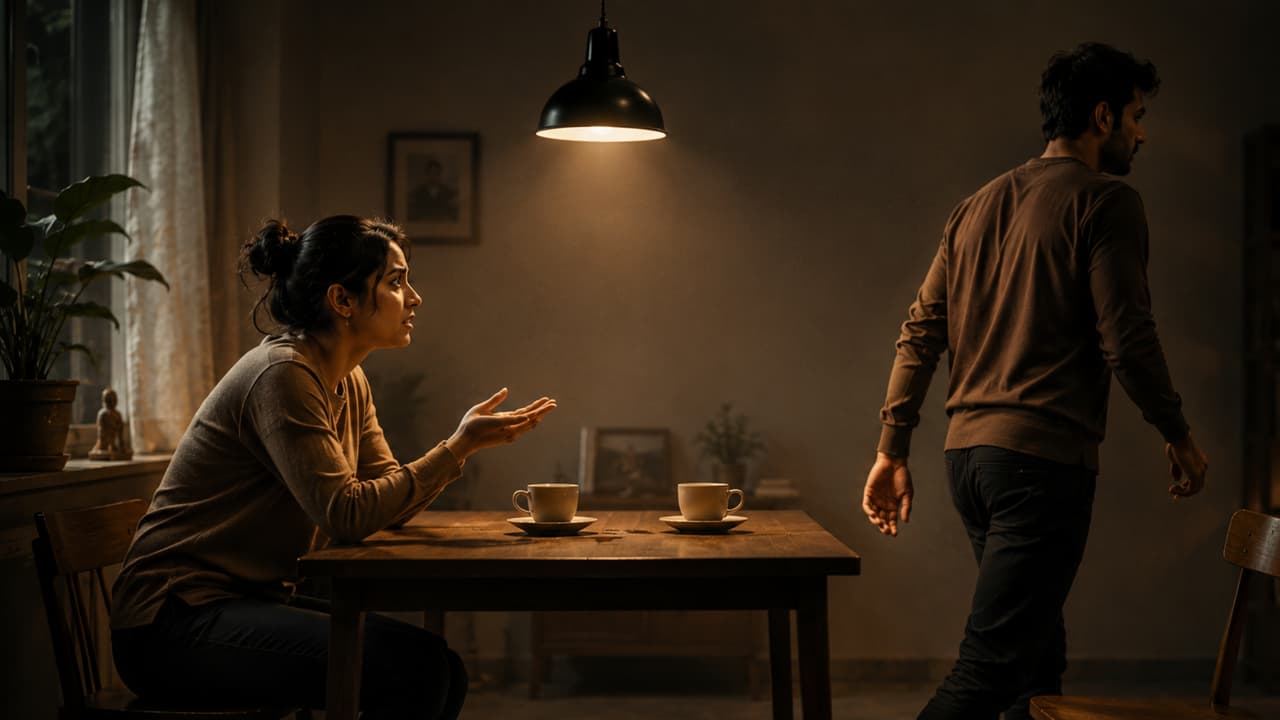
It doesn't matter what kind of relationship it is, but it must roll on. “No, no, no, no, no. Please don't separate. Please don't separate. Please don't separate.” The thing must continue because in separation there is danger. Give me the security of continuity. “No, we are together. We hate each other, but we are together.”

Not only do we hate each other, we even have kids born out of hatred. Yeah? When you hate each other, you know, revenge sex, five kids. Think of the quality of life of those kids. But you won't separate because there is security, and that's a decision. So I can't do anything about it.

Questioner: Okay. Thank you, sir.

Questioner: Good evening, Acharya Ji. I'm Paritosh. I have this question that mind is that disease which disables me from being honest to myself, and it has been the source of trouble for me since..."

Acharya Prashant: Why are you escaping responsibility? You are your own trouble. Mind is not the trouble. The mind is your shadow. The mind is just the collection of objects you have chosen to put around yourself. Why are you putting the blame on the poor collection?

Questioner: How to get rid of it, sir?

Acharya Prashant: You have to get rid of yourself.

Questioner: How to do that, sir? So, tell me how to do that?

Acharya Prashant: Don't put your energy into supporting yourself. See how you support your patterns. What is a pattern? “I'll be tomorrow what I was yesterday.” That's called a pattern, right?

See how you operate out of the past. See how you are invested in repeating and extending the past. And when you see you are again doing that, stop. Just stop.

Questioner: Thank you so much, sir. It was enlightening.

Acharya Prashant: There can be no method sir, because it's your life. You have to stop. It stops at that.

This article has been created by volunteers of the PrashantAdvait Foundation from transcriptions of sessions by Acharya Prashant
Comments
LIVE Sessions
Experience Transformation Everyday from the Convenience of your Home
Live Bhagavad Gita Sessions with Acharya Prashant
Categories