What Deserves Your Whole Life?

Acharya Prashant

17 min
626 reads
What Deserves Your Whole Life?
True dedication does not feel like painful sacrifice. When a goal becomes love, unnecessary distractions quietly lose importance instead of being forcefully abandoned. Personal growth and contribution to society are not separate; meaningful work naturally benefits both oneself and others. Real freedom is not outward performance but inner clarity. Life should be measured by inner elevation, not by comparison with others’ achievements. This summary is AI-generated. Please read the full article for complete understanding.

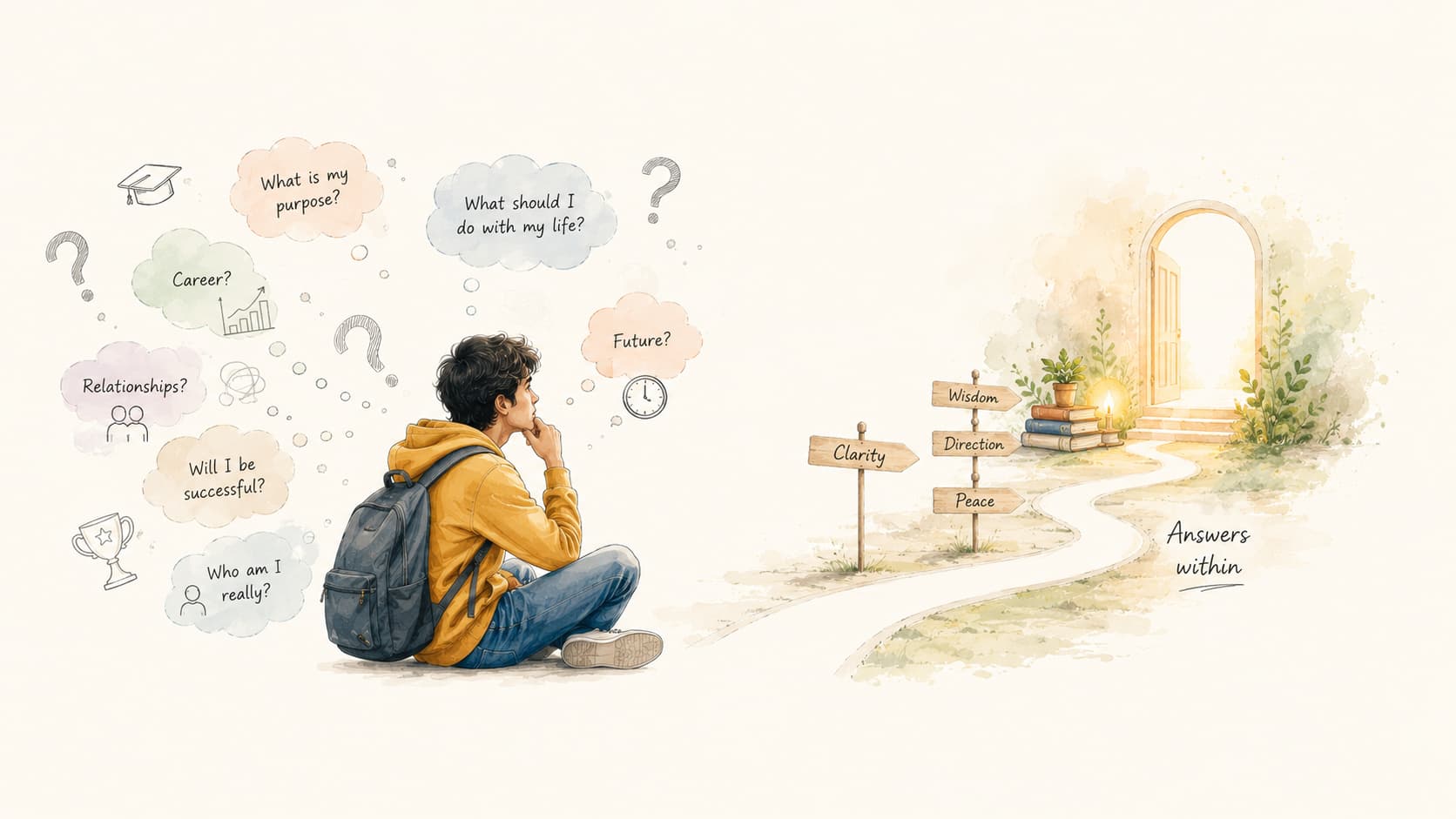
Questioner: Good evening sir. My name is Saksham. So my question is that, is it really needed to sacrifice everything for that one goal, your family, your friends, your recreational activities that you are doing since your childhood, as you have always been very active, but now you have to achieve that one goal? So you have to stop everything and then achieve it. So should we have a balanced life or a goal-oriented life?

Acharya Prashant: See, whenever you will need to sacrifice, whenever sacrifice will be an activity additional to the goal that you are pursuing, it's quite likely a strong indicator that there is very little love for the goal. I'll clarify. The mental model you are coming from is: here is this goal that I have chosen, right? And you're asking me, should I be fully dedicated to this goal or should there be balance? That's the word you used, right? Balanced. Should I invest myself 100% into this or must there be other things as well? And the presence of 10 other things, in addition to this one, is what you are calling as balance, right?

And if I advise you, let's say, that no, put your heart and soul into it, 100% focus here, then the other things will need to be what you are calling as sacrificed. So there would be two things then. You're talking of two parallel activities: one, pursuing a goal; secondly, and separately, more importantly separately, dropping all things other than that goal. Whenever that happens, there is probably a mismatch, a dissonance.

How?

If I am actually very, very discreetly choosing this (pointing to the glass of water) for myself, if I know the worth of this, if I know why this is important for me and the world and everything and everybody, if I really know the absolute importance of this, then where is the mental energy and the mental space to dedicate to any other thing? So the other things will not need to be sacrificed as an additional activity. They'll just drop silently, very quietly, even without your knowledge. You won't even know where all the relatively worthless things disappeared.

Now, does that mean that there would be nothing left in life apart from this?

No sir, not exactly. What would happen is that whatsoever is needed in pursuit of this, because this is not a goal anymore, this is love; whatsoever is needed in the pursuit of this would get aligned to this, would get aligned to this.

Now, this is something, if it's a worthy goal, probably it demands 10, 20, 30 long years of your life. So you'll say, first of all, I need to stay alive for that long, 30 years. So you will take out time for your body. You will take out time for sports, let's say, but now it's sports aligned with your mission, sports keeping you fit for the sake of your goal, your love. So it's not as if other things will not remain in life. They will remain, but in an aligned way. And the other things, they will get dropped, not sacrificed.

Why am I asking you to avoid the word sacrifice? Because sacrifice denotes value. When you say you're sacrificing something, that is equal to saying that the thing had value. But I renounced, I gave up, and that's some sort of pain. No? When you know that value is contained in this, then the other things, you know, don't really contain value. They evaporate. They're not sacrificed. They are ignored. They are no more there as things of value. Are you getting it?

On the other hand, if you say, out of a total inventory of 100 units of value, this (pointing to the glass of water) one has 40, this (pointing to the cup of tea) has 30, this (pointing to the handkerchief) has 20, and this (pointing towards the book) has 10, and then you say I'm choosing 40, then you will have to make a sacrifice. But that's not the way life is. Because if you are choosing 40, then you're still sacrificing 60.

The sacrifice, the worth of the sacrifice, is actually bigger than the worth of what you have chosen. Even though relatively this 40 is bigger than this 30, 20 and 10, cumulatively they amount to 60. Are you getting it?

No. That's not the way life operates. That's the way businesses can operate. In life, you dedicate yourself fully to the absolute.

How is that possible?

You have to live with yourself, right? You, as far as you are concerned, are your utmost priority. Even this entire world exists to you. Therefore, see what is it, that you most desperately need to do in life for your own fulfillment, and that is your absolute.

And then you can say this does not carry 40 upon 100 value. This carries 100 by 100 value. And in the pursuit of this, if I have to do five other things, I'll do that. If this be my destination, then if I have to adopt five different routes, I'm fully flexible. That kind of flexibility is welcome. Flexibility when it comes to the routes, the means, but the end cannot be flexible.

When it comes to the means and the methods and the routes, display total flexibility. But you cannot have flexibility in the objects that you love. You cannot say 40% love to this, 30% love to this. You can love only the absolute, right?

And that absolute is not a far-off thing. When you look at your own inner condition, you are your own absolute, right? Because one lives within himself, herself. When you look within yourself, and if you are honest enough, you know what is it that you need. And that which you then need is not something only of your own. Therefore, the pursuit is not selfish. That which you really need is also something that the entire world needs.

So without any guilt, pursue that which you really need. Really need, really in bold, really underlined, really, right? And in the process, as it keeps getting cleared, be ruthless. Pursue it wholeheartedly. Find other things dropping by the wayside. Don't bother. If you find one route blocked, immediately switch to the other one. No issues with any of that.

Questioner: Thank you so much sir.

Acharya Prashant: I'm sure this has not been very clear, but as we move, probably we'll be able to see it a little more clearly.

Questioner: No sir, it was clear sir.

Acharya Prashant: Okay, I'm glad.

Questioner: Hello sir, my name is Shivansh Mishra and I've been listening to you from past 3 years. And I was in Kota when I started listening to you, and my life was really changed when I started listening to you. I'm so thankful. I'm so, so thankful and grateful for all the teachings I got from you, and it was really a great thing for me.

So my question is: I am passionate about something. I actually love doing something. Maybe it's art, maybe it's drawing, maybe it's singing, maybe it's talking to people and educating them about something. But then I see, going out in the world, that the world is being a cruel place actually. People are suffering. People are truly in pain.

And then I see that what I was doing, I was just dancing, enjoying whatever my love was, and then I actually felt guilty that all those moments were just a waste, or should I just go and help people, or what should I do? I could go and help people, or I just follow what my love was? That's my question sir.

Acharya Prashant: The problem is the distinction you draw between helping and celebrating. And that distinction also comes from personal elevation and social contribution. Celebrating, in your model, corresponds to personal elevation. And helping, in your mental model, corresponds to social contribution. And you have drawn a wedge between these two. Erase that line. That's the answer.

If you're helping someone, let that be the celebration. For me, this is a party. It's a huge party. And just as you know, when you have parties, the attendance thins as the night thickens, and when it's nearing 4:00 a.m., 5:00 a.m., you're left with your core circle, the inner group, and that's when the party really peaks.

I also, when I speak to you all, it is the last half an hour that I enjoy the most because now the outer circles are all gone. The inner ones, the core ones only, they remain. This is a party, and I'm enjoying it.

Why must there be a distinction between personal elevation and social contribution? What you do for your own sake, if it is truly done, it will be socially useful as well. These two are one. Don't draw a distinction. But that distinction comes fundamentally from the classical modern separation between personal life and professional life. You say personal life is one thing, professional life is another thing. And when you do that, then life becomes hell.

Then in your personal life, what would be celebration, in your personal life, that would be called absenteeism. The fellow is not focusing so much on work. Instead, he is focusing on personal care. He has gone off to the Himalayas to take care of himself.

Now there is a contradiction. Now there is a conflict. But that's the standard professional model. You must stay clear of that model. Unify life, lead an integrated life, erase the distinction. What you do for yourself must be something that is of great help to others as well. And that's not a moral obligation. That's an indication. That's an indication that you're doing the right thing.

When you will really do the right thing for yourself, you will find it has become impossible to separate self-love from social work. Both are one.

You'll find that it has become impossible to work just for yourself. You'll find what is helping you is actually helping the entire universe. Now there is no distinction. Are you getting it?

Questioner: Yes sir.

Acharya Prashant: Don't keep these two fragments.

Questioner: So sir, what you are saying is self-love and the work one will do for the society are actually not different, but they will be in a single body.

Acharya Prashant: They are exactly the same, exactly the same. Right now, I'm as much in the party as everybody else is. I'm celebrating, though that doesn't look from my face, but yes. In fact, this is the only celebration I have in my life. After this, what to do? This is the moment I live for.

Questioner: Sir, I sit in my room and I think about it: I want to make this world a better place. I want to make people happy. I want to make people smile. And then I feel, what should I do?

Acharya Prashant: No, no, I'm not talking about making people happy. I'm talking of coming inwardly to a point where your interests and the social interests become inseparable. In general, it's a zero-sum game. What is good for you is something that is not good for society, right? That's what is called competition. If I get something, I have snatched it from someone else, right? The zero-sum mechanics. That's not the way to live.

Inwardly, you have to come to a point where what is helping you is found to help everybody else as well. Yes, it helps me and it helps everybody else. It's a collective thing.

Questioner: Thank you so much sir.

Questioner: Good evening sir. Myself Shauni, a B.Tech first year student. My question is: what is one belief that most of the young people consider normal today, but you think is deeply harmful for their futures?

Acharya Prashant: Diseases of several kinds. How do I put my finger on one? Young people, apart from the unifying factor that they are all young, are actually pretty diverse on several dimensions. So there is not really just one belief that…

I think freedom. Freedom is the superstition that your generation carries. Freedom is your drug, your poison, your deepest superstition. You think you are free. You think you are free, whereas you are not. Just because outwardly you find yourself more empowered and more at ease to do things that the previous generations could not, you have entertained a belief that you are free. And you quite fiercely try to defend your freedom.

Without being free internally, you want to exercise your freedom externally without knowing what it means to be internally free. You want to display, perform freedom. That's a nice word. You want performative freedom. We perform our freedom. How? In the choice of our clothes, in the choice of our words, a new vocab, an entire lingo you have invented. And you say, “We'll do this, we'll do that.”

But inwardly, you are carrying fears as deeply as the caveman did and any other generation did. Inwardly there is doubt, confusion, neurosis, lust, all kinds of things that were always present. Are you free? No, you're not. But outwardly you carry a great pretense of liberation. This, that, you know, “Don't interfere with us. This is what I want to do. My life, my choice, my way or the highway.” All those things.

I appreciate the sentiment towards freedom. Freedom obviously is the highest. But freedom devoid of any inner mourning is a deep kind of bondage. It is just bondages wearing Gen Z costumes. Old bondages were wearing saris, new bondages are wearing minis. But the change of costume does not mean change of center, does it?

So that's your superstition, freedom.

Be really free before you try to perform freedom on the outside, think of what inner bondages exist. Look at them. Be ruthlessly honest about them. Watch them drop.

Questioner: Thank you sir.

Questioner: Good evening sir. My question to you: even though I intellectually understand that every person has a different trajectory in life, still I find myself comparing with others, and this is a very common trait among people. So what is the root cause of this and how can one overcome it?

Acharya Prashant: Elaborate a little.

Questioner: Like, you constantly compare. Like myself, I'm an undergrad B.Tech student, and one of my friends, if they're doing an internship or they've gotten a certificate or they're doing something much more than I am, I still, in my conscious mind, even though I don't want to compare with them, I end up doing so. Why does this happen and how can I overcome it?

Acharya Prashant: Comparison must happen. The thing is that we internally are at one place,and given that we are alive, we want to rise to a higher place. We live within ourselves, right? The experiencer is within, even if all the objects are outside.

So this is where we are. And whatever we do in life is for the sake of rising to an inner higher position. Even if you rise to a position outside, externally, socially, that is meant to make you feel good internally. Even if you have external accomplishment, you want that external accomplishment to make you feel internally good, right? So the objective ultimately is to rise inwardly from here (low) till here (high). That's the purpose of life. And it is for this purpose that one strives even externally. One does make all the movements in the world, all those things one is constantly doing. But the purpose of even external movement is internal ascension.

So comparison must be there. But the comparison must be between my current state, the initial state, and the final state. The comparison cannot be between this and that. The comparison must be between this and this. Where am I placed on the internal axis, the y-axis?

Life is meant to rise on the y-axis. The x-axis is a means to rise on the y-axis. So if you want to measure how you are doing in life, and you must measure how you're doing in life, the way is to see whether you have risen from y = 1 to y = 3. Instead, what we do is, remaining at y = 1, we extend and expand ourselves: x = 48, x = 102, x = 574. How does that help if y has remained at 1?

So comparison must be made between y₁ and y₂, where I was initially and where I am finally. And there is nothing final. Everything is intermittent because one is constantly on the journey, right? So do make a comparison, but not between these two are orthogonal, right? What does orthogonal mean? That they cannot be compared, and movement on any axis does not necessarily amount to movement on the other axis.

So you have to act in a way where y is f(x). Any movement on x must correspond to a positive movement, an upward movement on y. That's the equation most of us forget. Therefore, we keep advancing in the x direction, this way, that way, without any corresponding elevation on the y-axis. Worse still, it is possible to move on the x-axis in a way that will depress your y position. How does that sound?

Your y-coordinate has tremendously increased from 50 to 5,000. And what has that amounted to? You stood at y = 1. Your initial coordinate was 50, 1. x was 50, y was 1. You exerted yourself in the x direction and x increased to 5,000. And now your coordinate is 5,000, -1. That's what is called a wasted life. Wasted life. Did so much, got nothing in return. In fact, got negative returns.

That equation is something you must be very, very cautious of. Are all my external efforts resulting in internal elevation? You must never forget this question, okay?

Questioner: Thank you so much sir.

This article has been created by volunteers of the PrashantAdvait Foundation from transcriptions of sessions by Acharya Prashant
Comments
LIVE Sessions
Experience Transformation Everyday from the Convenience of your Home
Live Bhagavad Gita Sessions with Acharya Prashant
Categories