We drop the distractions, return to the work we know is right, and before long the mind is cluttered again. So we start sorting the noise: what is it, where is it from, why now? But nobody studies a trash bin while walking past it, and nobody gets off a train because the coach stinks. The turbulence comes from the part of us that is always at war with the part that knows what is right, and no one should expect a smooth road. Are we stuck because of the noise, or because we stopped?
We leave a talk moved, and by evening it has faded, so we ask how to stay aware every moment. Yet one glance at a report that says cancer is never forgotten; even in our dreams we remember it, and no one has to remind us. We remember what we truly want to save. The mirror is held up once, and a teacher can do no more than that. Sunlight pours through every window, and we can still crawl under a rock. What are we choosing, each time we forget?
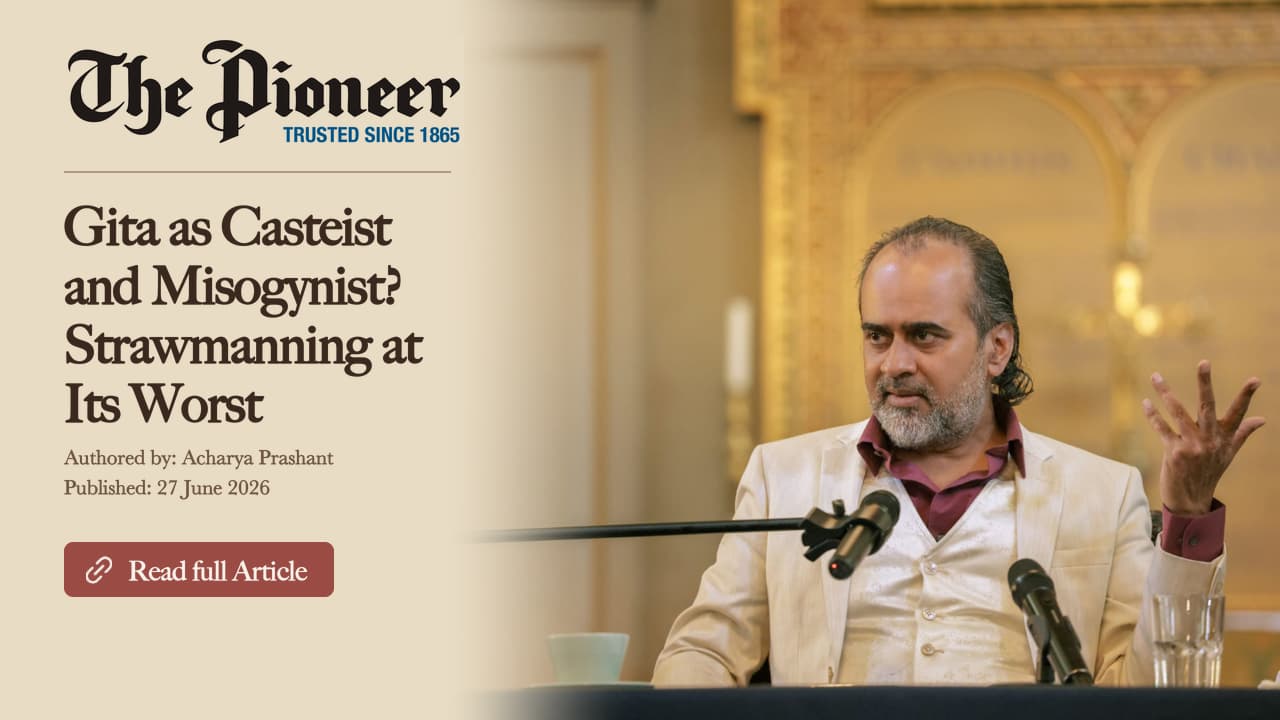
The Bhagavad Gita is often accused of supporting caste and misogyny through selective quotations that ignore context, grammar, and the text's central teachings. A closer reading shows that its emphasis is on inner qualities, conscious action, and spiritual equality rather than birth-based hierarchy or gender discrimination. Misinterpretations arise when isolated verses are detached from their broader meaning, while the Gita consistently points toward self-knowledge, freedom from ego, and the universal possibility of liberation for every human being.
We have all put down a book that could have helped us, or dozed off halfway through something that mattered. A man who could not keep food down was given medicine, and he threw that away too, since it went in by the same route. Most of us strike a similar deal: we move into a place that stinks and, within a week, call the smell normal. Show our fifteen-year-old self the life we lead now and they would scoff. What would change if we admitted we do not like our condition?
Yoga is action without attachment. Yoga is to refuse everything that keeps you little and limited. To live without a reason, to love without a cause, to act without greed and desire, that is Yoga. Total purposelessness is Yoga. Yoga is freedom from all whys.

Especially in the modern world, unfortunately, a degree of constant anxiety has become an almost normalized state for us. A large portion of our mental health problems as a collective is very much about anxiety and fear. Burn-outs, career pressures, problems with self-esteem, fear of others, stress about studies etc.—all…

How many hours do you spend meditating each day?
This is a trick question!
Whether you are “meditating” one hour per day or six, you are not truly meditating. This is because meditation is not something you do to escape life. Meditation is a way of life.
Meditation is to…

Questioner: Would you please be able to explain to us the difference between the mind, the soul, the spirit, and consciousness?
Acharya Prashant: There is just consciousness; that consciousness requires physical support. That consciousness requires a physical support, right? That physical support is called: the man.
When we say consciousness,…

Those who are lazy, lack not in energy but in understanding. In physical nature, there is a tendency toward work minimization. If something gives you more output with less work, you will do it. You do not know that the right work brings benefits, dividends, and joy. Had you known it, you would have chosen the right action over laziness every moment.

Questioner: Namskar Acharya ji. Pardon me for not remembering exactly but in one of the shivirs where we had read ‘Gospel of Sri Ramakrishna’ to come to terms with this expression called ‘Adhikar Bhed.’
So therein Ramakrishna was saying that, “now in modern times there cannot be any Adhikar Bhed,…

Acharya Prashant: It has been told to us that there exist two centers. I suppose it has been very freshly told to you right? Very recently. He says, “How do I know that I am living out of the right center? How does a young man know whether he’s not…

Acharya Prashant (AP) All the diversities that you see are the world. And these diversities are what make the mind suffer and here the sages have picked up all the diversities and have said that all these diversities are actually one. The distinctions are merely apparent. Actually, there is an…

Acharya Prashant (AP): The mind has been continuously lying to you. What has it been telling? It's been telling you that there exists no reality outside of itself; that it's not possible to 'be' without being the mind. That's what the mind has been telling you in its own selfish…

Questioner: Why think so much about decisions? Shouldn’t our decisions be spontaneous? I like to decide in a free flow.
Acharya Prashant: So the questioner is stressing on the spontaneity of decisions. He says that he likes to decide in a flow. It's a good thing, your intention is good.…

The word for a Guru does not really exist in the English language. So, they have borrowed Guru itself, Guru. But they have borrowed the word Guru and rather misunderstood it and misapplied it. So, anybody who seems to be an expert at anything, can be justifiably called a Guru in the English language. Now that's not the proper usage in spirituality or in Sanskrit.

Questioner (Q): Good afternoon, Sir. I have a doubt. In the market, there are a number of Bhagavad Gitas available. Somebody told me that there are eighty varieties of the Gita. Even though the slokas are the same, from what I have seen, the explanation was not making sense. In…

Questioner 1 (Q1): Acharya Ji, Pranam. There are certain and similar objects that occupy my mind every day. However much I try to get rid of them, they still linger. How should I get rid of them? Please help.
Acharya Prashant (AP): They are just occupying a void. That void…

The world is like an open book to the one whose eyes are open; if you cannot read the world, then you have to look at yourself first, then you have to be mindful of your own condition. Read more...

Acharya Prashant: Observing the daily ordinary actions of the mind, that is the only way. Observing it as an impartial observer. There is no other method that is going to work because all other methods are ‘isolations.’ The method does something to life. The method excludes life; the method…

Acharya Prashant (AP): What’s happening here, firstly I will read it out to you and then explain.Once, the five senses disputed among themselves about their personal superiority. The five senses quarreled as to who is superior among them. So, once the five senses disputed and each of them was…

Questioner (Q): I have been suffering from a type of OCD (Obsessive Compulsive Disorder) called somatic OCD for the last two years. I was in constant fear, every single moment, for around two years. I was on sleeping pills and anti-anxiety pills, but I think what helped me a lot…

Questioner: Acharya Ji, a good discussion happened yesterday in which many seekers participated and shared their understanding of Prakṛiti, Puruṣha and other things.
During the discussion, it was put that Prakṛiti, Puruṣha, Māyā, are mere concepts and that one is pure Ātman, never threatened and…

Questioner(Q): Hello Sir, I am Saurav, PhD student at IIT-Patna. Sir, a couple of years ago I met with a bike accident. At that moment, I felt like time was moving very slowly. I don’t know if it was just my feelings, but I searched on the internet and I…

We have to realize that the root of all these external problems is man's mind. So, first of all, we have to get rid of the notion that by having the right kind of legislation, or structures, or systems, or international treaties or agreements, or social processes, we can just sail out of these troubled waters. Read more....

Questioner (Q): Put in some difficult situations and old locations, I am surprised to see my old tendencies of hurt and dependence are back; they never did leave. I am selfish, difficult and stubborn. Help me Acharya Ji. Help me move ahead of this pettiness. Please!
Acharya Prashant (AP): You…

The mind is the entire set, the whole universe of objects that the ‘I’ has a relationship with. Not the entire set of everything that is there in the universe. One does not have a relationship with everything. But whatsoever one develops a relationship with becomes mind. An object untouched by the self, the ego is just an object. But the moment the object is touched by ‘I’, it becomes vishay or mind. And, mind is an accumulation, a congregation of objects that it is in relationship with.

Questioner (Q): Good evening, sir. In many places, especially in college, it is seen that the person starts drinking or smoking just because of peer pressure because he has a fear that if he doesn't do this, his group will throw him out. So, what are your views regarding this…

Acharya Prashant: Immerse yourself in the right action, then where is space and the time to worry? Indeed you are stealing time away from work. So that you can indulge in worries and anxiety and fancy and all kinds. Young people fantasize, don't they? Some fantasize about beautiful, pretty exciting…

Questioner: In the middle of a storm with the agony of not getting what I want, I can get out of the mind only by holding on to your videos and writings. Rest comes again only to be swept away in the next moment. It feels like an impossibility to…

Acharya Prashant: If one is living rightly, then youth is the permanent state of one's mind. The body can grow old. The mind cannot grow old if one has lived rightly. Youth, that way is your default state.
The 'Atma' has no age; it is ageless; the mind has the…

Superficiality offers pleasures. Superficiality offers cheap salvation. Therefore, it is easy to be attracted to superficiality. On the other hand, true spirituality challenges you to pay a heavy price. So, you see, all this knowledge has existed since antiquity. Yet there are people who do not want to read the Gita.

Questioner: Why do people commit suicide?
Acharya Prashant: They still have a lot of hope. They feel that suicide would redeem them. They have not given up everything. They are still carrying a lot of hope. If I do not know what is beyond life, how can I enter that…

Destiny is the inviolable thing. You cannot get rid of it. You have to reach there. So, better choose in favour of your destiny. Now, destiny is something that can, at most, keep waiting till eternity. But you can never dismiss it. So, make a choice in the favour of destiny. Bow down to your destiny, surrender to your destiny. If it has to happen, why keep postponing it? Because that postponement is just suffering. Destiny is love. Destiny is what each of us craves, is crazy for.

There is only one Dharma. And that is to attain liberation or peace, to gain freedom from your bondages, to gain freedom from your inner chaos and noise, to gain freedom from your inner falseness. Gaining freedom from inner falseness is more commonly known as Truth realization. It is a euphemism—a very decorated euphemism. It’s not really Truth that is really realized; it is falseness that is dropped.

The world is full of people who pursued what they call their interest, or their hobby—or their love even—and kept feeling as frustrated as you probably do. See, the influences that others have upon us, we resist them. So, as you are saying, your parents have a certain influence upon you. You want to resist it, you don’t feel comfortable. There is a constant feeling that, “I am doing something under somebody’s influence or pressure.

We love to talk of Swami Vivekananda as a youth icon. And I am asserting that were he to be here today, it is the youth that would resist him the most. When he returned from the United States, a huge procession greeted him, right at the port. But when he asked for just a hundred people who could be his soldiers, he was denied. Nobody wants to accept a Swami Vivekananda. He was resisted then, he would be resisted even today.

There is no revolution possible without the Gita. That’s the reason why even those who are not remembered particularly for their spiritual inclination, people like Subhash Chandra Bose, even they founded their core on Gita. What kind of revolution can you do if it’s the body that’s always at the top of your mind? You require a Gita to tell you that this body is perishable and would anyway go. Gita only teaches you, "Endure and fight."

We readily admit we know little about neuroscience, yet we are sure we know our office, our family, our own name and address. That certainty is the bigger problem. Whatever we claim to know, we turn into a target, the way a blip on a radar marks a plane for the missile. And the one thing we never look at is the one who claims to know. When a teacher holds up a mirror, we call it disagreement and walk away. Is it really disagreement, or the fear of being dissolved?

We know the shortcut will cost us later, and we take it anyway. We tell ourselves the reckoning lies somewhere ahead, in a court, a bill, a bad result. But what if the price is already being paid, the moment we choose? The one in us who longs for love and freedom is the same one who shuts the cage door, hoping to keep everything at once. No judge sits outside us; we are the judge and the convict both. What do we most deeply want, and what keeps competing with it?

You wild away your childhood in just trivial matters and your youth in desires and consumption and now you are left with only regrets when you are old.* That's what the saints have always been telling you. Read more.....

Is peace something we can sit our way into? We try: eyes closed, body motionless, hoping for a glimpse of something higher. But the body is never still, the brain hums on, and the only perfectly still body is a lifeless one. Real stillness, then, may have little to do with posture. It may mean standing firm in what matters most, with no alternative and no substitute. Where in our lives are we truly still, and where do we keep shifting?

We gladly worship Krishna the cowherd of Mathura and Vrindavan, yet the Krishna of Kurukshetra, who speaks the Gita, is rarely welcome. Much of what we call religion is a request: we pick a favourite deity, place and ritual, then ask for a car, money or a cure. The Gita values rituals done for desire as little as a pond beside the ocean. Popular religion says, "I want, therefore I act." The Gita says, "Know who you are and then simply let things happen." Which of the two do our prayers come from?

You look in the mirror, and if there is a speck or blemish on your face, you want to change something. If you look at the Gita and that doesn't result in changes in your life, then you are misusing it. Anybody who holds the Gita must be ready to look within and discard all that which is unnecessary, borrowed, antithetical to life. If that is not happening, then that's disrespect to the Gita.

There is such great fun in leaving yourself behind and turning a servant to the Truth. It’s almost like Krishna advising Arjuna, “Talk in everlasting words and dedicate them all to Me—*mām ekaṃ śaraṇaṃ vraja, sarva-dharmān parityajya*.” And at numerous places in the *Bhagavad Gita*, he says, “Arjuna, you are not fighting for yourself, you are fighting for Me. As long as you fight for yourself, if you win, you suffer, and if you lose, you suffer. And when you fight for Me, then you are a victor even before the fight begins.”

Restlessness lives on the promise that, eventually, I will find rest somewhere. There is no great future waiting for you. If you are lonely right now, lonely is what you are, and no great company is waiting for you in the future. You have nothing except what you think you have right now. This is it. When you see this, you enter into rest right now!

You have ample gurus who come over and say, “You know, you do this and then you can do whatever you want to do.” Now the moment you hear this kind of philosophy that Yoga will help you do better whatever you want to do, I suppose one must run away. Because that’s exactly antithetical to Yoga. Yoga is not about doing whatever you want to do; it’s the ego that says that, not the dedicated, devoted, wise mind. That does not come from there.

It is not others that you have to be cautious of. You have to be cautious of that within you which gets influenced by others, which does not know others but gets influenced by others. It does not live in knowing. It lives in indoctrination. How to know the real master? See, who is treating your disease. How do you know a doctor? Not by his degrees but by his ability to treat you.

Guilt says, “I am better than how and what I did.” Right? There need not be any imagination in this. Far better than guilt is the realization of one’s actual state. And once you realize where your choices and decisions have brought you, there is a certain sublimation. That honest realization does not shout too loudly, but it has great power. For that power to arise, you first have to acknowledge where you really are.

Don’t think of heaven and hell as the afterlife; both are here, right now. As the Niralamba Upanishad says: Right company is heaven; wrong company is hell. If you are someone who loves to be with people who will take you towards truth, joy, and simplicity, you are already in heaven. And if you surround yourself with people who pull down your consciousness, then verily, you are—right now—in hell.

It’s unfortunate that today, methods of meditation are being mistaken for meditation itself. Meditation is what makes us human—it must be continuous, 24x7. No method can be continuous or 24x7. Meditation is a way of life, a beautiful love affair. Just as the body cannot wait to breathe, consciousness cannot wait to meditate—it’s a madness of love, not dry, ritualistic, or time-bound.